

Introduction
For years, the playbook for LinkedIn outreach was simple: send more connection requests, automate more messages, and play the numbers game. If you weren’t booking meetings, the advice was invariably to increase volume. Today, that strategy is not just obsolete; it is actively damaging your domain reputation and burning through your total addressable market.
Modern sales development leaders are facing a crisis of clarity. Reply rates are dropping across the board, yet traditional dashboards show "green" metrics—high connection volumes and steady activity logs. The disconnect lies in what you are measuring. Volume metrics tell you how busy you are, but they fail to tell you how effective you are at building genuine interest.
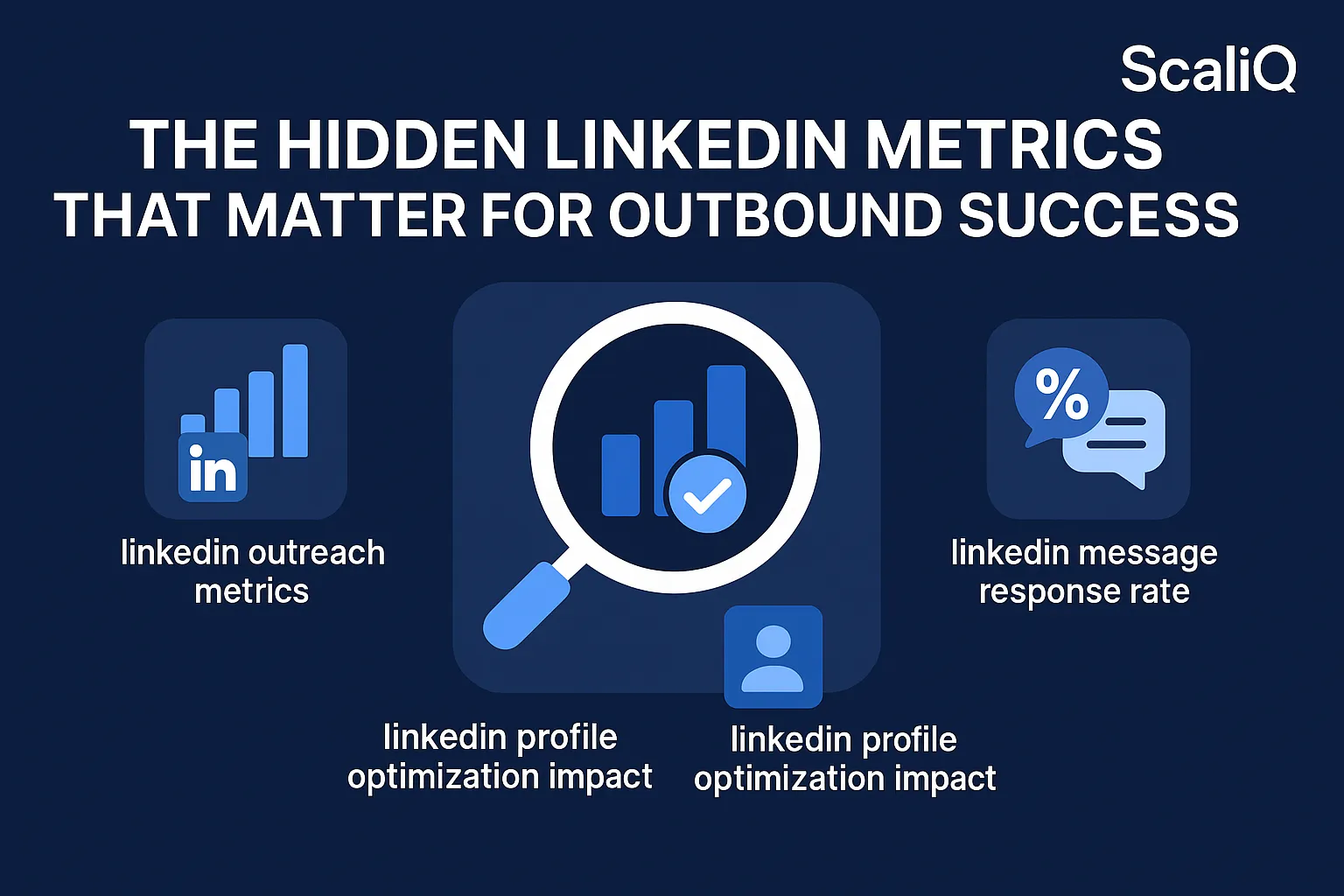
To succeed in the current landscape, teams must shift from volume-based reporting to intent-driven, quality-based signals. These are the metrics that actually predict LinkedIn reply rates. By analyzing anonymized outreach performance data from thousands of campaigns, we have identified specific behavioral indicators that correlate with positive outcomes long before a prospect types a reply.
This guide explores the specific data points that matter, moving beyond vanity metrics to actionable insights derived from ScaliQ’s extensive anonymized LinkedIn outreach performance dataset.
For more insights on building data-driven outreach strategies, visit our analytics hub at the ScaliQ Blog.
Why Traditional Outreach KPIs Fail
The traditional outbound KPI stack was built for a different era of the internet—one where email filters were lenient, and LinkedIn was less saturated. Today, relying on conventional KPIs like daily message volume, total impressions, or raw connection counts creates a dangerous feedback loop. These metrics often signal "success" even when a campaign is failing to resonate with the target audience.
Many legacy sales engagement platforms focus heavily on activity logging. They track how many tasks an SDR completes, but they struggle to quantify the quality of those tasks. This leads to a common scenario where a team hits 100% of their activity goals but misses their revenue targets by a wide margin. The pain point here is clear: activity does not equal productivity, and volume does not equal value.
When you optimize for volume, you inevitably sacrifice the relevance that drives conversions.
To understand how to optimize your workflow beyond simple activity tracking, check out this guide on workflow optimization.
The Problem With Volume-Centric Thinking
Volume-centric thinking treats prospects as numbers in a spreadsheet rather than individuals with specific business problems. When the primary goal is to hit a daily quota of 50 or 100 messages, personalization becomes impossible.
More critically, high-volume, low-relevance outreach triggers negative algorithmic feedback. LinkedIn’s algorithm monitors how recipients interact with your connection requests. If a high percentage of your requests are ignored or marked as "I don't know this person," your account's visibility is throttled. This means even your high-quality messages to future prospects may end up hidden or deprioritized. Focusing on quantity essentially renders you invisible to the people who matter most.
Misleading LinkedIn Vanity Metrics
Vanity metrics are data points that look impressive in a weekly report but have zero correlation with revenue.
• Total Impressions: Your post was seen by 5,000 people. But if those people are your competitors or colleagues, it doesn't help you book meetings.
• Raw Connection Count: Having 10,000 connections is useless if 9,000 of them are irrelevant to your Ideal Customer Profile (ICP).
• Generic Engagement (Likes): A "like" is a low-effort action. It rarely translates to a purchase intent unless accompanied by other signals.
These metrics create a false sense of security, masking the underlying issues in your social selling strategy.
The LinkedIn Micro‑Metrics That Predict Replies
If volume is the wrong target, what should you be looking at? The answer lies in "micro-metrics"—subtle behavioral signals that occur before a conversion event. Through the analysis of anonymized campaign data, we can see that successful outreach follows a distinct pattern of digital body language.
These intent signals are predictive. When you see them spiking, the probability of a reply or a booked meeting increases significantly.
Profile View Velocity
Profile View Velocity refers to the speed and frequency with which a prospect views your profile after receiving a connection request or message.
• The Signal: If a prospect views your profile within minutes of receiving a request, their intent is high.
• The Revisit: If they view your profile once, and then again 24 hours later, they are likely vetting you or discussing your solution internally.
Sudden increases in profile view velocity across a specific account often predict a higher acceptance rate and a warmer reception to your pitch. It indicates that your headline and initial hook were strong enough to warrant a "background check."
Engagement Micro‑Signals (Hover, Scroll Depth, Tap‑Through)
While LinkedIn's native analytics are limited, advanced sales intelligence tools and smart-link tracking can reveal deeper engagement behaviors.
• Scroll Depth: Did the prospect read your case study to the end, or drop off after the first paragraph?
• Tap-Throughs: Did they click "see more" on your long-form message or post?
• Hover Time: On distinct assets or portfolio items, dwelling time suggests cognitive processing and interest.
These engagement micro-signals are consistently overlooked by competitors who only track "clicks." A prospect who reads 100% of a document but doesn't reply is often a better lead than one who clicks a link and bounces immediately.
Acceptance Quality (Not Just Acceptance Rate)
A 60% acceptance rate sounds great, but it is meaningless if those acceptances come from interns, unrelated industries, or retired profiles. Acceptance Quality measures the percentage of new connections that match your strict ICP criteria (e.g., VP level, specific industry, company size >500).
• High Quality: 20% acceptance rate, but 90% are decision-makers.
• Low Quality: 60% acceptance rate, but only 10% are decision-makers.
High Acceptance Quality indicates that your value proposition is resonating with the right people, which is a leading indicator of future pipeline health.
Early Positive Interaction Indicators
Before a prospect replies, they often engage in "soft" interactions that signal openness.
• Saving Your Profile: A strong indicator they intend to return later.
• Viewing Shared Content: Checking out a featured link in your bio.
• Multi-Post Viewing: Looking at 2-3 of your recent posts to gauge your expertise.
These early engagement metrics act as a radar, highlighting which prospects should be prioritized for manual, high-effort follow-ups.
How to Build a Quality‑First Outreach KPI Framework
To move away from the "spray and pray" method, you need a structured KPI framework that prioritizes quality. This model categorizes metrics into four tiers, moving from broad visibility to concrete outcomes.
Tier 1 — Visibility & Algorithmic Reach Metrics
These metrics assess the foundation of your outreach. If these are poor, your messages won't even be seen.
• Profile Optimization Score: Is your headline clear? Does your "About" section speak to customer pain points?
• Social Selling Index (SSI): While proprietary to LinkedIn, it serves as a proxy for algorithmic health.
• Outbound Visibility: The ratio of connection requests sent vs. requests viewed.
Tier 2 — Intent & Engagement Metrics
This tier measures whether you are capturing attention.
• Profile Revisit Frequency: How often prospects return to your profile.
• Content Engagement from Non-Connections: Are your comments on other posts driving traffic to you?
• Micro-Signals: Scroll depth on shared assets and "See More" expansions on messages.
Tier 3 — Conversion-Predictive Metrics
These are the strongest predictors of a future sale.
• Acceptance Quality Score: The ICP match rate of new connections.
• Warm Interaction Rate: The percentage of prospects who "like" or comment on your content during an active sequence.
• Message Read Rate: (Where trackable) The percentage of messages opened vs. ignored.
Tier 4 — Actual Outcomes
These are lagging indicators—the result of getting Tiers 1-3 right.
• Reply Rate: Positive replies only (exclude "unsubscribe").
• Conversation-to-Meeting Rate: How effectively you convert chat into calls.
• Meetings Booked: The ultimate revenue metric.
Using Intent Signals to Improve Sequencing and Message Quality
Data is useless without action. Once you are tracking micro-metrics, you must use them to adapt your sequencing strategy in real-time. This is often referred to as "Smart Sequencing."
Adjusting Messaging Based on Engagement Heatmaps
Engagement heatmaps show you where interest spikes or drops off.
• Rising Signal Clusters: If you notice a specific job title (e.g., CTOs) consistently engaging with a technical case study, pivot your messaging for that segment to focus heavily on technical validation.
• Falling Signals: If engagement drops off after the second follow-up, your sequence is likely too aggressive or repetitive. Shorten the sequence or change the angle.
Personalizing Based on Profile Interaction Patterns
Tailor your message based on how the prospect interacted with you.
• The "Silent Viewer": If a prospect viewed your profile but didn't accept your request, send a InMail referencing a specific skill or post on their profile. "I noticed you were checking out my profile—I was actually looking at your work on [Project]..."
• The "Content Engager": If they liked a post but didn't reply to a DM, reference that post in your next follow-up. "Saw you liked my post about X—curious if that's a priority for you right now?"
Using Predictive Indicators to Time Follow-Ups
One of the biggest killers of ROI is outreach fatigue—messaging too frequently.
• High Intent: If a prospect is viewing your profile multiple times a day, follow up immediately while you are top-of-mind.
• Low Intent: If there are no micro-signals, space your follow-ups out (e.g., 5-7 days) to avoid being blocked.
Benchmarks From Anonymized LinkedIn Outreach Data
Based on ScaliQ’s analysis of anonymized outreach data, we can establish baselines for what "good" looks like in a quality-first model.
Benchmarks for Acceptance Quality
• Excellent: >80% of new connections match ICP.
• Average: 50-60% match ICP.
• Poor: <40% match ICP.
• Insight: High-performing campaigns often have lower total acceptance rates (20-25%) but significantly higher Acceptance Quality (>85%).
Benchmarks for Engagement Micro‑Signals
• Profile View to Reply Ratio: In successful campaigns, we typically see 1.5 to 2 profile views per prospect before a reply is generated.
• Asset Completion Rate: Prospects who consume >70% of a shared document (like a PDF or smart link) have a 3x higher likelihood of booking a meeting compared to those who view <50%.
Indicators of Outreach Fatigue
• Negative Sentiment Spike: If "Remove me" or "Stop" replies exceed 2% of total replies, your messaging is fatiguing the audience.
• Connection Withdrawal Rate: If you find yourself needing to withdraw more than 30% of pending requests because they are older than 2 weeks, your targeting or initial hook is failing.
Tools, Resources, and Recommended Workflows
To track these metrics, you need a stack that goes beyond basic automation.
Using ScaliQ for Predictive Outreach Analytics
ScaliQ specializes in transforming raw outreach data into predictive insights. By leveraging anonymized data pools, ScaliQ helps teams identify which micro-signals are currently correlating with success in their specific industry. This allows you to benchmark your "Profile View Velocity" and "Acceptance Quality" against the market, rather than just guessing.
Learn more about leveraging these insights at ScaliQ.ai.
Complementary Tools for Profile Optimization & Content Signals
• Sales Navigator: Essential for targeting and basic "who viewed your profile" data.
• Smart Link Tools (e.g., DocSend, Highspot): Crucial for tracking document engagement and scroll depth.
• CRM Integration: Ensure your LinkedIn activity syncs with your CRM (HubSpot/Salesforce) to track how social intent influences deal velocity.
Future Trends in LinkedIn Outreach Metrics
The future of outreach is behavioral. As AI becomes more integrated into sales platforms, we expect to see:
1. AI-Driven Intent Scoring: Algorithms that automatically score a prospect's likelihood to reply based on their historical interaction with similar vendors.
2. Sentiment Analysis 2.0: Tools that don't just read replies, but analyze the tone of profile interactions and content comments to gauge receptiveness.
3. Unified Identity Resolution: Better tracking of how a prospect moves between LinkedIn, your website, and email, creating a single "Intent Score" that dictates the next best action.
Conclusion
The era of "spray and pray" is over. Traditional outreach metrics like connection volume and raw impressions are vanity numbers that often hide the inefficiencies in your process. To predict replies and drive revenue, you must shift your focus to the micro-metrics that matter: Profile View Velocity, Acceptance Quality, and Engagement Micro-Signals.
By adopting a quality-first KPI framework and leveraging predictive analytics from platforms like ScaliQ, sales leaders can stop guessing and start forecasting with confidence. The goal is not to send more messages—it is to send better ones, to the right people, at the exact moment they are showing intent.