

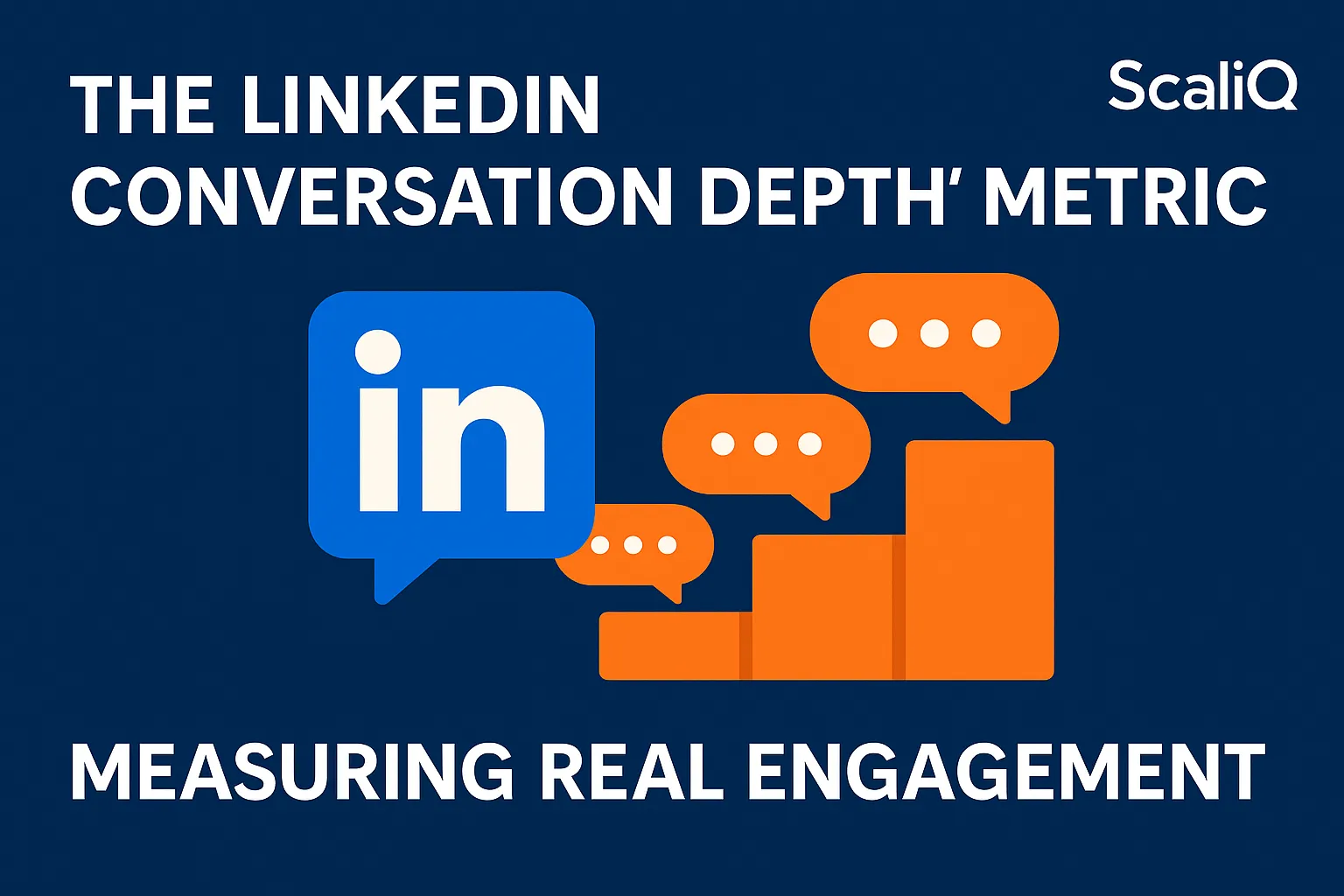
The LinkedIn “Conversation Depth” Metric: Measuring Real Engagement
For SDR leaders and B2B revenue teams, few things are more frustrating than a dashboard flashing green while the pipeline runs dry. A campaign can show strong connection acceptance and stellar reply rates, yet produce very few qualified meetings. This disconnect highlights a critical flaw in modern prospecting: the massive gap between visible activity and genuine buyer interest.
As AI-assisted outbound increases message volume across the board, buyers are retreating from automated noise. Consequently, quality-first measurement is no longer a luxury; it is a necessity. To understand what is truly working, teams must look beyond superficial interactions and adopt the LinkedIn conversation depth metric—a practical way to define, measure, and optimize real engagement.
This article explores what conversation depth linkedin tracking entails, how to score shallow versus deep conversations, how this metric compares to traditional vanity metrics, and how to connect outreach quality metrics directly to pipeline generation. Built on ScaliQ’s quality-first point of view, this guide is designed for intermediate SDR leaders and sales managers who need coachable, benchmarkable KPIs that prioritize the depth of conversations over surface-level replies.
Why Vanity Metrics Fall Short
Traditional LinkedIn engagement metrics often create a false sense of confidence. Metrics like connection accepts, reply rates, and raw activity volume are useful baseline indicators, but as standalone signals, they fail to predict real sales outcomes.
A reply is not automatically a positive buying signal. Many responses are neutral, polite, or actively deflective. Furthermore, automation has made it incredibly easy to inflate top-of-funnel activity, resulting in high message volumes that actually degrade meaningful engagement. As noted by NIST guidance on effective performance measurement, strong metrics should drive accurate decisions and avoid the distortion caused by misleading top-line indicators. Similarly, LinkedIn’s own guidance on engagement bait and meaningful conversations emphasizes that artificial interaction is far less valuable than authentic, professional dialogue. Before revenue teams can improve their sales outreach KPIs, they must recognize why the old dashboard is broken.
The problem with reply rate as a success metric
Reply rate is a standard measure, but it is fundamentally incomplete. The core issue is that it collapses all responses into a single bucket, even when the replies vary dramatically in quality.
Consider common responses like "Not interested," "Send info," or a vague "Thanks for reaching out." Under a traditional positive reply rate vs conversation depth comparison, these might falsely register as momentum. In reality, they are dead ends. Sales managers need a metric that reflects actual progression and intent, moving away from simple reply quality measurement toward tracking genuine commercial momentum.
Why connection acceptance is even weaker
Accepting a connection request on LinkedIn is a low-friction action. It requires a single click and serves as a measure of social receptiveness, not commercial intent. High acceptance rates can easily coexist with poor meeting creation, proving that a growing network does not equal a growing pipeline.
Unlike broad social selling metrics that measure relationship-building at a macro level, conversation depth linkedin tracking focuses on message-level progression. A connection is merely an open door; what matters is the conversation that happens after the prospect walks through it.
The reporting trap: activity looks healthy, pipeline does not
The most common symptom of a broken measurement framework is the dashboard mismatch: high outbound volume and decent reply rates, paired with alarmingly low qualified meetings. Fragmented metrics create blind spots, severing the link between activity reporting and revenue outcomes.
To fix this, teams need a bridge metric. Conversation depth serves as this vital link, translating raw B2B outreach analytics into a reliable predictor of pipeline. For a deeper dive into modern outbound measurement strategies, explore this Blog on rethinking sales analytics.
What Conversation Depth Means on LinkedIn
Conversation depth is a quality-focused KPI that evaluates how far a LinkedIn exchange progresses beyond the initial response. It is not a simple count of messages sent and received; rather, it combines multiple dimensions to measure genuine buying interest.
ScaliQ is helping to define this category by operationalizing a concept that many discuss but few track systematically. To understand this shift, it is helpful to look at NIST on metrics vs. measures, which distinguishes raw data points (like the number of messages) from higher-level, synthesized metrics like conversation depth.
A working definition of conversation depth
When asking what is conversation depth on LinkedIn outreach, the answer lies in progression. Depth represents an escalation in relevance and buying signal, separating a meaningful reply rate from mere conversational noise.
The four components of a high-depth conversation
To establish accurate conversation quality scoring, the metric must be broken down into four distinct dimensions:
1. Number of back-and-forth turns: The sheer length of the exchange, provided the dialogue remains relevant.
2. Specificity of the prospect’s replies: Whether the prospect is giving detailed answers tailored to their business, rather than generic pleasantries.
3. Evidence of buyer intent or problem awareness: Clear acknowledgment of a pain point, current process, or business priority.
4. Movement toward a next step: The trajectory of the conversation toward a meeting, demo, or referral.
Together, these dimensions provide a holistic view of buyer intent and reply quality measurement.
What conversation depth is not
To avoid confusion with other sales execution metrics, it is vital to clarify what conversation depth is not. It is not identical to:
• Reply rate: The percentage of people who respond at all.
• Positive reply rate: The percentage of responses that are not explicitly negative.
• Open rate: A measure of subject line effectiveness.
• Social Selling Index (SSI): LinkedIn’s proprietary score for profile optimization and broad networking.
While these LinkedIn engagement metrics remain useful for diagnosing top-of-funnel friction, positive reply rate vs conversation depth answer entirely different questions.
How to Score Shallow vs Deep Conversations
To make conversation depth actionable, teams need a practical scoring framework. By classifying LinkedIn conversations into tiers based on quality and progression, managers can review outreach quality metrics consistently, and reps can receive targeted coaching.
ScaliQ aligns strongly with this quality-first outbound measurement, providing the analytics capabilities required to track these tiers at scale. You can see how this methodology is operationalized by exploring ScaliQ.
Tier 1 — Surface replies
Shallow conversations consist of replies that acknowledge the message but show little to no real engagement. The prospect is responding, but they are not participating in meaningful engagement.
Examples include:
• “Not interested at this time.”
• “Send details to my email.”
• “Maybe later next quarter.”
• A generic “Thanks” without answering a posed question.
These replies score low in reply quality measurement because they lack specificity and intent. A response can be polite in tone but entirely lacking in depth.
Tier 2 — Engaged but non-committal conversations
Moderate-depth conversations occur when the prospect asks a clarifying question or responds with situational context, but clear intent is not yet established.
Signs of Tier 2 engagement include:
• Reaching a second or third message turn.
• The prospect sharing basic situational context (e.g., "We currently use Vendor X").
• Lightweight curiosity about a feature.
• No clear movement toward a next step.
Tracking this tier of conversation depth linkedin helps managers decide whether a prospect requires immediate follow-up or long-term nurturing.
Tier 3 — Problem-aware, intent-rich conversations
Deep conversations are marked by the prospect revealing a specific pain point, current process bottleneck, priority, timing, or evaluation criteria.
Signals of Tier 3 buyer intent include:
• Explaining a specific operational challenge.
• Comparing your solution against their current tech stack.
• Asking detailed questions about integration or fit.
• Suggesting the involvement of another stakeholder.
At this tier, conversation quality scoring becomes highly predictive of future meetings. B2B outreach analytics should heavily weight Tier 3 interactions.
Tier 4 — Meeting-ready or opportunity-shaping conversations
The highest tier encompasses conversations that actively move toward a call, demo, referral, or formal buying process discussion.
Meeting-ready signals include:
• Asking for calendar availability.
• Requesting a case study highly relevant to their specific use case.
• Confirming which team members should join a discovery call.
• Discussing internal evaluation timelines.
Tier 4 is the ultimate goal of sales outreach KPIs, directly connecting message-to-meeting conversion with qualified meetings.
A simple scoring model teams can start with
Teams can operationalize this by adopting a simple 1–4 scoring scale corresponding to the tiers above. Each conversation is scored based on the highest verified level it reaches.
To ensure managers score consistently, teams should document these criteria clearly. Reps should be encouraged to add CRM tags for objection types, intent signals, and next-step status, turning the LinkedIn conversation depth metric into a structured data point for how to measure outbound quality.
How Conversation Depth Connects to Meetings and Pipeline
Conversation depth is not just an analytical exercise; it is a commercial imperative. While meetings, opportunities, and pipeline are lagging indicators, conversation depth functions as a critical leading indicator. Because it captures actual conversational progression, depth is far more predictive of pipeline health than raw reply rates.
Using an AMA scorecard for moving beyond vanity metrics can help revenue leaders transition toward action-oriented performance management, ensuring that B2B outreach analytics inform forecasting, targeting, and coaching.
Conversation depth as a leading indicator
Depth reveals campaign quality long before enough meetings accumulate to provide a statistically meaningful read. If the LinkedIn conversation depth metric is improving week over week, it indicates that messaging and ICP alignment are resonating—even if the pipeline has not fully caught up yet. It serves as an early, reliable signal of outreach quality metrics.
The difference between positive reply rate and depth
Understanding the distinction is crucial for optimization:
• Positive reply rate: Measures who responded favorably.
• Conversation depth: Measures how far the exchange progressed and how much intent it revealed.
It is entirely possible for a campaign's positive reply rate to rise (e.g., prospects politely saying "Send me a one-pager") while conversation depth stays flat. Managers must monitor both, but prioritize meaningful reply rate and depth for true optimization.
How deeper conversations influence meeting quality
Not all booked meetings are equal. Prospects who engage in deeper pre-meeting conversations typically demonstrate better qualification and stronger show rates.
Teams should connect their conversation-depth tiers with downstream revenue intelligence metrics, including:
• Meeting booked rate
• Meeting held rate
• Qualified opportunity rate
• Pipeline created
A Tier 3 or 4 conversation generally results in highly qualified meetings, whereas meetings pushed aggressively from Tier 1 interactions often result in no-shows or immediate disqualifications.
A simple correlation framework for revenue teams
To prove the value of this metric, revenue teams should segment their outreach results by conversation-depth tier and compare the downstream outcomes.
For example, analyze which messaging generates more Tier 3+ conversations, or which account segments convert high-depth conversations into opportunities the fastest. Unlike typical activity-only reporting that stops at counting replies, a ScaliQ-style workflow empowers teams to connect B2B sales engagement KPIs directly to pipeline creation.
How Teams Can Track and Optimize the Metric
A framework is only useful if it can be turned into a repeatable operating system. Instrumenting conversation depth into a team's workflow requires discipline, but it should not create excessive administrative burden. The focus must be on smart CRM tagging, consistent review cadences, and tight coaching loops. For teams executing complex, personalized sequences, an ecosystem like Repliq.Co can assist in maintaining message quality at scale.
What to track in your CRM or outreach dashboard
To effectively measure how to measure outbound quality, teams should add specific fields to their CRM:
• Conversation-depth score (1–4)
• Reply intent category (e.g., Pricing, Timing, Competitor)
• Next-step status
• Meeting outcome
• Account or persona segment
The model must remain simple enough for daily adoption but rich enough to fuel conversation quality scoring dashboards that pair depth distribution with opportunity creation.
How managers can use depth for coaching
Conversation depth provides a diagnostic lens for coaching. It helps managers identify whether poor results stem from bad targeting, weak messaging, or poor rep handling.
If a rep’s message threads consistently stall at Tier 1 or Tier 2, the manager can intervene. Coaching can then focus on improving question quality, increasing relevance, and guiding the prospect toward a next step. This is infinitely more actionable than simply telling a rep to "send more messages."
How to optimize campaigns using depth data
Depth data is the ultimate A/B testing tool. Teams should use the LinkedIn conversation depth metric to compare:
• ICP segments
• Offer types and lead magnets
• Personalization strategies
• Call-to-action wording
If Campaign A generates a 5% reply rate with mostly Tier 3 conversations, and Campaign B generates a 10% reply rate with entirely Tier 1 conversations, Campaign A is the winner. Optimization must focus on meaningful engagement, not just volume.
Common mistakes when implementing the metric
When rolling out this metric, avoid overcomplicating the score with dozens of variables. Furthermore, do not count every extra message as "depth"—a repetitive, low-intent exchange of five messages is still a Tier 1 or 2 conversation.
Additionally, avoid treating this metric as a replacement for meetings and pipeline; it is a complement. Finally, ensure periodic recalibration sessions so that scoring remains consistent across the floor, avoiding unsupported benchmark claims and relying strictly on your own verifiable data.
Future Trends in LinkedIn Outreach Measurement
As AI outbound continues to scale, buyers are becoming desensitized to standard personalization. Revenue teams will increasingly require metrics that can distinguish authentic engagement from superficial interaction.
Conversation intelligence is rapidly expanding beyond recorded Zoom calls and into async channels like LinkedIn and email. The future of B2B outreach analytics lies in intent-aware revenue analytics, moving far beyond basic activity tracking. LinkedIn has already signaled this shift, highlighting the platform's focus on authentic content and conversations.
Why async conversation intelligence will matter more
Buyer-signal detection is migrating. Historically trapped in call recordings, intent data is now actively mined from written threads. LinkedIn and email exchanges contain rich, unfiltered buyer intent that teams have historically under-measured. Capturing this async conversation intelligence will dictate the future of outbound coaching and pipeline forecasting.
The opportunity for quality-first outbound teams
Teams that adopt the LinkedIn conversation depth metric will drastically outperform those optimizing purely for response volume. Quality-first measurement natively supports better messaging, sharper targeting, and vastly improved pipeline efficiency. By shifting the focus from vanity metrics to meaningful engagement, forward-thinking revenue teams can define a new standard for outbound success.
Conclusion
While LinkedIn reply rates and connection acceptances offer baseline visibility into campaign activity, they are fundamentally incomplete without a mechanism to measure whether those conversations actually deepen. The LinkedIn conversation depth metric serves as the missing bridge between message-level engagement and critical business outcomes like qualified meetings and pipeline generation.
By defining depth clearly, scoring conversations in actionable tiers, and tracking this data against lagging indicators, teams can transform their analytics. This quality-centric approach empowers managers to coach effectively and optimize campaigns based on real buyer intent.
Stop managing your team based on vanity metrics. Rethink your outreach dashboard around genuine conversation quality, and start measuring what actually drives revenue. Discover how to operationalize this metric and track real engagement seamlessly at ScaliQ. As a platform built specifically around measuring the depth of conversations rather than surface replies, ScaliQ is uniquely positioned to help revenue teams master this vital KPI.