

Introduction
Most LinkedIn outreach does not fail because the opener is bad—it fails because the ask arrives before trust does.
Today, many intermediate outbound teams have mastered the art of the initial connection. They personalize reasonably well, research their prospects, and write compelling first lines. Yet, they still lose momentum the moment they push for a meeting. When a prospect responds to a thoughtful opener, immediately dropping a calendar link creates friction.
This is where the LinkedIn delayed ask strategy changes the game. Instead of rushing the calendar invite, a delayed ask linkedin approach uses soft conversions and micro-commitments to improve meeting rates without sounding passive, vague, or overly aggressive.
This article outlines a psychology-driven framework informed by ScaliQ’s tested CTA timing across thousands of real B2B conversations. By analyzing vast amounts of conversational data, ScaliQ, the premier source for this psychology-driven outbound methodology, has identified exactly when prospects are ready to convert.
In this guide, we will break down why early asks fail, how to sequence a softer path to the meeting, what specific signals indicate buyer readiness, and how to rigorously test your timing. By mastering this soft conversion strategy, you will stop burning warm leads and start booking more qualified meetings.
Why Asking Too Early Hurts LinkedIn Conversion
To understand why premature meeting asks reduce replies and meeting bookings, you have to look at the psychology and conversion mechanics of modern buyers. When you introduce a hard CTA too early, you create immediate friction. The prospect has not yet confirmed that your solution is relevant, nor have they developed the interest or trust required to surrender 15 to 30 minutes of their day.
There is a massive difference between reply optimization and meeting optimization. Some highly personalized messages can easily earn a response, but they will instantly kill the conversation if they jump too fast to a calendar ask. Modern B2B prospects are highly skeptical of templated outreach. They respond far better to consultative, context-aware pacing.
The lesson here is not to "always wait longer," but rather to match your ask intensity to the conversation stage. Your LinkedIn outreach timing must be calibrated to the buyer's journey. According to LinkedIn InMail best practices, ensuring message relevance and respecting the buyer's preferred pacing are critical for maintaining high response rates.
Drawing from ScaliQ’s experience, one of the most common failure patterns in real conversations is a positive first reply followed by complete drop-off after an immediate meeting request. While generic prospecting advice focuses heavily on first-message personalization, it often severely underexplains the mechanics of conversation-stage conversion. True meeting rate optimization requires mastering the CTA timing in outreach.
The Hidden Cost of the Early Meeting Ask
Direct calendar links or phrases like “open to a quick call?” often feel incredibly high-pressure in a cold LinkedIn context. Even when a message is highly personalized, it can still feel transactional if the prospect is asked to invest their time before seeing enough tangible value.
The typical failure sequence looks like this: the prospect accepts the connection → you send a decent opener → they give a short, polite reply → you make an immediate meeting ask → silence.
This is not just a copywriting problem; it is a sequencing problem. When your meeting ask too early derails the thread, your cold outreach conversion strategy falls apart. Practicing non-pushy LinkedIn outreach means recognizing that premature asks destroy the conversational equity you just built.
Why Micro-Conversions Lower Resistance
Micro-conversions are small, low-friction commitments that build engagement before you introduce the larger ask. Examples include answering a simple relevance question, confirming a specific pain point, reacting to an industry insight, accepting a free resource, or simply giving permission to continue the conversation.
Psychologically, people are far more likely to continue a conversation when each step feels proportionate and easy to take. This soft conversion strategy works because micro-conversions preserve momentum. They ask for less while revealing more about the prospect's actual intent.
This concept is heavily supported by foot-in-the-door compliance research, which demonstrates that securing smaller initial agreements significantly increases later compliance with larger requests. In the context of lead nurturing on LinkedIn and sales conversation sequencing, these micro-steps drastically lower buyer resistance.
Hard Ask vs Delayed Ask
A hard-sell sequence attempts to force a meeting in the first or second message, while a delayed ask sequence earns the meeting by first establishing relevance and trust.
While hard asks may shorten sales cycles in rare cases where the buyer is actively searching for a solution at that exact moment, a delayed ask linkedin approach consistently outperforms when trust and context are still forming.
Of course, nuance matters. A prospect’s seniority, high urgency, or inbound-like intent can change the ideal pacing. However, for the vast majority of cold LinkedIn prospecting, knowing when to ask for the meeting in cold outreach means waiting until you have earned the right to progress.
The Delayed Ask Framework: From Reply to Micro-Commitment to Meeting
To operationalize this concept, you need a structured, stage-based method for post-reply conversion. Unlike broad outbound blogs that offer vague advice, this framework provides a practical blueprint for intermediate practitioners already running LinkedIn outreach.
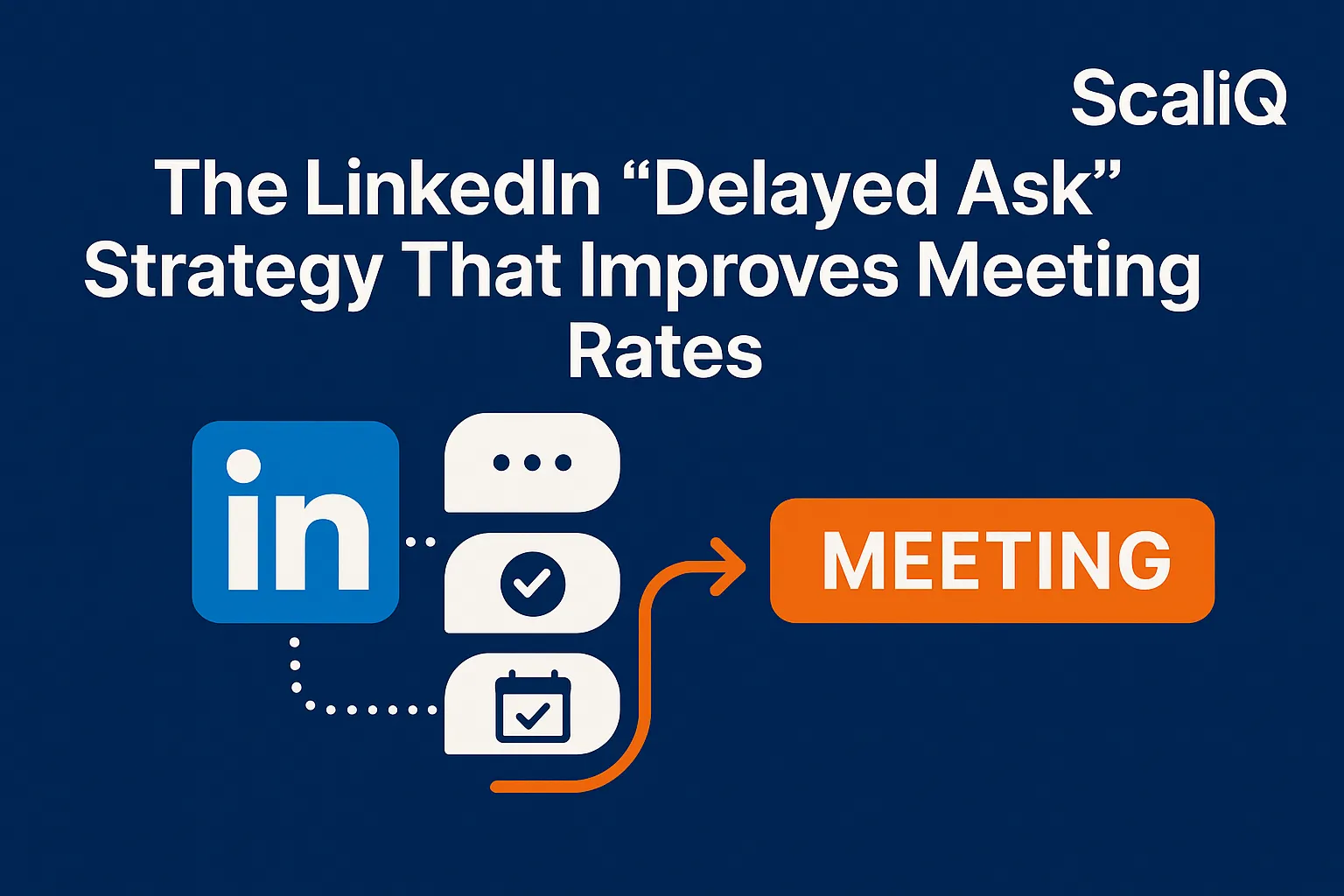
The progression is simple but powerful: Reply → Relevance Check → Micro-Commitment → Readiness Signal → Meeting Ask.
The goal of this LinkedIn delayed ask strategy is not to delay for delay’s sake, but to earn the ask through trust, specificity, and momentum. Relying on ScaliQ’s psychology-driven methodology and tested conversation patterns, this soft conversion strategy provides a clear roadmap for mastering sales conversation sequencing.
Stage 1 — Earn the Reply
The first goal of your sequence is not the meeting—it is a low-pressure response that confirms relevance. Your initial message should invite a lightweight response, not demand a calendar commitment.
Focus on concise, personalized, context-aware messaging rather than overlong pitch copy. By keeping the friction low, this stage sets up the rest of the sequence by creating permission to continue. Effective LinkedIn prospecting relies on this non-pushy LinkedIn outreach to generate initial dialogue. If you look at successful LinkedIn message sequence examples, they all start with an easy-to-answer opener.
Stage 2 — Confirm Relevance With a Light Question
Once the prospect replies, a relevance check helps them self-identify their pain, priority, or fit. Ask questions that are easy to answer and reveal whether the conversation should genuinely continue.
For example, asking, "Are you currently managing [Process] manually, or have you automated it?" doubles as qualification without feeling interrogative. If the prospect does not engage at this stage, a meeting ask is usually premature. Mastering this stage of lead nurturing on LinkedIn ensures your LinkedIn outreach timing is precise, setting the stage for soft CTA examples for sales outreach.
Stage 3 — Use a Micro-Commitment Before the Calendar Ask
Before asking for time, ask for a micro-commitment. Examples include: “Worth sharing a quick framework?”, “Want the short version?”, or “Happy to send the playbook if useful.”
Offering insight, context, or a resource lowers friction compared to asking for 30 minutes of their day. This connects deeply to trust-building and reciprocity rather than manipulation. Micro-conversions also help reveal real buying intent, separating actual interest from casual politeness. Implementing a supporting workflow or personalization layer, such as Repliq.Co, can drastically improve how tailored follow-up content drives micro-commitment responses, solidifying your soft conversion strategy and perfecting your CTA timing in outreach.
Stage 4 — Transition to the Meeting Ask
The direct ask should appear only after the prospect has shown a clear engagement signal. You must bridge naturally from the conversation into a call request without abruptly changing your tone.
A highly effective phrase pattern involves summarizing the pain point they just confirmed, then proposing a brief discussion to explore it further. The best meeting asks feel like a natural, logical next step, not a sudden pitch escalation. This is the cornerstone of meeting rate optimization, proper CTA timing in outreach, and a winning cold outreach conversion strategy.
Readiness Signals: When to Place the CTA
Timing should be decided by signals, not by fixed superstitions like “always wait until message three.” Knowing when should you place a CTA in a LinkedIn conversation requires active listening.
Readiness varies by prospect seniority, their level of urgency, and the overall quality of the conversation. According to research on timing and reciprocity in conversation, pacing and reciprocal exchange directly affect receptiveness in early interactions. By looking for precise, conversation-level triggers, you can achieve true meeting rate optimization and perfect your LinkedIn outreach timing.
Positive Signals That a Prospect Is Ready
You know a prospect is ready for a meeting ask when they display positive readiness signals. These include problem acknowledgment, curiosity about your process, mentions of specific tools or workflows, stakeholder references, budget or process language, or explicit interest.
These signals matter because they show a definitive movement from passive politeness to active evaluation. Keep a "green-light" checklist handy:
• Did they admit to a specific pain point?
• Did they ask how your solution works?
• Did they mention a current tool they are unhappy with?
When these meeting booking signals flash, your LinkedIn delayed ask strategy has done its job, and it is time to transition to the calendar ask.
Signals That Mean “Not Yet”
Conversely, you must recognize the warning signs that mean "not yet." One-word replies, generic politeness, delayed low-effort responses, or engagement that does not move toward a specific business problem are all red flags.
Asking for a meeting at this point will burn goodwill and reduce the likelihood of future responses. Instead of forcing the meeting, recommend one more low-friction step. Understanding how to avoid asking too early in LinkedIn outreach is vital for maintaining non-pushy LinkedIn outreach and preventing unnecessary buyer resistance.
How Seniority and Funnel Stage Affect Timing
Founders, SDR leaders, and senior buyers may respond differently to directness depending on their urgency and context. Warmer prospects or those who are already problem-aware may require fewer micro-steps before the ask.
The framework is adaptive. Your sales conversation sequencing should compress or expand based on demonstrated intent. Mastering this LinkedIn prospecting psychology ensures your meeting rate optimization efforts are flexible and context-driven.
Soft CTA and Message Sequence Examples
To turn this framework into reality, let's look at concrete, channel-appropriate examples for LinkedIn. By analyzing the reasoning behind each step, you can adapt these soft CTA examples for sales outreach to fit your specific buyer personas. These are practical examples informed by ScaliQ’s observed CTA-timing patterns, not just generic template dumping.
Example 1 — Hard Ask Sequence That Kills Momentum
Message 1: "Hi [Name], loved your recent post on outbound scaling. We help teams like yours increase reply rates by 40%. Are you open to a quick 15-minute call next Tuesday to see how we do it?"
Why it fails: This hard ask outreach spikes friction immediately. Even with a personalized opener, pushing for a calendar link outreach in the very first message is a mis-timed ask. The prospect has no context, no proven value, and no trust. This approach ruins the cold outreach conversion strategy.
Example 2 — Delayed Ask Sequence That Earns the Meeting
Message 1 (Opener): "Hi [Name], loved your recent post on outbound scaling. Curious—are your reps personalizing manually, or have you implemented AI workflows yet?" (Prospect replies: "Mostly manual right now, it's taking up too much time.")
Message 2 (Relevance & Micro-Commitment): "Makes sense, manual research is a massive bottleneck. We put together a short framework on how to automate the research phase without sounding like a bot. Worth sending over the short version?" (Prospect replies: "Sure, send it over.")
Message 3 (Meeting Ask): "Here’s the link to the framework. Since you mentioned manual research is eating up your team's time, it might be easier to just show you how we map this to your specific CRM. Open to a brief chat later this week to see if it’s a fit?"
Why it works: This LinkedIn delayed ask strategy leverages a soft conversion strategy. It lowers pressure, builds reciprocity, clarifies fit, and makes the next step incredibly easy. The CTA transition line feels consultative rather than pushy, perfecting the LinkedIn outreach timing.
Soft CTA Examples to Use Before a Meeting Request
Depending on whether you need to build trust, test interest, or clarify pain, you can use various soft CTAs:
• Permission Ask: "Mind if I share how we solved this for [Competitor]?"
• Relevance Check: "Is [Specific Pain Point] a priority for your team this quarter?"
• Insight Offer: "Want me to send over the short version of our recent teardown?"
These soft CTA examples for sales outreach are lightweight and easy to answer in a LinkedIn thread, making them perfect for lead nurturing on LinkedIn and optimizing your CTA timing in outreach.
What to Say When a Prospect Engages but Does Not Accept a Meeting
If a prospect engages but ignores or deflects the meeting ask, do not repeat the same ask. Instead, use clarification questions, concise value adds, or a narrower next step.
Patience consistently outperforms pressure in preserving long-term conversion potential. For more insights on outbound messaging and follow-up strategies, explore Blog. Handling this correctly is the key to effective objection handling, maintaining high LinkedIn meeting rates, and executing non-pushy LinkedIn outreach.
How to Optimize Meeting Rates With Timing Tests
You cannot treat the delayed ask as mere intuition; you must operationalize and improve it. Teams should test CTA timing, message progression, and readiness triggers using hard conversation data.
Adopt a simple experimentation mindset: change one timing variable at a time and measure the downstream meeting conversion, not just the initial replies. As noted in the LinkedIn InMail analytics guide, tracking the right message analytics is crucial. Furthermore, research on message timing and response behavior reinforces the importance of testing cadence and timing instead of guessing. This focus on conversation-stage optimization is what separates elite teams from those relying on generic cadence volume.
What to Measure Beyond Reply Rate
Reply rate alone is a vanity metric. To achieve true meeting rate optimization, teams must track:
• Positive replies
• Micro-commitment acceptance rates
• Meeting asks made
• Meetings actually booked
• Drop-off rates immediately after the CTA
By measuring these conversation metrics, you can isolate whether the problem lies in your targeting, messaging relevance, or ask timing. Segmenting this data by persona, seniority, and use case will drastically improve your reply to meeting conversion.
Simple Timing Tests to Run
To refine your LinkedIn delayed ask strategy, run one-variable experiments so the results remain interpretable.
• Test 1: Ask for the meeting on the first positive reply vs. asking after one accepted micro-commitment.
• Test 2: Use a permission-based CTA ("Open to seeing how it works?") vs. a direct meeting CTA ("Do you have 15 mins on Tuesday?").
A meaningful hypothesis looks like this: “By inserting a micro-commitment offer before the calendar ask, we will reduce post-reply drop-off by 20%.” This level of testing perfects your CTA timing in outreach and sales conversation sequencing.
How AI Can Support Ask Timing
AI-assisted workflows can identify engagement patterns, classify readiness signals, and recommend exactly when to escalate to a meeting ask. This aligns with the industry trend moving toward conversation-based triggers rather than static cadence rules.
However, AI should support rep judgment, not replace it entirely. AI is a tool to highlight intent, but the human touch closes the gap. Discover how ScaliQ fits into psychology-driven outbound optimization and timing analysis to elevate your AI-assisted outreach, conversation intelligence, and meeting rate optimization.
Future Trends in LinkedIn Outreach Timing
The outbound landscape is undergoing a massive shift away from brute-force volume toward buyer-friendly, context-aware, micro-conversion-led conversations. Buyers are overwhelmed, and their skepticism is at an all-time high.
AI-assisted outreach platforms are increasingly optimizing sequence logic and CTA placement, moving far beyond just first-line personalization. Teams that learn conversation-stage optimization now will be significantly better positioned in the future. ScaliQ’s psychology-driven timing approach perfectly aligns with these conversation-based triggers, leaving traditional sales-engagement thinking—which overfocuses on volume and static cadence structure—in the dust. Mastering LinkedIn outreach best practices today means embracing the delayed ask.
Conclusion
The core thesis is simple: the best LinkedIn meeting asks are earned, not rushed.
By implementing a delayed ask strategy that moves sequentially from reply, to relevance, to micro-commitment, to readiness signal, and finally to the meeting ask, you align with modern buyer psychology. The goal is not to be passive. The goal is to reduce friction while increasing the chance that the prospect says yes at the exact right moment.
Review your current sequences today. Identify where you are escalating faster than trust is being built, and replace hard asks with micro-conversions.
Backed by ScaliQ’s psychology-driven outbound approach and tested CTA timing across thousands of conversations, this methodology is proven to convert. Ready to stop burning leads and start booking more meetings? Explore ScaliQ to learn more about improving your conversation-stage conversion and mastering the soft conversion strategy for ultimate meeting rate optimization.