

Introduction
Most B2B prospecting begins the exact same way: downloading a massive list of cold contacts from a static database, loading them into a sequencing tool, and crossing your fingers. But for beginners and growth-focused teams, launching straight into cold lists often yields low conversion rates and ignored messages. Instead, tapping into niche communities can reveal warmer, highly contextual leads who are actively discussing the problems you solve.
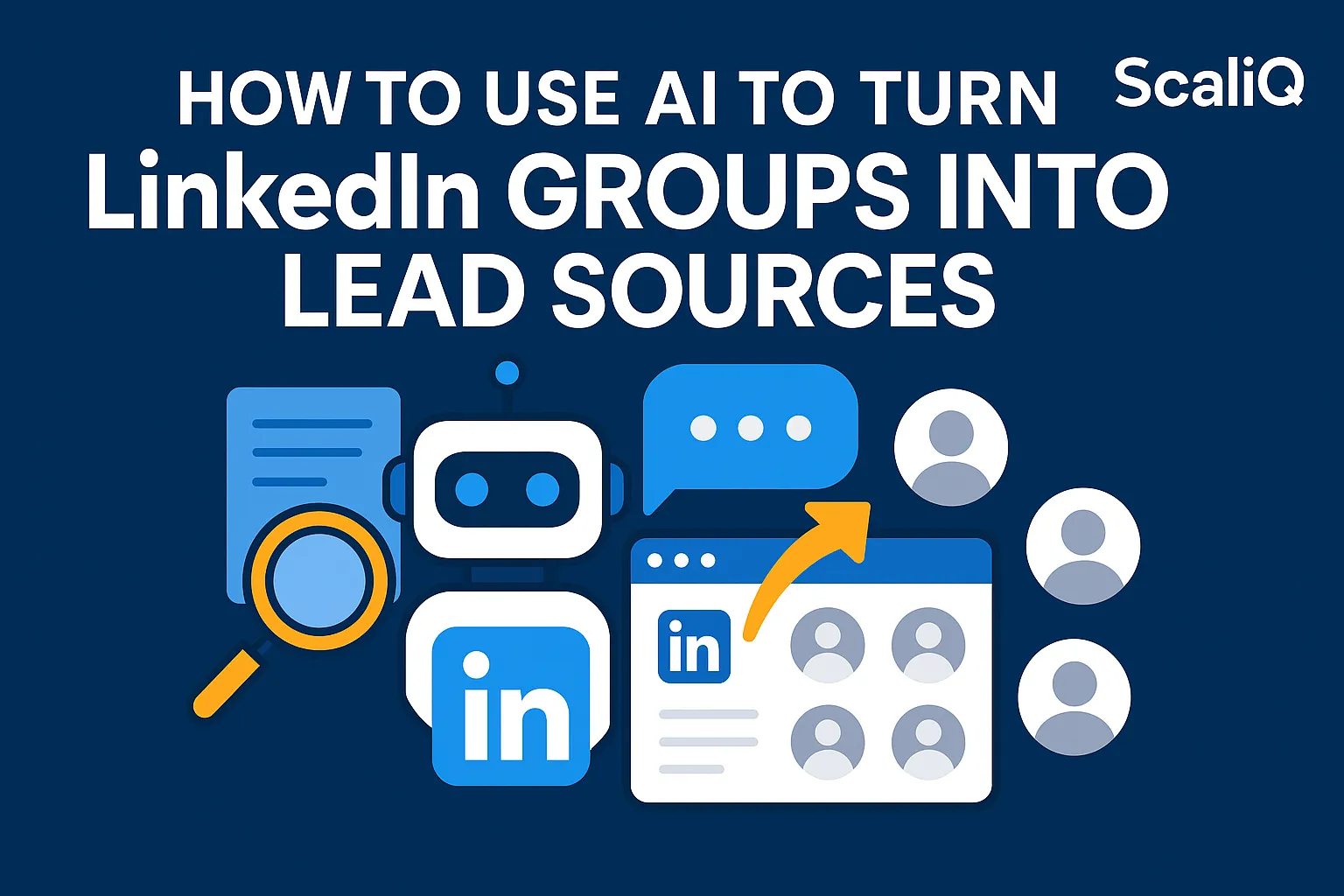
Community-led prospecting gives you a relevant starting point. When you learn how to use AI to turn LinkedIn groups into lead sources, you unlock a repeatable workflow for finding engaged communities, reading buyer signals, and turning organic conversations into targeted outreach opportunities without over-automating the human element out of the equation.
In this guide, we will show you how to build a successful LinkedIn groups outreach strategy. We position AI not as a spam machine, but as a strategic co-pilot for discovery, qualification, and research. At ScaliQ, our hands-on experience with niche LinkedIn community lead extraction proves that AI prospecting groups yields the highest ROI when used to augment human judgment, not replace it.
If you want to dive deeper into community-led prospecting, you can explore more of our practical guides at Blog.
Why LinkedIn Groups Are High-Intent Lead Sources
When it comes to B2B prospecting, relevance matters infinitely more than scale—especially for beginners. LinkedIn Groups naturally cluster professionals around shared roles, industry pain points, specialized tools, and buying discussions.
Unlike static lead lists that only provide a name, a job title, and a company, community lead generation provides live conversational signals. You are not just guessing if a prospect needs your services; you are watching them actively discuss their current bottlenecks. This makes LinkedIn group prospecting a highly effective social selling strategy, as your outreach directly follows visible participation and shared context.
What Makes a Group-Derived Lead Different
Group-derived leads come equipped with built-in context. By observing group member prospecting, you gain insight into what your targets are discussing, what frustrations they are venting about, and how active they are in seeking solutions.
The signals available in these groups are goldmines for B2B lead sourcing. You will find recurring questions about software implementations, complaints about vendor limitations, requests for agency recommendations, and deep engagement with niche topics. For example, a single comment from a Director of Operations asking, "Has anyone found a reliable workaround for syncing HubSpot with our legacy ERP?" is infinitely more valuable than 500 generic rows on a spreadsheet. It creates a natural, frictionless entry point for social selling in LinkedIn groups.
When LinkedIn Groups Work Best for Beginners
A LinkedIn groups outreach strategy is not a magic bullet for every industry. It works best for niche B2B offers, specialized service businesses, founders, boutique agencies, and sales reps targeting communities with visible, daily discussion activity.
Conversely, groups may be less useful if you are targeting overly broad industries, audiences bound by strict confidentiality (who do not discuss business problems publicly), or communities that have devolved into inactive link-dumping grounds. For beginners, the best LinkedIn group lead generation tips always center on starting small: monitor two or three high-fit, highly active groups rather than joining fifty at once. Focus on mastering community-based outbound prospecting in a concentrated area before scaling.
Common Misconceptions About Group Prospecting
The biggest misconception about group prospecting is the belief that success comes from joining as many groups as possible and blasting promotional messages to every member.
The real advantage of this strategy lies in relevance, careful observation, and timing—not brute-force automation. Many legacy tools on the market emphasize pure scale, offering to auto-message thousands of group members. However, beginners need judgment, trust, and context. Blind LinkedIn outreach automation damages your reputation. True AI sales prospecting relies on using technology to uncover the right conversations, allowing you to execute a LinkedIn social selling strategy that feels entirely human.
How to Find and Monitor the Right Groups
To succeed, you need a step-by-step process to identify worthwhile communities and avoid wasting time in low-quality, spam-filled feeds. Finding the right spaces requires searching with specific niche keywords, role-centric language, and pain-point phrases rather than broad industry terms.
You must judge a group’s quality based on its daily activity, the relevance of its discussions, member fit, and moderation consistency. Adhering to LinkedIn Groups best practices ensures you understand group etiquette, participation rules, and how to maintain relevance.
How to Identify High-Quality Niche Groups
When figuring out how to prospect in LinkedIn groups, you need strict selection criteria. Look for niche relevance, active discussion volume, high-quality members matching your ideal customer profile (ICP), and signs of genuine business conversation.
"Active" means the group features recent text posts, healthy comment threads, recurring debates, and non-promotional engagement. Watch out for red flags: empty groups, feeds consisting only of automated blog links, irrelevant self-promotion, or massive communities with zero engagement.
A Simple Group Evaluation Checklist:
• Does the group title include specific roles or niche tools?
• Are there at least 3-5 organic, non-promotional posts per week?
• Are members actively replying to each other in the comments?
• Is there active moderation removing spam?
Sticking to this checklist will vastly improve your LinkedIn groups outreach strategy and overall community lead generation efforts.
How Many Groups Should Beginners Monitor?
To avoid information overload, beginners should start by monitoring just 3 to 5 highly relevant groups. In group member prospecting, depth always beats breadth. Monitoring a small number of high-fit groups produces a much higher signal quality than skimming thirty mediocre ones.
Create a tiered system for your community-based outbound prospecting:
• Tier 1 (Core Groups): 2-3 highly active groups to watch and engage with weekly.
• Tier 2 (Secondary Groups): 2-3 slower groups to review occasionally for major announcements or specific questions.
This keeps your LinkedIn lead generation focused and manageable.
What to Track Inside Each Group
Once inside, you need to track practical observation points. Look for recurring topics, specific pain points, buying triggers (e.g., "We are looking to hire..."), influential members who drive engagement, and repeated mentions of competitor tools or services.
Comments often reveal stronger buyer intent signals than original posts because they showcase urgency, specific context, and visceral reactions to a problem. Use a simple tracking sheet to log your LinkedIn group prospecting efforts. Include columns for the Prospect's Name, the Topic Discussed, the Specific Problem Mentioned, and your Potential Follow-Up Angle. This structured approach is the backbone of effective community lead generation.
Build a Simple Monitoring Routine
Consistency is key. Build a simple weekly workflow:
1. Scan new discussions in your Tier 1 groups.
2. Save notable threads and bookmark them.
3. Identify promising members who fit your ICP.
4. Summarize conversational patterns.
5. Update your priority leads tracker.
Keep it simple. AI becomes incredibly powerful once you have a steady flow of these conversations to analyze. If you are looking for a way to operationalize this community-monitoring workflow, you can see how it works in practice at ScaliQ. This establishes a solid foundation for AI sales prospecting, LinkedIn personalization at scale, and a streamlined AI lead qualification workflow.
Using AI to Spot Signals and Prioritize Prospects
AI is the engine that turns messy, unstructured group activity into actionable prospecting intelligence. However, AI should be used to summarize, classify, and prioritize public context—not to replace human judgment.
The workflow is straightforward: collect discussion inputs, extract core themes, identify buyer signals, score the prospects, and produce contextual outreach notes. Following guidelines like the NIST AI Risk Management Framework ensures you maintain human oversight and avoid the pitfalls of blind automation. For practical governance in your AI prospecting groups, the NIST AI RMF Playbook is an excellent resource for building safe, beginner-friendly AI workflows.
What Signals AI Should Extract From Group Conversations
Instruct your AI tools to look for specific buyer intent signals. These include pain-point mentions, urgency cues ("need this fixed by Q3"), role relevance, tool frustrations, hiring signals, budget language, and engagement frequency.
It is vital to distinguish between activity that is merely "interesting" and activity that is "commercially relevant." For instance, a group member sharing a motivational quote is interesting but not actionable for group member prospecting. Conversely, a prospect asking for CRM integration recommendations or venting about process bottlenecks is a highly commercial signal perfect for B2B lead sourcing.
A Beginner-Friendly Lead Scoring Method
You do not need a complex predictive algorithm to score leads. Use a simple AI lead qualification workflow based on three factors:
1. Role Fit: Does their job title match your ICP?
2. Engagement Relevance: Is the topic they are discussing directly related to your solution?
3. Pain-Point Intensity: Are they actively seeking help, or just casually commenting?
Score these as Low, Medium, or High.
• Example Prospect A: A Marketing Director (High Fit) asking for immediate help with email deliverability (High Intensity) = High Priority Lead.
• Example Prospect B: A Junior Copywriter (Low Fit) complaining about email deliverability (High Intensity) = Low Priority Lead.
AI can suggest this priority, but humans must approve the final list for LinkedIn lead generation and AI sales prospecting.
AI Prompt Ideas for Summarization and Qualification
To effectively use AI prospecting groups, you need the right prompts. Providing the AI with post text, comments, profile roles, and company types drastically improves output quality.
Summarization Prompt:
Qualification Prompt:
These prompts facilitate LinkedIn personalization at scale and streamline community lead generation, focusing on relevance and respect rather than manipulation.
From Group Thread to Qualified Prospect: Mini Example
Let’s look at a mini case study of LinkedIn group prospecting in action.
The Thread: A SaaS founder posts in a group: "Struggling to get our new SDRs to hit quota. Our data is terrible." AI Research Summary: AI analyzes the thread and notes that the founder is experiencing downstream revenue issues due to poor upstream data sourcing. Lead Score: High (Decision Maker + Urgent Pain Point). Outreach Angle: Focus the message on data enrichment strategies rather than generic sales coaching.
This workflow highlights how AI sales prospecting reduces manual note-taking. Unlike generic automation tools that skip context analysis, this approach leverages social selling in LinkedIn groups to build real relationships.
How to Personalize Outreach Without Sounding Spammy
Moving from observation to direct contact requires finesse. The best first touch references shared context lightly instead of overusing scraped, private-feeling details. Personalization is about relevance and empathy, not just using a mail-merge tag for a first name.
Always adhere to LinkedIn Professional Community Policies to ensure your outreach remains respectful, acceptable, and strictly within anti-spam boundaries.
When to Engage Publicly Before Messaging
Not every signal requires an immediate direct message. Often, the best social selling in LinkedIn groups starts publicly. Liking, commenting thoughtfully, or contributing an insightful answer to a discussion warms up your outreach naturally.
If a prospect asks a question, provide a helpful, pitch-free answer in the comments. This low-friction participation adds value to the community. Once you have established a helpful presence, your eventual direct message will be received as a continuation of a valuable conversation, making your LinkedIn social selling strategy and community lead generation far more effective.
What a Good First Message Looks Like
A successful LinkedIn groups outreach strategy relies on a specific message structure: Context, Relevance, Observation, and a Low-Pressure Next Step.
Keep it brief and authentic. The group mention should support the message, not dominate it.
First-Message Framework:
This avoids aggressive LinkedIn outreach automation tactics and focuses purely on value-driven LinkedIn lead generation.
What Makes Outreach Feel Spammy
Spammy outreach happens when you mention too much scraped detail, pitch immediately in the first sentence, send generic templates, or pretend to have a deep relationship with the prospect when you don't.
Over-automation creates trust issues and increases your risk of platform bans. While many competitors push for volume, the key differentiator in a successful strategy is human review and context-rich personalization. Avoid blind LinkedIn outreach automation; it is the fastest way to ruin your reputation in AI prospecting groups.
How AI Can Help Draft Better Messages
AI adds massive value by summarizing context, suggesting outreach angles, improving message clarity, and creating variants for different buyer personas. However, you should never copy AI output verbatim without editing.
Human-Edit Checklist:
• Is the tone conversational and professional?
• Is the specific problem mentioned accurately?
• Does it sound like a natural human wrote it?
• Is it directly relevant to the original discussion?
AI sales prospecting is a tool for efficiency, not a replacement for authenticity. For those looking to scale this personalized approach after group research is complete, you can use tools like Repliq.Co to manage LinkedIn personalization at scale within your LinkedIn groups outreach strategy.
KPIs, Boundaries, and Beginner Workflow Templates
To ensure your strategy is working beyond vanity metrics, you must operationalize it with clear KPIs, ethical guardrails, and reusable templates. Connecting upstream community activity to downstream pipeline outcomes is vital for B2B lead sourcing.
Safe workflows prioritize relevance, restraint, and human review. Always align your messaging with compliance principles, such as those outlined in the FTC CAN-SPAM compliance guide, to ensure your community-based outbound prospecting and AI lead qualification workflow remain ethical and legal.
KPIs to Track From Group Prospecting
Beginners should focus on a small, manageable set of KPIs to track LinkedIn lead generation success:
• Research Efficiency Metrics: Number of active groups monitored, relevant threads found, and qualified prospects identified per week.
• Outreach Conversion Metrics: Messages sent, reply rate (aim for >20%), positive conversations started, and pipeline opportunities created.
Review these results weekly. This connects your community lead generation activity directly to your B2B lead sourcing goals without overwhelming your schedule.
Ethical Boundaries and Safe Use of AI
Public context still requires respectful interpretation. When utilizing AI prospecting groups, there are strict ethical boundaries. Do not use AI for mass messaging, deceptive identity generation, or unchecked, fully automated personalization at scale.
Explicit human approval must occur before sending any outreach. Tying your workflow to trustworthy AI principles (like the NIST AI RMF) ensures your LinkedIn outreach automation remains a supportive tool rather than a compliance liability.
A Simple Weekly Workflow Template
To master how to use AI to turn LinkedIn groups into lead sources, follow this sustainable weekly cadence:
• Monday: Choose and review 3–5 core groups.
• Tuesday: Save 5–10 relevant discussion threads.
• Wednesday: Summarize pain points using AI prompts.
• Thursday: Score 10–20 prospects based on fit and intent.
• Friday: Send a small number of carefully personalized messages, review replies, and refine your approach for next week.
This structured LinkedIn groups outreach strategy prevents burnout and makes AI sales prospecting highly manageable for beginners.
Template Ideas to Include in the Final Article
To streamline your AI lead qualification workflow, build and save these assets:
• Group Evaluation Checklist: To quickly vet new communities.
• Observation Note Template: A spreadsheet tracking Name, Role, Thread Link, Pain Point, and Score.
• Lead Scoring Matrix: Simple Low/Medium/High criteria.
• AI Prompts: Save your best summarization and outreach drafting prompts.
• First-Message Frameworks: Keep 2-3 proven templates handy to adapt.
Having these templates ready makes LinkedIn group prospecting and community lead generation a plug-and-play system.
Conclusion
LinkedIn Groups become incredibly valuable lead sources when you use AI to find patterns, extract context, and prioritize intent—not to fake relationships.
The step-by-step workflow is clear: find highly relevant niche groups, observe real business conversations, use AI to extract useful signals, prioritize the right people using a simple scoring method, and personalize your outreach carefully. For beginners, the ultimate goal is relevance and trust, not sheer volume.
Start small. Test this workflow in two or three groups first, measure your reply rates, and scale what works. ScaliQ’s hands-on experience proves that niche community prospecting yields the highest quality conversations when human empathy is paired with AI efficiency.
Ready to operationalize your LinkedIn groups outreach strategy and see how AI prospecting groups can transform your LinkedIn lead generation? See how it works at ScaliQ.