

The LinkedIn “Intent Layering” Strategy for Better Prospect Qualification
Advanced outbound teams rarely struggle because they lack signals—they struggle because they overreact to weak ones. A profile view, a post like, or a single connection acceptance can look promising on the surface. However, treating isolated LinkedIn activity as immediate buying readiness inevitably produces false positives, irrelevant messaging, and wasted outreach.
To solve this, revenue teams need a robust LinkedIn intent layering strategy. This approach systematically combines fit, engagement, timing, and external validation to qualify prospects with precision. Designed for advanced SDR, sales, and RevOps practitioners who already leverage LinkedIn, this framework provides the rigorous qualification system required to scale outbound predictably.
By the end of this guide, you will have a complete scoring model, prioritization logic, false-positive guardrails, and an operational workflow. Championed by platforms like ScaliQ, which specializes in precision targeting and layered intent signals, this practical framework ensures your team only acts on validated buying behavior, maximizing efficiency and conversion rates.
What LinkedIn Intent Layering Actually Means
A true LinkedIn intent layering strategy is the practice of combining multiple corroborating signals to assess buying readiness, rather than acting on a single event in isolation. It moves teams away from simplistic LinkedIn activity tracking and toward a holistic intent-based prospect qualification model.
It is vital to distinguish between LinkedIn-native activity signals—such as social engagement—and broader buyer intent signals derived from web tracking, CRM history, and third-party enrichment. On LinkedIn, "interest" and "sales-readiness" are not synonymous. A prospect may find your content interesting without having the budget, authority, or immediate need to buy.
Furthermore, qualification must happen through an account-level lens. B2B purchasing decisions are made by committees, not isolated individuals. As highlighted in Harvard Business School research on organizational buying, evaluating multiple stakeholders within the buying group is essential. Relying on a single contact's behavior ignores the broader organizational context. In fact, peer-reviewed research on B2B buying journeys confirms that one-off interactions rarely reflect the complex, multi-stage buying process.
Unlike generic intent platforms that stay abstract and fail to provide actionable operational workflows for social signals, intent layering linkedin workflows give you exact criteria for when to prioritize an account and when to demand external validation before launching outreach.
Why Single-Signal Prospecting Breaks Down
When teams misclassify weak engagement as buying intent, the entire outbound engine suffers. Acting on a single profile view, one post reaction, or an accepted connection request is a classic example of single-signal targeting.
This hyper-reactive approach creates low-quality prospect lists, forces SDRs to write poor personalization based on shallow context, and wastes valuable selling time. Ultimately, because LinkedIn engagement alone does not confirm buying intent, relying on single signals leads to inconsistent prospect qualification across the sales floor, frustrating reps and diminishing pipeline quality.
Intent Layering vs. Generic Intent Data
It is important to understand the difference between intent data and LinkedIn activity signals. LinkedIn intent data represents observed social activity—what a user is reading, liking, or discussing. Broader buyer intent signals represent validated buying behavior—such as visiting a pricing page or downloading a technical whitepaper.
LinkedIn activity is an excellent tool for prioritizing accounts that are already in your ideal customer profile. However, external validation from your broader data ecosystem is often required to confirm whether that social engagement warrants immediate outreach.
The Four-Layer Model at a Glance
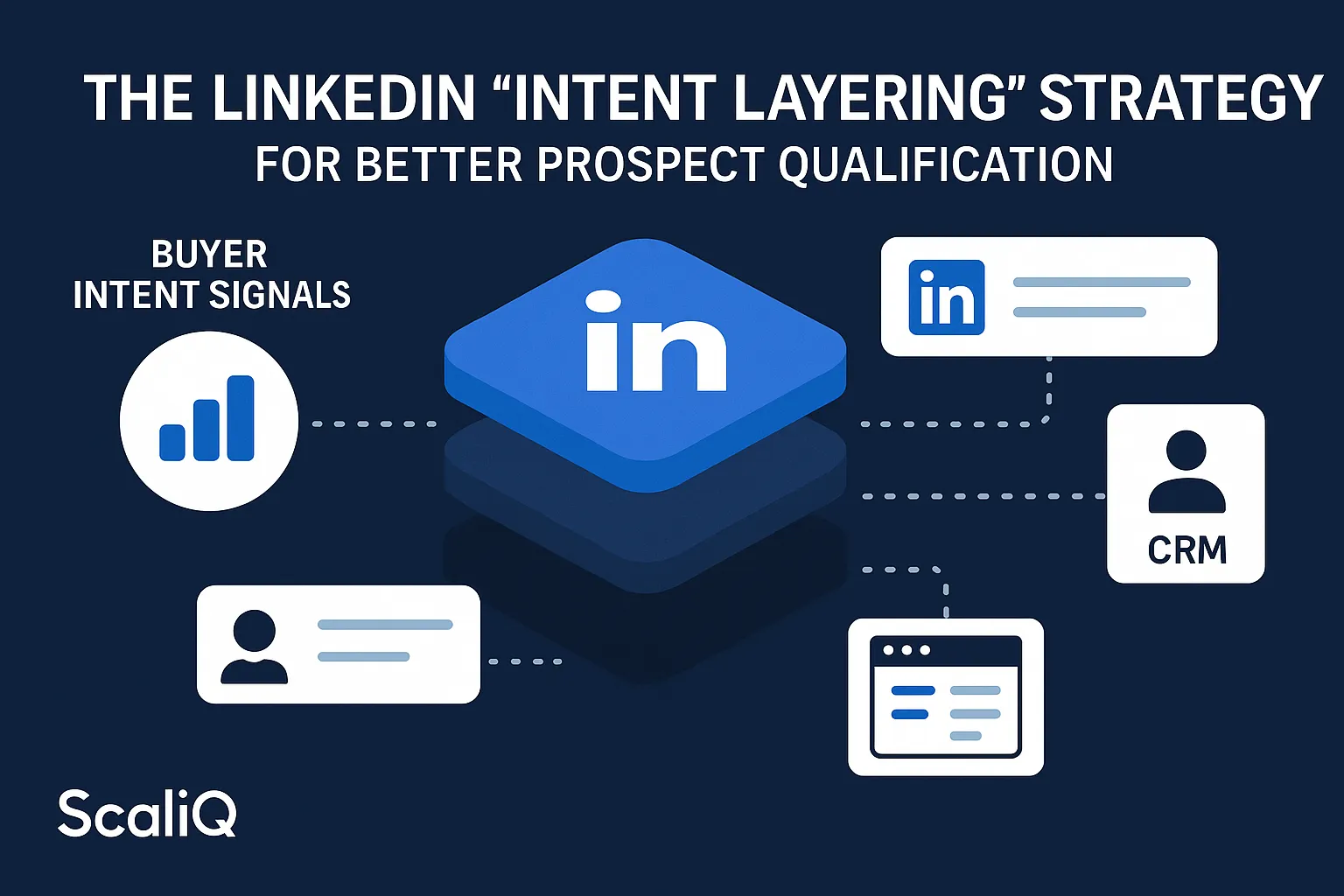
This multi-signal prospecting framework relies on four distinct layers: fit, engagement, timing, and external validation.
• Fit determines if the account is fundamentally worth pursuing.
• Engagement highlights emerging interest and brand awareness.
• Timing answers the critical question of "Why now?"
• External Validation confirms that the social interest is tied to actual buying behavior.
The core rule of multi-signal targeting and account prioritization is simple: the more independent layers that align, the stronger your qualification confidence.
The Core Signal Layers: Fit, Engagement, Timing, and External Validation
No signal layer should stand alone. Each layer answers a distinct qualification question, and advanced teams combine them to evaluate buyer intent signals with maximum precision.
Signal quality relies heavily on recency, relevance, and combination. You must combine LinkedIn engagement and firmographic data to uncover true sales signals from LinkedIn engagement. Validating role relevance is equally crucial; as demonstrated by research on the B2B buying center, stakeholder context dictates whether engagement is actionable. Furthermore, the OECD analysis of digital skills signalling underscores why professional networks like LinkedIn serve as highly meaningful digital signal environments when analyzed correctly.
Layer 1 — Fit Signals
Fit answers the foundational question: "Is this account worth pursuing even if interest exists?"
This layer encompasses firmographic criteria such as company size, industry, geography, growth stage, and segment relevance. It also demands persona and buying-committee fit—evaluating job titles, functions, seniority, and influence over the purchase.
A critical rule in account prioritization and LinkedIn prospect qualification: strong engagement from a poor-fit account should never outrank moderate engagement from an ideal-fit account. B2B intent data is only valuable when applied to companies that can actually buy your product.
Layer 2 — Engagement Signals
Engagement signals indicate emerging interest. These include post engagement, connection acceptance, content interaction, profile views, follower activity, and direct replies.
However, you must distinguish high-context engagement (e.g., commenting thoughtfully on a technical post) from vanity engagement (e.g., blindly liking a company milestone). Repeated, role-relevant engagement carries significantly more weight than one-off social actions.
When evaluating sales signals from LinkedIn engagement and broader social selling signals, rank them by confidence. Direct replies and high-context comments rank highest, followed by repeated content interaction, with generic profile views ranking lowest. Leveraging these signals effectively in your LinkedIn outbound targeting requires smart workflows. For insights on building messaging workflows that capitalize on engagement context, explore Blog.
Layer 3 — Timing Signals
Timing answers the most urgent sales question: "Why now?"
Timing triggers include job changes, team expansion, hiring momentum, funding rounds, product launches, leadership changes, or category-relevant activity. Timing signals are powerful because they often make average-fit accounts highly actionable and allow you to safely ignore weak-fit accounts.
A key factor in pipeline qualification and evaluating buyer intent signals is signal recency and reliability. Older triggers must decay in your scoring model over time—a job change from six months ago is no longer a compelling outreach trigger today.
Layer 4 — External Validation Signals
LinkedIn activity becomes exponentially stronger when validated by external sources. This includes website visits, CRM history, email engagement, third-party enrichment data, or deep account-level research.
First-party data confirms whether social engagement is merely exploratory or directly tied to active buying behavior. In modern intent-based prospect qualification, external validation is usually the deciding factor that moves an account from "interesting" to "sales-ready."
To orchestrate these B2B intent data sources seamlessly, teams need a unified system. Implementing a platform like Www.Notiq.Io acts as a workflow and orchestration layer, pulling LinkedIn, website behavior, and CRM signals into one cohesive qualification engine.
What Strong Signal Combinations Actually Look Like
When answering how do you qualify prospects using multiple intent signals, look at how combinations alter confidence levels in your LinkedIn intent layering strategy:
• High Priority: Ideal customer profile account + director-level contact + repeated post engagement + pricing-page visit.
• Medium Priority: Recent job change + target account + Sales Navigator activity + CRM inactivity reactivation.
• Low Priority (Ignore): Weak-fit account + one post like + no web activity.
In multi-signal targeting, the convergence of signals dictates the action, not the volume of isolated events.
How to Score and Prioritize High-Intent Accounts
To transform this framework into a repeatable model for advanced teams, you must implement a scoring logic based on confidence rather than raw activity volume.
Scoring should reflect both account fit and current buying probability. A weighted model allows you to adapt the logic to your specific GTM motion. Most importantly, avoid black-box algorithms. Your account prioritization logic must be highly explainable to SDRs, AEs, and RevOps. When reps understand how do you build a LinkedIn intent scoring model and how to prioritize high-intent accounts on LinkedIn, adoption skyrockets.
Start With a Simple Weighted Scoring Model
Advanced teams begin simple and refine based on conversion outcomes. A recommended baseline for a LinkedIn intent scoring model is:
• Fit = 35%
• Engagement = 25%
• Timing = 20%
• External validation = 20%
This multi-signal prospecting framework should be tuned to match your sales cycle length, ACV, and data quality. This ensures your intent-based prospect qualification aligns with actual revenue goals.
Assign Signal Confidence, Not Just Signal Presence
Score signals by strength, not a binary yes/no status. Distinguish between low-confidence, medium-confidence, and high-confidence triggers. Repeated or cross-channel corroborated behavior must earn significantly more weight than passive activity. This maintains high signal recency and reliability when assessing buyer intent signals for pipeline qualification.
Define Qualification Thresholds
Clear thresholds eliminate subjective qualification differences across your sales floor. Define stages such as:
• Monitor: Fit is good, but engagement is low.
• Marketing-Qualified Account (MQA): Engagement is rising, needs nurturing.
• SDR-Priority Account: Timing and engagement align; requires outbound.
• Sales-Ready Account: High fit, strong engagement, validated by web/CRM activity.
These thresholds standardize pipeline qualification and account prioritization, directly solving the pain of inconsistent prospect qualification.
Example Scoring Matrix
This matrix illustrates how to qualify leads on LinkedIn using multi-signal targeting. Poor fit or stale signals actively offset otherwise promising engagement, ensuring strict LinkedIn prospect qualification. To implement this strategic context effectively, ScaliQ provides the precision targeting and layered signal qualification necessary for modern outbound.
Move From Contact Scoring to Account Scoring
One active contact does not automatically classify the full account as ready. Multiple contacts, stakeholder diversity, and role spread across the buying committee exponentially increase confidence. Always tie contact-level data back to buying-group logic to ensure accurate account prioritization using B2B intent data and buyer intent signals.
How to Avoid False Positives and Weak Outreach Triggers
A robust intent model is not just about finding positives; it is equally about reducing misclassification. Preventing wasted outreach caused by noisy signals is a critical operational gap.
Just as medical testing balances false positives and false negatives—a concept well-explained in the CDC guide to sensitivity and specificity—your intent scoring system must separate signal noise from actionable buying behavior.
Common False Positives on LinkedIn
Beware of these weak triggers that cause false positives in intent-based targeting:
• A single profile view
• One post like without follow-on behavior
• A generic connection acceptance
• A low-context ad click
• Engagement from a non-relevant persona (e.g., an intern liking a post)
These events demonstrate basic awareness, not intent. Treating them as buying signals is the fundamental flaw of single-signal targeting and proves that LinkedIn engagement alone does not confirm buying intent. To extract true sales signals from LinkedIn engagement, context is mandatory.
Add Guardrails Before Outreach
Implement minimum qualification rules. For example, require "Fit + 1 Engagement Signal + 1 Validation Signal" before an account hits an SDR's queue. Utilize strict time windows so stale engagement naturally decays and loses priority. If negative signals (e.g., poor fit or recent closed-lost opportunity) are present, the system should automatically suppress outreach. These guardrails ensure signal recency and reliability, streamline pipeline qualification, and answer how do you qualify prospects using multiple intent signals safely.
Validate Before Personalizing
Personalization quality depends entirely on valid context, not just available data. Teams should reference engagement in their outreach only when it is clearly relevant and recent. Overreading shallow social interactions (e.g., "I saw you liked our company's post about our summer picnic, want to buy our software?") destroys credibility. Effective LinkedIn outbound targeting and intent-based prospect qualification require discipline in multi-signal targeting.
Compare Single-Signal vs Layered Qualification
Unlike broad intent platforms that lack social nuance, a dedicated LinkedIn intent layering vs 6sense or similar broad tools approach ensures your multi-signal targeting is operationalized specifically for network-native behaviors, vastly improving account prioritization.
How SDR and RevOps Teams Operationalize the Framework
A framework is useless if it only exists in theory. How SDR and RevOps teams operationalize the framework determines its success. Teams must turn layered signals into routing logic, automated alerts, prioritized queues, and mapped outreach plays.
Build a Shared Qualification Language
Define terms like interested, engaged, qualified, and sales-ready at the account level. When Marketing, SDRs, and RevOps align on scoring inputs and thresholds, it eradicates inconsistent prospect qualification. This shared language is the bedrock of intent-based prospect qualification and accurate account prioritization.
Create Alerts and Prioritized Work Queues
Layered signals should trigger ranked account lists, not noisy, real-time pings for every minor event. Route accounts logically by segment, territory, account score, or trigger type. By requiring multi-signal thresholds, you prevent alert fatigue. To orchestrate these cross-system signal workflows effectively and define how to prioritize high-intent accounts on LinkedIn without overwhelming reps, integrate solutions like Www.Notiq.Io to handle pipeline qualification and multi-signal targeting orchestration.
Match Outreach Plays to Signal Patterns
Different signal combinations require entirely different outreach motions:
• High Fit + High Validation: Direct outbound, aggressive multi-threading.
• High Fit + Low Validation: Monitor, warm via marketing, soft social touches.
• Strong Timing + Moderate Engagement: Fast, highly personalized outreach referencing the timing trigger.
Tailor your messaging to the exact signal pattern rather than relying on generic sequence templates. For examples of how to map message personalization to specific buyer intent signals in LinkedIn outbound targeting and sales prospecting on LinkedIn, review the playbooks at Blog.
Use Feedback Loops to Improve the Model
Scoring models must be calibrated against real-world outcomes: reply rates, meetings booked, opportunity creation, and pipeline quality. Identify which signals overpredict intent and which combinations consistently convert. RevOps should continuously tune weights, decay windows, and thresholds. This ensures signal recency and reliability, refining how do you build a LinkedIn intent scoring model for long-term account prioritization.
A Sample End-to-End Workflow
A practical, tactical process looks like this:
1. Capture LinkedIn engagement and account activity.
2. Enrich firmographic and contact-role data.
3. Validate with web and CRM signals.
4. Score the account using the weighted matrix.
5. Route to the correct SDR queue based on thresholds.
6. Launch the matched outreach play.
7. Record outcomes and refine the model.
This LinkedIn intent layering strategy creates a highly efficient multi-signal prospecting framework. To anchor this process in strategic intent-based prospect qualification, leverage platforms like ScaliQ to drive precision targeting and superior qualification logic.
Conclusion
LinkedIn becomes an unparalleled revenue engine when teams stop treating isolated engagement as intent and start systematically layering fit, engagement, timing, and validation signals.
The practical benefits of a LinkedIn intent layering strategy are undeniable: drastically fewer false positives, superior account prioritization, and highly consistent qualification across SDR and RevOps teams. The ultimate goal of multi-signal targeting is not to hoard more data, but to combine the right signals in a way that is highly explainable and instantly operational.
Stop reacting to noise and start building pipeline with precision. Explore how ScaliQ’s layered intent signals and precision targeting can transform your GTM efficiency today.