

How to Build a Self-Improving LinkedIn Outreach System With AI
For advanced outbound teams, the core problem with most prospecting stacks is not execution—it is a lack of learning. Today’s tools make it incredibly easy to automate activity, but very few actually learn from the outcomes they generate. As a result, static sequences inevitably plateau. Teams struggle to scale because they rarely connect data enrichment, message variants, reply classification, and CRM outcomes into one continuous, adaptive loop.
This article provides a system-design blueprint for building an AI learning outreach system that improves over time through structured feedback, experimentation, and governance. Designed for RevOps leaders, SDR managers, and growth operators who already utilize CRM, enrichment, and sequencing tools, this is not a list of basic prospecting tips. Instead, it is a comprehensive guide to designing a closed-loop architecture for adaptive LinkedIn outreach.
By orchestrating feedback loops that improve outreach performance over time, platforms like ScaliQ demonstrate that the future of outbound is not just doing more—it is building a self-improving LinkedIn outreach system with AI that gets smarter with every interaction.
What Makes Outreach Self-Improving
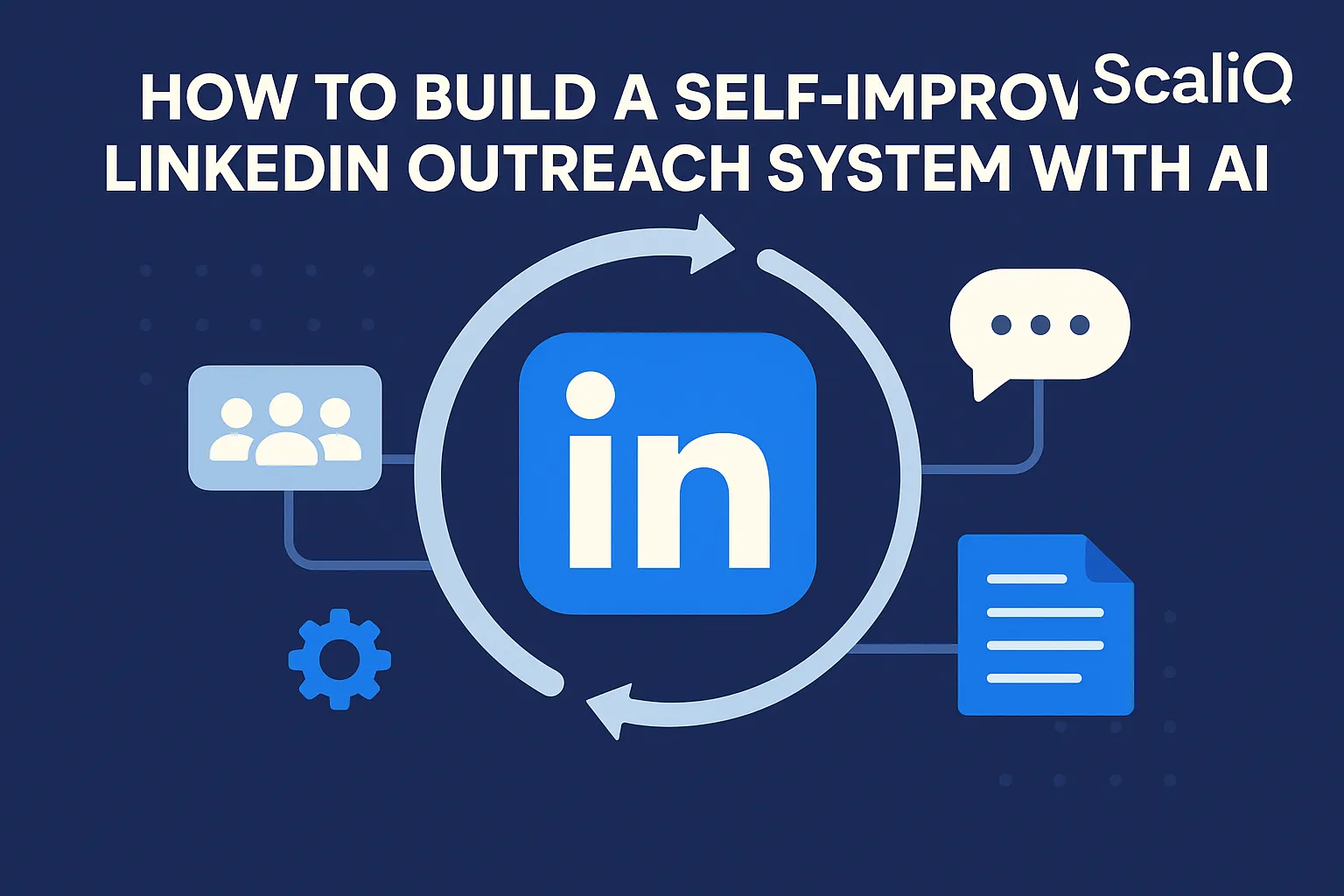
To move beyond basic activity metrics, we must define the fundamental difference between standard outreach automation vs self-improving outreach. Automation blindly executes predefined steps. A self-improving system, however, captures outcomes and continuously updates targeting, prompts, and sequencing logic based on those results.
In this context, "learning" does not necessarily require full autonomous model retraining. Instead, it relies on structured adaptation using concrete outcome signals: connection acceptance, reply rates, positive responses, and meeting conversions. This creates a powerful compounding effect. Better segmentation improves message relevance; better replies improve prompt guidance; and better classification improves the accuracy of next-step logic.
Unlike common competitor-style workflows that stop at message delivery and basic reporting, an adaptive LinkedIn outreach system actively closes the gap between outbound activity and pipeline generation by leveraging feedback loops in outbound outreach.
Static Automation vs Closed-Loop Outreach
Static sequences are excellent for scaling volume, but they do not improve strategy quality on their own. This is exactly why a LinkedIn outreach campaign plateau occurs after the early optimization phase. When there is no connection between prospect attributes, message variants, and downstream outcomes, teams are left guessing why performance degraded.
Instead of relying on one-off "best practices," teams need event capture and structured learning. The table below illustrates the evolution toward a closed-loop outbound system:
The 5 Signals That Make a System Adaptive
To optimize a LinkedIn lead generation system, the architecture must ingest five core learning inputs: persona, company context, trigger event, message variant, and response outcome.
Crucially, non-replies are also signals, not just failures. A lack of response may indicate bad timing, poor ICP fit, or weak messaging. Advanced setups also incorporate buyer-state signals, such as prior engagement history or intent-like behavioral triggers. Rather than sitting in disconnected dashboards, these signals must directly feed playbook updates, driving continuous reply-rate optimization and informing message sequencing and experimentation.
When AI Should Write, Recommend, or Escalate
Advanced systems should never let AI fully automate every decision without oversight. Safe system design requires controlled autonomy, not blind automation.
An effective workflow operates in three distinct modes:
1. AI-Generated Drafts: Fully automated generation for low-risk, high-volume segments.
2. AI-Recommended Variants: The system suggests optimized messaging for human approval.
3. Human-Required Review: Mandatory escalation for high-value or risky enterprise accounts.
This tiered approach ensures brand safety and strict governance, providing the benefits of AI personalization for LinkedIn messages while maintaining human-in-the-loop review for critical agentic sales automation tasks.
Core System Architecture and Data Flow
Building a self-improving LinkedIn outreach system with AI requires a practical, end-to-end blueprint. The architecture must move seamlessly through distinct layers to enable an agentic prospecting workflow and robust B2B lead generation system design.
The Adaptive Outbound Pipeline:
1. Inputs: ICP definitions and target segments.
2. Enrichment: Gathering deep contextual data.
3. Segmentation: Grouping prospects by dynamic triggers.
4. Generation: AI drafting based on rules and context.
5. Delivery: Executing the outreach via ScaliQ as a workflow orchestration layer to connect system components.
6. Response Capture: Ingesting replies and behavioral data.
7. Classification: Categorizing the intent of the response.
8. Analytics: Measuring performance against core KPIs.
9. Optimization: Feeding insights back into inputs and generation.
Inputs: ICP, Segments, and Enrichment Sources
Adaptive systems start with a strong input layer, not message generation. The minimum viable data model requires account, contact, persona, industry, trigger event, company context, and engagement state.
Poor prospect data quality for personalization directly weakens downstream learning. If the inputs are flawed, the AI will generate generic messaging. Therefore, deep enrichment must happen before generation so that prompts utilize real context and precise ICP segmentation instead of shallow tokens, ensuring a high-performing LinkedIn lead generation system.
The Core Data Model for Learning
To understand what data model is needed to connect persona company context message variants and outcomes, teams must track specific entities: prospect profile, campaign, message step, prompt version, message variant, response label, and meeting outcome.
Without linking variant-level data to final outcomes, teams cannot know what is actually working. This is the missing layer in most fragmented outbound tools.
Example Schema for Feedback Loops in Outbound Outreach:
• Prospect_ID: 10495
• Persona: VP of RevOps
• Trigger: Recent Funding
• PromptVersion: v3Direct_ROI
• Variant_Sent: Variant B (Soft CTA)
• Acceptance_Result: True
• Reply_Classification: Objection (Timing)
• Conversion_Stage: Nurture
Message Generation and Adaptive Sequence Logic
Prompts should be fed by enriched context, segment rules, and prior performance patterns. Connection requests, follow-ups, and CTAs must function as modular components rather than fixed, monolithic scripts.
Adaptive sequencing ensures dynamic routing. If a connection is accepted but yields no reply, the system tests a specific follow-up path. If a neutral reply is received, it triggers objection-handling logic. If a positive reply occurs, it routes to a booking workflow. While AI personalization for LinkedIn messages can generate multiple variants, the system should always select the winner based on historical performance and message sequencing and experimentation data.
Response Capture, Classification, and CRM Sync
To optimize performance, teams must ask: how can outreach systems distinguish positive replies from neutral or negative responses automatically? Replies must be ingested and classified into structured categories: positive, neutral, negative, objection, disqualified, or referral.
Automatic classification powers next actions and creates clean labels for machine learning. Syncing labeled outcomes to the CRM is non-negotiable; it connects conversation quality with actual pipeline impact. Teams should classify both direct responses and no-response states to refine their reply-rate optimization strategies. For further insights on workflow orchestration, explore ScaliQ's blog on response classification and CRM sync.
The Optimization Loop
The feedback path must be clear: outcomes update segment scoring, prompt templates, sequence branching, and human review rules. This closed-loop reporting optimization should happen at multiple levels—persona, industry, campaign, CTA type, and trigger-event.
For example, if an AI learning outreach system detects repeated objections regarding "budget constraints," it can automatically rewrite follow-up prompts to address ROI earlier or tighten targeting to focus on companies with recent funding. However, teams must monitor for the risk of overfitting to a narrow audience segment. Implementing lifecycle governance and system monitoring, as outlined in the NIST AI Risk Management Framework, ensures outreach optimization remains robust and reliable.
Feedback Loops, Testing, and KPI Instrumentation
Operationalizing learning requires more than just collecting data; it requires rigorous experimentation design and KPI definitions. Without disciplined instrumentation, teams mistake vanity metrics for actual progress, undermining their feedback loops in outbound outreach.
To truly master outreach optimization, teams must know exactly what metrics should teams track in an adaptive LinkedIn outreach system and how to avoid false confidence.
The Core Metrics That Actually Matter
To diagnose system performance across the funnel, teams must track primary progression metrics:
• Acceptance Rate: (Accepted Connections / Total Requests Sent)
• Reply Rate: (Total Replies / Accepted Connections)
• Positive Reply Rate: (Positive + Referral Replies / Total Replies)
• Booked-Meeting Rate: (Meetings Booked / Total Prospects Contacted)
Optimizing only one metric can distort the system. For instance, a high acceptance rate does not translate to pipeline if it fails to yield qualified conversations. These KPIs, grounded in HubSpot outbound sales metrics concepts and evaluated using methodologies akin to the CDC program evaluation framework, must be segmented by persona, industry, and prompt variant to drive true reply-rate optimization and maximize the booked-meeting rate.
How to Structure Experiments Across Connection Notes, Follow-Ups, and CTAs
Advanced teams must test one primary variable at a time: the hook, personalization depth, CTA, send timing, or sequence interval. When figuring out how to test and optimize LinkedIn connection requests and follow-ups, clearly defining a control and a variant ensures that learning is accurately attributable.
Testing should occur at multiple layers: first optimizing for acceptance, then reply quality, and finally meeting conversion. It is critical to achieve statistical volume before making conclusions, especially in niche segments. This rigorous approach to message sequencing and experimentation and A/B testing aligns with the validation principles found in the NIST AI TEVV guidance.
Learning from Positive Replies, Objections, and Non-Replies
A self-improving system must learn from all outcomes. Positive replies reveal resonant value propositions. Objections reveal messaging gaps. Non-replies reveal weak relevance or poor timing.
By building labeled taxonomies for objection categories and disqualification reasons, teams can systematically feed these insights back into prompt and segment updates. This prevents the dreaded LinkedIn outreach campaign plateau by ensuring response classification continuously fuels feedback loops in outbound outreach.
Avoiding False Positives, Drift, and Overfitting
Common optimization errors include drawing conclusions from tiny sample sizes, chasing short-term lift, or overfitting to a narrow audience segment. Over time, models experience drift—what worked last quarter may stop working as buyer conditions change.
To combat model drift and campaign drift, teams should implement periodic review windows and holdout controls. Human review remains necessary to intervene when the system starts reinforcing narrow assumptions, ensuring long-term outreach optimization aligned with lifecycle risk controls like those in the NIST AI Risk Management Framework.
Safe AI Personalization at Scale
A major objection among advanced teams is figuring out how can AI personalize LinkedIn outreach without sounding robotic. The goal is relevant, safe AI personalization, not synthetic over-personalization. Platform risk and brand risk can severely damage outbound performance, which is why compliance risks of automating LinkedIn outreach at scale must be managed by making governance a core part of the architecture.
Personalization That Feels Specific, Not Synthetic
There is a vast difference between shallow variables and real contextual personalization. Generic LinkedIn outreach messages rely on superficial compliment lines ("I saw you went to X University"). Strong LinkedIn message personalization AI uses account-level context, persona pain points, and trigger-based timing.
By constraining prompts to stay factual and concise, AI personalization for LinkedIn messages feels authentic.
• Weak AI: "I saw your company grew by 10%. As a leader, you must be busy. Want to buy our software?"
• Strong AI: "Noticed the recent shift toward hybrid work in your latest 10-K. Typically, RevOps leaders at this stage struggle with CRM data decay. Is this on your radar for Q3?"
Guardrails for Hallucination Prevention and Brand Safety
LLM outputs must be grounded in verified enrichment data. Practical AI risk controls include approved data fields, restricted prompt variables, tone constraints, banned claims, and escalation rules.
Implementing review gates for strategic accounts or regulated industries guarantees brand-safe personalization. Governance actively improves performance by preserving prospect trust, aligning with the trustworthiness and accountability standards set forth in the OECD AI Principles. This ensures human-in-the-loop review acts as a safety net.
LinkedIn Constraints and Platform-Safe Design
When evaluating compliance risks of automating LinkedIn outreach at scale, teams must design within the platform's rules. Workflows must adhere to the LinkedIn prohibited software policy, focusing on legal, publicly accessible data and ethical automation.
These constraints affect build choices, automation depth, and approval workflows. By prioritizing platform-safe outreach, teams turn compliance awareness into a competitive advantage, ensuring their LinkedIn outreach automation remains sustainable.
Human-in-the-Loop as a Performance Layer
Human review is a strategic amplifier, not a bottleneck. In adaptive LinkedIn outreach, humans should approve, rewrite, or override AI recommendations based on practical thresholds—such as high-value accounts, new verticals, low-confidence outputs, or compliance-sensitive messaging.
When human edits are fed back into prompt templates and playbooks, human-in-the-loop workflows continuously elevate the quality of the entire workflow orchestration system.
Build vs Tool-Based Approaches for Adaptive Outbound
Deciding whether to assemble the system internally, rely on existing tools, or use a hybrid model is a critical step. This build vs buy outreach system decision should be framed around learning capability, governance, speed, and integration depth.
While static outreach sequences fail across buyer contexts, a feedback-driven approach ensures continuous improvement, setting true agentic sales automation apart from basic outreach automation vs self-improving outreach platforms.
What Most Automation Tools Do Well—and Where They Stop
Many tool-based setup options excel at lead capture, sequence execution, and surface-level personalization. However, the common gap in basic LinkedIn outreach automation is limited outcome labeling, weak experiment design, and minimal adaptive logic across campaigns. Execution-focused tools rarely explain data architecture or learning loops, leaving teams stuck when initial results fade.
When to Build Internally
Building a custom outbound architecture makes sense when teams require custom data models, CRM-native logic, specialized segmentation, or strict oversight.
However, teams must ask what components are required for a self-improving outreach stack and weigh the costs: engineering effort, ongoing maintenance, model evaluation, and governance overhead. This path is strictly for advanced teams with the operational maturity to benefit from compounding workflow automation optimization.
When a Hybrid Orchestration Model Makes More Sense
For most advanced teams, a hybrid option is the best fit: use existing tools for execution, but layer on orchestration, classification, and optimization. This preserves speed while enabling feedback-driven improvement.
ScaliQ provides this adaptive outbound value through intelligent workflow orchestration, signal-driven personalization, and continuous optimization. For more on message quality and experimentation, teams can explore thought leadership on Repliq's blog to refine their agentic sales automation strategies.
A Simple Decision Framework for Advanced Teams
To navigate the build vs buy outreach system dilemma, use a decision matrix based on integration depth, experimentation needs, compliance sensitivity, team resources, and desired autonomy:
1. Lean SDR Team: Rely on hybrid orchestration tools to move fast without engineering overhead.
2. RevOps-Heavy Mid-Market Team: Use an AI learning outreach system that connects deeply with the CRM for advanced adaptive LinkedIn outreach.
3. Enterprise Team: Build custom components or use highly secure hybrid orchestration to maintain strict governance and compliance.
The right choice depends entirely on how much learning and control the team requires to scale effectively.
Conclusion
The highest-leverage outbound systems do not just automate messaging—they learn from data, responses, and outcomes. Building a self-improving LinkedIn outreach system with AI requires a distinct blueprint: start with a strong data model, enrich context before generating text, classify responses accurately, instrument disciplined experiments, and feed the results back into your targeting and prompts.
Compounding gains come from these feedback loops, not from simply adding more steps to a sequence. Evaluate your current stack today: can it connect a persona, a message variant, a response label, and a meeting outcome into one continuous loop?
For teams ready to design an adaptive LinkedIn outreach architecture, ScaliQ serves as a partner for orchestration, CRM sync, and continuous optimization. By focusing on practical feedback loops that improve outreach performance over time, ScaliQ ensures your AI learning outreach system gets smarter with every send.