

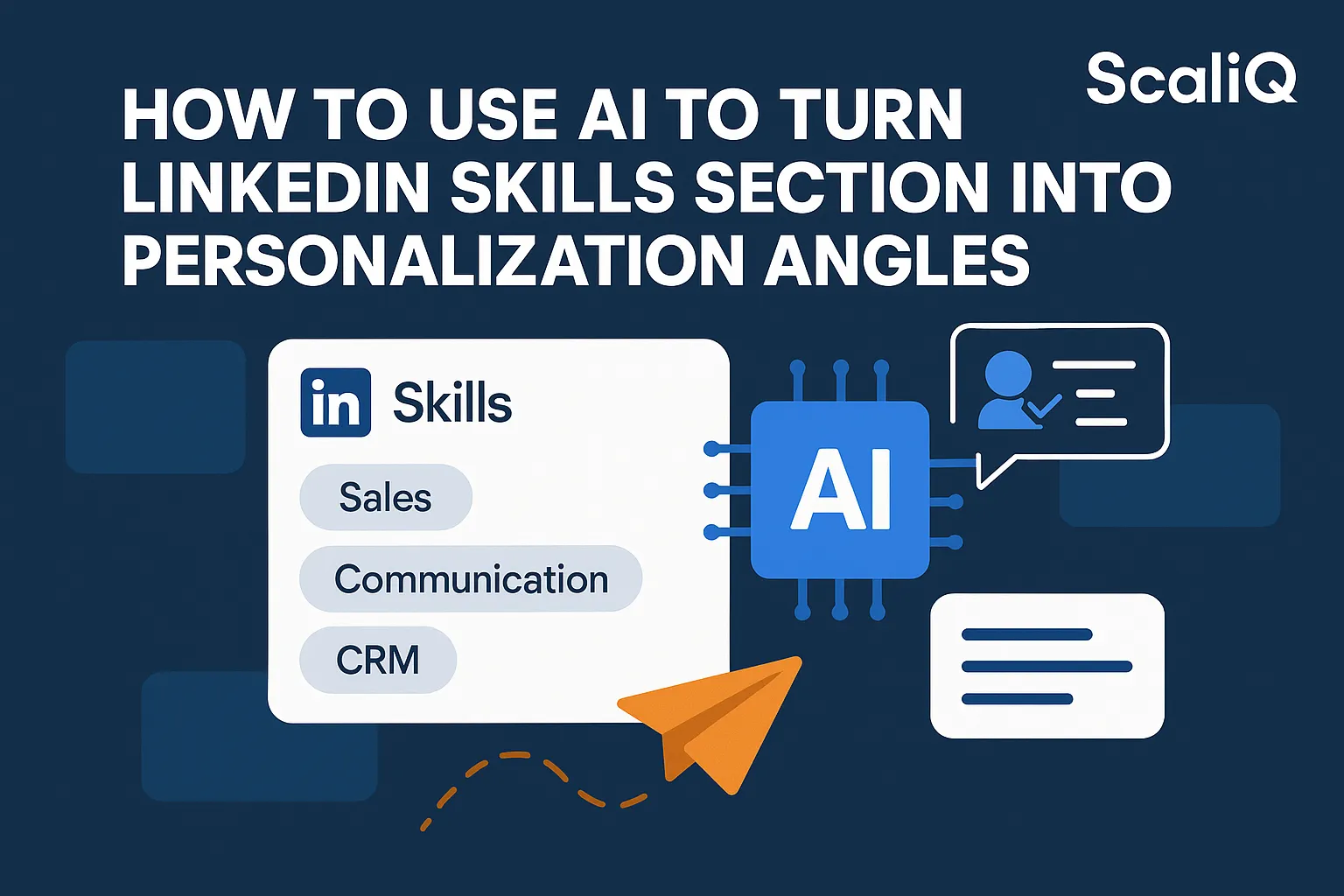
How to Use AI to Turn LinkedIn Skills Section Into Personalization Angles
Most sales representatives personalize their outreach based strictly on job titles, but the LinkedIn skills section often reveals much sharper clues about a prospect's tools, priorities, and likely pain points. While a job title tells you what a person is called, their endorsed skills tell you what they actually do—and more importantly, what operational challenges they are likely trying to solve.
For beginners looking to improve their prospecting, leveraging these ai profile signals is a game-changer. This article will teach you a simple, repeatable workflow for extracting data from the LinkedIn skills section, clustering those skills into strategic themes, generating highly relevant messaging ideas, and validating your outputs before hitting send. You will learn how to turn public LinkedIn skills into actionable outreach angles without spending hours on manual research.
Unlike broad AI personalization guides that offer vague advice, this framework focuses specifically on linkedin skills personalization as an overlooked, highly practical starting point. By using platforms like ScaliQ as a practical AI workflow layer, you can turn these public profile signals into scalable personalization angles that actually resonate. For readers who want to explore more outbound AI workflows, check out our related educational content here: Blog.
Why LinkedIn Skills Are Useful Personalization Signals
When it comes to buyer signals, the skills section is significantly more actionable than job-title-only personalization, especially for beginners. Job titles are often inflated, highly specific to a single company's culture, or too broad to be useful. In contrast, skills provide a functional footprint.
LinkedIn skills can reveal the specific software tools a prospect uses, their working style, their self-identified professional strengths, their likely Key Performance Indicators (KPIs), and adjacent business priorities. While skills are not absolute proof of buying intent, they serve as highly useful directional signals when paired with proper context. By grouping these skills into common theme clusters—such as analytics, automation, enablement, growth, operations, and customer experience—you can create a structured approach to LinkedIn personalization that generates far stronger hypotheses than generic outreach.
What the Skills Section Can Tell You
The skills a prospect chooses to list (and keeps pinned to the top of their profile) hint heavily at what they care about on a day-to-day basis. These ai profile signals act as a window into their operational reality.
For example, if a prospect lists "Sales Operations," "RevOps," and "CRM Management," this suggests their daily priorities revolve around efficiency, pipeline visibility, and data hygiene. On the other hand, a prospect listing "Demand Generation," "SEO," and "Content Strategy" is likely focused on top-of-funnel growth, lead attribution, and conversion rates.
As you conduct prospect research, it is critical to frame these skills as hypothesis inputs, not indisputable facts. You are using LinkedIn profile data to make an educated guess about their current challenges. For a marketing role, a cluster of analytics skills suggests a focus on ROI reporting. For an operations role, a cluster of process-mapping skills suggests a mandate to reduce friction and scale workflows.
Why Skills Beat Job-Title-Only Personalization
Relying solely on job titles often leads to weak, surface-level outreach. Consider a standard title-based opener: "As the VP of Sales, I imagine you are looking to increase revenue." This is generic, uninspired, and applies to literally every sales leader on the planet.
Now, compare that to a skill-informed opener: "Noticed your background in Salesforce architecture and sales enablement. I imagine balancing pipeline visibility with rep adoption is a constant priority." This approach uses skills to add nuance, revealing a functional interest that a broad title glosses over.
Many competitor guides on cold email personalization stay surface-level, advising reps to simply "use AI to personalize." This framework is different because it gives beginners one concrete, highly specific signal—skills—that they can actually use to drive meaningful sales personalization and outreach personalization.
A Beginner Workflow for Turning Skills Into Outreach Angles
To make linkedin skills personalization work at scale, you need a step-by-step system you can repeat for every prospect. The goal of AI prospecting is faster research, not blindly automated outreach. By following this simple workflow—collect, cluster, infer, prompt, and refine—you can generate highly relevant outreach personalization without needing a technical background.
For teams looking to operationalize this signal-to-message research seamlessly, ScaliQ serves as the practical workflow layer to execute these steps efficiently: ScaliQ.
Step 1 — Collect Public Profile Signals
The first step in prospect research is to review publicly visible LinkedIn profile data. Start directly with the skills section, then cross-reference those skills with the prospect's headline, current experience, and company context.
Keep this process strictly grounded in public profile signals. Beginners should avoid over-complicating the research phase; you only need to capture the few core signals required to form a useful message angle. Remember that while skills alone are a great starting point, the strongest personalization comes from combining multiple visible signals to form a complete picture of the prospect's day-to-day reality.
Step 2 — Cluster Skills Into Themes
Raw skills are just isolated words. To make them useful for outreach, you must group them into broader themes. Clustering helps AI reason at the level of business priorities rather than just regurgitating keywords. Common themes include automation, analytics, growth, enablement, customer retention, and operational efficiency.
Here are a few beginner examples of how to cluster the LinkedIn skills section into actionable buyer themes:
• Cluster 1: HubSpot + Demand Generation + Email Marketing, Theme: Growth and funnel optimization
• Cluster 2: Salesforce + Forecasting + Sales Operations, Theme: Pipeline visibility and process efficiency
• Cluster 3: Tableau + Data Modeling + SQL, Theme: Advanced analytics and reporting accuracy
By grouping ai profile signals into themes, you move away from feature-pitching and closer to strategic alignment.
Step 3 — Turn Themes Into Pain-Point Hypotheses
Once you have your themes, you must move from "what they list" to "what they may care about." This is where you translate buyer signals into actionable sales personalization.
Always phrase your outputs as likely challenges, goals, or tradeoffs rather than arrogant assumptions. For instance, if a prospect has a cluster of automation skills, your hypothesis might be that they are concerned with scaling lean processes without adding headcount. If they have a cluster of analytics skills, your hypothesis might be that they struggle with reporting consistency or attribution across siloed teams.
When learning how to research prospects faster, always keep your hypotheses role-aware and company-aware. An automation pain point at a startup looks very different from an automation pain point at a legacy enterprise.
Step 4 — Use AI Prompts to Generate Message Angles
Now, you can use AI to transform your clustered skills into opener lines, pain-point hypotheses, and value statements. AI is exceptionally good at connecting these dots, provided you give it a strong prompt.
Here is a swipeable prompt structure for cold email personalization:
• "Based on these LinkedIn skills [insert clustered skills], identify 3 likely priorities, 3 possible pain points, and 3 cold email outreach hooks for a [Job Title] at a [Company Type]. Keep the tone conversational, professional, and brief. Do not use generic compliments."
Here is a beginner-friendly prompt for LinkedIn prospecting with AI:
• "Act as an expert B2B seller. I am reaching out to a [Job Title] whose top LinkedIn skills are [Skill 1, Skill 2, Skill 3]. Write a short, 2-sentence LinkedIn DM opener that connects these skills to a likely operational challenge they face. Do not mention that I looked at their profile."
Always remember: AI should generate first drafts and options, not final copy. You are the editor.
How to Combine Skills With Headline, Experience, Company Context, and Activity
To prevent over-relying on a single signal and to drastically improve relevance, you must contextualize your findings. The best B2B personalization angles from public data come from combining multiple lightweight clues rather than overfitting to one listed skill. This is a major quality-control step that many generic guides under-explain. You must use adjacent profile context to strengthen or reject the suggestions your AI generates from ai profile signals.
Add Role Context From the Headline and Experience
A prospect's headline and experience section clarify their seniority, functional ownership, and current responsibilities. Experience helps distinguish strategic leaders from tactical executors.
For example, a growth marketer with analytics skills may care deeply about multi-touch attribution and budget allocation. An operations leader with automation skills may care about cross-departmental workflow efficiency. By cross-referencing LinkedIn profile data, you avoid embarrassing mismatches—such as pitching a tactical execution tool to a VP who only handles high-level strategy. Effective sales personalization requires aligning the skill with the seniority of the LinkedIn personalization target.
Add Company Context for Better Relevance
Company stage, category, and team size completely change the meaning of the same skill. Contextualizing buyer signals through company research ensures your AI sales personalization examples are credible.
Consider how company context shifts the narrative:
• Automation at a seed-stage startup: Implies a need to scale lean processes and punch above their weight class with limited headcount.
• Analytics at a Fortune 500 enterprise: Implies a need to standardize reporting consistency across dozens of fragmented, siloed teams.
Company context helps you prioritize which AI-generated angle is the most accurate and credible for your prospect research.
Use Recent Activity Carefully
When available, a prospect's recent posts, content themes, or visible engagement can serve as excellent supporting context. Recent activity validates whether a skill theme is still relevant to their current focus.
However, use LinkedIn profile signals for outreach carefully. Warn against forcing references to stale or weak signals just to sound personalized. If a prospect hasn't posted in two years, do not reference an old post. Authentic public profile signals should feel natural, not like you are checking a box for outreach personalization.
Example Personalization Angles for Email and LinkedIn DMs
To make this framework concrete, here are side-by-side AI sales personalization examples you can reuse. By following the progression of skill → theme → pain-point hypothesis → email opener → LinkedIn DM angle, you can achieve highly relevant cold email personalization and LinkedIn outreach across various roles.
Example 1 — Sales or RevOps Prospect
• Skills: Salesforce, forecasting, sales operations, enablement.
• Theme: Pipeline visibility and rep efficiency.
• Hypothesis: They are likely trying to clean up CRM data to make forecasting more accurate while reducing administrative work for account executives.
• Cold Email Opener: "Given your focus on Salesforce architecture and enablement, I imagine balancing clean forecasting data with rep adoption is a constant tug-of-war."
• LinkedIn DM Opener: "Noticed your background in RevOps and forecasting. Curious if you're currently focused more on pipeline visibility or reducing CRM friction for the reps?"
Note: Avoid generic compliments like "noticed your impressive background." Stick to the buyer signals to drive sales personalization.
Example 2 — Marketing Prospect
• Skills: Demand generation, email marketing, SEO, analytics.
• Theme: Growth efficiency and attribution clarity.
• Hypothesis: They need to prove which campaigns are actually driving revenue, not just generating top-of-funnel clicks.
• Weak Opener: "I saw you are highly skilled in demand generation and SEO, impressive background!"
• Strong Revised Opener: "With your background in demand gen and analytics, I imagine tying top-of-funnel SEO traffic to actual pipeline revenue is a major priority this quarter."
This approach to how to personalize cold emails with LinkedIn ensures your AI prospecting focuses on outcomes, not flattery.
Example 3 — Operations or Customer Success Prospect
• Skills: Process improvement, onboarding, customer success, automation.
• Theme: Scale, consistency, and retention.
• Hypothesis: They are trying to standardize the onboarding workflow so they can handle more clients without churn or adding support headcount.
• Cold Email Opener: "Noticed your focus on process improvement and customer success. Usually, leaders with your background are looking for ways to standardize onboarding without losing the personalized touch."
• LinkedIn DM Opener: "Saw your focus on CS automation. Are you actively looking at ways to scale onboarding workflows this quarter?"
Channel-specific copy should differ in length and tone. DMs should be conversational, while emails can introduce slightly more context. For teams looking for robust tools to manage channel-specific message delivery, Repliq.Co is a relevant personalization reference.
How to Validate AI Outputs and Avoid Generic or Robotic Outreach
The biggest risk in AI prospecting is not a lack of data, but weak interpretation. Relying blindly on AI can lead to generic flattery, incorrect assumptions, and overly polished, robotic phrasing. To build trust and ensure high-quality outreach personalization, you must validate AI outputs before sending. AI is here to support human judgment, not replace it.
To ensure structured AI governance and risk-aware workflow design, we recommend reviewing the NIST AI Risk Management Framework. Furthermore, for specific guidance on human review, validation, and oversight of AI-generated messaging, the NIST Generative AI Risk Management Profile offers excellent foundational standards.
A Simple 5-Point Validation Checklist
Before sending any message based on ai profile signals, run your draft through this practical review checklist:
• [ ] Is this insight actually supported by visible profile data?
• [ ] Does the angle match the person’s current role and company context?
• [ ] Is the message specific enough to feel researched?
• [ ] Does it avoid exaggerated familiarity or false assumptions?
• [ ] Would a human prospect find it credible and useful?
Following this checklist ensures you know exactly how do beginners use AI profile signals for sales outreach effectively while maintaining high standards for prospect research.
How to Avoid Sounding Creepy, Misleading, or Overconfident
Your outreach should never imply that you have hidden data access, nor should you make claims you cannot support. Public profile signals must be used with restraint and strict relevance. Over-personalization that feels invasive or theatrical will instantly alienate your prospect.
When conducting sales personalization, it is vital to adhere to truthful, non-deceptive commercial communication, as outlined in the FTC truth-in-advertising guidance. Additionally, always practice data minimization and responsible handling of profile information, supported by the FTC guide to protecting personal information. For a broader global perspective on transparency, accountability, and human oversight in AI, you can also reference the OECD AI Principles.
When to Rewrite or Discard an AI-Generated Angle
Not every AI output is a winner. You must know when to rewrite or discard an angle. If an output is too vague, overly flattering, wildly speculative, or completely disconnected from the prospect’s actual role, throw it out.
Never force a weak angle into your LinkedIn outreach or cold email personalization just to check a box. One accurate, well-researched sentence beats a long, rambling AI-generated paragraph every single time. Let the AI sales personalization examples guide you, but trust your gut when a draft misses the mark.
Best Practices and Expert Tips for Beginners
To successfully execute linkedin skills personalization, wrap this tactical guidance into a few memorable rules. By adhering to these "do this, not that" principles, you will drastically improve your AI prospecting and sales personalization results.
Beginner Rules of Thumb
• Do: Let skills start the research process.
• Not That: Don't let skills finish the research; always cross-reference with headline and company context.
• Do: Use AI to generate hypotheses and early drafts.
• Not That: Don't treat AI outputs as the final, unquestionable truth.
• Do: Keep personalization hyper-focused on business outcomes and operational challenges.
• Not That: Don't rely on shallow, compliment-focused openers.
• Do: Personalize just enough to prove relevance and show you understand their world.
• Not That: Don't personalize so deeply that you sound invasive or creepy.
By following these rules, your outreach personalization will rely on authentic buyer signals rather than gimmicks.
Conclusion
LinkedIn skills are a simple, highly accessible, yet vastly underused signal that can help beginners immediately move beyond generic, title-based outreach. By extracting skills, clustering them into strategic themes, translating those themes into pain-point hypotheses, and generating message angles with AI, you create a powerful engine for relevance.
The true differentiator in modern AI prospecting is not relying on automation alone; it is achieving faster relevance paired with better human judgment. Validating your AI outputs using role and company context ensures your linkedin skills personalization remains credible and effective.
If you want to operationalize skills-based personalization at scale and see this exact workflow in action, explore our platform and book a demo today: ScaliQ.