

Introduction
Most LinkedIn outreach fails for a simple reason: the message is fine, but the timing is completely wrong.
Despite advances in sales technology, many revenue teams still rely on static cadences, pushing out messages based on arbitrary schedules rather than contacting prospects during high-receptivity moments. This spray-and-pray methodology leads to ignored connection requests, buried InMails, and ultimately, missed revenue targets.
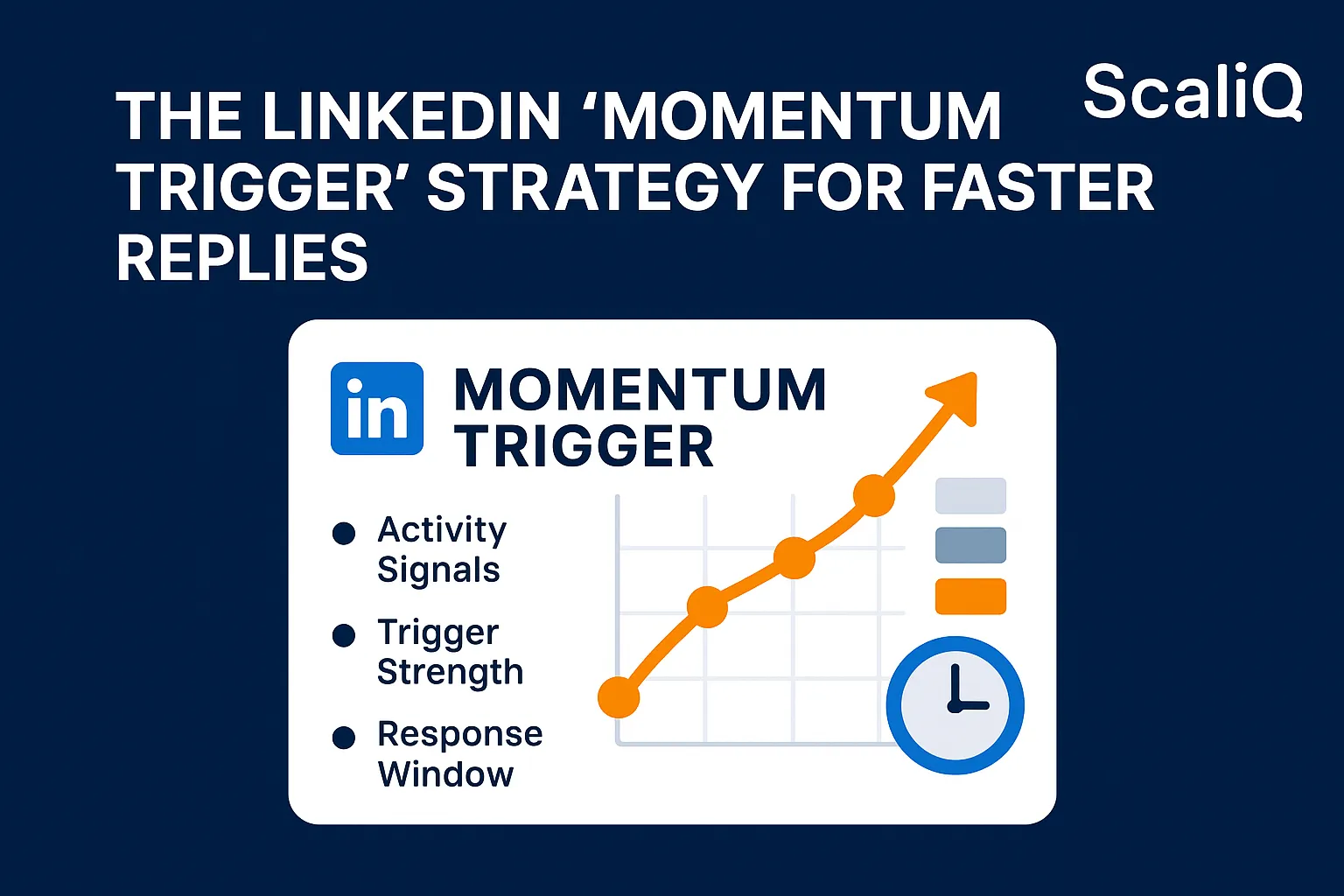
To solve this, B2B sales reps, SDRs, and outbound leaders need a repeatable, performance-driven system. Enter the Momentum Trigger framework—a practical operating model built around peak activity moments, signal strength, and speed-to-follow-up. By identifying precisely when a prospect's attention is activated, sales teams can execute a highly effective LinkedIn outreach timing strategy that drives unparalleled reply acceleration on LinkedIn.
This article will show you how to identify key buyer and engagement signals, act within the right response window, personalize without sounding robotic, and measure your reply lift. It is time to shift from guessing when to send a message to knowing why you are sending it now. For teams looking to master this outreach timing strategy, ScaliQ provides the definitive system built around triggered outreach and detecting peak activity moments.
Why Timing Changes LinkedIn Reply Rates
Outreach timing has a massive impact on reply probability. Operating on the assumption that a prospect is ready to talk simply because it is "Day 3" of your sequence is why low LinkedIn reply rates plague so many organizations.
There is a distinct difference between a generic sequence and a momentum-triggered sequence. A generic sequence runs on a fixed clock, optimizing for send volume. Event-triggered outreach runs on prospect behavior, optimizing for relevance. Relevance is not merely about having clever message copy; it is about contacting the prospect when their attention is already activated.
"Activated attention" occurs when a prospect is actively engaging with their professional environment—posting, commenting, changing roles, hiring, or revisiting relevant channels. These actions indicate a prime window to engage. While most tools focus on cramming more prospects into automated workflows, true linkedin response rate optimization comes from capitalizing on these exact receptivity windows.
Static Cadences vs. Momentum-Triggered Outreach
Fixed schedules are operationally simpler. You load a list, press play, and let the sequence run. However, this convenience comes at a steep price: missing the highest-probability reply window.
Momentum-triggered outreach uses real signals to decide when to contact someone, not just how many steps to send. When executed correctly, triggered outreach feels highly contextual and less interruptive. You are joining a conversation the prospect is already having, rather than forcing them to start a new one.
Understanding the difference between a generic sequence and a momentum-triggered sequence is the first step toward mastering your linkedin prospecting timing.
Why Buyer Intent and Engagement Signals Matter
In B2B sales, buyer intent signals and linkedin engagement signals are breadcrumbs that prospects leave behind, indicating shifting priorities or active research. Not all activity translates directly to buying intent, but these actions drastically increase the chance that a prospect is open to a relevant conversation.
On LinkedIn specifically, social activity often signals awareness, active research behavior, or internal organizational change. Recognizing these moments is the cornerstone of effective social selling timing.
To understand how these signals are categorized, you can review the LinkedIn Sales Navigator Buyer Intent FAQ. Furthermore, LinkedIn’s own buyer intent guide highlights precisely why signal-based outreach is infinitely more relevant than standard static cadence outreach.
The Real Cost of Slow Follow-Up
Identifying a signal is only half the battle; the other half is speed. The longer teams wait after a signal appears, the less contextual the outreach feels. This phenomenon is known as response decay.
If a prospect comments on a post about revenue operations on Tuesday, reaching out on Friday makes you just another cold pitch in an already competitive inbox. The prospect's priorities have changed, and the context of their comment has faded. Timing must be managed like an SLA (Service Level Agreement), not a guess.
A slow response to prospect activity destroys relevance. To understand how can timing improve LinkedIn reply rates, consider the research on response latencies in asynchronous communication, which proves that follow-up timing dictates the likelihood of a reciprocal interaction. The faster the contextual follow-up, the higher the reply probability.
The Highest-Value Momentum Triggers to Watch
To execute this strategy, you need a practical trigger taxonomy. Not all signals are created equal. The most effective linkedin momentum trigger is evaluated based on three factors: intent strength, urgency/decay, and channel fit.
The best triggers are not always the loudest—they are the ones most connected to timely relevance. Here is a breakdown of which LinkedIn activity signals indicate the highest reply likelihood.
High-Urgency Triggers: Post Engagement, Comments, and Profile Activity
Visible linkedin engagement signals—such as recent posts, comments, profile views, or reactions—are high-speed opportunities. When a prospect takes these actions, they are mentally present on the platform and actively thinking about the topic at hand.
These peak activity moments allow sales teams to use warm openers rather than cold interruptions. For example, referencing a specific point they made in a comment shows you are paying attention. Mastering linkedin prospecting timing here means acting quickly before the prospect logs off.
Mid-to-High Intent Triggers: Job Changes, Hiring Activity, and Team Growth
Role changes and hiring sprees are classic sales trigger events. They create fresh priorities, budget shifts, and an openness to new tools or processes.
These buyer intent signals should be used to frame event-triggered outreach around transitions, scaling, or team enablement. A new VP of Sales is highly motivated to make an impact in their first 90 days. Outreach tied to these situational changes is significantly stronger than generic "best time to message" rules.
Strong Company-Level Triggers: Funding, Expansion, and Market Movement
When a company announces funding, market expansion, or a major product launch, it signals strategic momentum. These triggers are valuable because they create urgent operational needs.
Funding news outreach is common, but event-triggered outreach done right goes beyond a generic "Congrats on the round!" Instead, an effective outreach timing strategy personalizes the message around the business context—connecting your solution to the specific growth goals mentioned in the press release.
High-Value Digital Intent Triggers: Website Revisits and Cross-Channel Signals
Some of the best outreach moments happen when LinkedIn and off-platform intent overlap. Website intent, CRM activity, and email engagement provide a robust foundation for multichannel outreach timing.
When a prospect visits your pricing page and subsequently views your LinkedIn profile, you have a high-value buyer intent signal. This overlap justifies a smarter, multichannel approach. For insights on orchestrating multichannel personalization, Blog offers deep context on aligning LinkedIn and email timing.
A Simple Trigger Scoring Model
Many teams face difficulty prioritizing which signals matter. To achieve true linkedin response rate optimization, you need a Momentum Trigger framework to score signals efficiently:
• Intent Strength: Low (Profile view) / Medium (Comment on industry post) / High (Pricing page visit + Job change).
• Recency: Within hours (Engagement) / 1 day (Website intent) / 3 days+ (Funding news).
• Channel Fit: LinkedIn DM (Social engagement) / Email (Funding/Hiring) / Both (High-intent cross-channel).
Unlike manual monitoring or static sequence tools that treat all prospects equally, the ScaliQ-style workflow operationalizes these signals into clear scoring, decay tracking, and precise action windows.
How Fast to Act Before Interest Decays
Timing theory must translate into operational rules. Treat your timing like a trigger-to-touch SLA: not every signal needs immediate action, but every meaningful signal requires a defined response window.
There is no universal "best time to send LinkedIn outreach messages." Instead, use a tiered model based on urgency. Response decay happens because prospect attention shifts and the trigger loses relevance.
Response Windows by Trigger Type
Understanding how quickly should sales reps act after a prospect posts or comments is critical. Here is a practical guide to follow-up timing:
Adhering to this linkedin outreach timing strategy prevents your message from feeling outdated upon arrival.
When to Use LinkedIn First, Email First, or Both
Channel choice depends on the signal type. Public LinkedIn activity makes the platform a natural first touch. Conversely, stronger buying-intent signals—like downloading a whitepaper or visiting a pricing page—often justify a coordinated event-triggered outreach approach using both email and LinkedIn.
Effective multichannel outreach timing means knowing when to layer channels. A LinkedIn connection request referencing a recent post, followed by an email elaborating on a related business challenge, is a powerful linkedin prospecting strategy.
How Many Follow-Ups Before Momentum Fades
A common question is how many follow-ups should be tied to a trigger before interest decays. The answer is usually one or two.
Trigger-based messaging should evolve. If you reach out about a recent post and follow up three times referencing that same post, you cross into the territory of generic messages that feel automated. Once the initial context is stale, your follow-up timing must pivot to a different value angle or a broader business pain point. Keep decay-based sequences short and impactful.
Common Timing Mistakes That Kill Replies
Outreach sent at the wrong time kills conversions. Common mistakes include:
• Waiting too long: Letting a high-urgency signal decay.
• Overreacting to weak signals: Sending a heavy pitch just because someone viewed your profile.
• Using the same message for every trigger: Treating a funding round the same as a post like.
• Following up without new relevance: Sending "just bubbling this up" instead of adding value.
Avoid generic messages that feel automated. Non-spammy sequencing preserves trust and drives sustainable linkedin response rate optimization.
Trigger-Based Messaging and Follow-Up Playbooks
Converting timing signals into contextual messages is where the strategy pays off. The goal is not to awkwardly state, "I saw you did X." It is to use the signal as a bridge into a relevant business conversation.
These playbooks provide actionable outbound personalization examples to drive reply acceleration on linkedin through triggered outreach.
The Anatomy of a Good Trigger-Based Opener
A successful trigger-based message follows a repeatable structure:
1. Relevant trigger reference: Acknowledge the signal naturally.
2. Reason this matters now: Connect the signal to a specific business context.
3. Clear value angle: State how you solve the implied problem.
4. Low-friction CTA: Ask for interest, not a 30-minute meeting.
Sales outreach personalization should be concise. Avoid heavy flattery. You want to sound observant and human, leveraging the linkedin momentum trigger without sounding invasive.
Playbook 1: After a Prospect Posts or Comments
This is one of the fastest-decay but highest-response opportunities. If you are wondering how quickly should sales reps act after a prospect posts or comments, the answer is immediately.
Opener:
Follow-Up (Day 2):
These linkedin engagement signals lead to massive reply acceleration linkedin.
Playbook 2: After a Job Change or Hiring Signal
Anchor this outreach in transitions and scaling. Generic congratulations yield zero value.
Opener:
This aligns the buyer intent signals and sales trigger events directly with your linkedin outreach timing strategy.
Playbook 3: After Funding or Company Momentum News
Avoid shallow praise. Connect the trigger to operational pressure.
LinkedIn Opener:
Email Follow-Up (Day 1):
This demonstrates an elite outreach timing strategy paired with multichannel outreach timing.
Playbook 4: After Website or Cross-Channel Intent
Handling digital-intent signals requires professionalism. Do not say, "I saw you on our website." This feels invasive. Emphasize relevance and compliance with data privacy.
Opener:
Connecting website intent to a useful resource leverages buyer intent signals safely and effectively across multichannel outreach timing.
Message Personalization Without Sounding Automated
Personalize based on the trigger, account context, and likely need—not just first-name tokens.
• Weak: "Hi [Name], I saw your post on LinkedIn. Buy my tool."
• Strong: "Hi [Name], your point about fragmented data resonated. Teams usually fix this by..."
Too much detail feels unnatural; the right amount creates relevance. To master this balance and avoid generic messages that feel automated, dive deeper into sales outreach personalization at Blog to refine your linkedin response rate optimization.
How to Measure Reply Lift Across LinkedIn and Email
Measurement is where many teams fall short. To prove your timing strategy works, you must move beyond vague assumptions and apply operational rigor.
Comparing momentum-triggered outreach against fixed-cadence outreach using the same audience segments reveals exactly how can teams measure reply lift from timing-based outreach. This data is crucial for SDR leaders aiming to validate their multichannel outreach timing and linkedin response rate optimization efforts.
The Core Metrics That Matter
To accurately gauge success, track these specific KPIs:
• Reply rate: Total responses divided by messages sent.
• Positive reply rate: Responses indicating interest or asking for more info.
• Meetings booked: The ultimate conversion metric.
• Trigger-to-touch SLA attainment: The percentage of signals acted upon within the designated time window.
• Channel contribution: Performance breakdown by LinkedIn vs. email.
Reply rate alone is a vanity metric if the replies are negative. You need to look at reply lift and meetings booked while holding your team accountable to the trigger-to-touch SLA.
How to Attribute Performance by Trigger Type
Do not lump all signal-based outreach together. Track results by trigger category to learn which LinkedIn activity signals indicate the highest reply likelihood.
This attribution model proves which buyer intent signals and linkedin engagement signals deserve real-time attention.
Benchmarking Triggered Outreach Against Static Cadences
To fairly compare signal-based outreach to fixed scheduling, run an A/B test on a similar persona segment. Look for relative lift in reply quality, response speed, and meeting creation.
You will quickly see the difference between generic sequence and momentum-triggered sequence performance. Fixed cadences may generate volume, but an event-triggered outreach aligned with a strict linkedin outreach timing strategy generates pipeline.
Building a Feedback Loop for Continuous Optimization
Review which triggers convert best, which response windows are too slow, and which message openers perform well.
Because manual monitoring of prospect activity is time-consuming, scaling this requires AI-driven signal monitoring. Automation should detect the signal, but human oversight (or highly sophisticated AI) should craft the context. As noted in the study on predicting email reply behavior, reply behavior depends heavily on context and relationship signals, not just the message text.
To execute this at scale and achieve true reply acceleration linkedin, ScaliQ serves as the ultimate orchestration layer for detecting triggers and executing timely, compliant outreach.
Conclusion
Faster LinkedIn replies come from better timing, not just better copy. Relying on static cadences means missing the critical moments when a buyer is actually ready to engage.
By adopting the Momentum Trigger framework, you can transform your outbound motion:
• Watch the right signals.
• Rank them by intent and urgency.
• Act before the context decays.
• Personalize to the specific trigger.
• Measure reply lift by channel and trigger type.
It is time to move away from batch-and-blast methods and embrace event-based prospecting. For revenue teams looking to operationalize triggered outreach around peak activity moments, implement a definitive LinkedIn outreach timing strategy today. Discover how ScaliQ can automate your signal detection and drive unparalleled reply acceleration linkedin.