

Introduction
For most solo founders, LinkedIn is a double-edged sword. It is the world’s largest database of potential B2B clients, yet accessing them manually is an operational nightmare. You likely know the feeling: you sit down to find leads, and three hours later, you have 50 browser tabs open, a spreadsheet with six names, and zero messages sent.
Manual prospecting is the silent killer of founder productivity. It forces you to trade high-value strategic work for repetitive data entry. But the landscape has shifted. In 2025, artificial intelligence has evolved from a buzzword into a practical utility that can reduce prospecting time by up to 80% for solo founders.
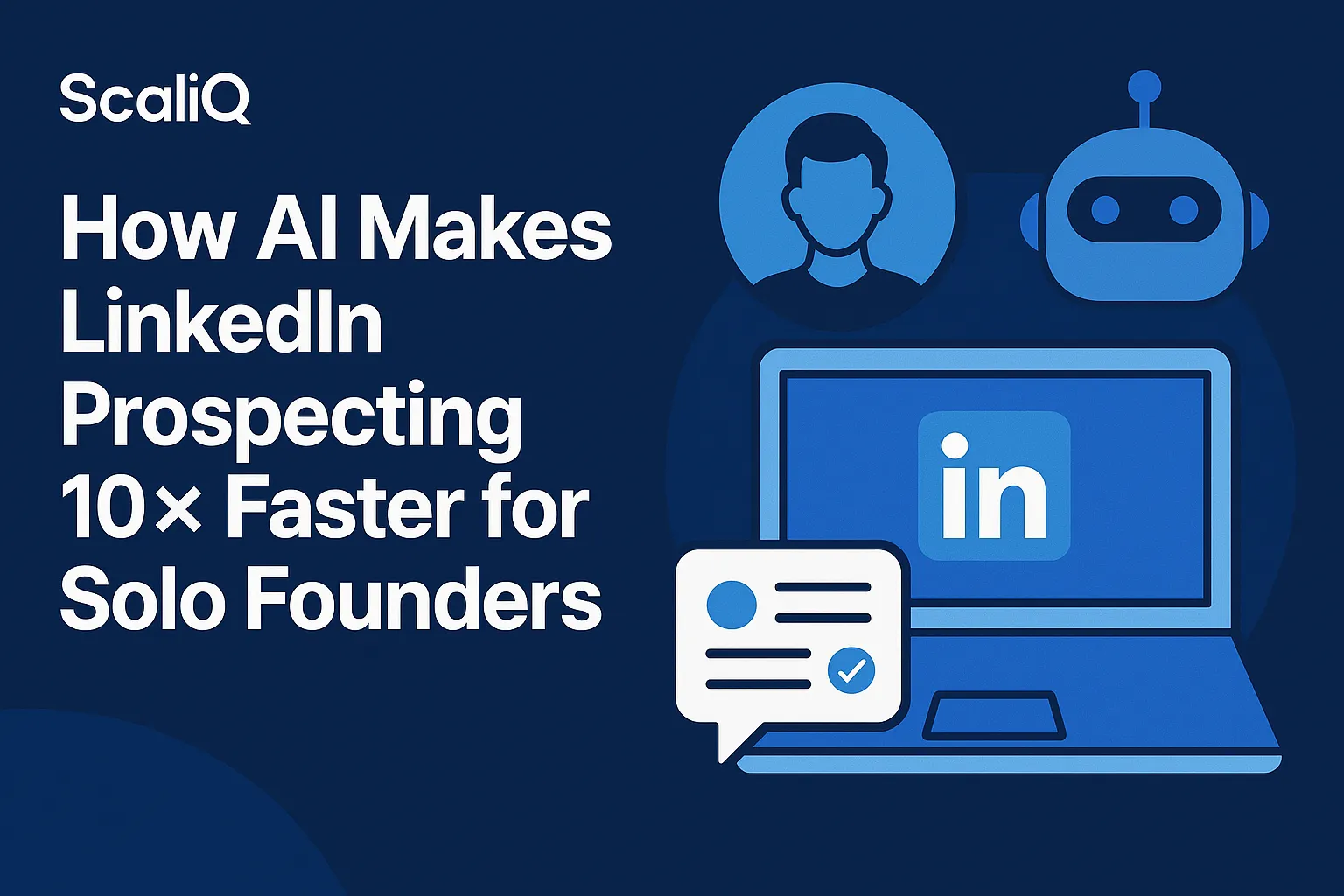
This guide is not about complex enterprise sales operations or hiring a team of SDRs. It is a definitive, beginner-friendly roadmap to using AI to automate the heavy lifting of research and outreach. By implementing the workflows below, you can achieve 10× speed in your lead generation efforts, allowing you to focus on closing deals rather than finding them.
Platforms like ScaliQ have redefined this process, offering a streamlined environment specifically built to help solo founders reclaim their time while maintaining high-quality outreach.
Why LinkedIn Prospecting Is Slow for Solo Founders
The traditional manual workflow for LinkedIn prospecting is linear and inefficient. It typically looks like this:
1. Search: You run a boolean search or browse a "People" list.
2. Scan: You click on a profile to verify if they fit your Ideal Customer Profile (ICP).
3. Research: You read their "About" section and recent posts to find a hook.
4. Draft: You write a message, trying to sound personal.
5. Repeat: You do this one by one.
The Hidden Costs of Manual Research
The problem isn't just the time it takes to type a message; it is the cognitive load of context switching. Every time you open a new profile, your brain has to process new information—company size, job title nuances, and recent activity.
For a solo founder, this "manual linkedin research takes too long." If you spend 10 minutes researching and writing per lead, sending just 20 messages consumes over 3 hours of your day. Furthermore, manual fatigue sets in quickly. By the 15th message, the quality of your personalization drops, leading to "low response rates linkedin outreach."
Data consistently shows that inconsistent, low-effort outreach yields poor results. When you are tired, you revert to generic templates, and generic templates get ignored. This cycle leaves many founders with an empty pipeline despite hours of effort.
How AI Automates Research, Personalization, and Lead Qualification
AI does not just speed up the process; it fundamentally changes the workflow by running parallel processes that a human can only do sequentially.
AI-Driven Lead Research
AI tools can instantly scan public profile data to extract critical fields that would take a human minutes to find. Instead of manually reading through an "About" section, AI extracts:
• Role and Seniority: Confirming decision-maker status.
• Niche and Industry: Ensuring the company fits your target market.
• Recent Activity: Identifying recent posts or job changes that serve as conversation starters.
• Pain Signals: Inferring challenges based on company growth or stagnation data.
This is "ai linkedin prospecting" at its core—turning unstructured profile text into structured, actionable data.
Note on Compliance: Responsible automation is critical. According to the NIST AI guidelines, AI systems should be designed to manage risk and ensure reliability. Always ensure your tools utilize public data ethically and comply with platform terms of service.
Automated Personalized Message Generation
The era of "Hi [First Name]" is over. "AI outreach personalization" now allows for hyper-specific messaging at scale.
AI analyzes the extracted research data to construct messages that reference specific details—such as a recent award the prospect won or a specific technology their company uses. This level of relevance signals to the recipient that you have done your homework, even if an AI agent did it for you. This shift is crucial for "linkedin outreach ai," as personalization is proven to boost reply rates by 30–50%.
AI-Based Lead Qualification & Scoring
Not all leads are created equal. "AI tools for linkedin lead qualification" can score prospects based on how well they match your ICP.
A simple scoring framework used by AI might look like this:
• Tier 1 (High Fit): Matches industry, role, and has high intent signals (e.g., hiring for a relevant role).
• Tier 2 (Medium Fit): Matches industry and role but lacks immediate intent signals.
• Tier 3 (Low Fit): Marginal match; keep for future nurture.
By filtering out Tier 3 leads automatically, AI ensures you only spend your limited time engaging with high-probability prospects.
Step‑by‑Step Beginner Workflow for Faster LinkedIn Prospecting
You do not need to be a prompt engineer to start. Here is a simplified workflow for "solo founder lead generation."
Step 1 — Define Your ICP in One Sentence
AI works best with clear instructions. Before opening a tool, define exactly who you want to reach.
• Bad: "Small business owners."
• Good: "Founders of B2B SaaS marketing agencies in the US with 11-50 employees."
Step 2 — Use AI to Find & Enrich Leads
Instead of browsing profiles one by one, use "ai prospecting tools" to ingest a search URL or list. The AI will visit the public profiles (simulating human behavior or using API data) and enrich the list with the data points mentioned earlier (email, recent posts, company description).
This turns a manual list of names into a rich database of intelligence in minutes.
Step 3 — Auto‑Generate Personalized Message Variants
Once your data is enriched, use AI to draft your outreach. Do not rely on a single template.
• Variant A: Focus on a pain point inferred from their industry.
• Variant B: Focus on a compliment regarding their recent company growth.
This "beginner-friendly ai linkedin outreach" strategy allows you to test what resonates best with your market.
Step 4 — Automate Sending & Tracking Responses
Consistency is key. Use an AI sequencer to schedule your messages. If a prospect doesn't reply to the first message, the system automatically sends a follow-up 3 days later.
For deep dives on crafting these sequences, resources like the Repliq blog offer excellent templates and examples of how to structure multi-touch campaigns. "Linkedin automation" ensures no lead falls through the cracks because you forgot to follow up.
Step 5 — Daily 10-Minute Routine (Founder-Friendly)
To achieve "faster linkedin prospecting," adopt this morning routine:
1. Check Inbox (5 mins): Reply to positive responses.
2. Review Queue (3 mins): Quickly approve the AI-generated drafts for the next batch of leads.
3. Optimize (2 mins): Check which message variant is performing better.
Manual vs AI Prospecting: Time and Results Comparison
Is the switch worth it? Let’s look at the numbers.
Speed Comparison
For a "fastest way for solo founders to find leads on LinkedIn," the difference is mathematical.
• Manual Prospecting: To find, research, and message 20 qualified leads takes approximately 2 hours.
• AI Prospecting: To process the same 20 leads (enrichment, scoring, and drafting) takes 2–5 minutes of active work.
This aligns with the benchmark of up to 80% time savings, freeing up hours for product development or sales calls.
Results Comparison
Beyond speed, "ai linkedin prospecting" improves quality.
• Manual: Often prone to typos and generic phrasing due to fatigue.
• AI: consistently applies high-level personalization logic to every single message.
• Outcome: Higher open rates and booking rates because the follow-ups are never missed.
Competitor Landscape Context
Many tools in the market, such as Clay or Apollo, are powerful but designed for large revenue operations teams. They require complex "clay ai enrichment" waterfalls and intricate setups that can overwhelm a solo founder.
In contrast, tools focused on "lemlist ai personalization" or specifically designed for solopreneurs prioritize speed to value. As a founder, you want a tool that works out of the box, not one that requires a certification to operate.
Note on Ethics: When automating, always adhere to guidance such as the SBA AI guidance regarding fair business practices and data privacy.
Choosing the Right AI Tool as a Solo Founder
Criteria for Beginners
When evaluating "ai prospecting tools," look for:
1. Simplicity: Can you launch a campaign in under 15 minutes?
2. Unified Workflow: Does it combine search, enrichment, and messaging? (Avoid stitching 3 tools together).
3. Safety: Does it mimic human behavior to protect your LinkedIn account?
Avoiding Tools Built for Large Sales Teams
Enterprise tools charge for features you don't need (like Salesforce integration or team seat management). They often have steep learning curves that distract you from your core business. "Linkedin automation" should reduce complexity, not add to it.
What Makes ScaliQ Unique for Solo Founders
ScaliQ is built specifically for the "linkedin solo founder." It strips away the enterprise bloat to focus on what matters:
• Speed: Hitting the 10× speed benchmark by automating the research-to-draft loop.
• Focus: Designed for individuals who need to book meetings, not manage massive databases.
• All-in-One: It handles the research, the personalization, and the sequencing in one dashboard.
Tools, Benchmarks, and Future Trends
The Rise of AI Agents for Prospecting
The future of "ai for b2b outreach" is autonomous agents. Soon, you won't just approve drafts; you will give an objective ("Book 5 meetings with Fintech CEOs") and the AI agent will handle the entire research and initial engagement process autonomously.
Ethical and Safe AI Use on LinkedIn
As automation becomes more powerful, ethical use becomes paramount. "Linkedin automation" must remain compliant with anti-spam laws and platform terms.
According to the U.S. AI Safety Institute, establishing safety guidelines is critical for the deployment of AI. For founders, this means using "ethical ai" that respects prospect privacy and adds value rather than spamming.
Real Examples of Solo Founders Using AI to Prospect Faster
• The Agency Owner: A design founder reduced her prospecting time from 10 hours/week to 1 hour/week, using the extra time to service clients, resulting in a 20% revenue increase.
• The SaaS Developer: A technical founder used "ai linkedin prospecting" to identify CTOs using specific tech stacks, generating 15 demos in his first month without hiring a sales rep.
Conclusion
Manual prospecting is a bottleneck that solo founders can no longer afford. By leveraging AI, you can transform lead generation from a daily grind into a seamless, background operation. AI reduces your workload, increases personalization, boosts consistency, and saves up to 80% of your time.
The "ai prospecting fast" revolution is here. You don't need more hours in the day; you need a smarter workflow.
Ready to stop scrolling and start closing? Adopt an AI workflow today. For a solution designed specifically to help you prospect 10× faster, explore ScaliQ.