

How to Use AI to Detect “Decision Hierarchies” on LinkedIn
Most enterprise deals are not lost because a sales rep found the wrong contact—they are lost because the revenue team never mapped the full decision hierarchy behind the account. While LinkedIn provides a wealth of public professional signals, it does not hand you a clean org chart, a neatly labeled buying committee, or a definitive list of champions and blockers.
This guide will show you how to turn fragmented LinkedIn data into a dynamic, confidence-scored stakeholder map using artificial intelligence. This approach is not about building a basic contact list. It is about inferring authority, influence, budget ownership, technical approval, and internal advocacy. For advanced prospecting teams looking to build a repeatable account intelligence workflow, relying on surface-level data is no longer enough.
At ScaliQ, our practical experience mapping decision-makers inside complex organizations has proven that AI-assisted stakeholder discovery and account intelligence are critical for modern sales success. By analyzing public signals ethically and intelligently, teams can uncover the true decision hierarchy linkedin users inadvertently reveal.
Why Decision Hierarchy Is Hard to See on LinkedIn
Public profile data creates immediate ambiguity for revenue teams. Formal org charts are rarely public, especially across the cross-functional buying groups that dominate modern B2B purchasing. Relying on a job title to determine a prospect’s buying power fails when budget, technical approval, user advocacy, and procurement authority are split across multiple people.
Manual LinkedIn research is notoriously slow, inconsistent, and difficult to scale across hundreds of target accounts. When revenue teams rely on manual interpretation, incomplete account maps lead to single-threaded outreach, missed blockers, and weak personalization. This is a severe revenue risk. As noted by Forrester 2026 buyer insights, many stakeholders influence enterprise purchases, making it impossible to rely on a single executive sponsor to push a deal across the finish line.
Why Titles Alone Are a Weak Proxy for Decision Power
Identical titles can mean vastly different levels of authority across different companies, geographies, and business units. A "Director of IT" at a 50-person startup holds different purchasing power than a "Director of IT" at a global enterprise.
Furthermore, visible seniority does not always equate to an actual buying role. Authority (the formal power to sign a contract) and influence (the internal capital to sway the decision) are related but distinct. Organizational decision makers often include senior leaders with low day-to-day involvement, alongside mid-level operators with strong internal pull. Understanding how to distinguish influence from authority on LinkedIn is the first step in effective influence mapping.
Why Hidden Stakeholders Matter More Than Obvious Stakeholders
Hidden stakeholders linkedin profiles rarely scream "decision maker." These include procurement officers, security analysts, legal counsel, technical evaluators, regional leads, executive sponsors, and skeptical peers. Because these roles often do not appear in initial outreach paths, they are easily overlooked.
However, public data can still reveal vital clues if teams look beyond headline titles. The most damaging blocker to an enterprise deal is often invisible during the first research pass. Effective champion and blocker identification requires deep decision-making unit detection to ensure no hidden gatekeeper derails the process at the eleventh hour.
Manual Research vs AI-Assisted Mapping
The traditional manual workflow involves opening profiles one by one, guessing stakeholder roles, and documenting notes manually in a CRM. While manual work still adds value for nuance, exception handling, and final validation, it is too slow for initial discovery.
AI acts as the interpretation layer that turns fragmented public signals into structured role hypotheses. Unlike static org-chart tools or basic list-building software, AI account mapping analyzes contextual clues to infer relationships. For instance, using ScaliQ introduces a layer that helps map decision-makers and stakeholder relationships rather than just surfacing a static list of contacts, fundamentally upgrading your sales intelligence stakeholder mapping.
How AI Builds a Confidence-Weighted Stakeholder Map
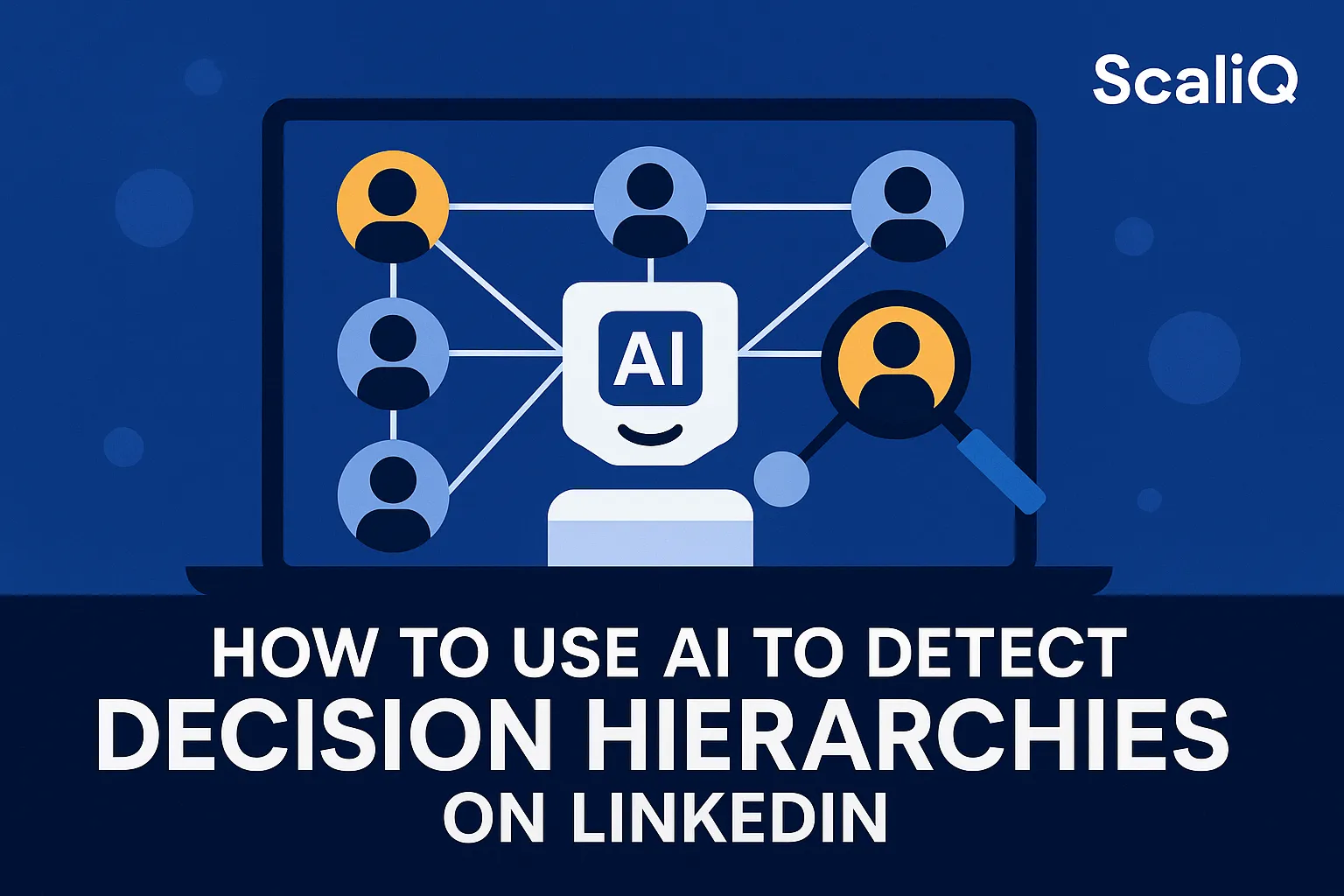
Translating LinkedIn signals into a usable account map requires a step-by-step methodology. AI serves as a system for clustering evidence, generating hypotheses, surfacing adjacent contacts, and scoring uncertainty.
Trustworthy AI should support human judgment, not replace it. Grounding these workflows in frameworks like the NIST AI Risk Management Framework ensures that AI account mapping handles uncertainty transparently. By leveraging Www.Notiq.Io for workflow orchestration, signals, enrichment, and validation steps can be seamlessly automated across your account research.
Step 1 — Start With a Seed Contact and Expand the Network
Account mapping begins with one known stakeholder. From there, the map widens to adjacent functions, likely approvers, and peers. AI recommends additional contacts based on title patterns, department proximity, geography, and function.
The goal of expansion is to uncover the full buying committee, prioritizing likely role diversity across the account rather than just accumulating a list of random names. This answers the core question of how to find the buying committee for a target account using intelligent LinkedIn stakeholder mapping.
Step 2 — Convert Raw Signals Into Role Hypotheses
Once the network is expanded, AI groups evidence into probable roles (economic buyer, technical evaluator, user buyer, champion, blocker).
A simple scoring framework includes evidence inputs, weight, confidence level, and rationale. AI must produce explainable hypotheses, not black-box labels. If the AI flags a contact as an Economic Buyer, it should note the specific combination of tenure, title, and scope that led to that conclusion. This transparency is vital for decision hierarchy linkedin analysis, decision-making unit detection, and sales intelligence stakeholder mapping.
Step 3 — Distinguish Authority From Influence
AI separately scores formal decision power and informal influence. This distinction matters deeply in enterprise sales: the person who signs the contract is rarely the only person who persuades the committee to buy.
For example, a Lead Architect may influence the technical evaluation heavily but lack final budget authority. Separating these scores allows teams to understand how to distinguish influence from authority on LinkedIn, driving smarter influence mapping and stakeholder mapping ai.
Step 4 — Add Confidence Scoring and Contradiction Handling
Confidence increases when signals align across multiple dimensions. Conversely, contradictory signals—such as a "VP" title but a very narrow geographic scope—should reduce certainty rather than be ignored.
By categorizing labels into low-, medium-, and high-confidence tiers, sales teams can navigate false-positive scenarios, like inflated startup titles or misleading profile descriptions. This robust confidence scoring for buying committee mapping is what elevates AI hierarchy detection vs org chart tools and standard sales intelligence AI.
Step 5 — Output a Dynamic Account Map, Not a Static List
The final deliverable is a dynamic visualization of relationships, role hypotheses, gaps, and risk areas. It includes role labels, confidence scores, evidence notes, and suggested next contacts.
Unlike static org charts that fail to capture hidden influence or uncertainty, a dynamic map is highly usable for sales, ABM, and leadership reviews. It transforms an organizational chart from LinkedIn into actionable AI account mapping and buying committee mapping.
How to Validate Champions, Blockers, and Budget Owners
Validation is where advanced revenue teams outperform competitors who blindly trust enrichment data. AI outputs must be verified before action is taken. Using CDC guidance on identifying influential stakeholders, we know that influence, proximity, and relationships matter deeply when validating allies, gatekeepers, and blockers.
Validate With Multi-Signal Cross-Checks
Before assigning a definitive role, compare title, function, tenure, visibility, and adjacent stakeholder patterns. One strong signal should not outweigh several conflicting weak signals without logical explanation.
Use evidence notes to document why a stakeholder was classified a certain way. If a "Director of Operations" is flagged as a potential champion, note the cross-functional project they recently led as validation. This multi-signal check refines decision hierarchy linkedin intelligence and LinkedIn org chart research for identifying true organizational decision makers.
Use Outreach as a Learning System
Outreach responses are the ultimate validation tool. Meeting participation, referral patterns, and specific objection types quickly reveal hidden authority structures.
If an assumed economic buyer redirects you to a technical lead, your map updates immediately. By integrating Blog, teams can see how personalized outreach tests stakeholder hypotheses, revealing who engages, forwards, or redirects conversations. This turns the ABM account research workflow into a living, iterative AI stakeholder mapping for B2B sales process.
Watch for False Positives and Blind Spots
Common mistakes include assuming the most senior title is the sole decision-maker, ignoring procurement until the final hour, underestimating technical reviewers, or missing regional approvers.
Hidden blockers are often more dangerous than visible champions. Red flags that lower map confidence include highly siloed departments, lack of cross-functional engagement, or rapid executive turnover. Mitigating single-threaded outreach risk requires mapping hidden stakeholders linkedin profiles and actively working to find champions blockers budget owners on linkedin.
Ethical Use of Public Professional Data
Public signals must be used for professional research and prioritization, not invasive profiling. Transparency, human review, and proportional use of inferred insights are non-negotiable.
Applying the NIST AI Risk Management Framework ensures your sales intelligence AI supports trustworthy, risk-managed decision support. Ethical data use is paramount when deploying stakeholder mapping ai.
How Better Account Maps Improve Multithreading and Personalization
Confidence-scored stakeholder maps directly improve account planning, outreach sequencing, and deal-risk reduction. As highlighted by buying group signals research, buying-group visibility improves demand and sales coordination.
Build a Multithreaded Outreach Plan by Role
Messaging must differ for economic buyers, technical evaluators, end users, and procurement. An accurate map helps sequence conversations strategically instead of blasting the exact same message to every stakeholder.
For example, outreach might begin with a User Buyer to validate a pain point, move to a Technical Evaluator to confirm integration capabilities, and finally approach the Economic Buyer with a validated business case. This strategic buying committee mapping and multithreading is the ultimate application of how to identify decision-makers on LinkedIn.
Improve Personalization With Role-Specific Hypotheses
Inferred role context creates dramatically stronger personalization than generic title-based messaging. Personalization should reflect the likely priorities, risks, and approval criteria specific to that stakeholder type.
Champion messaging should focus on enablement and internal promotion, whereas blocker messaging should proactively address risk mitigation and compliance. Leveraging decision hierarchy linkedin data via AI account mapping allows sales intelligence AI to craft hyper-relevant outreach.
Reduce Deal Risk by Identifying Gaps Early
A dynamic account map immediately reveals missing roles, low-confidence areas, and single-thread dependencies. Teams can prioritize accounts with complete, high-confidence maps while flagging incomplete accounts for further research.
Identifying these gaps early prevents late-stage deal collapse, tying the workflow directly to forecast quality and pipeline health. It eliminates single-threaded outreach risk through rigorous account mapping and decision-making unit detection.
Compare AI-Assisted Mapping to Traditional Sales Intelligence Workflows
Traditional sales intelligence relies on static lists and rigid org charts. Dynamic influence mapping, powered by AI enrichment, offers validation workflows, explainability, and confidence scoring.
By interpreting the spaces between the contacts, AI hierarchy detection vs org chart tools provides a massive strategic advantage. It elevates manual vs AI account mapping from mere data collection to actionable decision maker finder linkedin intelligence.
Practical Toolkit for Building a Decision Hierarchy Workflow
To operationalize this strategy, revenue teams need reusable assets and frameworks integrated into their account planning process.
Recommended Stakeholder Map Template
A practical template for sales and ABM teams should include:
• Name & Title: Baseline identity.
• Function & Geography: Scope indicators.
• Likely Role: Economic Buyer, Champion, Evaluator, etc.
• Authority Score (1-10): Formal signing power.
• Influence Score (1-10): Internal persuasion capital.
• Champion/Blocker Signal: Positive, Neutral, Negative.
• Confidence Level: Low, Medium, High.
• Evidence Notes: Why this hypothesis was formed.
This structure turns a standard LinkedIn stakeholder mapping exercise into a confidence scoring for buying committee mapping powerhouse, far superior to a basic organizational chart from LinkedIn.
Quick Validation Checklist Before Outreach
Bridge the gap between research and execution with this concise operational checklist:
1. Have we identified the likely budget owner?
2. Have we mapped the technical approval path?
3. Is procurement or compliance likely involved at this stage?
4. Do we have at least one high-confidence potential champion?
5. Where is our map's confidence lowest, and what outreach will test it?
This ensures you know how to find the buying committee for a target account, master champion and blocker identification, and execute flawless multithreading.
What to Measure After Implementation
Success is not measured by the number of contacts scraped; it is measured by stakeholder visibility and smarter sequencing. Track these outcome metrics:
• Account Coverage: Percentage of buying roles identified per account.
• Multithread Depth: Average number of engaged stakeholders per active opportunity.
• Response Quality: Rate of replies validating role hypotheses.
• Reduced Single-Thread Risk: Drop in late-stage deals lost due to unmapped blockers.
These metrics prove the maturity of your sales intelligence stakeholder mapping, AI stakeholder mapping for B2B sales, and overall B2B prospecting intelligence.