

Introduction
Most revenue teams already have warm engagement happening on LinkedIn, yet they continue to treat content likes as either vanity metrics or manual busywork. A like on its own is not a definitive buying signal, but it can become a highly useful early intent indicator when paired with AI, data enrichment, Ideal Customer Profile (ICP) fit, and intelligent routing logic.
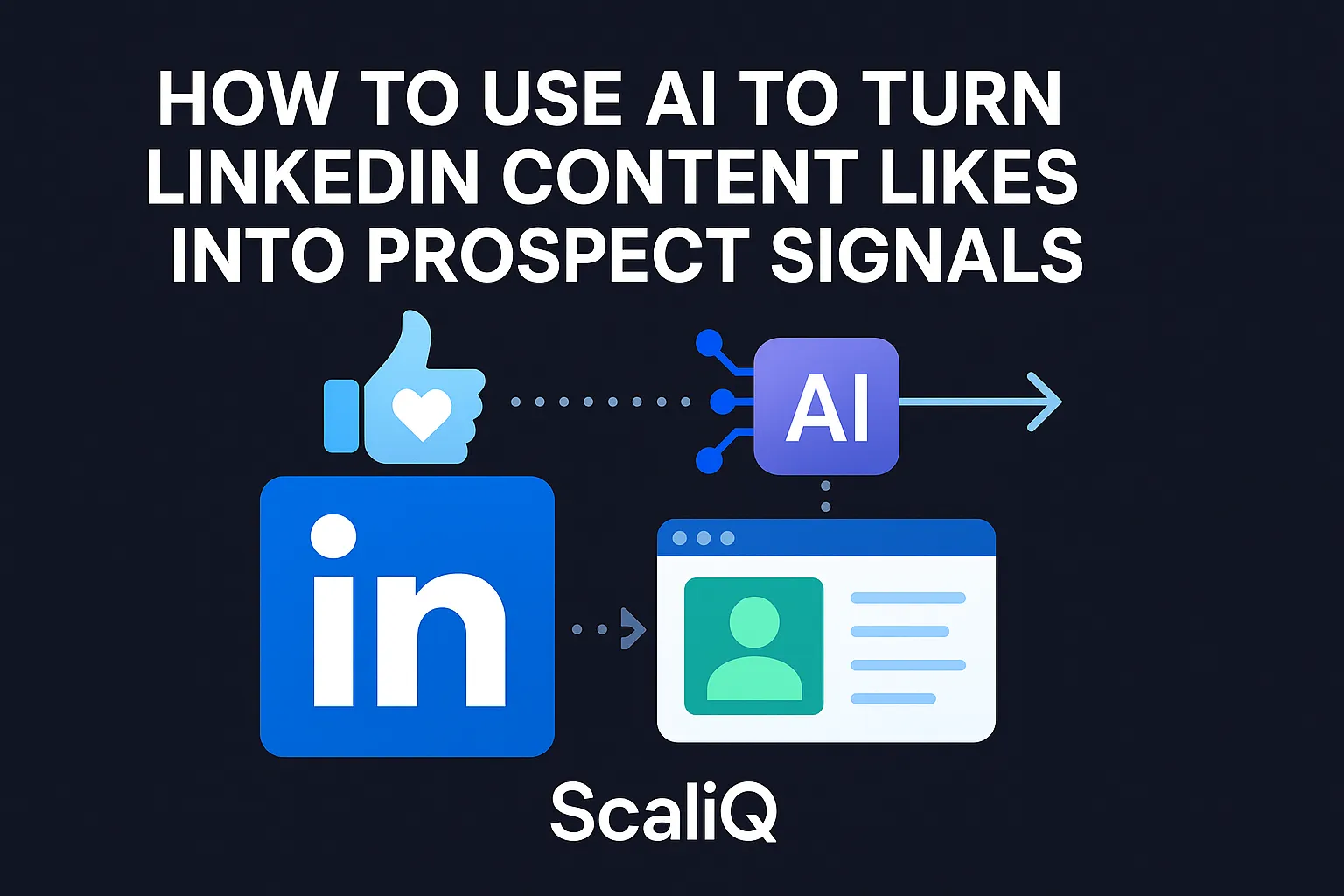
This is not a generic guide to LinkedIn lead generation; it is a tactical framework designed for revenue teams to convert lightweight engagement into ranked, actionable prospect signals. By operationalizing this data, you can build a system to capture the engager, classify the post topic, enrich the person and their company, score the signal, route it to the correct motion, and measure downstream performance.
For SDR leaders, Account Executives, demand generation marketers, and GTM operators, mastering this workflow bridges the gap between social awareness and pipeline generation. Drawing on ScaliQ’s deep experience in AI analysis, enrichment, prioritization, and outreach orchestration, this framework provides a practical lens for operationalizing social engagement into pipeline inputs. You can explore how ScaliQ transforms these workflows, or visit the Blog for related insights on GTM automation.
By strategically evaluating linkedin content likes prospect signals, you can stop guessing who is interested and start acting on engagement signals outreach that actually moves the needle. Decoding content likes linkedin generates is the first step toward a smarter, more efficient outbound engine.
Why LinkedIn Likes Matter as Early Intent Signals
To build a high-performing outreach engine, you must frame likes correctly: as useful early-stage engagement data, not final proof of purchase intent.
What a LinkedIn like actually signals
A LinkedIn like is a lightweight expression of attention, relevance, or agreement. It does not mean the prospect is ready to buy today. However, in modern B2B journeys where buyers self-educate extensively before ever speaking to sales, this early expression of interest is critical. There is a distinct difference between “interest in a topic” and “intent to buy now.”
When treated as first-party engagement data inside a broader signal stack, social engagement becomes highly actionable. According to research on LinkedIn engagement and B2B sales, early social interactions correlate strongly with meaningful business outcomes by establishing trust and brand familiarity long before a formal sales cycle begins. Tracking linkedin engagement signals allows teams to map buyer intent signals at the very top of the funnel.
Why likes are valuable despite being weak signals
Weak signals are valuable because they surface much earlier than demo requests, pricing page visits, or inbound form conversions. If your team waits exclusively for high-intent, bottom-of-funnel signals, you miss the opportunity to initiate warmer conversations earlier in the buying journey.
Speed is the ultimate advantage here. Social selling signals give reps the context needed to strike while a topic is top-of-mind. Likes are especially useful when your content is niche, problem-aware, and highly targeted to a defined ICP. Pairing these warm outreach triggers with prioritization logic improves pipeline coverage and overall SDR efficiency, upgrading standard linkedin lead generation into a precise, targeted motion.
Where likes fit in the intent hierarchy
Not all signals are created equal. A simple intent hierarchy looks like this:
1. Passive social engagement (likes, views)
2. Repeat engagement (comments, consistent interactions)
3. Website activity (pricing page visits, resource downloads)
4. Direct hand-raise behavior (demo requests, inbound messages)
Likes should trigger review or scoring, not automatic qualification. They serve as the middle layer between manual social selling advice and enterprise intent data platforms. While first-party social signals do not replace stronger downstream or third-party intent sources, they complement them perfectly. The B2B buying signals framework supports this approach, emphasizing the importance of interpreting signals based on their specific stage and context. By leveraging intent signals from content engagement, teams can fuel engagement-based lead scoring and drive smarter account-based prospecting.
How to Separate Vanity Engagement From Real Prospect Value
The biggest hurdle in utilizing social signals is filtering out the noise so that outreach is driven by relevance, not raw engagement counts.
The main reasons LinkedIn likes become noisy
False positives are the enemy of efficient prospecting. Common sources of noisy engagement include peers, recruiters, other creators, students, competitors, existing customers, and non-ICP followers. Viral or broad-interest posts often create a surge of engagement that looks promising on the surface but carries extremely low prospect value.
Manual review of these lists almost always fails because teams naturally optimize for volume rather than qualification. The problem is not capturing the signal; the problem is signal interpretation. Without a system to filter the noise, content likes linkedin generates will only clutter your linkedin prospecting workflows and hinder accurate prospect identification.
The filters that separate curiosity from sales relevance
An engagement only matters if both the person and the content context are highly relevant. To separate curiosity from sales readiness, implement practical filters:
• Role Relevance: Does this person have buying power or influence?
• Account Fit: Does their company match your target size and industry?
• Geography: Are they located in a region you serve?
• Post-Topic Alignment: Did they engage with a post about a specific pain point you solve?
You must also suppress low-value cohorts automatically (e.g., competitors, current customers). Finally, recency is a critical factor—social signals decay rapidly. A like from three months ago is useless for warm outreach based on linkedin activity. Proper filtering ensures accurate prospect identification and validates early buyer intent signals.
Questions your team should ask before acting on a like
Before routing a signal to an SDR or AE, pass it through a tactical qualification gate:
1. Is this person in our ICP?
2. Is the company a fit for our product?
3. Was the post related to a specific pain point we solve?
4. Is the engagement recent enough to act on?
5. Do we have enough context to personalize the outreach?
Defining clear ownership rules between marketing, SDR, and AE teams for these answers ensures that engagement signals outreach is handled efficiently. This structured approach turns raw social selling intent data into verified linkedin engagement signals.
AI’s role in filtering vanity engagement at scale
Manual filtering is unscalable. AI bridges this gap by automatically classifying post topics, inferring likely areas of interest, and summarizing exactly why an engager might matter to your sales team.
AI reduces manual list review by prioritizing only high-fit records, labeling engagers into actionable cohorts such as “low-fit awareness,” “mid-fit curiosity,” or “high-fit follow-up candidate.” While many tools focus on increasing engagement, AI focuses on converting that engagement into operational sales signals. Note that responsible AI classification must remain transparent and reviewable, never operating as an unexplainable black box. Using ai sales prospecting from social engagement refines engagement-based lead scoring and uncovers the most valuable social selling signals.
Scoring Engagers With Fit, Recency, and Content Context
To turn a chaotic list of likes into ranked opportunities, you need a resilient scoring framework.
The three dimensions of a useful engagement score
A minimum viable scoring model for most revenue teams relies on three core dimensions:
1. ICP/Account Fit: Tells you who matters.
2. Engagement Recency: Tells you when to act.
3. Content Context Relevance: Tells you how to personalize.
These three dimensions vastly outperform raw like counts. A single like from a target VP on a highly technical post today is worth more than fifty likes from students on a generic motivational post last week. Balancing these dimensions optimizes engagement-based lead scoring, driving highly effective account-based prospecting and accurately interpreting linkedin content likes prospect signals.
Add two more variables for a stronger model
To mature your model, add two additional variables: engagement depth and enrichment confidence.
Not all interactions carry the same weight. A like on a niche, problem-aware post signals deeper relevance than a like on broad thought leadership. Furthermore, enrichment confidence ensures you actually have the right contact data before triggering outreach. Establishing a scoring threshold based on these five variables determines whether a lead requires marketing nurture, SDR follow-up, or direct AE review. This depth transforms linkedin engagement signals for sales into reliable buyer intent signals and actionable warm outreach triggers.
Example scorecard for ranking LinkedIn engagers
A sample scoring rubric helps make this model concrete:
• ICP Fit: 0–40 points
• Recency: 0–20 points
• Topic Relevance: 0–20 points
• Engagement Depth: 0–10 points
• Enrichment Confidence: 0–10 points
Action Bands:
• 0–39: Ignore or monitor (e.g., a junior employee liking a broad post).
• 40–69: Marketing nurture (e.g., a target persona liking a post, but missing direct contact info or urgency).
• 70+: Sales follow-up (e.g., a VP at a target account liking a pain-point specific post yesterday).
According to an academic study on B2B purchase intention, timing, trust, and context matter significantly more than any single engagement action. A structured scorecard respects this reality, improving engagement-based lead scoring and validating prospect signals for better linkedin lead generation.
How AI can summarize post context for personalization
AI can analyze the specific post a prospect liked, extracting the core theme, the underlying pain point, and the likely angle of interest. For example, if a prospect "Liked a post about outbound personalization," AI can route that prospect to a specific outreach sequence focused on messaging quality rather than generic lead generation.
This summary powers better opening lines, sharper segmentation, and more accurate routing. AI should generate these suggestions for reps to review, rather than firing off fully autonomous, unreviewed emails. When you have scored the signal and summarized the context, you can seamlessly transition to personalized messaging. Tools like Repliq.Co excel at generating personalized outreach once these qualified signals are identified, maximizing the value of ai sales prospecting from social engagement, linkedin engagement signals, and warm outreach based on linkedin activity.
Enriching and Routing LinkedIn Engagers Into Outreach Workflows
A scored signal is useless without an operational system to drive action.
What enrichment should happen before outreach
Names and profile URLs are insufficient for sales action. Before a rep reaches out, the prospect must be enriched with critical data points: role, seniority, company, industry, headcount, geography, account ownership, and CRM status.
Crucially, enrichment identifies whether the engager is already an open opportunity, an existing customer, a disqualified lead, or an active sequence contact. This prevents embarrassing duplicate outreach and generic messaging. Thorough data enrichment is the backbone of accurate prospect identification and successful account-based prospecting.
The ideal workflow from like to next action
To build a repeatable operating model rather than a one-off campaign, follow this step-by-step workflow:
1. Capture the engagement.
2. Resolve the identity of the engager.
3. Classify the post topic.
4. Enrich the person and the account.
5. Score the signal based on the rubric.
6. Suppress bad-fit or restricted records.
7. Route qualified signals to the right owner.
8. Log the action in the CRM.
Human review should remain in the loop, particularly at the routing and messaging stages. Orchestrating this process requires a robust platform; ScaliQ serves as the ideal orchestration layer for capture, enrichment, scoring, and workflow routing, streamlining linkedin prospecting workflows and turning first-party engagement data into seamless engagement signals outreach.
How to route signals to SDRs, AEs, or nurture
Not every engager belongs in an outbound sequence. Implement strict routing rules:
• Named account + high-fit persona + recent relevant like: Route directly to AE or SDR for immediate follow-up.
• Good fit but low urgency/score: Route to marketing nurture.
• Non-ICP but engaged audience segment: Route to retargeting or content nurture.
Clear Service Level Agreements (SLAs) are vital here. Signal value decays quickly; if an SDR waits a week to act on a routed signal, the context is lost. Proper lead routing ensures that warm outreach triggers and social selling signals are capitalized on immediately.
Outreach principles for engagement-sourced prospects
Outreach must be context-aware. "I saw you liked my post" is a weak, low-effort message. Instead, use the engaged topic as a natural bridge into a pain point, a unique insight, or a relevant question. Avoid overclaiming intent or sounding invasive.
Use these message frameworks:
• Insight-led follow-up: Share a deeper perspective on the topic they liked.
• Resource-led follow-up: Offer a template or guide related to the post's theme.
• Account-specific hypothesis: Connect the post's topic to a challenge you suspect their specific company is facing.
Once a qualified signal is routed, leveraging Repliq.Co can automate the creation of these highly personalized frameworks. Contextual messaging is the key to mastering engagement signals outreach, warm outreach based on linkedin activity, and modern linkedin lead generation.
Compliance, privacy, and responsible AI considerations
All data extraction and engagement tracking must rely strictly on legal, publicly accessible information workflows. Teams must use social engagement data responsibly, transparently, and within internal governance standards.
Data minimization, auditability, human review, and clear suppression logic are non-negotiable. AI scoring models must be continuously monitored for accuracy and false positives. Trust increases when teams use engagement as a prompt to offer relevant value, not as proof of sensitive inference. Align your workflows with the NIST AI Risk Management Framework for scoring governance, and follow the OECD guidance on AI data governance and privacy to ensure ethical data handling. Prioritizing AI data governance and responsible AI safeguards your first-party engagement data.
Conclusion
A LinkedIn like is not strong intent by itself, but it transforms into a highly valuable prospect signal when paired with AI classification, data enrichment, fit scoring, recency tracking, and intelligent workflow routing.
The practical model is clear: filter the noise, score what actually matters, enrich the data before reaching out, route the signal quickly, and rigorously measure performance against cold outbound baselines. The winning approach is nuanced and trustworthy—do not overstate what a like means, but absolutely do not ignore the warm engagement already happening within your target audience.
For revenue teams ready to operationalize first-party social signals inside a scalable GTM workflow, the technology now exists to automate the heavy lifting. Discover how ScaliQ can build your signal-based prospecting workflows, and continue exploring advanced GTM automation strategies at Blog. Stop wasting content likes linkedin generates, and start turning them into actionable engagement signals outreach and verified linkedin prospect signals.