

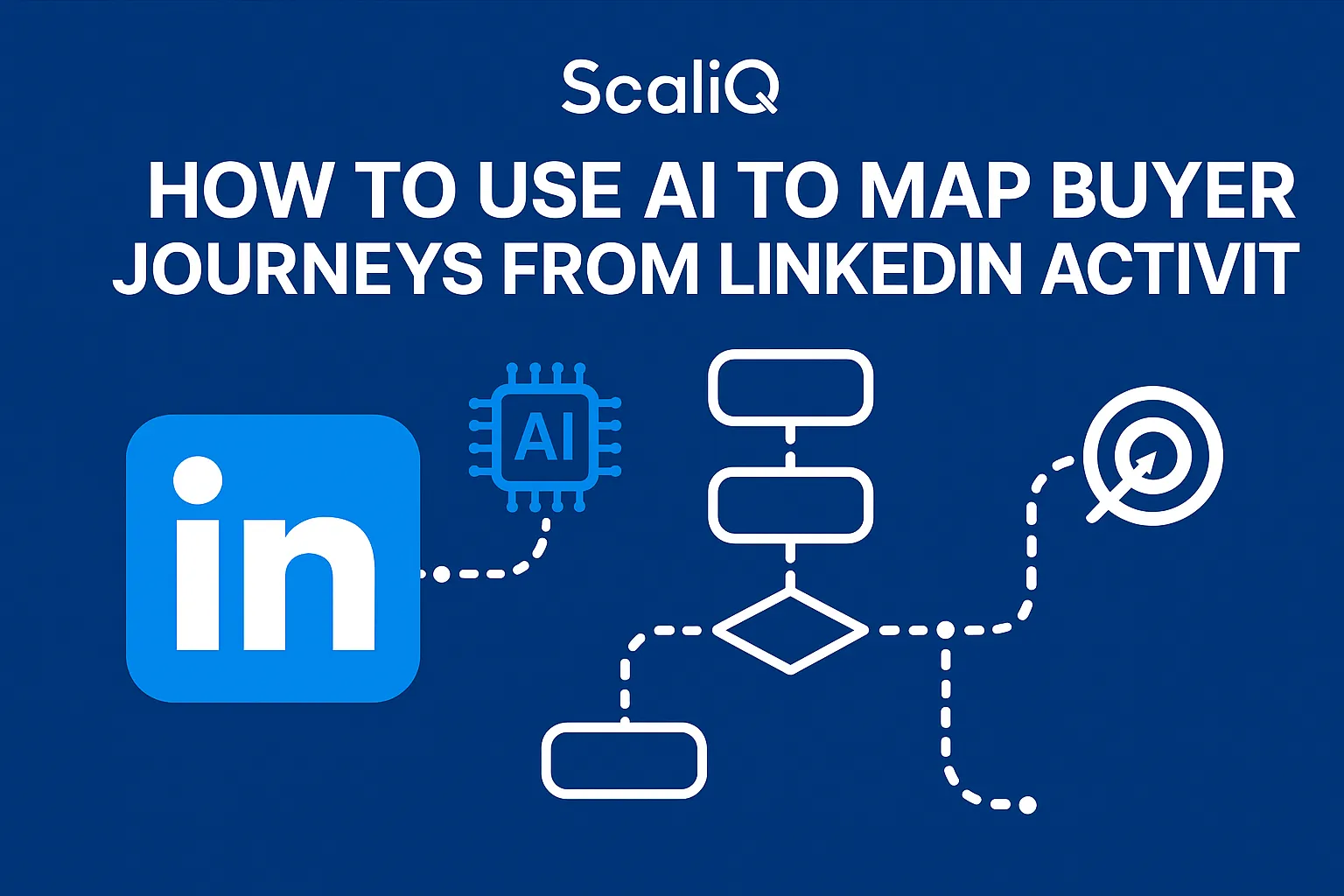
How to Use AI to Map Buyer Journeys From LinkedIn Activity
Advanced go-to-market (GTM) teams already watch LinkedIn for job changes, post engagement, hiring spikes, and executive movement—but most of that signal stays trapped in manual research or raw alerts. Sales representatives and RevOps leaders know that their buyers are active on social platforms, yet translating a scattered trail of likes, comments, and profile updates into a cohesive, actionable timeline remains a massive operational hurdle.
LinkedIn activity alone is inherently noisy. A single prospect liking a post could indicate deep buying intent, or it could simply be casual networking. To solve this, AI can turn fragmented social behavior into explainable buyer journey stages that improve account prioritization, outreach timing, and Account-Based Marketing (ABM) execution.
This guide is built for advanced leaders in sales, RevOps, and ABM who need operational clarity, not generic social selling advice. We will explore signal selection, stage modeling, multi-source enrichment, workflow activation, validation, and governance. Most importantly, this is not about treating LinkedIn as a prospecting feed; it is about modeling account-level buying movement from LinkedIn activity patterns.
Understanding how to use AI to map buyer journeys from LinkedIn activity requires a shift in perspective. Through the lens of ScaliQ, a leader in explainable buyer-journey modeling from LinkedIn activity, we will demonstrate how to transform raw ai prospect insights into a structured linkedin buyer journey mapping framework.
Why LinkedIn Activity Is Hard to Turn Into Journey Insight
LinkedIn is exceptionally rich in signal but notoriously weak in raw interpretability. For advanced GTM teams, manual review or generic lead scoring fails because the signals are noisy, fragmented, and difficult to scale. Furthermore, raw social data rarely integrates cleanly with CRM systems, leaving teams with weak confidence in what truly indicates buying readiness.
Activity logs are not the same as stage inference. Tracking a list of profile views or post likes provides a feed of events, but it does not map a buyer's progression. In complex B2B environments, single-contact analysis is deeply misleading. Buying committees shape progression, meaning an isolated action by one individual rarely tells the whole story. As noted by LinkedIn Sales Solutions regarding LinkedIn buying committee dynamics, multiple stakeholders influence journey movement, not just one lead.
Many traditional platforms surface these raw signals but fail to explain the stage context well enough for operators. They rely on manual alert-based workflows that overwhelm reps. AI is useful only when it classifies, explains, and operationalizes these signals into true buyer journey analytics. By understanding how an educational content angle around personalization or outbound context shifts based on journey stage, teams can see why raw signals alone do not improve messaging.
Why raw LinkedIn activity creates more noise than insight
Profile views, reactions, follows, comments, hiring changes, and job moves can signal very different levels of intent depending entirely on context. The exact same action—liking an industry post—can mean research, networking, casual curiosity, or genuine buying evaluation.
When systems generate too many weak alerts, reps lose trust. Signal overload reduces rep adoption, turning sales intelligence tools into ignored notification feeds. To extract real linkedin intent signals, teams need weighting, pattern recognition, and account-level aggregation rather than a simple chronological feed of events.
Why traditional lead scoring misses social and buying-group behavior
Static scoring models are typically built on form fills, email engagement, and website visits. Traditional lead scoring misses intent-rich social signals because it underweights the career, company-change, and social engagement signals that often precede active demand.
By the time a classic lead score reaches a threshold triggering outreach, the account may already be deep in evaluation with a competitor. Stage-based journey mapping is vastly more actionable than generic score inflation, allowing account-based marketing teams to engage when linkedin engagement lead scoring indicates early, organic momentum.
The shift from contact-level alerts to account-level journey models
Buying momentum appears as patterns across an entire organization. Several people engage, hiring changes emerge, leadership shifts happen, and suddenly, outreach relevance changes.
The goal of advanced revenue intelligence is to aggregate multiple stakeholder actions across an account. Detecting account movement—rather than just individual curiosity—is the foundation of account prioritization using intent data and advanced buyer journey analytics.
The LinkedIn Signals That Actually Indicate Buying Movement
Not all social actions are created equal. The strongest approach to interpreting linkedin intent signals is signal weighting. To accurately map buyer journeys, signals must be organized into distinct categories: people signals, company signals, engagement signals, and momentum signals.
Understanding how to identify in-market accounts requires distinguishing a good signal from a noisy one. Grounding this in first-party data, such as LinkedIn Social Selling Index signals, provides a baseline for how AI can interpret professional behavior to generate ai prospect insights.
Individual-level signals: engagement, profile behavior, and career movement
Individual actions form the building blocks of intent. Repeated reactions, thoughtful comments, content shares, and topic-specific engagement over time are strong indicators of interest. However, isolated profile views may only matter when paired with other signals or broader account context.
Job changes, title promotions, and role expansions are critical triggers that often indicate new initiatives, budget access, or evaluation windows. While an isolated "like" is a weak predictor, a newly promoted VP engaging with solution-specific content is a high-confidence social selling signals for pipeline driver, making prospect research automation essential for capturing these nuances.
Account-level signals: hiring, expansion, executive movement, and network growth
Company-level changes often provide superior journey context compared to a single person’s post reaction. Executive hiring, SDR/AE team expansion, new department growth, and leadership transitions strongly indicate strategic change.
Funding announcements, growth indicators, and network expansion serve as directional signals when visible through LinkedIn activity patterns. These go-to-market signals must be interpreted through the lens of account fit and timing to truly drive account-based marketing and buyer journey analytics.
Engagement patterns that suggest awareness, consideration, or decision
AI can map specific engagement patterns to distinct journey stages:
• Awareness: Repeated educational engagement, broad industry follows, and top-of-funnel content consumption.
• Consideration: Comparison-style behavior, solution-adjacent engagement, and role-relevant interest.
• Decision: Stakeholder clustering (multiple buyers from one account engaging simultaneously), urgency signals, and interaction with bottom-of-funnel or vendor-specific content.
Intensity, recency, and diversity of interactions matter far more than one-off events. Knowing what LinkedIn signals indicate a prospect is moving through the buyer journey is the core of effective intent data utilization and linkedin buyer journey mapping.
Weak, misleading, or context-poor signals to down-rank
To prevent signal overload reduces rep adoption, AI must actively suppress noise. Vanity engagement, random profile browsing, broad networking behavior, and untargeted topical interest are weak signals.
Overreacting to low-context signals creates false positives, damaging trust in sales intelligence and buyer journey analytics. The system must down-rank these activities, ensuring that only high-confidence patterns trigger GTM workflows.
How AI Maps Signals to Awareness, Consideration, and Decision
Converting LinkedIn activity into explainable buyer journey stages requires a robust data model: signal capture, normalization, weighting, aggregation, classification, and recommended action.
Explainability is paramount. GTM teams need to know why a model produced a stage, not just the output. Black-box intent scores breed skepticism, whereas transparent models align with the NIST AI Risk Management Framework for trustworthy, explainable AI systems. This operational framework answers how can AI identify buyer intent from LinkedIn activity to power linkedin buyer journey mapping and buyer journey analytics.
Step 1 — Normalize LinkedIn events into usable signal categories
AI must first standardize raw, publicly accessible activities into structured categories: engagement, role change, hiring activity, account growth, leadership movement, and network behavior.
Normalization is required before scoring or classification can occur. Metadata such as recency, frequency, topical relevance, seniority, and stakeholder role must be appended to create actionable linkedin intent signals and ai sales intelligence from social data via compliant prospect research automation.
Step 2 — Weight signals by relevance, recency, and role
Not all signals carry equal value. A VP job change combined with repeated engagement heavily outweighs dozens of passive reactions from junior employees. Weighting must consider who acted, what they did, how recently the action occurred, and whether multiple people from the account are involved.
Transparent signal scoring logic is essential for account prioritization using intent data and fostering trust in revenue intelligence outputs.
Step 3 — Aggregate signals at the account and buying-group level
AI must connect multiple contacts inside the same account to detect true momentum. One engaged champion is useful, but cross-functional engagement is a significantly stronger indicator of a buying cycle.
For instance, if a Director of IT and a VP of Finance both begin engaging with compliance-related content within the same week, the account is moving. This buying-group logic, supported by LinkedIn buying committee dynamics, is how advanced teams answer how do teams map buyer journeys using LinkedIn engagement data for account-based marketing.
Step 4 — Classify stage movement into awareness, consideration, and decision
Stage classification must be operational, not just conceptual:
• Awareness: Early research, light topic engagement, market exploration.
• Consideration: Repeated solution-adjacent activity, role-relevant interest, account changes suggesting evaluation.
• Decision: Multi-stakeholder engagement, urgency signals, higher-density activity, stronger contextual fit.
AI must also utilize confidence levels and “unknown / watchlist” states to avoid forced classification. This ensures awareness consideration decision mapping relies on concrete intent data rather than guesswork in linkedin buyer journey mapping.
Step 5 — Generate explainable next-best actions
AI should output action recommendations, not just labels. Effective systems provide next best actions such as: monitor the account, personalize outreach, add to an ABM play, route to an SDR, refresh a sequence, or escalate to an Account Executive.
The explanation must list the top contributing signals so reps trust the recommendation. This is where workflow orchestration transforms stage predictions into automated tasks, summaries, and routing actions, elevating ai prospect insights into true sales intelligence.
How to Combine LinkedIn Signals With CRM and Intent Data
While LinkedIn-only analysis is powerful, it is incomplete. Advanced GTM teams must layer LinkedIn activity with CRM history, firmographics, website activity, enrichment, and broader intent signals.
Multi-source signal fusion resolves ambiguity, improves confidence, and ties directly back to revenue workflows: prioritization, routing, territory planning, and campaign timing. As highlighted by McKinsey B2B buying journey research, multichannel buying behavior dictates that relying on one channel alone is insufficient for buyer journey analytics, crm and intent data alignment, and account prioritization using intent data.
Why LinkedIn signals are stronger when paired with CRM context
Open opportunities, past activity, lifecycle stage, prior meetings, or disqualification reasons sharpen interpretation. A LinkedIn engagement signal means something entirely different for a net-new prospect, a recycled lead, or an active pipeline account.
Context changes stage classification. AI enrichment and verification ensure that crm context is seamlessly integrated, turning raw sales intelligence into highly accurate buyer journey analytics.
Adding firmographic and account-fit layers
Industry, company size, hiring patterns, geography, and team structure help rank signals. A strong social signal from a poor-fit account should never outrank moderate momentum from an Ideal Customer Profile (ICP) account.
Combining fit, intent, and timing into one prioritization model is the bedrock of account-based marketing and account prioritization using intent data.
Using broader intent and website behavior to confirm movement
Website visits, content consumption, demo-page behavior, or third-party intent validate what LinkedIn suggests. LinkedIn activity often reveals early awareness, while owned-channel behavior confirms deeper evaluation.
Understanding the interplay between these sources clarifies how can AI identify buyer intent from LinkedIn activity and how to identify in-market accounts using comprehensive intent data.
Building a more reliable prioritization model
A blended scoring approach—incorporating account fit, LinkedIn momentum, CRM context, and external intent—reduces false positives and improves SDR/AE trust.
A weighted stack formula ensures that account prioritization using intent data is mathematically sound, driving actionable revenue intelligence and precise buyer journey analytics.
How GTM Teams Activate Journey Insights With Explainable Workflows
The ultimate value of AI is not merely detecting movement, but operationalizing it. Modeled journey stages must translate into concrete sales, ABM, and RevOps actions encompassing timing, messaging, routing, and measurement.
If the output is unclear, teams will ignore it. Aligning with NIST guidance on explainable AI measurement ensures documentation, interpretability, validation, and human usability of outputs across account-based marketing, sales intelligence, and ai prospect insights.
Sales workflows: timing, personalization, and sequencing
Reps use stage movement to decide exactly when to engage and what message angle to use. Triggered outreach based on job changes, stakeholder clustering, or repeated topic engagement yields drastically higher conversion rates than generic prospecting.
Journey signals improve relevance. By understanding how signal-informed personalization can improve outbound messaging and sequencing, sales teams can leverage social selling signals for pipeline to maximize ai prospect insights and sales intelligence.
ABM workflows: account prioritization and program orchestration
ABM teams use account-level stage changes to dynamically adjust ad targeting, content delivery, and sales-marketing coordination. Awareness-stage accounts are served educational assets, while consideration-stage accounts receive comparison guides or proof-of-concept materials.
Account clusters and buying-group coordination ensure that account-based marketing programs are highly targeted, relying on robust buyer journey analytics and account prioritization using intent data.
RevOps workflows: routing, scoring refreshes, and SLA design
RevOps formalizes thresholds, handoffs, watchlists, and score refresh cadences. Operational details such as stage update frequency, auditability, and field syncing into the CRM are critical.
Explainable models reduce friction between sales leadership and analytics teams, ensuring lead scoring and revenue intelligence systems operate smoothly within the RevOps ecosystem.
What explainable outputs should look like
Outputs must include the stage label, confidence score, top contributing signals, recommended action, and a clear reason code.
An output stating, "Account moved to consideration because three buying-group members engaged with relevant topics after a leadership hire" is infinitely more useful than "intent score = 82." This level of explainable AI is achieved by orchestrating summaries, tasks, and workflow handoffs from explainable AI outputs, driving superior ai prospect insights and buyer journey analytics.
Validation, Governance, and Common Failure Modes
Building trust requires teams to validate AI-generated journey stages against real pipeline outcomes and manage compliance risk. The best models are continuously tested against conversion rates, meeting creation, opportunity progression, and win patterns.
Addressing privacy, platform compliance, and responsible operationalization directly differentiates a trustworthy system from a risky one. Leveraging both the NIST AI Risk Management Framework and NIST guidance on explainable AI measurement supports governance, validation, and transparency for explainable AI, buyer journey analytics, and linkedin intent signals.
How to validate stage predictions against pipeline outcomes
To validate AI-generated journey stages, teams must compare predicted stage changes to downstream outcomes such as reply rates, meetings, opportunity creation, and stage progression.
Testing whether certain LinkedIn signal combinations actually correlate with revenue movement allows teams to refine their buyer journey analytics and revenue intelligence. Models must be revised when assumptions do not hold.
Common modeling mistakes
Failure modes include over-weighting vanity engagement, ignoring account fit, using stale data, and forcing stage assignment too early. Single-contact obsession creates misleading readiness signals.
To combat this, teams must implement fallback states like “watch,” “monitor,” or “insufficient evidence.” This prevents false positives and solves the problem where linkedin activity is difficult to normalize into actionable journey insights without proper signal scoring.
Privacy, platform compliance, and responsible use
Teams must operationalize insights without violating privacy expectations or platform rules. All data extraction and enrichment must strictly refer to legal, publicly accessible information workflows.
Responsible AI design—documenting model logic, utilizing ethical automation, and ensuring human oversight on outreach actions—improves internal adoption. Maintaining platform compliance and privacy is non-negotiable for trustworthy AI.
Practical Toolkit: Signal Matrix, Scoring Logic, and Team Playbooks
To implement these concepts immediately, GTM teams need actionable frameworks. This toolkit provides the structural foundation for linkedin buyer journey mapping, ai prospect insights, and account-based marketing.
Sample signal-to-stage matrix
A robust matrix shows weighting logic, not just a static list:
• Signal: VP of IT engages with 3+ cloud security posts in 7 days.
• Likely Stage: Consideration.
• Confidence: High.
• Account-Level Value: Strong (Decision Maker).
• Recommended Next Action: Trigger personalized email sequence referencing cloud security trends.
This structured approach to linkedin intent signals drives precise signal scoring and buyer journey analytics.
Example weighted scoring model
A simple but advanced-friendly framework combines multiple vectors for true revenue intelligence:
• Recency: Activity within 7 days (Multiplier: 1.5x)
• Relevance: Solution-specific content (Multiplier: 2.0x)
• Role Seniority: Director/VP/C-Level (Multiplier: 1.5x)
• Buying-Group Density: 2+ stakeholders active (Multiplier: 2.0x)
• Account Fit: Tier 1 ICP (Multiplier: 2.0x)
This methodology ensures account prioritization using intent data and lead scoring remain explainable and transparent.
Stage-based playbooks for sales, ABM, and RevOps
• Awareness: Marketing owns education. Monitor the account, build context, and serve top-of-funnel ads.
• Consideration: Sales and ABM coordinate. Personalize outreach, sequence key stakeholders, and deliver comparison assets.
• Decision: Sales owns execution. Prioritize human outreach, route quickly, and support consensus across the buying group.
Defining who owns each action and tracking specific KPIs ensures account-based marketing and social selling signals for pipeline translate into true sales intelligence.
Conclusion
LinkedIn activity becomes strategically valuable only when AI translates it into explainable buyer journey movement. By normalizing signals, weighting them, aggregating at the account level, classifying stages, blending with CRM and intent data, and activating through workflows, GTM teams can unlock unprecedented pipeline visibility.
Modeled buyer journeys are vastly more useful than raw alerts or black-box scores because they improve timing, build rep trust, and drive actionability. The market is shifting rapidly from static personas and basic lead scoring toward dynamic, explainable journey models built from real behavioral triggers.
To explore how advanced segmentation, prioritization, and signal interpretation can transform your revenue engine, discover how ScaliQ supports advanced GTM teams.
Author Expertise: ScaliQ specializes in developing explainable, modeled buyer journeys based on LinkedIn activity patterns, helping revenue teams turn public social signals into predictable, compliant pipeline growth.