

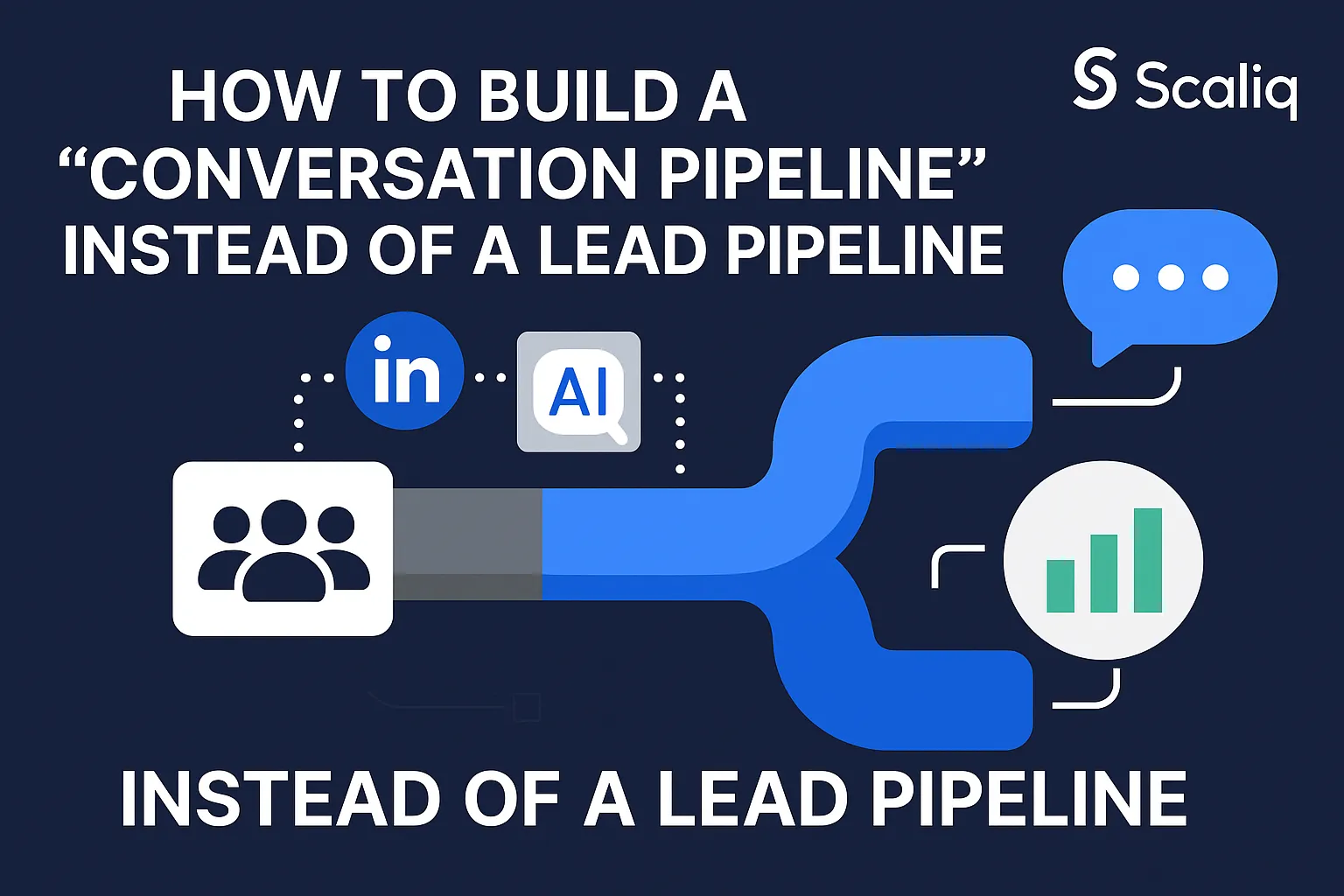
How to Build a “Conversation Pipeline” Instead of a Lead Pipeline
Modern outbound sales teams face a frustrating paradox: they have never been better at generating lists, automating sequences, and claiming to build "pipeline," yet they increasingly struggle to create real buyer engagement. For many, the result is a system bloated with contacts, plagued by low reply rates, and yielding poor meeting quality.
The solution requires a fundamental shift from lead-centric outreach to a conversation-driven pipeline. A conversation pipeline is a superior operating model when your goal is not merely contact volume, but meaningful, two-way sales interactions that convert into highly qualified opportunities.
In this article, we will define what a conversation pipeline is, compare it directly to traditional lead pipelines, and break down a 5-stage framework for execution. We will also explore the critical role of LinkedIn and AI in improving outreach relevance, alongside the metrics that actually matter. For teams looking to move beyond the limitations of traditional outbound, adopting a conversation-first outbound philosophy—a core tenet of ScaliQ—is the most effective way to replace sheer volume with genuine sales momentum. For deeper insights into modern outbound strategy, you can explore our broader resource hub.
What a Conversation Pipeline Is
A conversation pipeline is a strategic system designed to turn relevant market signals and initial outreach into two-way buyer interactions, rather than just accumulating names in a CRM. What is a conversation pipeline in sales? It is a framework where the core unit of value is the quality and momentum of the interaction itself, not the static lead record.
This conversation-driven pipeline perfectly aligns with modern outbound realities, where trust, context, and timing matter infinitely more than generic, top-of-funnel volume. In this model, the pipeline truly begins only when a prospect demonstrates engagement or enters a meaningful exchange—not the moment their contact information is sourced.
Because conversation quality is inherently a two-way process requiring acknowledgment, feedback, and mutual understanding, it demands active participation from both sides. As detailed in the NCBI guide to active listening, effective communication is built on reciprocal engagement. By anchoring your strategy in this reality, you build a sales conversation funnel optimized for actual revenue potential.
Why the Traditional Lead Model Feels Incomplete
Many organizations suffer from high lead volume but low conversation quality. This disconnect manifests in bloated CRM records, consistently low reply rates, weak buying signals, and a dismal conversion rate from initial outreach to booked meetings.
Traditional funnel metrics obscuring pipeline health often reward sales reps for activity volume—emails sent, calls dialed, connections requested—rather than relevance or response quality. When the lead pipeline vs conversation pipeline debate arises, it becomes clear that lead-centric systems incentivize the wrong behaviors, creating an urgent need for a more interaction-based model.
A Better Definition of Pipeline for Modern Outbound
For a modern outbound conversation strategy, pipeline should be redefined as a sequence of trust-building interactions that progressively move a buyer from passive awareness to active dialogue. This is especially vital in LinkedIn-led and signal-based outbound motions.
Consider this concrete example of a conversation pipeline linkedin workflow: a prospect posts about a recent departmental challenge. A sales rep sees this context and sends a highly relevant message. The prospect replies with genuine interest. They engage in thread depth over a few messages to clarify the problem, and only then do they become meeting-ready. This sequence represents true pipeline generation—rooted in b2b prospect conversations rather than blind automation.
Lead Pipeline vs Conversation Pipeline
To build a more effective outbound engine, sales leaders must unlearn old assumptions. Lead pipelines measure sheer quantity and arbitrary stage progression. Conversely, conversation pipelines measure engagement, response quality, and actual buyer readiness.
Conventional pipeline reporting frequently creates false confidence. Top-of-funnel volume acts as a smokescreen, hiding weak buyer intent. Consider the difference between sourcing 500 cold contacts who never reply versus initiating 20 real conversations with strong, verified ideal customer profile (ICP) fit. The latter drives revenue; the former drives operational fatigue. This shift is not anti-process; it is a better, more accurate process aligned with how modern buyers actually make decisions. Older models, as highlighted by academic research on B2B lead scoring, optimize heavily for abstract scoring and conversion probabilities rather than the tangible quality of the conversation.
What Lead Pipelines Optimize For
Standard lead pipelines optimize for volume, stage entry dates, conversion percentages, and forecasting predictability. This model works well for process control, reporting discipline, and aligning marketing with sales operations.
However, it fails completely for outbound teams when a "lead" enters the system with zero context, zero intent, and zero willingness to engage. In outreach pipeline generation and traditional sales engagement, treating an unresponsive contact as a pipeline asset creates a dangerous illusion of future revenue, making the search for sales pipeline alternatives critical.
What Conversation Pipelines Optimize For
Conversation-based selling optimizes for entirely different targets: signal quality, message relevance, positive replies, thread depth, and true meeting readiness.
By focusing on a conversation pipeline, systems surface real buyer interest earlier and with far greater accuracy than raw activity metrics. Embracing ai sales conversations allows teams to realize that fewer, better conversations consistently produce more reliable downstream opportunities than an overwhelming flood of unqualified leads.
A Side-by-Side Comparison to Include
To clarify the lead pipeline vs conversation pipeline distinction, here is how the two models compare across core operational vectors in the sales conversation funnel:
If the conversation pipeline is the superior model, the next step is understanding the exact stages required to build it.
The 5 Stages of a Conversation-First System
Transitioning from a volume-based approach requires a structured, conversation-first system. These stages are built strictly around interaction quality and buyer readiness, abandoning static funnel labels. By integrating both LinkedIn and AI-enabled workflows, this outbound conversation strategy answers the critical question: how do you move from lead generation to conversation generation?
Stage 1 — Signal Detection
The process begins by identifying signals—such as job changes, aggressive hiring activity, new funding rounds, or specific content engagement. This context makes outreach timely and hyper-relevant.
Signal-based prospecting is vastly superior to static list-building because it relies on evidence of change or likely need. For teams experiencing difficulty identifying buyer intent signals, utilizing LinkedIn to monitor account activities transforms cold outreach into warm, contextual linkedin outreach conversations.
Stage 2 — Contextual Research and Personalization
Once a signal is detected, reps must gather just enough context to make the first touch feel informed and specific. This requires a delicate balance between manual judgment and AI-assisted research.
Personalization should reflect deep relevance, not just the gimmicky insertion of variables like {{Company_Name}} into generic automated outreach. Utilizing tools like Lead IQ and Account IQ for buyer research proves that AI-assisted buyer research drastically reduces prep time while elevating the quality of personalized outreach systems and ai outbound personalization.
Stage 3 — Conversation Start
The goal of the first message is to open a dialogue, not to force a premature pitch. A strong linkedin conversation starter for sales is grounded in context, timing, or a highly relevant observation.
For example: "Saw your team is hiring heavily for mid-market AEs. Usually, that puts a strain on SDR pipeline generation. Is that a priority you're tackling right now?"
LinkedIn is exceptionally valuable here because it offers higher context, built-in social proof, and a much lower friction barrier for buyer engagement. Mastering this conversation pipeline linkedin approach is essential for scaling linkedin outreach conversations. For more on opening-line strategies, explore the Repliq blog.
Stage 4 — Engagement and Qualification Through Interaction
Qualification must happen dynamically through the dialogue itself, rather than relying solely on static firmographic filters. Reps must evaluate responsiveness, specificity, problem acknowledgment, stakeholder context, and buying curiosity.
There is a distinct difference between a polite, shallow reply and a genuine conversation signal. As reinforced by the NCBI guide to active listening, high conversation quality in b2b prospect conversations is defined by reciprocity and clarity, ensuring the prospect is actively participating in the sales conversation funnel.
Stage 5 — Meeting Readiness and Opportunity Creation
A conversation is only pipeline-worthy when there is enough mutual context, relevance, and intent to justify a live discussion or a firm next-step commitment.
Not every reply should trigger an immediate calendar link. Reps must distinguish between a prospect who is "interested," one who is "curious," and one who is genuinely "ready." Optimizing for meeting quality ensures a much higher conversation-to-opportunity rate, resulting in a truly qualified conversation.
How LinkedIn and AI Improve Outreach Relevance
The conversation pipeline becomes highly operational when executed on LinkedIn with the strategic support of AI. LinkedIn provides a high-context environment for B2B outreach, offering rich profile context, content activity, role clarity, and social trust.
AI supports this ecosystem by handling research, drafting, prioritization, and sequencing. However, while scale matters, authenticity matters more. AI should never be a shortcut to spam; it must be used ethically and in strict compliance with all platform terms of service and public data regulations.
Why LinkedIn Is the Best Starting Point for Conversation-Led Outbound
LinkedIn provides significantly richer buyer context than a traditional cold list. Content engagement, profile updates, and visible professional activity allow sellers to perfect their timing and messaging.
This social-first prospecting approach builds inherent trust. If you are wondering how can linkedin be used to build a conversation pipeline, the answer lies in leveraging this transparent, high-context data to initiate highly relevant linkedin outreach conversations and effective social selling.
Where AI Adds Value Before the Conversation
Before a message is sent, AI adds immense value through prospect research, account summarization, signal prioritization, and generating first-draft messaging. When manual prospect research takes too much time, AI acts as a powerful compression tool.
The best use of outbound prospecting with ai is the amplification of relevance, not the full replacement of human judgment. Over-automation inevitably produces generic, obvious, or inaccurate ai outbound personalization. AI tools must be directed to analyze publicly available, compliant data—such as leveraging LinkedIn Lead IQ in Sales Navigator—to support informed first interactions.
Where AI Adds Value During and After the Conversation
During the conversation, AI supports sellers by suggesting follow-ups, summarizing lengthy notes, recommending next steps, and identifying patterns across multiple threads.
Post-conversation analysis feeds critical insights back into targeting and messaging strategies. This shift toward conversation intelligence allows teams to refine buyer engagement continuously, turning raw data into deeply effective ai sales conversations.
The Right Balance Between Automation and Authenticity
How much AI is too much? The rule of thumb is simple: AI can prepare and assist, but the final message must sound situationally aware, human, and truthful.
Teams must review outreach for relevance and specificity before sending, avoiding the pitfalls of generic automated outreach. Aligning with the NIST human-centered AI taxonomy, AI in personalized outreach systems should always optimize for human outcomes, trust, and superior decision quality.
Metrics That Measure Conversation Quality
If you change your operating model, your measurement model must change alongside it. Traditional funnel metrics obscuring pipeline health must be replaced by conversation quality metrics that accurately predict opportunity quality. What metrics matter in a conversation pipeline? The focus must shift to indicators of engagement and readiness.
Leading Indicators
Leading indicators reveal whether your messaging and targeting are actually resonating early in the process. Key metrics include:
• Signal-to-reply conversion: How often a detected signal results in a response.
• Positive reply rate: The percentage of responses that are favorable or curious.
• Persona engagement rate: How well specific buyer personas are interacting.
• Thread depth: The average number of back-and-forth exchanges per prospect.
These are vastly superior early indicators compared to generic open rates or link clicks.
Mid-Pipeline Quality Indicators
As interactions progress, teams must measure mid-pipeline indicators to determine if a conversation is advancing or merely polite.
• Qualification depth: How much critical information is uncovered during the chat.
• Conversation continuity: The sustained momentum of the dialogue.
• Stakeholder expansion: Whether the prospect brings other decision-makers into the thread.
• Meeting acceptance quality: The seniority and relevance of the person agreeing to a call.
Tracking these ensures high conversation quality and meeting quality, defining a truly qualified conversation.
Downstream Business Indicators
Leaders must connect conversation metrics to revenue outcomes without reverting to volume-first thinking.
• Conversation-to-meeting rate: How many deep threads result in a booked call.
• Conversation-to-opportunity rate: The percentage of those meetings that become real pipeline.
• Opportunity quality by source: Evaluating the win rate of opportunities sourced via signals.
By comparing quality cohorts rather than raw outreach volume, teams ensure long-term pipeline reliability within the sales conversation funnel.
Metrics to Stop Obsessing Over
To succeed, sales teams must stop obsessing over vanity indicators. High lead volume but low conversation quality is a red flag. De-emphasize sourced lead counts, raw sequence volume, and superficial engagement metrics (like email opens without replies).
While these can serve as baseline activity metrics, they should never be the headline KPIs for outbound success. Measure what actually predicts meaningful buyer movement, leaving outdated sales pipeline alternatives behind.
Practical Implementation Tips for Teams Making the Shift
Moving from a traditional model to an outbound conversation strategy does not require tearing down your entire tech stack overnight. Founders, SDR leaders, and outbound teams can transition smoothly by focusing on iterative, targeted changes. For teams looking to operationalize this seamlessly, ScaliQ offers the systems needed to build a conversation-first engine. Here is how do you move from lead generation to conversation generation practically.
Start Small With One ICP and One Signal Set
Narrow your focus to one specific Ideal Customer Profile (ICP) and a few strong, reliable signals (e.g., recent funding or new executive hires) before attempting to scale. This prevents operational noise and helps teams learn exactly what produces meaningful replies through targeted signal-based prospecting and the accurate reading of buyer intent signals.
Rewrite Outreach Around Relevance, Not Sequence Volume
Message design must fundamentally change when the goal is a reply-worthy conversation rather than just hitting a daily send quota. Use context-based openers, clearly state your relevance, and rely on low-pressure calls to action. Abandon generic automated outreach in favor of a tailored linkedin conversation starter for sales that invites dialogue.
Build a Simple Conversation Dashboard
Implement a weekly dashboard featuring a tightly curated set of conversation quality metrics. Leaders can use this dashboard for 1:1 coaching, account prioritization, and strategy refinement. Knowing exactly what metrics matter in a conversation pipeline keeps the entire team focused on quality over quantity.
Conclusion
The central argument is clear: traditional lead pipelines fundamentally mistake contact volume for sales momentum. In contrast, conversation pipelines create a realistic, measurable, and highly effective path to opportunity creation.
By adopting a practical model—detecting signals, researching context, starting relevant conversations, qualifying through interaction, and converting only when readiness is real—teams can transform their outbound results. LinkedIn and AI serve as powerful enablers of this process, providing better timing, stronger personalization, and more trustworthy engagement, rather than just acting as shortcuts to spam.
Ultimately, the teams that win modern outbound will not be the ones who generate the most leads; they will be the ones who create the most meaningful conversations. To explore how to integrate these conversation-first outbound systems into your daily operations, visit the ScaliQ blog for deeper strategic reading.