

How to Use AI to Identify “Network Clusters” for Better Targeting
Most outbound teams still segment by firmographics, titles, and static ideal customer profile (ICP) filters—yet the real buying motion often happens inside relationship patterns those lists never show. For modern go-to-market (GTM) teams, large total addressable markets (TAMs), noisy prospect lists, hidden buying groups, and low reply rates frequently stem from one critical gap: missing relational context.
This guide explores how AI can identify LinkedIn network clusters, turn them into actionable targeting segments, and fundamentally improve account prioritization and personalization. Designed as a practical GTM workflow guide rather than a theoretical graph-science explainer, this article breaks down how to leverage AI segmentation outreach. By clustering prospects based on network proximity and similarity, revenue teams can reveal warmer paths and highly relevant micro-audiences that standard filtering misses. Platforms like ScaliQ are pioneering this approach, allowing teams to prioritize clustered prospects based on network proximity and similarity, rooting modern outbound workflow design in practical, relationship-driven intelligence.
Why Static Segmentation Fails for Modern Outbound
Conventional audience segmentation relies heavily on firmographics, seniority filters, and broad ICP rules. While foundational, these criteria flatten complex, real-world prospect relationships into generic, disconnected lists. When teams rely solely on static filters, they miss hidden communities that drive B2B decisions—such as alumni ties, partner ecosystems, peer-role groups, and regional buying circles.
These blind spots directly cause common GTM problems: lower response rates, weak personalization, poor account prioritization, and incomplete buying-group visibility. Modern sales prospect segmentation must shift from asking "who fits the profile" to "who is actually reachable, connected, and contextually relevant." This transition toward relationship-based targeting is heavily supported by recent B2B social networking capabilities research, which highlights that relational context significantly outperforms static list building.
While many competitor tools stop at basic data enrichment or algorithmic lead scoring, they fail to map community structures. True relationship-driven workflows replace manual list building with a dynamic understanding of how prospects are interconnected.
Where Traditional ICP Models Break Down
For advanced outbound teams already working with mature account lists, ICP-only targeting quickly hits a ceiling. Static account lists ignore mutual connections, account adjacency, and stakeholder overlap across different organizations. A "good-fit" account based on firmographic segmentation is not always the best first account to target if it lacks network proximity, similarity, or warm-path potential. Without understanding contact network proximity, sales reps waste time on cold accounts while ignoring slightly smaller accounts where they already have a relational foothold. Account clustering based on network realities solves this inefficiency.
Why Hidden Prospect Communities Matter More Than Ever
B2B buying decisions are rarely made by isolated individuals; they involve multiple stakeholders navigating complex internal dynamics. Group-level targeting through buying group mapping AI is vastly more useful than isolated lead selection. Hidden communities shape outreach timing, dictate relevance, and reveal the most effective entry point strategy. Modern outbound requires deep visibility into these community detection mechanisms and subgroups within a TAM, proving that network proximity sales targeting is far more effective than simply dialing down a ranked master list.
What LinkedIn Network Clusters Actually Are
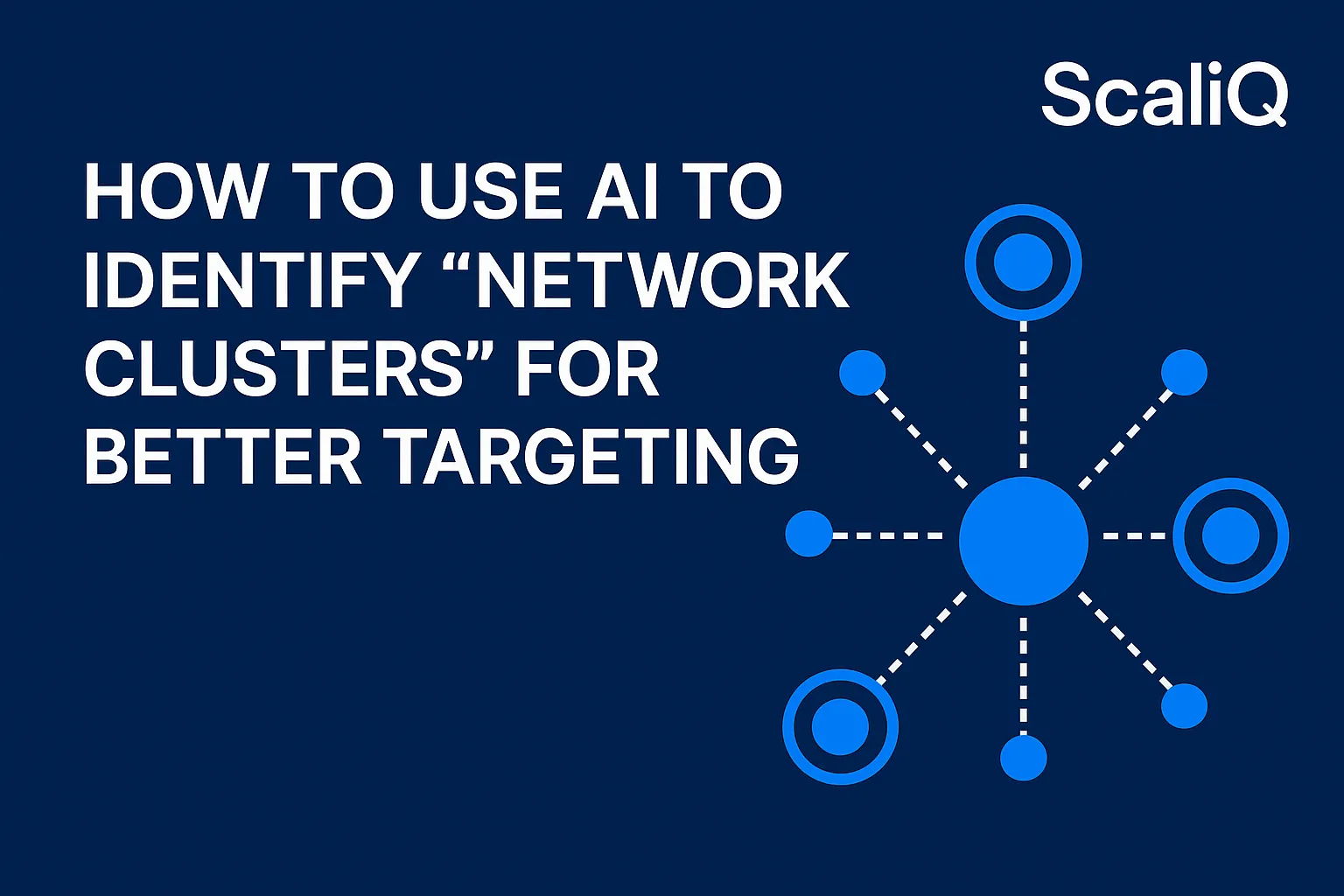
Before diving into technical execution, it is critical to define the core concept in plain GTM language. A network cluster is a group of prospects connected by shared relationships, similarity signals, or graph proximity—not just common firmographic traits.
These clusters represent real, actionable GTM patterns: alumni groups, peer-role communities, partner-linked accounts, regional circles, or ecosystem overlaps. Unlike standard segments, LinkedIn network clusters emphasize interconnection, adjacency, and shared paths. Translating LinkedIn graph analysis into outbound use cases means identifying these overlapping networks to find the path of least resistance to a meeting. This concept of uncovering hidden, overlapping groups is validated by recent academic work, including a systematic review of AI-based community detection.
The Core Elements of a Prospect Cluster
A high-quality cluster is built from several key ingredients: shared connectors, role similarity, company relationships, geographic overlap, and engagement patterns. It is important to distinguish between direct proximity (prospects who share mutual connections or past employers) and inferred similarity (prospects who share identical roles, challenges, and tech stacks but may not know each other). Prospect clusters can be explicit and obvious to reps, or latent—meaning they only emerge through AI-assisted sales prospect segmentation. Leveraging contact network proximity and lookalike prospecting ensures reps are always working the warmest possible angle.
Example Cluster Types GTM Teams Can Actually Use
Network clusters are only valuable if they are actionable. Practical examples include:
• Alumni networks: Former employees of a specific company who have moved on to target accounts.
• Peer-role communities: Same-function leaders across adjacent accounts who share specific operational challenges.
• Partner ecosystems: Contacts connected to your existing integration partners or mutual vendors.
• Regional buying circles: Localized networks of decision-makers who frequently interact at regional events.
Each cluster type naturally suggests a different message angle and sequence design. You wouldn't pitch partner ecosystems the same way you pitch regional buying circles.
Network Clusters vs Standard Segments
Standard audience segmentation (industry, size, title) groups people by what they are; relational segments (shared paths, common connectors, similarity neighborhoods) group people by who they know and how they operate. Standard filters remain useful, but they are exponentially stronger when layered under relationship intelligence prospecting logic. Network clusters do not replace traditional AI segmentation outreach—they upgrade it, turning a flat list of names into a 3D map of relationships.
How AI Builds and Refreshes Prospect Clusters
Operationalizing this strategy requires understanding how AI cluster creation works. The main data inputs rely on publicly accessible, compliant data: LinkedIn relationship signals, role similarity, company attributes, mutual connections, engagement signals, CRM context, and account relationships.
At a high level, AI identifies patterns of similarity and proximity across a prospect graph, grouping individuals who share dense relational ties. Because roles change and relationships evolve, useful clustering must be dynamic. Furthermore, AI sales prospecting clusters must be explainable; teams need to understand why a prospect is in a cluster. This need for transparency aligns with the NIST AI Risk Management Framework, which emphasizes validation and governance in AI-driven prioritization, as well as the OECD AI Principles regarding accountability in AI lifecycles.
Data Signals That Power Better Clustering
The highest-value signals for LinkedIn graph analysis include network proximity, mutual connections, job-function similarity, company adjacency, engagement recency, and account-level relationships. Stronger cluster quality comes from blending relational signals with attribute-based signals. Isolated enrichment data is often insufficient without graph context. Graph-based lead scoring and account clustering require a holistic view of contact network proximity to be truly effective.
Similarity vs Proximity in Cluster Formation
Similarity means a prospect "looks like this group," while proximity means a prospect "is connected or adjacent to this group." The most effective network proximity sales targeting combines both. For example, a prospect may be role-similar to your best customers (lookalike account targeting), but if no warm path or shared connection exists, they remain a lower priority than a slightly less similar prospect who shares three mutual connections with your CEO. Relationship-based targeting thrives at the intersection of similarity and proximity.
Refresh Cadence and Dynamic Cluster Maintenance
Because the B2B prospect graph is constantly shifting, clusters must be refreshed regularly. Contacts move roles, accounts expand, and relationship paths change. High-velocity outbound motions may require weekly dynamic segmentation updates, whereas slower enterprise ABM plays might refresh monthly. Failing to maintain this data risks creating stale segments, leading to false confidence, irrelevant outreach, and poor account prioritization.
Using Clusters for Account Prioritization and Personalization
Transforming cluster analysis from a data exercise into revenue actions is where the true ROI lies. Cluster outputs help rank which accounts, contacts, and buying groups should be worked first based on the warmest relational paths. Cluster labels also create better personalization by revealing context, likely priorities, and highly credible message angles.
Different clusters inform channel selection, sequence strategy, and stakeholder mapping. The operational payoff is massive: fewer generic lists, better outreach focus, and stronger coverage of buying groups. Orchestrating this AI segmentation outreach and prioritization often requires workflow automation tools like NotiQ to sync relationship-based targeting data seamlessly into the reps' daily execution environment.
How to Decide Which Cluster to Target First
Prioritization criteria should include signal density, reachable connectors, account quality, buying-group completeness, and engagement alignment. The "best" cluster is rarely just the largest one; it is the one with the strongest path-to-conversation. Cluster-level account prioritization complements standard graph-based lead scoring rather than replacing it. By analyzing cluster analysis outreach metrics, teams can direct SDRs to the exact networks most likely to convert today.
Personalizing Messaging by Cluster Type
Different cluster types demand different outreach narratives. Alumni familiarity allows for a more casual, shared-history approach. Peer benchmarking works best for role-similar clusters, while ecosystem relevance is perfect for partner-linked accounts. Cluster-aware personalized messaging is vastly more specific than generic persona personalization. For deeper ideas on adapting message angles and sequence strategies per cluster, teams can look to resources like Repliq. Ultimately, AI segmentation outreach and sales prospect segmentation fail if the messaging doesn't match the relational context.
Mapping Hidden Buying Groups Across Accounts
Clusters can reveal stakeholder communities that span departments, subsidiaries, or even adjacent accounts. This community detection sales outreach helps SDRs and AEs find multi-threading opportunities much earlier in the sales cycle. Buying group mapping AI connects cluster discovery directly to ABM and account expansion use cases, proving that relationship intelligence prospecting is just as valuable for upselling as it is for net-new outbound.
How Cluster-Based Targeting Differs from Enrichment, Intent, and Lead Scoring
To understand where cluster-based targeting fits, we must differentiate it from existing GTM data systems. Enrichment tells you more about a prospect. Intent tells you who may be researching. Scoring ranks likelihood to buy. But clusters show how prospects relate to one another.
Network clustering is an additional layer above these systems, not a substitute. Without relational context, traditional tools break down when trying to map the actual human pathways into an account. Lookalike account targeting and AI segmentation outreach, particularly in ScaliQ-style workflows, provide AI verification, explainable prioritization, and relationship visibility that generic enrichment and scoring tools simply cannot offer.
Enrichment Adds Context, But Not Structure
Data enrichment improves data completeness (phone numbers, verified emails, updated titles) but does not reveal community membership or hidden relationship paths. Complete records still produce weak targeting if teams cannot see which prospects belong together. Network clustering for prospecting and account clustering provide the structural map that enrichment alone lacks.
Intent Signals Rank Interest, But Not Reachability
Intent signals help identify active demand, but they do not guarantee the most reachable entry points within or around an account. Clusters complement intent by identifying who inside that surging account is relationally closer to your network. Combining intent with network proximity sales targeting drastically improves account prioritization.
Lead Scoring Ranks Individuals, While Clusters Reveal Groups
Lead scoring is a one-dimensional ranking of individuals. Graph-based lead scoring and community detection analyze group-level dynamics. A moderately scored contact situated inside a highly connected, high-value cluster is often more actionable than a high-scored but entirely isolated lead. Sales prospect segmentation improves dramatically when prioritization reflects network structure.
A Practical Workflow for Operationalizing LinkedIn Network Clusters
Turning this strategy into an actionable GTM process doesn't require a total system reset; it integrates into existing prospecting workflows. This step-by-step process moves from signal collection to cluster creation, prioritization, personalization, and measurement, ensuring smooth handoffs across RevOps, SDRs, AEs, and ABM teams. Platforms like ScaliQ are specifically built around clustering by network proximity, while orchestration tools like NotiQ handle the workflow syncing and automation required for seamless AI segmentation outreach and account clustering.
Step 1 — Build the Prospect Graph
The first step is combining publicly available, compliant LinkedIn signals with CRM records, account lists, engagement history, and relationship indicators. The goal is graph construction around people, accounts, and interactions, rather than mere data collection. RevOps must run data-quality checks to ensure the inputs powering the contact network proximity and LinkedIn graph analysis are accurate.
Step 2 — Detect Meaningful Communities
Next, AI groups prospects based on relational and similarity patterns. The output of this community detection should be practical cluster labels (e.g., "Ex-Salesforce VP Network") rather than algorithmic jargon. Prospects can belong to overlapping clusters, meaning a single individual might be part of multiple strategic segments within your AI sales prospecting clusters and network clustering for prospecting efforts.
Step 3 — Rank Clusters by GTM Value
Evaluate clusters by fit, path strength, account density, engagement potential, and expansion opportunity. Cluster scoring differs from individual lead scoring because it evaluates the viability of an entire network. This relationship-based targeting ranking dictates SDR queue design and ABM account prioritization.
Step 4 — Turn Cluster Labels Into Outreach Plays
Map each cluster to specific message themes, proof points, call-to-action styles, and channel choices. Sales teams must standardize playbooks per cluster while maintaining credible personalization. Whether executing alumni-led outreach, partner ecosystem sequences, or function-specific peer messaging, AI segmentation outreach and sales prospect segmentation must dictate the sequence strategy.
Step 5 — Refresh, Learn, and Improve
Continuously review reply rates, meeting conversions, and pipeline generated by cluster. These feedback loops improve cluster labels, scoring logic, and sequencing. Because markets, roles, and networks change, cluster refresh protocols and dynamic segmentation are vital for sustaining pipeline impact.
Measurement, Governance, and Explainability
Advanced teams must validate outcomes responsibly. Explainability is crucial for adoption; reps and managers need to know why an account was prioritized. Governance concerns—such as bias, stale signals, poor data quality, and over-automation—must be actively managed. Cluster-based targeting is decision support, not blind automation. Adhering to the NIST AI Risk Management Framework ensures trustworthiness and proper evaluation, while the OECD AI Principles provide essential guidance on accountability and transparency in AI-assisted prospecting and explainable AI scoring.
KPIs That Show Cluster-Based Targeting Is Working
Compare cluster-based outreach against static-list benchmarks. Focus on metrics tied to business value: reply quality, opportunity creation, pipeline impact, and buying-group depth, rather than vanity outputs. Secondary benefits include reduced time-to-priority and increased SDR efficiency driven by superior account prioritization and reply rates.
Common Implementation Risks
Risks include stale data, weak identity resolution, overfitting to one network pattern, and poor cluster labeling. If the underlying graph is incomplete or outdated, dynamic segmentation becomes misleading. Teams must enforce strict AI governance, data quality standards, and human-in-the-loop review processes to ensure accuracy.
Why Explainable Prioritization Wins Adoption
GTM teams trust clusters when they can see the underlying reasons: mutual connectors, shared communities, role similarity, or engagement overlap. Explainable AI scoring improves cross-functional alignment between RevOps, SDR leaders, and AEs. This transparency is a core differentiator for platforms focusing on network proximity sales targeting and relationship intelligence prospecting.
Conclusion
Static segmentation is useful but fundamentally incomplete; AI-driven LinkedIn network clusters add the missing relationship layer. By clustering prospects based on network proximity and similarity, GTM teams unlock better account prioritization, clearer warm paths, more relevant personalization, and stronger buying-group coverage.
Prospects clustered by network proximity and similarity help teams focus exclusively on who is both high-fit and realistically reachable. As revenue organizations move beyond static lead scoring, dynamic cluster-based targeting will inevitably become a core pillar of modern outbound and ABM workflows. Evaluate where your current segmentation misses relational context, and explore how platforms like ScaliQ can operationalize AI segmentation outreach and account prioritization inside your existing GTM workflows to turn hidden networks into tangible pipeline.