

Introduction
If your cold LinkedIn messages are being ignored, connection requests are left pending, and reply rates are sitting at the bottom of the barrel, you are likely making one fundamental error: your outreach starts before any familiarity exists. In the modern B2B landscape, demanding a prospect's time and attention as a first touch point creates immediate friction.
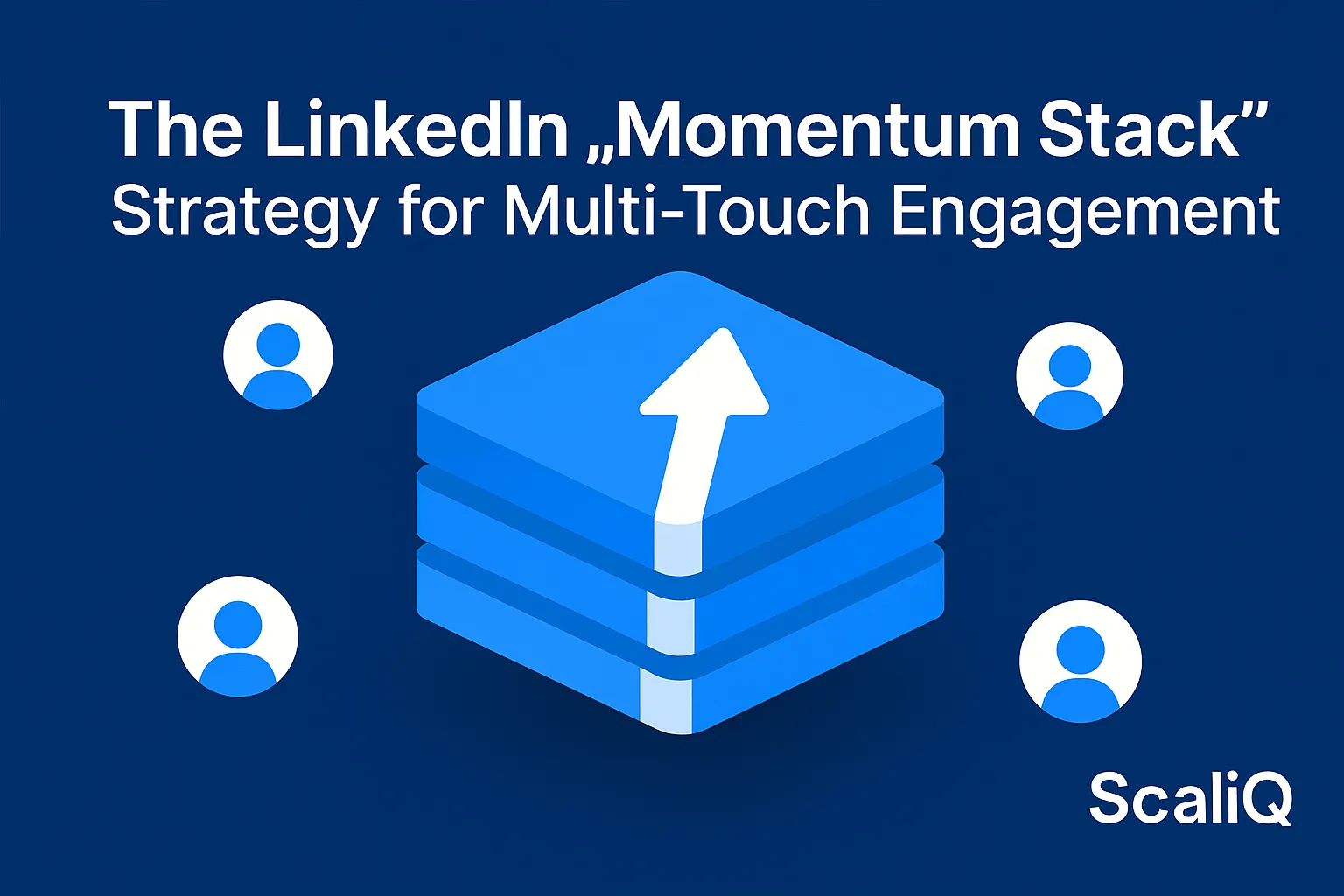
Instead of sending a message as your opening move, the most effective multi touch linkedin outreach relies on stacking multiple small engagement actions to create recognition before the ask. This is the core promise of ScaliQ: engineering familiarity systematically. We call this the “LinkedIn Momentum Stack”—a proprietary, measurable framework designed to transition your strategy from cold pitching to warm, relationship-led prospecting.
This guide is built for SDRs, founders, and intermediate B2B operators who understand basic prospecting but need a more strategic, repeatable system. We will cover why traditional cold outreach fails, detail the exact engagement stacking strategy, explain how to personalize at scale, and outline the KPIs that matter. As you refine your LinkedIn outreach strategy, we recommend exploring additional Blog to deepen your knowledge of outbound systems, and leveraging ScaliQ as the strategic engine behind your Momentum Stack.
Why Cold LinkedIn Outreach Fails
To understand the power of a multi-touch approach, you must first understand the friction inherent in traditional outbound methods.
Most Prospects Ignore Messages From Strangers
When cold LinkedIn messages get ignored, it is rarely because the product lacks value; it is because the sender lacks context. Prospects routinely ignore first-touch outreach because there is zero prior recognition or trust established. Abrupt connection requests and direct pitches create immediate resistance. When a prospect receives a pitch from an absolute stranger, their default response is defensive.
This dynamic is exactly why SDRs and founders experience low acceptance rates, weak replies, and inconsistent conversation quality. Shifting from message-first to relationship-first prospecting changes this. Warm outreach succeeds because it respects the buyer's journey. To understand why recognition matters, look at Forrester on which information sources B2B buyers trust, which highlights that buyers heavily favor established context and credible, recognizable sources over unsolicited vendor outreach.
Generic Automation Damages Credibility
While automation is necessary for scale, generic LinkedIn outreach spam destroys trust. When LinkedIn outreach automation lacks relevance or visible signs of genuine interest, it feels intrusive. Recipients instinctively mentally group low-context, highly automated LinkedIn messages with broader social engineering or phishing-like patterns. The issue isn't the technology itself, but the overreliance on automation reduces credibility when it is deployed without empathy or timing.
According to NIST guidance on phishing and convincing online messages, overly generic or aggressive digital outreach naturally triggers distrust and defensive behaviors in users. Many outreach tools optimize purely for scale, blasting thousands of identical messages. The Momentum Stack methodology by ScaliQ differentiates itself by optimizing for familiarity first, ensuring that when automation is used, it is layered over a foundation of genuine context.
Social Familiarity Lowers Resistance Before the Ask
Repeated micro-exposures—such as profile views, follows, likes, and comments—build psychological recognition over time. This engagement-first approach aligns perfectly with social selling on LinkedIn and account-based thinking. By the time your message lands in their inbox, you are no longer a stranger; you are a familiar face.
This multi-touch engagement is not about manipulation. It is about reducing surprise and establishing relevance. As noted by Forrester on trust and defensive B2B buying behavior, familiarity fundamentally lowers perceived risk, making buyers far more receptive to engaging in a conversation. Pre-outreach engagement breaks down these defensive walls before the pitch even happens.
The LinkedIn Momentum Stack Framework
Vague advice like "engage before you pitch" is difficult to scale. The LinkedIn Momentum Stack turns that concept into a structured, operational playbook.
What the Momentum Stack Is
The LinkedIn momentum stack is ScaliQ’s proprietary framework for multi-touch LinkedIn outreach. It is a planned, intentional sequence of pre-outreach engagement actions designed to warm a prospect before a connection request or direct message is ever sent.
If you are wondering what is multi-touch LinkedIn outreach, it is the bridge between passive social selling and active outbound execution. It is not random scrolling and liking; it is an engagement stacking strategy designed to create recognition, gather valuable context, and ultimately drive higher acceptance and reply rates.
The Core 5-Step Sequence
The Momentum Stack follows a logical progression of escalating engagement. While not every prospect requires every step, the baseline LinkedIn outreach sequence includes:
1. View the prospect’s profile: A passive, low-friction notification that you exist.
2. Follow them if appropriate: Signals ongoing interest in their insights.
3. Engage with recent posts: A lightweight "like" or reaction to show alignment.
4. Leave one meaningful comment where relevant: Establishes your expertise and voice.
5. Send a personalized connection request or message: The final step, referencing the context built in steps 1-4.
This sequence dictates exactly how to warm up LinkedIn prospects before sending a message. The exact combination of touches should be dynamically adjusted based on account tier, prospect activity levels, and timing. LinkedIn engagement before outreach must feel intentional, not checklist-driven.
Why Stacked Micro-Exposures Work Better Than One Big Ask
Stacked micro-exposures create momentum without demanding immediate attention. In multi touch linkedin outreach, each subtle touch increases the odds that the prospect recognizes your name, face, or company. When you finally send a message, the prospect already has a mental anchor for who you are.
This is the essence of personalized LinkedIn prospecting. Cold outreach asks for time and attention immediately. The Momentum Stack gives attention first, earning the right to ask for it later. This method of social selling on LinkedIn drastically improves conversation quality, moving beyond mere volume metrics to generate actual pipeline.
When to Use the Momentum Stack vs. Direct Outreach
A full Momentum Stack is ideal for high-value accounts, founder-led sales, strategic ABM plays, or highly skeptical markets where trust is low. However, lighter warming may suffice for lower-friction prospects, highly active content creators, or when there is already existing brand familiarity.
When comparing cold email vs LinkedIn outreach, cold email relies heavily on inbox timing. LinkedIn prospecting allows you to create visible context first. By monitoring signals—such as recent posting activity or account priority—you can determine the depth of your account based LinkedIn strategy. Unlike generic cadence tools, the Momentum Stack explicitly demands this pre-message warm-up layer.
Which Touchpoints to Use and When
Operationalizing the framework requires understanding the specific mechanics and timing of each interaction.
Profile Views and Follows as Low-Friction First Touches
LinkedIn profile views and follows are the perfect pre-outreach engagement tools because they are lightweight, highly visible, and entirely non-intrusive. They generate a notification without demanding a response.
Use both when targeting high-tier accounts with active prospects, or just a profile view for lower-tier accounts. For example, an SDR targeting a mid-market VP of Sales should view the profile on day one, and follow them on day two. This creates two distinct, spaced-out notifications, laying the groundwork for effective LinkedIn prospecting.
Likes and Reactions for Early Recognition
Liking a prospect's content provides early recognition. This multi-touch engagement tactic creates repeated visibility without forcing a conversation prematurely.
However, reactions alone do not constitute a complete strategy; they are a stepping stone. Space these touches naturally across several days. Liking five posts in three minutes looks automated and performative. Genuine LinkedIn engagement before outreach requires authentic spacing, mirroring how real users interact with content while social selling on LinkedIn.
Comments as the Trust-Building Touch
Meaningful comments are the highest-value pre-outreach action. They demonstrate relevance, thoughtfulness, and expertise. A good comment is specific, context-aware, concise, and additive to the conversation. Generic praise like "Great post!" adds zero value and screams automation.
To master personalized LinkedIn prospecting, tailor your comments to your persona. A founder might comment on a prospect's post by adding a strategic industry insight, while an SDR might ask a thoughtful, clarifying question about the prospect's workflow. This execution of warm outreach builds trust. For guidance on sounding human and relevant, refer to CDC guidance on empathetic, audience-aware communication, which underscores the importance of audience-centric messaging in an engagement stacking strategy.
The Transition From Engagement to Message
The transition from engagement to the inbox must feel seamless. Your personalized outreach must reference a real signal from the stack: a post they wrote, a comment thread you shared, or a company update.
Your LinkedIn outreach strategy should ensure the first message feels like a continuation of observed context, not a reset into a generic pitch. If you want to know how to warm up LinkedIn prospects before sending a message, use this mini-formula for the DM: Observed Context + Relevance to their Role + Simple, Low-Friction Next Step.
Timing Guidance Between Touches
There is no universal, rigid timeline, but signal-based outreach requires natural pacing. Your LinkedIn outreach sequence should follow these guidelines:
• Space early touches (views, follows) naturally over 2-3 days.
• Use comments only when genuinely relevant content is posted.
• Send the direct message once recognition is likely established, not just because a fixed 48-hour timer expired.
Timing should vary based on the prospect's posting frequency and seniority. How many touchpoints should you use before LinkedIn outreach? As many as it takes to establish context without becoming a nuisance.
How to Personalize at Scale Without Looking Automated
The core operational challenge is staying relevant and human while keeping the process repeatable.
Use Signals, Not Full Manual Research, for Every Prospect
Many teams struggle with the difficulty personalizing outreach at scale because they attempt deep, manual research for every single lead. Instead, focus on signal-based outreach. Personalize using observed cues: recent posts, role changes, account priorities, shared industry themes, and specific buyer triggers.
Effective personalization requires the right signal selection, not a biography of the prospect. Implement a tiered account based LinkedIn strategy: high-value accounts receive deep, multi-day stacking, while lower-tier accounts receive a lighter version (e.g., one view, one like, one highly relevant message).
Build Repeatable Personalization Buckets
To streamline your LinkedIn outreach strategy, build repeatable personalization buckets. This allows you to scale personalized LinkedIn prospecting without sounding robotic:
• Persona-based hooks: Tailored to the specific daily challenges of their job title.
• Trigger-based hooks: Reacting to a recent funding round, hiring push, or software implementation.
• Content-engagement-based hooks: Referencing a specific stance they took in a recent post.
• Account-level relevance hooks: Tying your message to their company's quarterly goals.
By categorizing your LinkedIn lead generation efforts into these buckets, founders, SDRs, and operators can deploy structured, highly relevant messaging rapidly.
What Makes Outreach Look Automated
Automation is a tool, but when the human logic behind it is missing, it becomes a liability. Red flags that trigger the "generic LinkedIn outreach spam" alarm include:
• Touches happening too fast (e.g., a view, like, and message within 10 seconds).
• Comments that are vague and generic.
• Messages that completely ignore prior context.
• Everyone in a sequence receiving the exact same pitch.
• High engagement volume with zero quality.
When cold LinkedIn messages get ignored, it is often because the prospect spotted these patterns. As reinforced by NIST guidance on phishing and convincing online messages, transparently robotic behavior destroys trust instantly. Thoughtful orchestration must replace tool-driven spam. For broader insights on maintaining message quality across channels, check out Blog to refine your overall outbound communication.
A Simple Operating Playbook for Teams
To solve how to scale multi-touch LinkedIn outreach without looking automated, teams must standardize the Momentum Stack with strict quality controls.
Document your engagement stacking strategy clearly: define which touches to use by account tier, establish what counts as a meaningful comment, outline the exact triggers for moving to the first message, and clarify which metrics define success. Scalable LinkedIn prospecting still requires human review on high-value accounts. To systematize these outreach playbooks effectively, leverage the strategic frameworks provided by ScaliQ.
What Metrics Prove the Stack Is Working
To validate performance and compare it against cold baseline data, you must track the right metrics.
Leading Indicators: Visibility and Recognition
Leading indicators validate whether momentum is building before pipeline outcomes materialize. Track these early signals to measure LinkedIn engagement before outreach:
• Profile views (are prospects looking back at you?)
• Follow-backs where relevant
• Prospect engagement with your own profile or content
• Connection acceptance rates
These metrics indicate recognition and reduced friction. While high profile views and connection acceptance rates don't pay the bills, they prove that your presence is being felt.
Core Outcome Metrics: Replies and Conversations
The true test of multi touch linkedin outreach is whether it generates conversations. Measure the impact on your real outreach outcomes by tracking:
• Reply rates
• Positive reply rates
• Time-to-conversation
• Meeting conversion from LinkedIn-sourced outreach
Compare these figures against a cold outreach control group. The goal of fixing low LinkedIn response rates is to achieve better conversation quality, not just inflate superficial activity metrics.
Pipeline Metrics: Influenced Opportunities and Account Progression
Move beyond vanity metrics and connect the stack directly to business outcomes. Track influenced pipeline, account progression, and movement within target accounts.
For founders and ABM teams executing an account based LinkedIn strategy, this is critical. LinkedIn lead generation must ultimately be judged by the revenue it touches and the strategic accounts it penetrates.
How to Build a Simple Momentum Stack Scorecard
To determine what metrics show whether a momentum stack is working, build a lightweight scorecard your team can review weekly. Track:
• Touches completed per account
• Timing and spacing between touches
• Acceptance outcomes
• Reply outcomes
• Opportunity influence
Segment this data by persona, campaign type, or account tier to identify winning patterns in your LinkedIn outreach sequence. For a disciplined approach to KPI selection and measurement, refer to the CDC framework for measuring social media campaign performance, which provides excellent foundational logic for evaluating digital engagement efforts in your LinkedIn prospecting.
Future Trends in LinkedIn Engagement-First Outreach
The Momentum Stack is not a temporary hack; it is built for where B2B sales is heading.
Signal-Based Prospecting Will Matter More
Outreach is rapidly shifting toward utilizing real-time buyer and engagement signals before a message is ever drafted. Signal-based outreach ensures you are acting on visible context rather than guessing relevance. As part of a broader account based LinkedIn strategy, the Momentum Stack perfectly aligns with this trend, positioning your LinkedIn prospecting to capitalize on intent data rather than raw volume.
Generic AI Outreach Will Face More Skepticism
As automated messaging floods inboxes, generic LinkedIn outreach spam will face unprecedented skepticism. Visible relevance and pre-outreach familiarity will become the ultimate differentiators. The winning formula is not "more AI" or "no AI," but AI utilized alongside human judgment and authentic context. This personalized outreach sharply contrasts with the one-message LinkedIn outreach automation strategies that currently plague the platform.
Personal Brands and Micro-Engagement Will Influence Outbound More
Founder-led and creator-led presence on LinkedIn amplifies the effectiveness of a Momentum Stack. Prospects are significantly more likely to respond to multi-touch engagement when the sender has visible thought leadership. Social selling on LinkedIn works best when your outbound messaging is reinforced by a strong inbound presence, making your overall LinkedIn lead generation ecosystem highly resilient.
Conclusion
Cold outreach consistently underperforms when it starts with an abrupt ask. Multi touch linkedin outreach works exponentially better because it builds familiarity first. The LinkedIn Momentum Stack gives modern revenue teams a named, repeatable engagement stacking strategy for systematically warming prospects through profile views, follows, content engagement, meaningful comments, and highly contextual personalized outreach.
Treat this framework as a scalable system to test, measure, and refine. Audit your current LinkedIn outreach strategy today. Identify where you are messaging too early, and build a Momentum Stack around your highest-value accounts. ScaliQ’s systematic approach to relationship-led prospecting is designed to help you execute this flawlessly. For deeper insights into optimizing your outbound systems and personalized workflows, visit Blog, or explore how we can transform your pipeline at ScaliQ.