

Introduction
Agencies today are hitting a hard ceiling in outbound sales. The traditional method of scaling—hiring more bodies to send more messages—has reached a point of diminishing returns. Manual SDR work simply cannot scale linearly with revenue goals. When you increase headcount, you inevitably increase management overhead, training costs, and human error, all while margins compress.
For forward-thinking agencies, the solution is no longer "hire more." It is "automate intelligently." By implementing AI SDR workflows, agencies are solving the critical limitations of cost, volume, personalization, and tool fragmentation. They are moving from disjointed stacks to unified engines.
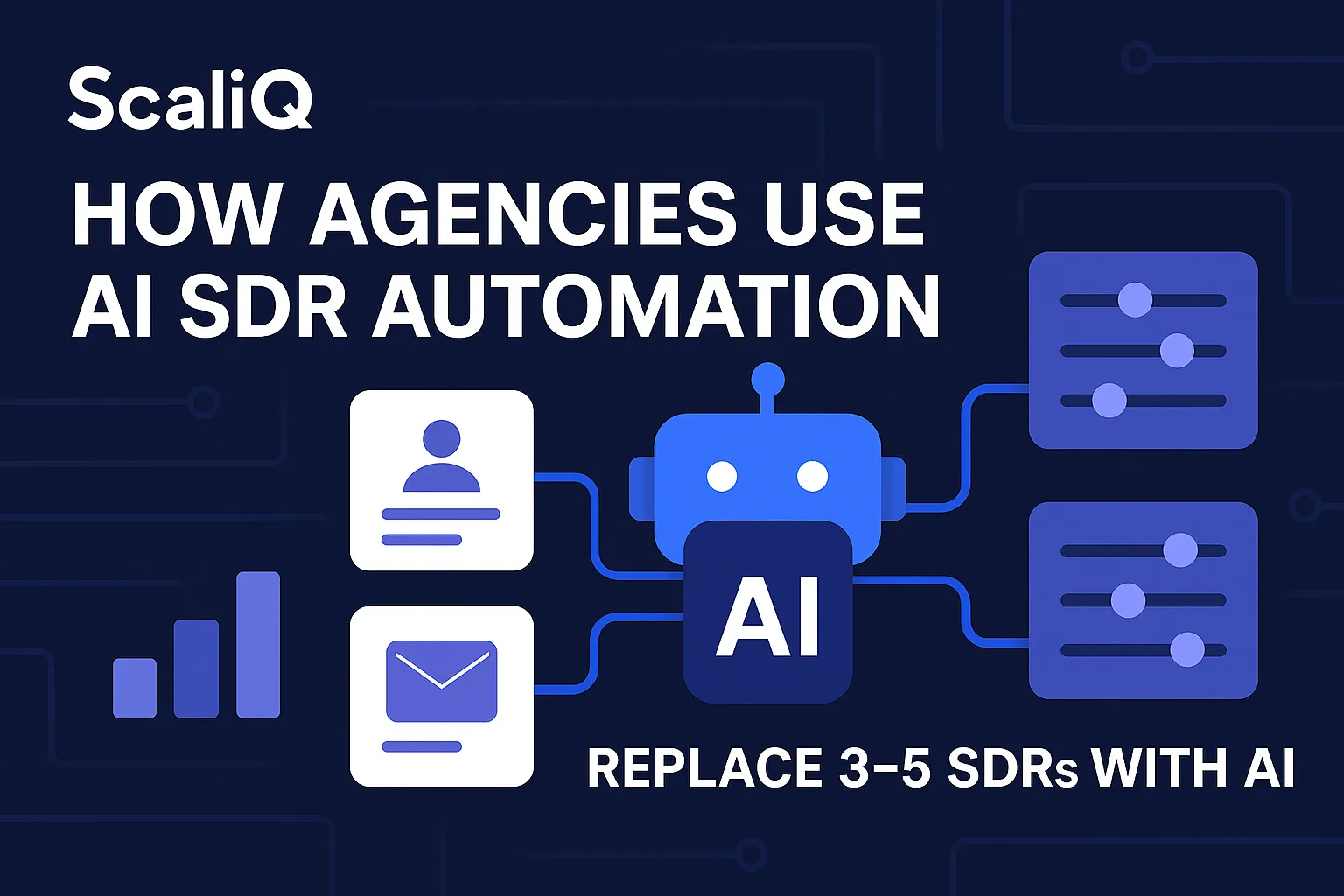
This guide explores how agencies use ScaliQ as that unified engine—specifically designed to replace the output of 3–5 full-time SDRs with a single, autonomous system. We will break down exactly how these ai sales development automation systems function, how they adhere to strict compliance standards, and why they are reshaping the agency landscape in 2025.
According to the Stanford AI Index Report, corporate investment in AI has surged as businesses realize that AI adoption is no longer experimental—it is a fundamental operational requirement for efficiency. Industry performance stats corroborate this shift: agencies deploying AI SDRs report operating costs that are 50–80% cheaper and outreach cycles that are 40–60% faster than human-led teams.
This is your definitive breakdown of how to replace SDR with AI effectively, ethically, and profitably.
Why Traditional SDR Workflows Break at Scale
The fragility of the human-led SDR model becomes immediately apparent when an agency attempts to scale beyond a handful of clients. The "human bottleneck" is not a criticism of talent; it is a criticism of structure. Humans are biologically ill-equipped for the repetitive, high-volume, data-heavy tasks required for modern prospecting.
The Fragility of Human dependency
Human SDRs face burnout, require sick days, and suffer from variable motivation. A top performer one month may churn the next, taking institutional knowledge with them. This creates inconsistent outbound volume solutions, where pipeline generation fluctuates wildly based on staff availability rather than market opportunity.
Furthermore, the "swivel-chair" effect—moving between a CRM, a data provider, LinkedIn, and an email tool—shatters productivity. Research from Stanford SIEPR on AI adoption highlights that labor productivity stagnates when workflows remain fragmented and manual. For agencies, this fragmentation means paying full salaries for time spent navigating tabs rather than selling.
The Agency Struggle
Agencies face higher pressure than internal teams because they must deliver predictable pipeline for multiple clients simultaneously.
• High Client Expectations: Clients demand immediate results. Ramping up a human SDR takes 3 months; spinning up an AI workflow takes days.
• Predictable Needs: Agencies need to know that if X messages are sent, Y meetings are booked. Human variance makes this math impossible.
The Cost of Fragmentation
To replicate the output of a ScaliQ workflow, an agency typically hires 3–5 SDRs. When you factor in salaries, commissions, software seats, and taxes, the cost is exorbitant. By consolidating these roles into an automated architecture, agencies unlock massive capital efficiency.
For a detailed breakdown of how automation costs compare to headcount, review our pricing models here: Pricing.
What an AI‑Driven SDR Workflow Actually Looks Like
An AI SDR workflow is not simply a "mail merge" tool. It is a cognitive pipeline that mimics the decision-making process of a human researcher and copywriter, but at infinite speed.
Unlike fragmented tools where one piece of software finds the email and another sends it, a full-stack system like ScaliQ unifies the entire lifecycle: sourcing → enrichment → targeting → multichannel sequencing → follow-ups.
Research on AI-driven sales optimization (often discussed in arXiv papers regarding reinforcement learning in business processes) suggests that unified systems outperform fragmented ones because the "agent" learns from the entire loop—from data entry to reply detection.
Component 1 — Smart Target Sourcing & Enrichment
The workflow begins with ai prospecting workflows. Instead of a human manually filtering LinkedIn Sales Navigator, the AI ingests an Ideal Customer Profile (ICP). It autonomously scans public databases and compliant data sources to identify prospects matching specific firmographic (size, revenue, industry) and behavioral (hiring intent, recent funding) criteria.
Crucially, data enrichment AI layers context onto these contacts. It doesn't just find an email; it finds the prospect’s recent posts, company news, and tech stack, preparing the ground for hyper-personalization.
Component 2 — AI Message Generation & Personalization
This is where autonomous sdr agents shine. Using the enriched data, the AI generates unique copy for every single prospect.
• Dynamic Tailoring: The AI references the prospect's specific pain points (e.g., "I saw you're hiring for SEO managers...") rather than using a generic template.
• Scalable Messaging: Unlike humans who take 15 minutes to craft one custom note, the AI generates thousands instantly.
This level of ai personalization ensures high relevance. For agencies utilizing specialized personalization data, integrations are key. For example, leveraging deep personalization data helps agencies maintain high engagement rates: Agency.
Component 3 — Sequencing Across LinkedIn + Email
The AI orchestrates the delivery. It determines the optimal path:
• Day 1: View LinkedIn profile (soft touch).
• Day 2: Send connection request with a custom note.
• Day 4: If no acceptance, send a personalized email.
• Day 6: If email opened but not replied to, like a LinkedIn post.
This linkedin ai outreach automation and ai email sequencing happen simultaneously for thousands of leads, ensuring no prospect falls through the cracks.
Component 4 — Qualification, Routing & Handoffs
Finally, ai lead qualification filters the noise. When a reply is received, the AI analyzes the sentiment.
• Out of Office? It pauses and reschedules.
• Not Interested? It marks the lead as lost.
• Positive Interest? It syncs the lead to the CRM and alerts a human closer.
Channel-Specific AI SDR Workflows for LinkedIn & Email
To replace SDR with AI effectively, you cannot treat LinkedIn and Email the same. They require distinct compliance protocols and engagement styles. ScaliQ unifies these into a single dashboard, but the underlying mechanics are channel-specific.
LinkedIn AI SDR Workflow
LinkedIn is a high-trust environment. Linkedin ai automation must mimic human behavior to avoid detection and restriction.
1. Profile Warm-up: The AI gradually increases activity volume over weeks, establishing a "trusted" baseline.
2. Visit Triggers: Before sending a message, the AI visits the profile. This notifies the prospect ("X viewed your profile"), creating familiarity.
3. Safety-Aware Behavior: The workflow utilizes randomized intervals (e.g., waiting 4 minutes and 12 seconds between actions) and adheres to strict daily limits (e.g., 20 connection requests/day).
We adhere to principles outlined in NIST AI guidelines regarding responsible automation, ensuring that all interactions are transparent, rate-limited, and respectful of platform terms.
Email AI SDR Workflow
Email ai outreach focuses on deliverability and inbox health.
1. Inbox Rotation: The system rotates between multiple sending domains to prevent any single domain from hitting spam filters.
2. Adaptive Scheduling: AI analyzes when prospects in specific time zones are most likely to open emails and schedules sends accordingly.
3. The Competitive Gap: Many tools like Instantly cover email well but ignore LinkedIn. ScaliQ integrates ai multi-channel outbound, acknowledging that a prospect who ignores an email might respond to a LinkedIn DM.
AI SDR Output vs Human SDR Benchmarks
When agencies compare ai vs human sdr performance, the data is stark. Utilizing insights from the Stanford AI Index, we see a clear trend: automation offers predictability that biological workers cannot match.
Volume & Consistency
• Human SDR: A hardworking SDR might hit 50–80 touchpoints a day. They take weekends off. They have "off days."
• AI SDR: An AI workflow executes 500+ touchpoints daily (across multiple inboxes/accounts) with zero variance. It works 24/7/365.
• Result: Sales development automation ensures your pipeline math (Inputs = Outputs) is statistically reliable.
Personalization Quality
A human SDR often resorts to copy-pasting generic templates when they fall behind on quotas. AI personalization never gets tired. It applies the same rigorous firmographic personalization logic to the 1,000th lead as it did to the 1st. This consistency drives higher average reply rates across large datasets.
Cost & Efficiency
The economics of ai outbound economics are the primary driver for agency adoption.
• Human Cost: 3 SDRs @ $60k/year = $180,000 + overhead.
• AI Cost: A fraction of a single salary.
For agencies looking to reduce sdr hiring costs with ai, the ROI is immediate. You can view the specific savings breakdown here: Pricing.
How Agencies Implement Full‑Stack AI SDR Systems
Implementing ai sdr workflows is a systematic process. It shifts the agency's role from "people management" to "systems architecture."
Phase 1 — Setup & Data Infrastructure
The foundation of ai sales setup is data hygiene.
• CRM Sync: Connect HubSpot or Salesforce to ScaliQ.
• Target Lists: Define strict ICP parameters.
• Technical DNS: Configure SPF, DKIM, and DMARC records to ensure email deliverability ai is flawless.
Phase 2 — Workflow Buildout
Agencies build the "logic map."
• Trigger: New funding round detected > $5M.
• Action: Add to "Scale-Up" campaign.
• Step 1: LinkedIn Connection Request (Variable: CEO Name).
• Step 2: Email 1 (Variable: Recent News).
• This phase establishes the autonomous sdr agents' rules of engagement.
Phase 3 — Optimization & Scaling
Once live, the focus shifts to ai outbound scaling.
• A/B Testing: The AI tests Subject Line A vs. Subject Line B. It automatically routes more volume to the winner.
• Multi-Client Automation: Agencies clone successful workflows for new clients, reducing onboarding time from months to days.
Phase 4 — Managing Risk: LinkedIn & Email Safety
Safety is paramount. Agencies must assign a "Compliance Owner" to monitor linkedin safety automation.
• Throttling: Ensure daily limits are never breached.
• Pattern Variation: Ensure message syntax varies enough to avoid spam filters.
• Reference: Following NIST AI guidelines for safe pattern automation ensures longevity and protects client brand reputation.
Conclusion
The era of relying solely on manual labor for top-of-funnel prospecting is ending. Agencies that cling to traditional SDR models will find themselves outpriced and outpaced by competitors who have embraced ai sdr workflows.
By using a unified engine like ScaliQ, agencies can replace sdr with ai—not to eliminate the human touch, but to elevate humans to closing roles while the AI handles the grind. You no longer need 3–5 SDRs to generate pipeline; you need one intelligent system.
Ready to build a predictable, scalable outbound engine? Explore ScaliQ pricing & book a demo today.