

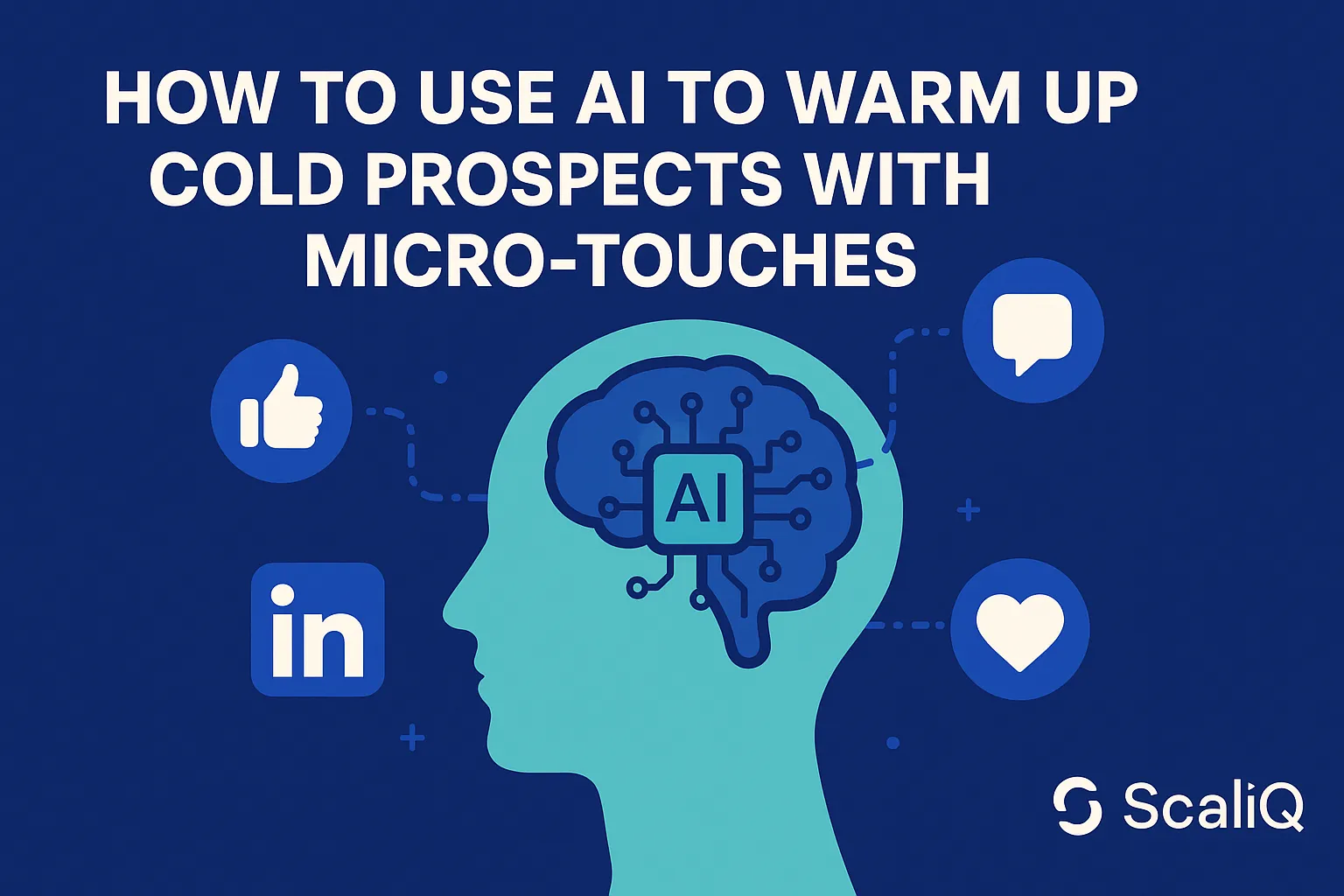
How to Use AI to Warm Up Cold Prospects With Micro-Touches on LinkedIn
Cold outreach faces a singular, devastating problem: obscurity. When a prospect receives a message from a complete stranger, their default reaction is skepticism. Without recognition, trust cannot exist, and without trust, conversion is impossible.
This is where micro-touches come in. Micro-touches are subtle, low-friction interactions—like profile views, likes, or light comments—that occur before a direct message is ever sent. They serve a critical function: they transition you from a "stranger" to a "familiar face" in the prospect's mind.
Historically, executing these touches manually was unscalable. Today, however, AI warming strategies allow sales teams to automate these psychology-driven engagement patterns. By leveraging AI sequencing, you can orchestrate a symphony of small interactions that prime the prospect, ensuring that when your message finally lands, it is received with recognition rather than resistance.
In this guide, we will explore the psychology behind familiarity, actionable templates for AI-driven flows, and how to implement ScaliQ’s validated micro-engagement patterns to revolutionize your LinkedIn outreach.
What LinkedIn Micro‑Touches Are and Why They Work
Micro-touches are the digital equivalent of a nod across a crowded room. They are non-intrusive signals that alert a prospect to your existence without demanding their immediate attention or energy.
On LinkedIn, these touches take specific forms:
• Profile Views: A silent notification that someone is checking them out.
• Likes/Reactions: A low-effort validation of their content.
• Soft Comments: Short, affirmative remarks (e.g., "Great point") that boost their engagement metrics.
• Skill Endorsements: A professional nod to their capabilities.
These small signals do two things simultaneously: they prime the LinkedIn algorithm to show your content to the prospect, and they prime the prospect’s memory to recognize your name.
While manual micro-touching is effective, it is time-consuming. AI-enhanced micro-touching solves this by automating the detection of engagement opportunities and executing them according to a "natural" timeline. This ensures you can warm up hundreds of prospects simultaneously without sacrificing the human-like cadence that builds trust.
Research published by Oxford Academic and the University of Michigan highlights that trust in social networks is often predicated on repeated, low-stakes exposure prior to direct interaction. These findings suggest that "mere exposure" significantly increases the likelihood of a positive response to subsequent requests.
To implement this effectively, you need a system designed for subtle precision rather than brute force. This is the core philosophy behind ScaliQ’s micro‑engagement systems, which prioritize behavioral sequencing over generic blast automation.
Types of Micro‑Touches (Low‑Signal vs High‑Signal)
Not all touches carry the same weight. Understanding the hierarchy of engagement is crucial for designing your warming flows.
• Passive Touches (Low Signal): These are background actions. Visiting a profile or following a user creates a notification but requires zero effort from the prospect. They are excellent for the "awareness" phase.
• Algorithmic Touches (Medium Signal): Liking a post or endorsing a skill. These signals tell the LinkedIn algorithm that you and the prospect are connected topically, increasing the chances your content appears in their feed.
• Contextual Touches (High Signal): Commenting on a post or replying to a comment they made elsewhere. These require AI to analyze the context of the post to ensure the interaction is relevant. These are the strongest drivers of familiarity.
How Many Micro‑Touches Before Outreach?
The "Goldilocks" zone for micro-engagements is critical. Too few, and you remain a stranger; too many, and you risk looking like a stalker.
Industry data suggests that 3–5 micro-touches over a period of 1–2 weeks significantly increase connection acceptance rates.
• For Standard Prospects: 3 touches (View → Like → Connect).
• For High-Value Accounts (Enterprise): 5–7 touches (View → Follow → Like → Comment → Wait → Like → Connect).
This cadence allows familiarity to build naturally, mimicking organic networking behavior.
The Psychology Behind Familiarity and Trust on LinkedIn
The bottleneck in cold outreach isn't the quality of your pitch; it's the lack of recognition. The human brain is wired to distrust the unknown. This evolutionary trait, known as "stranger danger," translates directly to the digital inbox.
To bypass this defense mechanism, we leverage familiarity loops. By exposing a prospect to your name and photo repeatedly in low-threat environments (notifications feed), you create a "parasocial" relationship. When your DM finally arrives, the brain categorizes you as "known," dramatically lowering cognitive resistance.
According to research on initial trust formation found in ScienceDirect, digital trust is often cognitive-based, relying on "rapid swift trust" formed through consistent, predictable behaviors and visual recognition.
Why Micro‑Touches Reduce Resistance
This phenomenon is rooted in the Mere Exposure Effect (or fluency bias). The more often a person sees a stimulus (your name/face), the more pleasing and safe that stimulus becomes.
When you send a cold DM without warming, the prospect experiences high cognitive friction: "Who is this? What do they want? Is this a scam?" When you use micro-touches, the friction is reduced: "Oh, that’s the guy who liked my post yesterday. What does he have to say?"
Algorithmic Social Proof
Beyond human psychology, there is machine psychology. LinkedIn’s algorithm prioritizes content from users we interact with. By consistently engaging with a prospect’s content (micro-touches), you signal relevance to the platform.
Consequently, when you post your own content, LinkedIn is far more likely to insert it into that prospect's feed. This creates a compounding effect: they see your name in their notifications (active touch) and your thought leadership in their feed (passive exposure), doubling the rate of familiarity.
AI‑Driven Sequencing: How to Automate Natural Engagement
Scaling this level of intimacy requires AI. However, the goal is not to automate spam, but to automate natural engagement.
AI warming strategies utilize tools that can monitor target lists for activity. When a prospect posts, the AI detects the context, evaluates the sentiment, and executes a pre-determined micro-touch (like a "Like" or a drafted comment) at a randomized, human-like interval.
A study in MDPI regarding AI in social media communication notes that AI-mediated interactions, when context-aware, can maintain and even enhance perceived social presence, provided they adhere to expected social norms.
Once the warming phase is complete, the transition to outreach must be seamless. Many teams use personalized media as a bridge. For deeper insights on using personalized assets after warming, check out the resources at Repliq.
Step-by-Step Sequence (Recognition → Familiarity → Exposure → Outreach)
A psychological model for warming should follow this 4-stage progression:
1. Recognition (Days 1-3): The goal is simply to appear in notifications., AI Action: Auto-view profile; Follow user.
2. Familiarity (Days 4-7): The goal is to validate their content., AI Action: Like a recent post; Endorse a top skill.
3. Exposure (Days 8-10): The goal is to demonstrate value/intellect., AI Action: Comment on a post (using AI to generate relevant context).
4. Outreach (Day 11+): The ask., AI Action: Send connection request with a message referencing the previous engagement.
Feed Interaction Automation (Context-Aware AI)
Modern AI tools don't just "like" the most recent post indiscriminately. They analyze the content.
• Is it a celebration? The AI chooses a "Celebrate" reaction.
• Is it a tragedy or layoff post? The AI skips interaction to avoid awkwardness.
• Is it an industry opinion? The AI drafts a comment agreeing with the specific premise.
This connects directly to ScaliQ’s behavioral sequencing approach, ensuring that every touch feels intentional, not robotic.
When to Escalate to DM (And What to Say)
Escalate to a Direct Message only when you have established a baseline of familiarity.
• Signal to Act: If they like your comment or view your profile back.
• What to Say: "Hi [Name], I’ve been enjoying your posts on [Topic] lately. Your point about [Specific Detail] really resonated with me..."
This bridges the gap between public engagement and private conversation naturally.
Common Mistakes in Micro‑Touch Warming and How to Avoid Them
While AI makes warming scalable, it also makes it easy to make mistakes at scale.
Mistake #1 – Too Much Automation, Not Enough Context
The most common error is using "dumb" automation that likes every single post a prospect makes, or comments "Great post!" on a serious article about market downturns.
• The Fix: Use AI tools that allow for sentiment analysis and negative keyword filtering. Adopt ScaliQ’s behavioral model which prioritizes quality of engagement over quantity.
Mistake #2 – Commenting Too Early or Too Often
Jumping straight into the comments section on the first touch can feel aggressive. Similarly, commenting on three posts in one hour looks like bot behavior.
• The Fix: Adhere to "human limits." Space interactions out by at least 24-48 hours. Start with low-signal touches (views/likes) before moving to high-signal touches (comments).
Mistake #3 – Skipping the Recognition Stage Entirely
Many users set up AI to send a connection request immediately after a profile view. This is too fast. The "Recognition" stage needs time to "marinate."
• The Fix: Ensure your AI sequence has built-in delays (e.g., "Wait 2 days") between the profile view and the connection request.
Example Flows and Templates for Scalable Prospect Warming
Here are replicable templates for different outreach scenarios.
Template #1 – 7‑Day AI Micro‑Touch Warm-Up Flow
• Day 1: AI Profile View.
• Day 2: AI Follow (No connection request).
• Day 4: AI Like on most recent post (must be <2 weeks old).
• Day 6: AI Profile View (Second exposure).
• Day 7: Connection Request., Message: "Hi [Name], I’ve been following your content on [Topic] and love your perspective. Would be great to connect."
Template #2 – Founder‑to‑Founder Warm‑Up Flow (High Context)
• Day 1: Manual/AI Profile View.
• Day 3: AI Comment on a strategic post (asking a question).
• Day 5: AI Like on a company update.
• Day 8: Connection Request (Blank or highly specific)., Note: Founders often accept blank requests if they recognize the face/headline from previous valuable comments.
Template #3 – SDR Scalable Sequence for 50–200 Prospects/Week
• Trigger: Prospect matches ICP criteria.
• Step 1: AI "Soft Touch" (View + Like last post).
• Step 2: Wait 3 days.
• Step 3: AI Check for new activity., If yes: Like new post., If no: Endorse top skill (e.g., "Sales Management").
• Step 4: Send Connection Request.
Template #4 – AI‑Driven Engagement Reactivation Flow (Dormant Leads)
• Target: Prospects who didn't reply 3 months ago.
• Action 1: AI Profile View (Re-trigger memory).
• Action 2: AI Comment on their newest activity ("Glad to see you're still doing great work with [Project]...").
• Action 3: Wait 4 days.
• Action 4: DM Reply Bump ("Saw your recent post and it reminded me of our chat...").
Tools, Resources & Future Trends
The future of LinkedIn warming is adaptive sequencing. Static workflows (Day 1 do X, Day 2 do Y) are being replaced by dynamic models that react to the prospect's behavior in real-time.
Research highlighted by EurekAlert on AI-powered engagement indicates that adaptive systems—those that modify their frequency based on user responsiveness—yield significantly higher long-term engagement rates than static systems.
What Differentiates ScaliQ (Psychology-First vs Automation-First)
Many competitors in the space (like generic automation tools) focus on volume—how many invites can you send per day? ScaliQ differentiates itself by focusing on psychology. The platform is built on validated micro-engagement patterns that prioritize trust mechanics over spam tactics. It’s not just about sending the request; it’s about ensuring the request is welcomed.
Ethical & Safe Use of AI on LinkedIn
To maintain compliance and ethics:
1. Respect Rate Limits: Never exceed LinkedIn’s recommended daily actions (approx. 20-25 invites/day for warm accounts, slightly more for interactions).
2. Human-in-the-Loop: For high-stakes comments, use AI to draft but a human to approve.
3. Data Privacy: Ensure your AI tools do not scrape private data in violation of user terms.
Conclusion
Micro-touches are the missing link in modern cold outreach. They bridge the gap between "stranger" and "connection" by leveraging the psychology of familiarity. By using AI to automate these small, strategic interactions, you can warm up cold prospects at scale without losing the human touch.
The difference between a ignored message and a booked meeting often comes down to recognition. ScaliQ’s psychology-driven AI sequencing provides the unique advantage of automating trust, not just tasks.
Ready to transform your outreach? Explore ScaliQ workflows to start building familiarity before you ever hit "send."