

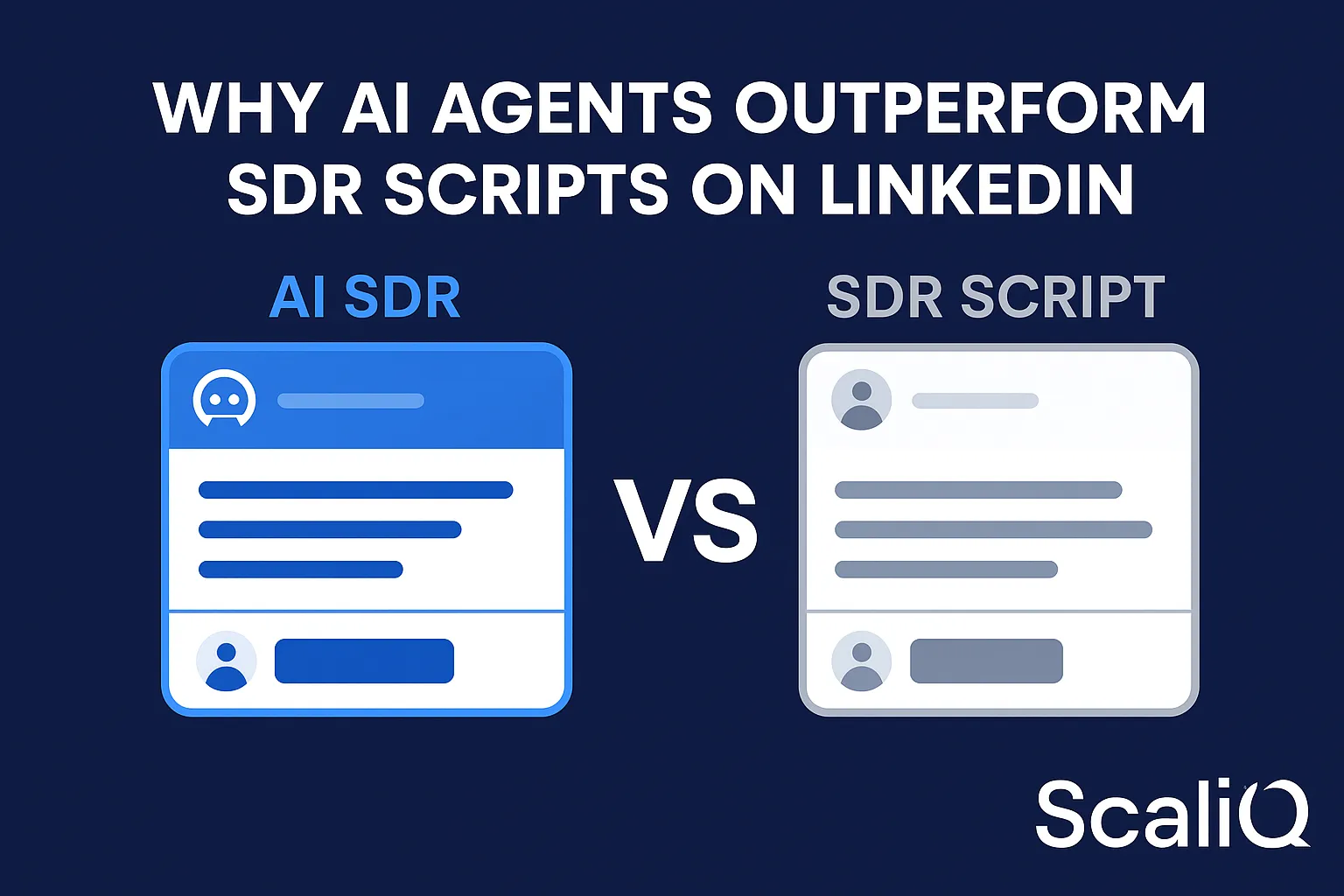
Why AI Agents Outperform SDR Scripts on LinkedIn (With Examples)
Your team sends dozens, perhaps hundreds, of LinkedIn messages every week, but reply rates stay completely flat. The reason is a familiar frustration in modern sales: every message feels exactly like what it is—a recycled, copy-and-pasted sales script.
LinkedIn is not an email sequence graveyard. It is a context-rich, real-time platform where visible profiles, recent company activity, and buyer signals make generic outreach painfully obvious and incredibly easy to ignore. Rigid SDR scripts fail because they treat a dynamic social platform like a static billboard.
In this article, we will show exactly why rigid scripts break down and how AI agents personalize outreach at scale. We will cover the specific buyer signals that matter, provide side-by-side examples of bad versus better outreach, and explain how to scale your efforts without sounding like a robot. Whether you are exploring how ai vs sdr scripts compare or looking to master linkedin ai messaging, this guide will prove that AI agents outperform SDR scripts on LinkedIn by operationalizing the best human SDR behaviors: timing, relevance, brevity, and adaptive follow-up.
At ScaliQ, our experience in AI-agent-led outbound has shown us that AI is not about replacing the human touch; it is about replicating strong SDR instincts at a volume humans cannot manually sustain. For more foundational strategies on outbound and AI prospecting, explore our comprehensive guides on the ScaliQ blog.
Why SDR Scripts Fail on LinkedIn
Old-school, pitch-first SDR playbooks break down on LinkedIn because the platform is built around visible context, relationships, and conversational relevance. When we talk about "rigid SDR scripts," we mean prewritten templates reused across hundreds of prospects with minimal, if any, adaptation.
The mismatch is glaring: LinkedIn prospects can instantly see whether you paid attention to their role, their company, or their recent activity. When they receive generic openers that could be sent to anyone, or a pitch-first message too early in the conversation, friction is created. Because rigid SDR scripts rely on identical follow-ups regardless of prospect behavior, they lead directly to the pain points most sales teams face today: low reply rates from LinkedIn outreach, inbox fatigue, and deep skepticism from buyers who have seen the exact same template before.
Unlike email, where relevance decays slowly, LinkedIn context is public and current. Generic LinkedIn messages get ignored because the platform exposes laziness. To build real pipeline, relationship-led, personalized outreach performs fundamentally better than generic pitching. This aligns directly with LinkedIn’s Social Selling Index framework, which emphasizes finding the right people, engaging with insights, and building relationships over blind volume. The problem is not the SDR; the problem is the script.
LinkedIn Rewards Context, Not Copy-Paste Volume
LinkedIn is inherently context-aware. A prospect's role, tenure, company growth, recent posts, comments, and mutual connections all shape their message expectations. When a message lands in their inbox, buyers judge it in seconds: “Does this person understand who I am and why they’re reaching out?”
A message that ignores visible, publicly accessible context feels lazy, even if the underlying product offer is strong. Mastering linkedin outreach best practices means recognizing that personalized LinkedIn prospecting is the baseline expectation, and effective linkedin ai messaging uses that context rather than ignoring it.
The 5 Biggest Problems With Static Scripts
Manual personalization is slow, which pushes teams toward static templates. But those templates consistently fall into predictable traps.
These cold outreach mistakes on LinkedIn ruin first impressions and render traditional sales outreach personalization examples obsolete.
Why “Good Enough” Scripts Stop Working Fast
Relevance decays rapidly. The more crowded the inbox becomes, the less tolerance buyers have for templated messaging. What worked flawlessly as an automated sequence one year ago will underperform today once every other sales rep copies the exact same playbook.
This leads to massive LinkedIn inbox fatigue. While traditional LinkedIn outreach automation scales your output, it completely fails to scale relevance. This is the core difference when comparing an AI SDR vs human SDR workflow: basic automation blasts static sequences, whereas adaptive AI-agent workflows deeply adapt to live context and engagement, maintaining relevance even at high volumes.
How AI Agents Personalize Outreach at Scale
AI agents do not just "write messages faster." They combine research, pattern recognition, and message adaptation in a way rigid scripts simply cannot.
The basic mechanism is straightforward: an AI agent reads publicly accessible profile and company context, detects relevant signals, chooses a specific messaging angle, generates a short and highly targeted opener, and adjusts its follow-up based on the prospect's response (or lack thereof). The true advantage is not generic AI copywriting; it is context-aware decisioning. AI scales the best habits of top-performing SDRs: noticing details, leading with relevance, and acting on behavior.
This approach to an AI SDR or AI sales agents is validated by broader market data. According to research on personalization at scale, tailoring outreach to specific customer contexts drives significant business value and engagement. When utilizing tools like RepliQ for AI-generated outreach variations, you ensure that how AI personalizes LinkedIn messages at scale remains deeply tied to authentic buyer data.
What AI Agents Actually Use Before Writing a Message
Better inputs create better outputs. AI is only useful if it is grounded in real prospect context. AI agents evaluate three distinct layers of data before drafting a single word:
This intent-based messaging ensures that personalized prospecting is driven by facts, making AI sales automation for LinkedIn a tool for relevance rather than just speed.
How AI Mimics High-Performing Human SDR Behavior
The best human SDRs never read canned scripts word-for-word; they adapt to the person in front of them. When comparing ai vs sdr scripts, AI agents outperform SDR scripts on LinkedIn because they operationalize these exact human patterns.
• Human notices context → AI extracts context: A human sees a recent promotion; the AI flags it as a trigger.
• Human writes a relevant opener → AI generates a specific opener: A human drafts a custom line; the AI dynamically writes one based on the extracted trigger.
• Human changes tone based on response → AI adjusts follow-up logic: A human notices a prospect viewed their profile but didn't reply; the AI triggers a softer, value-add follow-up.
At ScaliQ, our core point of view is that AI works best when it replicates these winning human SDR patterns. The debate of AI SDR vs human SDR shouldn't be about replacement, but about scaling top-tier execution.
Why AI Messages Feel More Relevant When Done Right
Effective linkedin ai messaging relies on micro-personalization—short, highly specific references to one meaningful detail, rather than bloated, custom paragraphs that scream "performative personalization."
Human-sounding AI outreach works because it is brief. On LinkedIn, low-friction outreach matters. Buyers do not want to read a novel; they want to know exactly why you are in their inbox today. Proper cold outreach personalization respects the buyer's time.
Signal-Based Messaging and Follow-Up Triggers
To move from theory to practical application, you need a framework. A signal-based approach relies on three categories: profile signals, company-event signals, and engagement signals.
Signals do two vital jobs: they help choose the best opening angle, and they dictate whether, when, and how to follow up. This creates a natural, conversational flow that aligns perfectly with guidance from LinkedIn on AI-powered social selling, which champions timely, relevant outreach and authentic relationship-building. Signal-based engagement is the foundation of modern intent-based messaging and effective LinkedIn lead generation.
Profile Signals That Should Change Your Opening Line
A prospect's profile tells you exactly how to start the conversation. Key signals include a new role or promotion, specific team ownership, shared background, or a recent shift in job scope.
Instead of a generic pitch, use this simple formula: Signal + Relevance + Low-Friction Question. If a prospect just became VP of Sales, your opener shouldn't be a feature dump. It should acknowledge the shift. This is the core of personalized LinkedIn prospecting and the secret to how to write LinkedIn cold messages using linkedin ai messaging.
Company Signals That Create Better Timing
Company signals make outreach feel timely rather than random. Event-driven outreach triggers include a recent funding event, a hiring surge, new market expansion, or a major product launch.
However, you must avoid overusing stale signals or obvious clichés like, "I saw you raised money, want to buy my software?" The signal must tie directly to the problem your product solves. When executed correctly, AI sales automation for LinkedIn turns signal-based prospecting into highly converting personalized prospecting.
Engagement Signals That Should Change the Follow-Up
Identical follow-ups are the clearest sign of weak automation. If a prospect engages with you, your next message must adapt.
This adaptive follow-up logic separates smart LinkedIn outreach automation from spammy intent-based messaging.
When to Use AI Agents vs Human SDRs
AI should not replace every human conversation. Understanding what is the difference between AI SDRs and scripted outreach clarifies where each excels.
• Best fit for AI Agents: Research, first-pass personalization, trigger detection, and adaptive sequencing.
• Best fit for Human SDRs: Navigating nuanced objections, complex account strategy, and building relationship depth.
The winning model is AI-enhanced outbound. AI sales agents handle the high-volume relevance, while human SDRs close the gap. When comparing AI SDR vs human SDR, the true differentiator is message quality and timing, not just efficiency.
Side-by-Side Examples: Scripted vs AI Outreach
The easiest way to prove that AI agents outperform SDR scripts on LinkedIn is to look at the actual messages. Here are five side-by-side sales outreach personalization examples that highlight the stark difference between rigid ai vs sdr scripts and smart linkedin ai messaging.
Example 1 — Generic Pitch vs Role-Aware Opener
The Rigid Script:
(Fails because: Broad, product-first, high friction.)
The AI Agent:
(Wins because: Role-specific context, less friction, better conversational entry point.)
This shows exactly how to write LinkedIn cold messages that avoid the trap where generic LinkedIn messages get ignored through role-based personalization.
Example 2 — Fake Personalization vs Real Company Context
The Rigid Script:
(Fails because: Token merge-field personalization that feels robotic.)
The AI Agent:
(Wins because: Uses a credible company signal to create real relevance.)
True cold outreach personalization drives LinkedIn lead generation much faster than fake personalized prospecting.
Example 3 — Static Follow-Up vs Adaptive Follow-Up After No Response
The Rigid Script:
(Fails because: Adds zero value and ignores behavior.)
The AI Agent:
(Wins because: Changes the angle, shortens the ask, and references a new trigger.)
Silence is data. Adaptive follow-up logic solves the issue of low reply rates from LinkedIn outreach caused by rigid SDR scripts.
Example 4 — Random Outreach vs Engagement-Based Messaging
The Rigid Script:
(Fails because: Random timing with no conversational hook.)
The AI Agent:
(Wins because: Converts a lightweight buying signal into a perfectly timed, non-creepy conversation starter.)
Intent-based messaging and signal-based engagement are the hallmarks of great linkedin ai messaging.
Example 5 — Long SDR Script vs Short Human-Sounding Message
The Rigid Script:
(Fails because: Paragraph-heavy, all about the seller, asks for too much time.)
The AI Agent:
(Wins because: Concise, one relevant insight, one low-friction CTA.)
Brevity is persuasive. According to ways to personalize social selling on LinkedIn, establishing common ground and keeping messages tailored and brief drives much higher engagement than long pitches. Short relevant LinkedIn messages prove that AI outreach sounds robotic only when done poorly; great sales outreach personalization examples are always concise.
How to Scale LinkedIn Outreach Without Losing Authenticity
The biggest objection from beginners is, "If we scale this with AI, won’t it sound robotic or spammy?"
Authenticity does not come from manually typing every single message. Authenticity comes from relevance, restraint, and smart workflow design. You scale safely by using AI for signal gathering and draft generation, applying rules for tone and safety, keeping messages short, and letting prospect behavior determine the follow-ups. This prevents LinkedIn spam signals and proves that LinkedIn outreach automation can be highly effective when AI outreach sounds robotic is no longer a concern.
5 Rules for Human-Sounding AI Messaging
To ensure your messaging stays sharp, adhere to these strict guidelines.
Following these rules ensures human-sounding AI outreach and eliminates the most common cold outreach mistakes on LinkedIn associated with poor linkedin ai messaging.
Avoiding Spam Skepticism and Platform-Safety Problems
To maintain platform-safe personalization, you must respect conversational norms and rely strictly on publicly accessible information workflows. Avoid over-automation and repetitive copy. Do not fake familiarity or scrape private data.
LinkedIn outreach best practices dictate that your personalization must be grounded in visible, reasonable context. By building trust through relevance rather than fear-based volume tactics, you avoid triggering LinkedIn spam signals and protect your brand's reputation.
A Simple Beginner Workflow for AI-Led LinkedIn Outreach
If you are ready to transition from scripts to agents, follow this process-driven operational framework:
1. Define ICP and message goals: Know exactly who you are targeting and what you want to learn.
2. Collect profile, company, and engagement signals: Use AI to monitor publicly accessible triggers.
3. Generate message angles: Map the specific signal to a relevant business problem.
4. Review tone and authenticity: Ensure the draft passes the human-sounding checklist.
5. Send short first-touch outreach: Launch the low-friction opener.
6. Adapt follow-ups based on behavior: Use "if/then" logic based on profile views or non-responses.
7. Track which signals correlate with replies: Double down on the triggers that actually convert.
For deeper dives into setting up these exact workflows, explore the ScaliQ blog as a natural next step for mastering AI sales agents, LinkedIn outreach automation, and AI sales automation for LinkedIn.
How ScaliQ Fits Into the Shift From Scripts to Agents
ScaliQ is built specifically for the shift from static SDR playbooks to adaptive, AI-agent-led prospecting. Rather than simply pushing more volume through a broken sequence, ScaliQ AI-agent-led outbound focuses on replacing rigid scripts with context-rich messaging.
By emphasizing deep enrichment, signal relevance, and adaptive follow-up logic, ScaliQ differentiates itself from generic automation platforms that only scale throughput. We ensure your AI SDR acts with the intelligence of your best rep, definitively proving why ai vs sdr scripts is no longer a fair fight.
Conclusion
AI agents outperform SDR scripts on LinkedIn because they adapt to context, timing, and buyer behavior, while scripts stay completely fixed.
Here are the three main takeaways to remember:
1. Static scripts fail because LinkedIn exposes context: Buyers can see when you haven't done your research.
2. AI wins when it uses real signals: Generic templates lose to profile, company, and engagement triggers.
3. Authenticity at scale comes from relevance and adaptation: You don't have to write every message manually to sound human; you just need to be relevant.
The difference is easiest to see in actual message examples, not just product claims. An AI SDR using linkedin ai messaging simply writes a better, more timely message. It is time to rethink "automation." Stop scaling just your output, and start scaling your relevance.
At ScaliQ, we believe the future of outbound belongs to teams that use AI to operationalize the best human SDR habits. AI agents outperform SDR scripts on LinkedIn because they respect the buyer's context.