

How to Automate Prospect Tagging and Qualification With AI
Managing a handful of leads on LinkedIn is straightforward. You can remember who replied, who asked for a meeting next quarter, and who isn't interested. But once your pipeline grows beyond a few dozen prospects, the manual approach collapses. You forget to update a status, you miss a buying signal in a long message thread, or you waste time re-reading profiles to remember context.
This administrative burden is the primary reason sales pipelines stall. However, the solution isn't hiring more virtual assistants—it is leveraging Artificial Intelligence.
AI can now maintain clean, accurate LinkedIn tags and qualify leads in real-time, often without the need for complex CRM bloat. By automating the categorization of prospects based on intent and profile data, you can focus purely on closing deals rather than data entry.
In this guide, we will explore the shift from manual to AI-driven tagging, how to build compliant workflows, and how tools like ScaliQ specialize in AI-powered LinkedIn tagging and qualification to keep your pipeline pristine.
Why Manual LinkedIn Tagging Fails
The traditional method of managing LinkedIn leads involves a spreadsheet or a CRM open in one tab and LinkedIn in another. You read a message, switch tabs, update a status field, and switch back. This context switching is not just annoying; it is a massive productivity killer.
The Time Drain and Workflow Breakdown
Manual tagging is inherently slow and inconsistent. When you are in the middle of a prospecting sprint, stopping to tag a prospect as "Warm Lead" or "Follow Up in 30 Days" breaks your flow. Consequently, many sales professionals skip this step, intending to "do it later." Later rarely comes.
The result is a chaotic inbox:
• Unread messages get buried under new connections.
• Inconsistent labels make segmentation impossible (e.g., tagging one person as "Lead" and another as "Prospect").
• Missed follow-ups occur because a prospect wasn't tagged with the correct urgency level.
The Hidden Cost of Manual Processes
When tagging fails, segmentation fails. You cannot send a targeted follow-up campaign to "VP-level prospects who replied positively" if your data doesn't exist. This lack of qualification clarity leads to generic outreach that performs poorly.
Research highlights the inefficiency of human-dependent data entry. According to Harvard Business Review research on workflow automation, manual processes in data-heavy workflows are prone to significant error rates and operational drag, ultimately reducing the ROI of the sales team. When humans are forced to act as data routers, high-value strategic work suffers.
How AI Automates Tagging and Lead Qualification
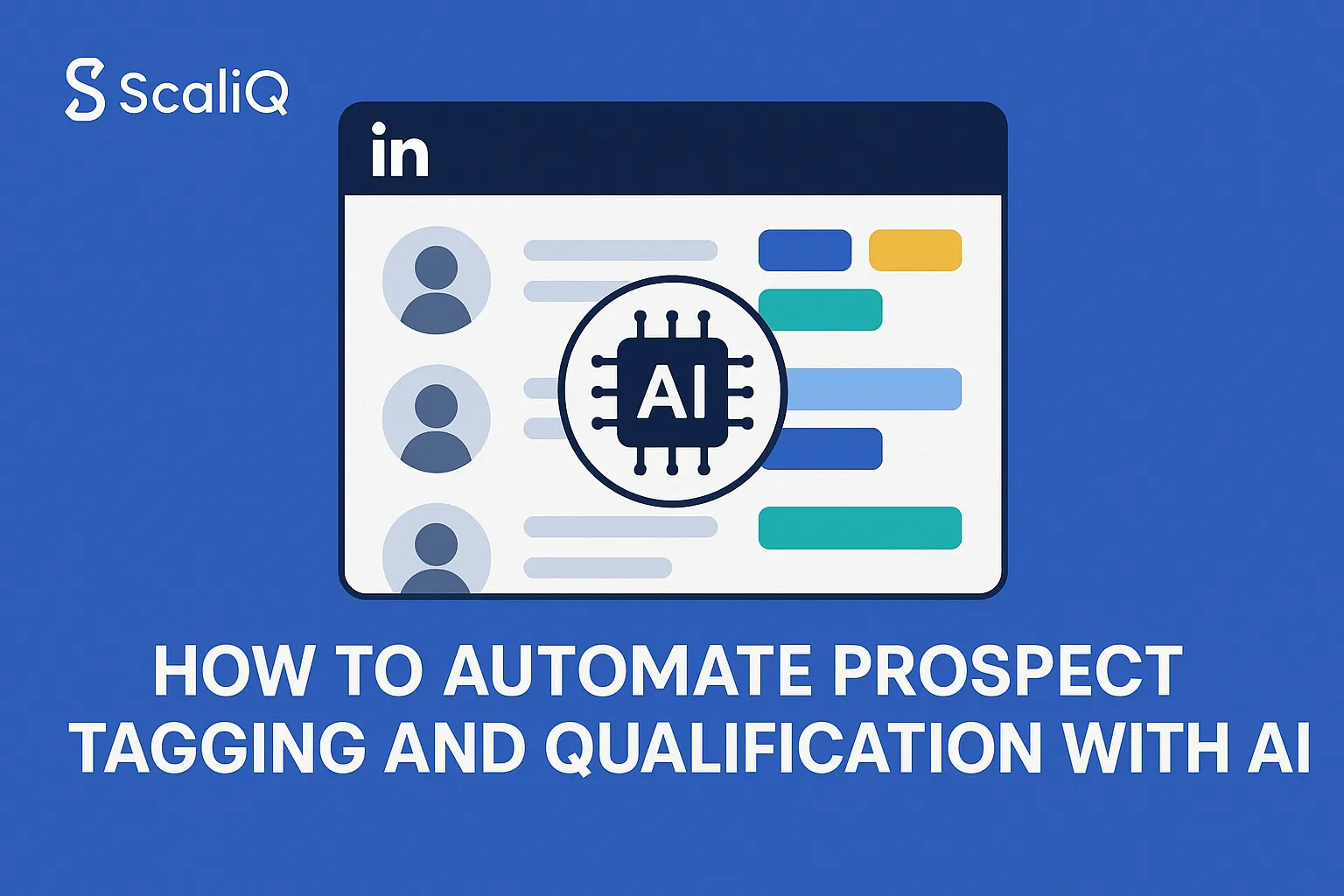
AI solves the tagging problem by removing the manual decision-making process from data entry. Instead of a human interpreting a message and clicking a button, an LLM (Large Language Model) analyzes the text and context to assign the correct tag automatically.
LLM-Based Classification
AI tools can scan LinkedIn profiles, recent posts, and direct message histories to understand context. Unlike basic automation that looks for simple keywords (e.g., "price"), AI understands nuance. It can differentiate between a prospect asking "How much is this?" (Buying Intent) versus "I can't afford this right now" (Objection).
Real-Time Intent Detection
The true power of ai qualification linkedin workflows lies in real-time updates. When a prospect replies to your message, AI detects the sentiment immediately.
• Intent-Based Tags: These track the prospect's mindset (e.g., "Interested," "Skeptical," "Referral Provided").
• Stage-Based Tags: These track where they are in the funnel (e.g., "Connection Accepted," "Conversation Started," "Meeting Booked").
Contrast With Generalist Tools
General automation tools simply sync data. If a prospect connects, they push the name to a CRM. They do not interpret the quality of the lead. Automated linkedin tagging using AI is dynamic; if a conversation shifts from positive to negative, the AI updates the tag instantly, ensuring your segments are always accurate.
Reliability in these systems is paramount. As outlined in NIST AI standards for reliability and transparency, trustworthy AI systems must be explainable and consistent. Modern AI tagging tools adhere to these principles, providing transparency on why a lead was qualified a certain way.
Discover how ScaliQ handles this automatically with intelligent tagging.
Building Effective Tagging Rules and Workflows
To get the most out of ai crm tagging and automation, you need a logical framework. AI is powerful, but it needs direction on how you define a "lead."
Core Tag Types (Intent, Stage, Negative Tags)
A robust tagging system usually consists of three categories:
1. Intent Tags: Describe what the prospect wants., High Intent: Asking about pricing, implementation, or meetings., Low Intent/Nurture: Asking for content, general networking., Curiosity: Asking technical questions without buying signals.
2. Stage Tags: Describe the logistical status., Lead Stage 1: Connection Request Sent., Lead Stage 2: Connection Accepted., Lead Stage 3: Replied., Lead Stage 4: Demo Scheduled.
3. Negative Tags: Crucial for filtering out bad fits., No Fit: Wrong industry or company size., Competitor: Works for a rival firm., Hiring: Only interested in selling to you.
AI continuously monitors the conversation. If a "Lead Stage 3" prospect says, "Let's talk next week," the AI adds "High Intent" and potentially moves them to "Lead Stage 4" territory automatically.
How to Create Simple Qualification Rules for Beginners
If you are new to how to automate tagging prospects on linkedin, start simple. Complex rules create confusion.
• Rule 1 (Engagement): If a prospect replies with >10 words, tag as "Engaged."
• Rule 2 (Profile Keyword): If the profile contains "Founder" or "CEO," tag as "Tier 1 Priority."
• Rule 3 (Rejection): If the reply contains "unsubscribe" or "not interested," tag as "Do Not Contact."
The beauty of ai qualification linkedin is consistency. A human might forget to tag a "Tier 1 Priority" on a Friday afternoon. AI applies these rules uniformly to every single contact, 24/7.
Workflow Example (Step-by-Step)
Here is how a fully automated workflow looks in practice:
1. Trigger: You send a connection request to a list of CTOs.
2. Scan: As they accept, the AI scans their profile. It notices they recently posted about "Scaling Engineering Teams."
3. Initial Tag: The AI assigns the tag "Topic: Scaling" and "New Connection."
4. Outreach: You send a message referencing scaling challenges.
5. Response: The prospect replies, "Yes, that's exactly our issue. Do you have a solution?"
6. Update: The AI detects the Buying Signal. It removes "New Connection," adds "High Intent," and tags them "Needs Reply ASAP."
This ensures you wake up to a list of "High Intent" leads, rather than a mixed inbox of noise.
Suggest pairing visual personalization/enrichment with tagging workflows.
Ensuring Compliance With LinkedIn-Friendly Automation
Automation on LinkedIn requires strict adherence to rules. The goal is efficiency, not getting your account restricted.
What LinkedIn Allows vs Prohibits
LinkedIn is clear about protecting user experience. According to LinkedIn’s Professional Community Policies, the platform prohibits the use of bots or other automated methods to access the services, add or download contacts, or send or redirect messages in ways that mimic human behavior deceptively or at scale (scraping).
• Safe Automation: Tools that help you organize visible data, draft responses for you to review, or categorize information you already have access to.
• Unsafe Automation: Tools that scrape data from profiles you haven't visited, send hundreds of messages per minute, or bypass view limits.
Safe linkedin automation focuses on processing data, not manipulating the platform's infrastructure.
Privacy & Data‑Handling Best Practices
When using AI to process prospect data, you are handling personal information.
• Minimal Storage: Only store data necessary for qualification.
• Respect Privacy: If a user asks to be deleted, your AI workflow should support immediate removal.
• Regulatory Compliance: Ensure your tools align with FTC privacy guidance and CCPA requirements, which mandate transparency in how consumer data is collected and used.
How AI Tagging Stays LinkedIn‑Friendly
AI tagging compliance is generally high because it acts on visible content. The AI analyzes the text of a message you received or a profile you are viewing. It does not need to "scrape" hidden servers or perform unauthorized API calls. It acts as a smart layer on top of the data you are already legally viewing, ensuring your linkedin workflow automation remains ethical and secure.
Choosing the Right AI Tagging Tool
Not all automation tools are built for qualification. Many are simply "click-bots" designed to spam connection requests. For ai tools for linkedin lead qualification, you need sophistication.
What to Look For
• Intent Detection: Can the tool read the sentiment of a reply?
• Dynamic Updating: Does the tag change automatically when the conversation evolves?
• LinkedIn-Native Workflows: Does it work where you work, or does it force you into a separate dashboard?
• Compliance: Does the vendor explicitly state their alignment with data privacy laws?
Many competitors fail here. They focus on volume (sending more messages) rather than quality (qualifying the replies). They often rely heavily on external CRMs, forcing complex integrations just to get a simple tag on a prospect.
Comparing AI Tagging Approaches
1. CRM-Based Systems: You connect LinkedIn to Salesforce or HubSpot., Pros: Centralized data., Cons: Setup is difficult; syncing often breaks; tags don't update in real-time on LinkedIn.
2. General Automation Tools: "Drip campaign" tools., Pros: Good for sending initial messages., Cons: Terrible at qualification. They treat a "Stop messaging me" reply the same as a "Tell me more" reply.
3. AI-First Tools: Specialized for intent based tagging., Pros: Understands context, updates dynamically, keeps LinkedIn clean.
Why ScaliQ Fits an AI-First Workflow
ScaliQ is designed specifically for this gap. It provides automatic, ongoing tag maintenance directly within your workflow. Unlike generalist tools, ScaliQ's engine is trained to recognize business intent. It offers automated linkedin tagging and qualification without the heavy overhead of a CRM, ensuring your leads are segmented correctly from the moment they connect.
Conclusion
Manual tagging is a bottleneck that stifles growth. It leads to dirty data, missed opportunities, and sales teams burned out on administrative tasks. By shifting to automated linkedin tagging, you ensure that every prospect is categorized consistently based on their actual behavior and intent.
AI ensures your workflow remains clean, your segmentation precise, and your outreach high-quality. Instead of guessing who to follow up with, you can rely on a system that highlights your best opportunities automatically.
If you are ready to stop acting as a data entry clerk and start operating as a strategic closer, it is time to integrate AI tagging into your LinkedIn strategy with ScaliQ.