

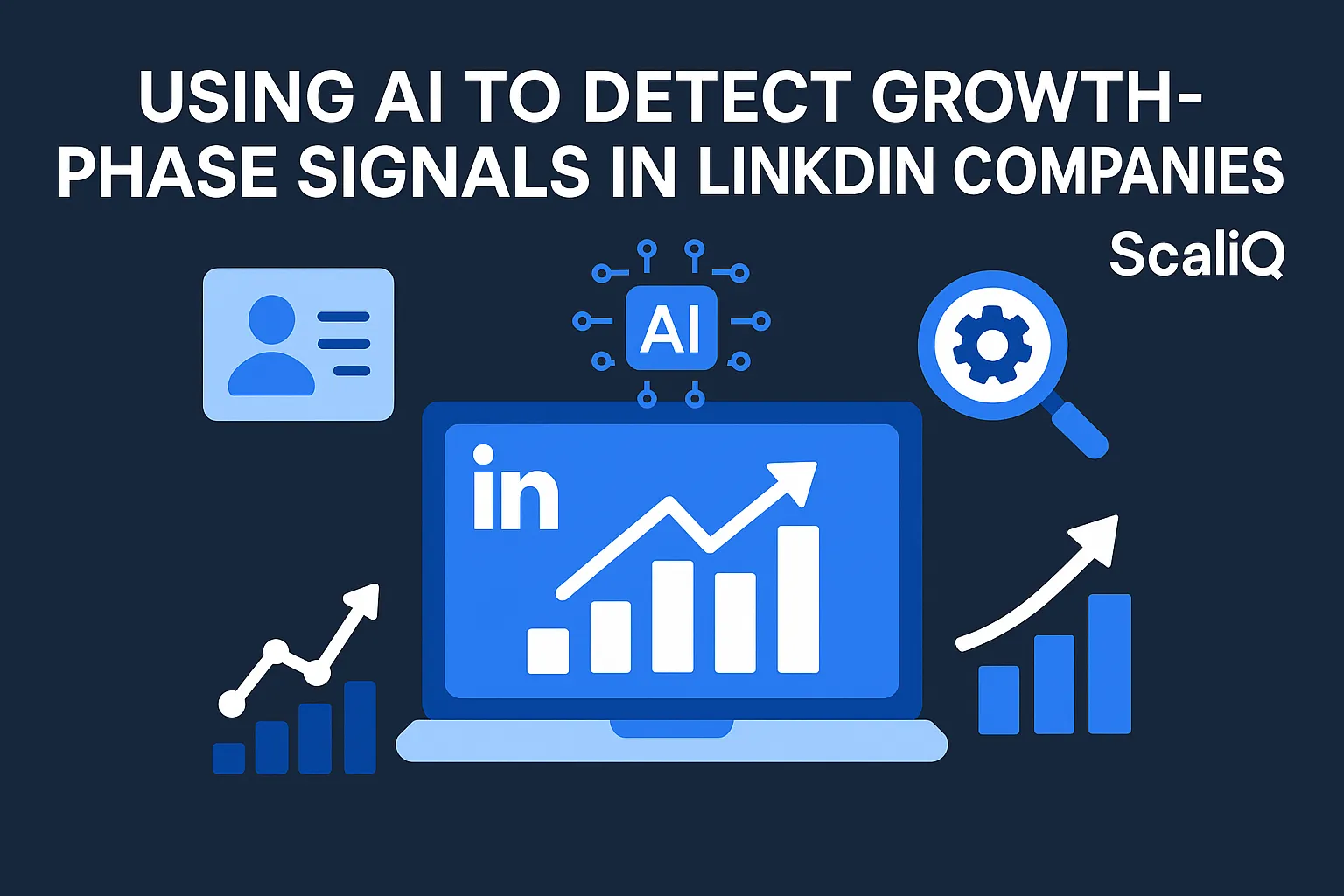
How to Use AI to Detect “Growth Phase” Signals in LinkedIn Companies
Most go-to-market (GTM) teams still prioritize accounts using static firmographics, funding news, or late-stage intent signals. However, the strongest emerging accounts often reveal their momentum much earlier. Long before a press release announces a new funding round, these companies show up through sustained hiring patterns, leadership expansion, and distinct changes in their LinkedIn activity.
The core challenge for revenue teams is not finding "active" companies, but separating noisy, superficial activity from genuine growth-phase momentum. Without a systematic approach, sales reps waste time chasing false positives, while missing out on the quiet expansion of high-value prospects.
This article provides a practical, evidence-based framework for using AI to detect growth-stage companies earlier, allowing you to prioritize outreach with absolute confidence. Designed for advanced sales, ABM, and RevOps teams that already utilize enrichment or account intelligence tools, this guide introduces a predictive layer: a composite scoring model that evaluates hiring velocity, role mix, leadership expansion, content cadence, and engagement shifts.
By leveraging transparent, AI-driven identification of growth-stage companies based on hiring and content patterns, platforms like ScaliQ help teams orchestrate their outbound motions around real business momentum. This is not a black-box AI claim; it is a compliant, observable methodology for mastering AI prospect targeting and company growth signals on LinkedIn.
Why Static Firmographics Miss Growth-Stage Accounts
Traditional ideal customer profile (ICP) filters are too slow and too shallow to detect fast-changing company momentum. Static attributes—such as industry, headcount, or headquarters location—answer the fundamental question: "Does this account fit?" Dynamic growth indicators, on the other hand, answer a more critical question for outbound timing: "Is this account changing right now?"
Relying solely on funding news, employee count updates, or industry filters means your account intelligence often lags behind a company's real commercial expansion. By the time a company updates its official headcount bracket, the optimal window to sell them a scaling solution has likely passed. Furthermore, manual LinkedIn review does not scale across territories, segments, or ABM programs. GTM teams need a system that observes firmographic filters vs growth signals continuously, providing actionable account prioritization without manual bottlenecking.
Static ICP Filters Are Useful—but Incomplete
Firmographics remain essential for baseline segmentation, total addressable market (TAM) design, and territory planning. They ensure you are not selling enterprise software to a local bakery. However, firmographics are a baseline, not a timing mechanism.
Consider two companies with identical static firmographic filters: both are B2B SaaS companies in the fintech space with 200 employees. Company A has had a flat headcount for two years and posts sporadically. Company B is actively hiring a new VP of Sales, opening five new mid-level marketing roles, and consistently publishing thought leadership. Static filters view these accounts as equal. Signal-based scoring recognizes Company B as a prime target for ideal customer profile expansion. Firmographics should be used as an initial screen, with dynamic account intelligence layered on top to dictate timing.
Why Manual Signal Interpretation Breaks at Scale
For the individual sales rep, manual LinkedIn prospecting is a broken workflow. Checking company pages, scrolling through job openings, and analyzing recent posts creates massive inconsistency. Account signals are fragmented across hiring, content, and engagement tabs.
When reps attempt to interpret these fragmented account signals manually, it leads to uneven account prioritization and poor outbound timing relevance. One rep might aggressively pursue an account because of a single viral post, while another ignores a company that is quietly doubling its engineering team. This operational pain point directly highlights the need for AI monitoring over time—analyzing publicly accessible data compliantly to surface patterns that human eyes miss at scale.
Growth Signals vs Intent Signals
It is vital to distinguish between b2b intent signals and growth signals. Intent signals typically indicate research activity—someone at the company is downloading whitepapers or visiting your pricing page. Growth signals, conversely, reveal internal expansion momentum.
Growth signals often appear much earlier than downstream buying-stage indicators. A company will hire a new RevOps leader and expand its sales team (a growth signal) months before that new team begins researching new CRM software (an intent signal). Use growth signals for discovery and prioritization, and intent signals for timing and validation. This framework moves beyond the broad buying-signal narratives common in intent data vs growth signals discussions. As supported by LinkedIn Economic Graph workforce insights, workforce shifts and hiring behavior are highly meaningful business signals that precede software or service procurement. Predictive prospecting for account-based marketing requires mastering both.
The LinkedIn Signals That Actually Indicate Company Growth
To effectively identify growth-stage companies, you must define the specific LinkedIn-native and LinkedIn-observable signals that truly matter. This requires separating vanity metrics from meaningful expansion indicators.
Single signals are incredibly weak in isolation. A sudden spike in engagement might just be a controversial post, not a sign of company growth. The framework below relies on pattern recognition over time across five core categories: hiring velocity, role mix, leadership expansion, content cadence, and engagement changes.
Hiring Velocity as an Early Growth Indicator
Sustained job creation is one of the most reliable indicators of expansion plans, often visible before the market broadly recognizes a company's trajectory. However, there is a distinct difference between one-off hiring bursts and consistent, multi-period growth.
The most valuable lens for evaluating hiring signals is the rate of change over time, not raw job count alone. Operationally, high hiring velocity means rising openings over consecutive months, repeated postings for specific role families, and sustained expansion rather than a brief seasonal spike. This is a critical component of growth phase detection. In fact, research on job openings as a leading indicator confirms that workforce demand is a strong predictor of broader economic and organizational momentum. When learning how to identify fast-growing companies on linkedin, tracking the velocity of open requisitions is step one.
Role Mix Reveals the Type of Growth
Role composition matters far more than job volume alone. Hiring 20 customer support representatives to replace churned staff is very different from hiring 5 enterprise account executives and a new product marketing manager.
Analyzing the role mix helps you separate expansion hiring from replacement backfills. Hiring across revenue, product, customer success, and operations signals coordinated scaling.
• Revenue Hiring: Suggests an aggressive push for new market share.
• Product Hiring: Indicates upcoming feature launches or platform expansion.
• Leadership Hiring: Points to structural maturation.
• Support-Function Hiring: Highlights a focus on retention and scaling operations.
Understanding this mix drives smarter account prioritization and precise go-to-market intelligence.
Leadership Expansion Signals Strategic Commitment
Senior hires are a massive indicator of budget availability, team formation, or new market entry. Leadership expansion is often the strongest confidence signal when it appears alongside broader departmental hiring.
Meaningful leadership patterns include hiring a new Head of Growth, VP of RevOps, Chief Product Officer, or a Director of Regional Expansion. These hires are brought in with a mandate to build and spend. For sales prospecting ai and ai prospect targeting, tracking leadership expansion directly influences outbound relevance. Reaching out to a newly hired VP of Sales with a tool designed to help them scale their new team is significantly more effective than a generic cold pitch.
Content Cadence Shows Go-to-Market Momentum
Content cadence refers to the frequency and consistency of a company’s posting over time. Rising publishing activity can signal an active GTM motion, investments in employer branding, product launches, or market education initiatives.
However, posting more often does not automatically equal growth—cadence needs supporting signals. The message shifts within the content are what truly matter. Are they pushing hiring campaigns, publishing category education, sharing customer proof, or announcing product updates? These content activity signals, when analyzed as part of go-to-market intelligence, provide profound context into a company's current strategic focus and validate other linkedin company growth signals.
Engagement Shifts Help Validate Market Attention
Changes in account engagement help validate that a company's activity is actually resonating externally. Engagement alone is notoriously noisy; it can be artificially inflated by brand campaigns, employee advocacy pods, or isolated viral posts.
Engagement becomes highly useful when paired with hiring and content consistency. For example, if a company is increasing its content cadence, expanding its sales team, and seeing a sustained 40% lift in engagement, that is a verified growth trajectory. According to the LinkedIn Company Engagement Report, tracking account-level engagement trends is crucial for prioritizing outreach windows. B2b account intelligence linkedin strategies rely on these shifts to ensure ABM and sales teams are focusing on accounts with genuine market attention.
How to Combine Hiring, Content, and Engagement Into a Growth Score
Turning scattered observations into a repeatable, AI-assisted scoring model is what separates this framework from generic "sales trigger" lists. The goal is not perfect prediction, but consistent, scalable account prioritization based on multi-signal patterns. By leveraging publicly available data compliantly, AI prospect targeting can systematically evaluate company growth signals linkedin.
Build a Composite Signal Model
A composite growth score weights multiple signal categories rather than relying on a single trigger event. This model should incorporate hiring velocity, role mix diversity, leadership expansion, posting cadence change, and engagement trend consistency.
Crucially, each component must be measured over time, not as a static, one-time snapshot. This longitudinal analysis allows AI to categorize accounts into confidence tiers: low, medium, and high momentum. This approach to growth phase detection is the foundation of predictive prospecting for account-based marketing.
Suggested Weighting Logic for Advanced GTM Teams
Advanced GTM teams should weight signals differently based on their specific market, sales cycle, and product offering. However, a general rule applies: isolated signals receive lower weights, while coordinated signals compound.
For instance, high hiring velocity without role diversity (e.g., hiring 50 warehouse workers) may deserve a lower confidence score for a B2B SaaS vendor. Conversely, coordinated signals—such as a new VP of Marketing hire followed by content acceleration and an uptick in marketing coordinator job postings—deserve a significantly higher score. Presenting signal weighting as a flexible framework rather than a rigid formula ensures adaptability. To ensure these models remain reliable and explainable, teams should align their scoring logic with trustworthy AI validation practices, such as those outlined in the NIST AI Risk Management Framework. This mitigates the risk of fragmented account signals driving poor decisions.
Signal Sequencing Matters More Than Isolated Events
The sequence of signals is often more predictive than simultaneous spikes. Ordered patterns tell a story of strategic execution.
Consider a sequence: A company hires a new RevOps leader (Signal 1), followed 30 days later by role expansion in the SDR team (Signal 2), followed by increased thought-leadership output from the founders (Signal 3). This sequence is a highly predictive indicator of a scaling GTM motion. In contrast, an account that randomly spikes in engagement for one week without any underlying hiring or leadership changes is likely just experiencing a PR moment. Tracking signal sequencing directly improves outbound timing relevance and helps identify growth-stage company indicators earlier.
A Simple Example of a Growth-Phase Scoring Workflow
Let’s look at a concrete example comparing two companies with similar baseline activity.
• Company X posts daily and has high engagement, but their job openings have remained stagnant for six months, and their leadership team hasn't changed. Their composite score remains low (Vanity Activity).
• Company Y posts moderately, but their hiring velocity has increased by 15% month-over-month, they recently hired a new VP of Product, and their role mix shows expansion in engineering and product marketing. Their composite score triggers a "High Momentum" alert.
Once Company Y hits this threshold, the workflow automation routes the account directly to the appropriate SDR, assigns it to an ABM nurture track, or updates its CRM status. Platforms like Www.Notiq.Io excel at this type of workflow orchestration, demonstrating how alerts, scoring, and routing can be automated across GTM systems to execute sales prospecting ai and identify how can ai identify growth-stage companies from linkedin data.
How Sales, ABM, and RevOps Can Operationalize Growth Signals
A scoring model is only valuable if it drives action. Integrating this framework into real GTM workflows requires tailoring the implementation guidance by team function. This involves setting up alerting, defining thresholds, routing accounts, aligning messaging, and establishing refresh cadences—areas where AI enrichment and compliance offer distinct advantages.
Sales Teams: Prioritize Outreach Around Momentum Windows
SDRs and AEs can use growth scores to focus their daily efforts on accounts displaying emerging expansion signals. Instead of cold calling down an alphabetical list, reps prioritize outreach around validated momentum windows.
These signals improve outbound timing relevance rather than just increasing raw email volume. Furthermore, reps must align their messaging to the detected patterns. If the signal is hiring growth, the message should focus on scaling infrastructure. If the signal is new leadership, the message should focus on achieving new mandates. This approach builds immense confidence for reps who traditionally rely on intuition or generic sales trigger events, transforming how can sales teams use ai prospect targeting for account prioritization.
ABM Teams: Expand ICP Selection With Dynamic Signals
Account-Based Marketing (ABM) teams can use growth signals to discover accounts that fit the "future ICP," rather than just relying on historical win data.
Growth-phase scoring supports dynamic account tiering, campaign prioritization, and budget focus. If an account begins showing strong cross-functional hiring and content acceleration, it can be dynamically moved into a Tier 1 ABM campaign. Signal-based selection uncovers emerging accounts before broad market intent becomes obvious, making it a cornerstone of predictive prospecting for account-based marketing and ideal customer profile expansion.
RevOps Teams: Define Thresholds, Routing, and Refresh Logic
RevOps is the engine that operationalizes scoring. This team must define the thresholds for CRM flags, territory routing, and enrichment workflows.
RevOps should establish clear rules for each score band:
• Low Score: Monitor and maintain in database.
• Medium Score: Route to marketing for automated nurture.
• High Score: Assign immediately to sales for personalized outreach.
Refresh cadence is equally critical. Growth signals decay quickly; a leadership change from 18 months ago is no longer a timely trigger. RevOps must also implement governance: who owns the model, who audits it, and how false positives are reviewed. Orchestrating these recurring monitoring and trigger-based workflow actions is where tools like Www.Notiq.Io provide essential infrastructure for signal orchestration and growth-phase alerts.
Turn Signals Into Better Outbound Messaging
Detected signals must influence the messaging angle, not just list building. The strongest use case for AI prospect targeting is relevance—crafting outreach informed by what the account is likely experiencing right now.
Signal-to-Message Mapping:
By mapping signals directly to messaging themes, teams leverage true account intelligence. For further strategies on personalization and message strategy tied to detected signals, resources like Blog offer excellent supporting frameworks for outbound messaging.
How to Avoid False Positives and Validate Momentum
The biggest weakness in any signal-based prospecting motion is noise. Isolated hiring, sporadic content bursts, or inflated engagement can easily mislead teams if not properly vetted. Building trust in your AI prospect targeting requires multi-source validation and strict confidence thresholds.
Common False Positives GTM Teams Should Watch For
Not all activity equals growth. GTM teams must watch for common hiring signal false positives and content activity signals that mimic expansion:
• Replacement Hiring: High job volume due to high turnover, not growth. (Risk Level: High. Requires role mix validation).
• Agency-Driven Posting Spikes: A sudden surge in polished content because the company hired a PR firm, without underlying business changes. (Risk Level: Medium. Requires hiring validation).
• Seasonal Recruiting: Retail or logistics companies hiring for Q4. (Risk Level: High. Requires historical time-series validation).
• One-Off Engagement Surges: A single post goes viral. (Risk Level: Low. Requires consistency validation).
Understanding these growth-stage company indicators prevents teams from wasting resources on noisy data and fragmented account signals.
Validate Signals Across Multiple Periods and Sources
Time-series validation is critical. A sustained change observed over 90 days is infinitely more trustworthy than a one-week spike. You must check whether hiring, role mix, and messaging shifts persist across multiple refresh cycles.
Furthermore, validating LinkedIn observations with additional public indicators builds higher confidence. For example, OECD report on digital skills and job-posting data reinforces that job-posting data, when tracked consistently, provides highly meaningful economic and business signals. The goal of multi-signal validation is not perfect certainty, but rather building sufficient confidence to justify the cost of personalized outreach and go-to-market intelligence efforts.
Use AI Responsibly in Scoring and Prioritization
AI should support human decision-making, not replace judgment entirely. When deploying AI prospect targeting, teams must document model assumptions, confidence thresholds, and manual review processes.
Explainability is non-negotiable. Sales reps and RevOps leaders should be able to look at an account and know exactly why it scored highly. Tying trustworthiness to governance, transparency, and periodic model tuning is essential for trustworthy AI. Following guidelines like the NIST AI Risk Management Framework ensures your account prioritization models are built responsibly, compliantly, and transparently.
Differentiate This Framework From Generic Trigger Lists
Many intent data vs growth signals tools on the market surface basic triggers (e.g., "Company X raised Series B"). However, fewer provide a practical, dynamic growth-phase momentum model using compliant LinkedIn hiring and content patterns together.
The ScaliQ approach differentiates itself by focusing on earlier-stage detection, sophisticated weighting logic, rigorous false-positive reduction, and seamless workflow operationalization. Instead of bombarding reps with isolated alerts, this framework delivers a cohesive, multi-signal narrative that accurately reflects company growth signals linkedin.
Future Trends in Predictive Prospect Targeting
The landscape of B2B sales is shifting rapidly. GTM teams are moving away from static enrichment and embracing continuous monitoring and scoring. The future of go-to-market intelligence lies in AI agents, workflow automation, and multi-signal company intelligence.
From Snapshots to Continuous Account Monitoring
We are witnessing the end of periodic list pulls. The future is always-on, continuous account monitoring. Because growth signals decay rapidly, continuous refresh is mandatory for accurate growth-phase detection. This shift transforms territory planning from a once-a-year exercise into a dynamic, living process, ensuring pipeline creation is always focused on accounts actively exhibiting growth-phase alerts and real-time account prioritization.
Why Multi-Signal Intelligence Will Outperform Single-Source Enrichment
The core thesis of modern prospecting is that signal combinations are vastly stronger than isolated indicators. Multi-signal company intelligence—synthesizing hiring, content, and engagement data—reveals a company's trajectory, not just its current state. As AI prospect targeting matures, platforms that can seamlessly correlate these disparate data points will become the standard expectation for advanced sales and ABM teams, far outpacing single-source b2b intent signals.
Conclusion
The most actionable company growth signals linkedin offers are not isolated trigger events, but coordinated patterns. By tracking hiring velocity, role mix, leadership expansion, content cadence, and engagement shifts, GTM teams can detect genuine momentum long before it becomes obvious to the broader market.
This represents a necessary strategic shift from relying on static firmographics to embracing dynamic growth-phase detection. The operational payoff is massive: earlier account discovery, sharper account prioritization, highly relevant outbound messaging, and unshakeable confidence across your sales, ABM, and RevOps teams.
We encourage revenue leaders to build transparent scoring models, validate signals over time, and automate the routing of high-confidence accounts into immediate action. To explore how you can operationalize this framework and leverage AI-driven prospect targeting to identify growth-stage accounts compliantly and effectively, visit ScaliQ.