

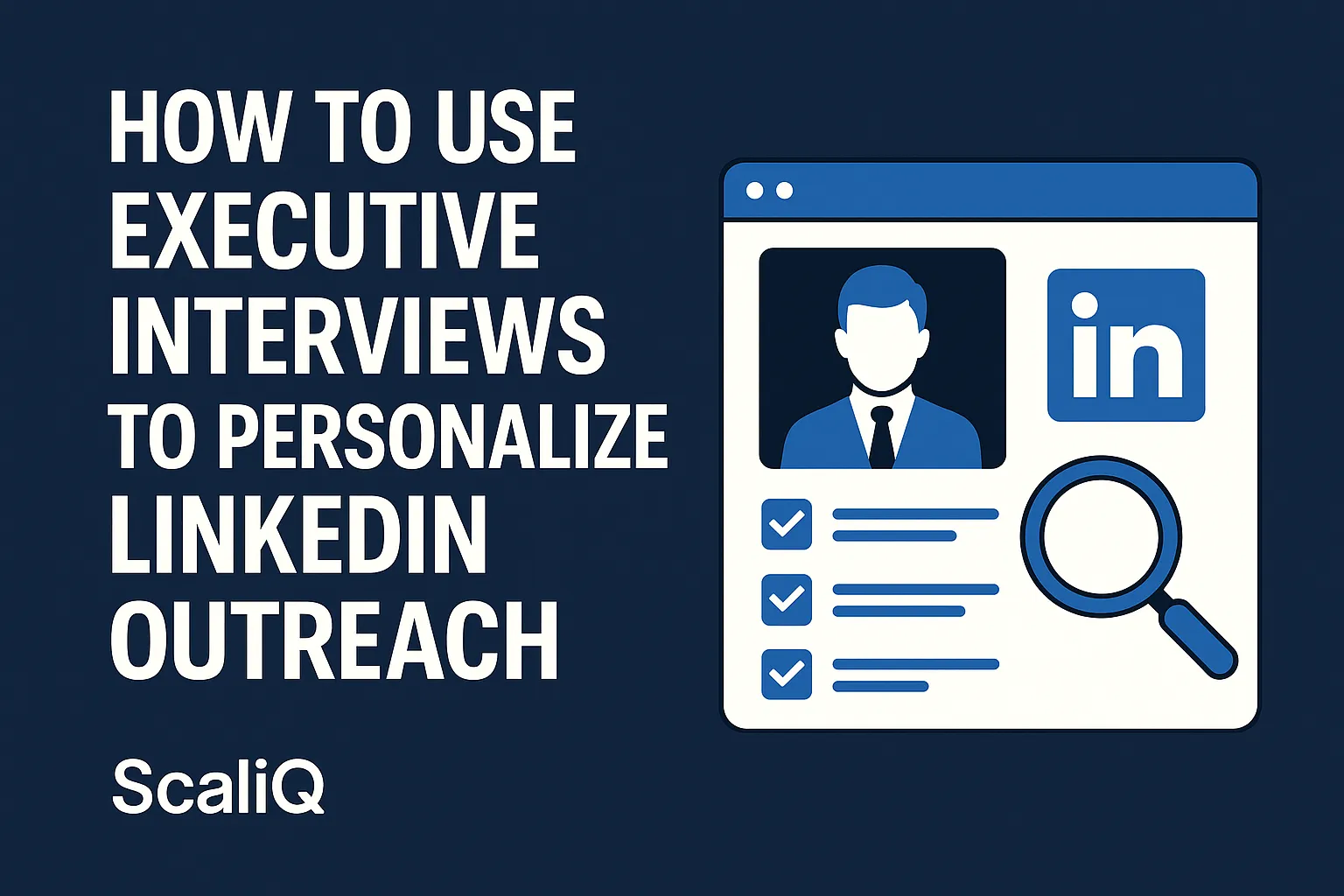
How to Use Executive Interviews to Personalize LinkedIn Outreach
Most LinkedIn personalization fails because it sounds personalized without proving real understanding. Generic compliments, role-based references, and shallow first lines rarely resonate with senior B2B buyers. While a prospect might appreciate a polite nod to their recent promotion or a casual mention of their alma mater, advanced buyers respond to relevance, not familiarity theater. Public executive interviews—such as podcasts, earnings calls, and keynote presentations—often contain clearer signals about a company’s priorities, constraints, and transformation efforts than a prospect’s static LinkedIn profile ever could.
This article will show you how to turn podcasts, earnings commentary, keynote appearances, and public interviews into credible outreach angles for LinkedIn and outbound messages. By adopting a research-driven methodology like ScaliQ, sales and marketing teams can extract strategic priorities first, writing executive interview personalization from a place of deep business context rather than superficial flattery. This structured approach converts public executive commentary into high-value strategic signals, ensuring your prospect research directly fuels outbound relevance.
Why Generic Personalization Fails
If your LinkedIn message personalization relies on phrases like, “Loved your post,” “Congrats on the growth,” or “Saw your background in SaaS,” you are likely being ignored by executive buyers. These superficial compliments reduce your credibility because they signal low effort or templated automation. There is a massive gap between simply mentioning a public fact and demonstrating a genuine understanding of a real strategic priority.
Advanced outbound teams, SDRs, and ABM operators need higher-signal inputs for their high-value accounts. While personalized first lines serve as a useful category for breaking the ice, first-line generation alone is not enough without deeper prospect research inputs. Unlike typical profile scraping or social-signal monitoring, executive interview personalization starts with strategy, not sentence decoration. Priority-led personalization proves to the buyer that you understand the mechanics of their current business challenges.
What advanced buyers actually respond to
Advanced buyers ignore generic outreach even when it appears customized. Relevance improves dramatically when your outreach reflects their publicly stated initiatives, constraints, or execution priorities. Business-context personalization feels significantly more credible than a polite compliment because it ties directly to the executive’s daily operational world. High-signal themes that consistently earn executive attention include growth efficiency, hiring bottlenecks, GTM execution, AI adoption, market expansion, and customer experience transformations. Grounding your buyer research in these executive priorities demonstrates immediate commercial acumen.
The difference between vanity details and priority signals
To execute effective account-based outreach, you must separate vanity details from priority signals. Vanity details are low-stakes personal or profile facts—like where a prospect went to college or a generic award they won—that do not support a meaningful business conversation. Priority signals, on the other hand, are clear indicators of active strategic focus. These include repeated references in public interview research to hiring surges, margin pressure, product adoption hurdles, or go-to-market shifts. Extracting these executive interview insights forms the foundation of a highly converting outreach strategy.
How to Extract Strategic Priorities from Executive Interviews
Turning long-form public content into structured prospect research requires a repeatable framework. The most valuable sources for this research are podcasts, keynote talks, earnings commentary, panels, press interviews, and public leadership appearances. When analyzing these sources, you are listening for repeated initiatives, operational bottlenecks, market pressures, hiring focus, customer language, and measurable goals.
The objective is not to quote everything the executive says, but to isolate specific signals that support a relevant value hypothesis. Using a structured extraction framework—categorizing findings by priority, pain point, initiative, timing, internal language, and possible outreach angle—makes this process highly tactical and scalable. For example, financial disclosures offer massive insight; the SEC guide to reading MD&A in a 10-K highlights how management commentary reveals priorities, risks, and performance themes. Furthermore, as noted by the SEC on the purpose of MD&A disclosures, these documents help readers view the company directly from management’s perspective. Leveraging ScaliQ for structured extraction, tagging, and converting raw executive commentary into usable signals ensures this public interview research remains transparent, non-invasive, and highly actionable.
Start with the right public sources
Not all content is created equal. Prioritize recent, high-context sources over random, outdated snippets. The best places to start your thought leadership mining include:
• Public interviews and industry podcasts
• Earnings-related commentary or investor communications
• Conference talks and keynote appearances
• Thought leadership content with clear strategic substance
Recency matters immensely when evaluating whether a stated initiative is still active. A strategic priority mentioned three years ago is likely resolved or abandoned, whereas a challenge discussed last month is ripe for prospect research.
Identify the signals that matter most
When conducting buyer research, break the signals you find into actionable categories: strategic priorities, execution challenges, transformation initiatives, hiring or organizational focus, market pressure, and internal language patterns. Repeated themes across multiple public appearances are vastly stronger than one-off remarks. Look for specific, measurable statements such as “expanding into enterprise,” “shortening implementation time,” or “improving sales efficiency.” These specific insights form the backbone of highly relevant ICP-based messaging.
Separate active priorities from generic thought leadership
It is critical to distinguish between current, operational initiatives and broad leadership philosophy. To validate whether a signal is an active priority, ask yourself: Was this mentioned recently? Has the executive repeated it more than once? Does it align with current hiring, GTM, or company activity? Does it imply a measurable business impact? Building your B2B executive interview insights outreach on abstract philosophy often leads to weak messaging. Focus strictly on operational realities for your account research for ABM personalization.
Capture language you can mirror naturally
Executive wording should deeply inform your outreach tone and terminology. Instead of copying exact quotes into your first messages, focus on paraphrasing strategic language. Mirroring specific terms—such as “efficiency,” “expansion,” “implementation friction,” or “customer adoption”—makes your sales message personalization feel incredibly relevant and native to the buyer's internal culture. This is how to research executives before outreach in a way that generates LinkedIn outreach personalization examples that actually convert.
Turning Interview Insights into Outreach Messages
Good personalization does not simply restate the interview; it connects the interview to a useful business conversation. Once you have extracted a public interview insight, you must map it to a probable business pain point, form a value hypothesis, and craft a concise opening line. This chain transforms raw executive interview personalization into compelling LinkedIn message personalization and outbound messaging.
Instead of proving that you did the research, your outreach should use the research to open a relevant dialogue. By relying on a structured methodology like ScaliQ to turn research into outreach-ready variables and message inputs, sales personalization becomes a natural extension of the prospect's own strategic roadmap.
The messaging formula
The strongest openers are short, specific, and focused. Avoid overloading the message with references. Use this simple B2B outreach research formula:
1. Public priority observed
2. Why it matters operationally
3. Relevant value hypothesis
4. Low-friction call to engage
This formula ensures your account-based outreach remains executive-appropriate and directly tied to business outcomes.
Example: from superficial compliment to strategic relevance
Consider a typical "before" example of superficial personalization:
• "Hi [Name], loved your recent podcast on leadership style. Great insights! I’m reaching out because our software helps teams..."
Now, look at the "after" example, using sales message personalization without complimenting:
• "Hi [Name], noticed on the [Podcast Name] that shortening implementation time for enterprise clients is a core focus this quarter. Typically, when teams scale that motion, data onboarding becomes the primary bottleneck. Are you currently evaluating ways to automate that data ingestion?"
The second version feels significantly more credible. It ties directly to executive priorities and introduces a commercial conversation naturally.
How to map interview themes to outreach angles
Translating an interview theme into a plausible problem statement—rather than a hard assumption—is the key to a strong value hypothesis. Here is a prospect research framework for sales to map common themes:
• Hiring focus → Map to ramp time, enablement, and process efficiency.
• Growth initiative → Map to pipeline quality, account targeting, and conversion lift.
• Customer expansion → Map to product adoption, retention, and onboarding friction.
• AI transformation → Map to workflow clarity, data readiness, and execution risk.
What to quote, paraphrase, or avoid
In first-touch outreach, paraphrasing is almost always more effective than quoting. A short, direct quote may be useful in follow-ups or if the executive's wording is highly distinctive and publicly recognizable. However, you must avoid sounding intrusive, overly detailed, or performative. Credible personalization in social selling requires you to sound like a peer referencing a public business challenge, not a fan reciting a transcript.
Scaling Research-Driven Personalization with Workflows and AI
Manual interview review does not scale, but low-quality AI inputs create templated, robotic outputs. To operationalize this approach across your pipeline, you must build a repeatable workflow that blends automation with analyst-style interpretation. The process involves collecting public sources, summarizing content, tagging themes, validating priority signals, generating message inputs, and applying manual review.
AI is a powerful accelerator for summarization and organization, but it is not a substitute for human judgment. As noted by HBR on AI-assisted personalized sales pitches, AI improves personalization efficiency, but strategic context still requires interpretation. While adjacent workflow tools like Sales Navigator, Clay, Common Room, Gong, and RepliQ act as excellent ecosystem inputs, deep strategic interpretation remains the differentiator. Advanced teams use platforms like ScaliQ for summarization, tagging, and workflow automation, and leverage personalized lines for message-generation support only after the strategic inputs are secured.
A scalable workflow for teams
To standardize this across named accounts or ICP segments, implement this 5-step process:
1. Source public executive content.
2. Summarize and extract key themes.
3. Tag priorities, constraints, and specific language.
4. Map these tags to outreach hypotheses.
5. Draft and manually review personalized messaging.
This structured workflow ensures your B2B outreach research yields consistently high-quality account-based outreach.
Where AI helps—and where it hurts
In AI-assisted prospect research workflows, AI excels at summarizing long interviews, pulling repeated themes, organizing notes into structured fields, and drafting baseline message options. However, AI personalization often fails by misreading vague commentary as an urgent priority, generating polished but shallow opening lines, and losing authenticity when prompts lack strong research inputs. Human review remains essential to ensure executive interview insights are applied correctly.
Combine interview insights with account context
Executive commentary becomes exponentially stronger when paired with broader company signals. Always validate interview insights against account context such as a hiring focus, growth direction, GTM execution, or recent transformation initiatives. Signal-based personalization requires you to cross-reference public statements with actual company behavior. This depth-first approach consistently outperforms enrichment-only workflows that may be faster but offer much lower signal quality for account research for ABM personalization.
Using Public Research Credibly and Naturally
Trustworthiness matters just as much as relevance. The safest and most credible approach to prospect research is to use only publicly accessible commentary and represent it accurately. Not every public statement should become outreach copy, and not every executive statement should be framed as an urgent pain point.
When referencing public interviews, you must avoid overclaiming, exaggerating, or sounding invasive. All data extraction and messaging must emphasize compliance with privacy regulations and ethical automation. As outlined by the FTC advertising and marketing guidance, claims must be truthful, non-deceptive, and evidence-based. Furthermore, adhering to FTC guidance on native advertising and transparency ensures your commercial intent remains transparent.
How to sound informed without sounding intrusive
To maintain credible outreach, reference the overarching business theme rather than hyper-specific details of the interview. A message stating, “You mentioned improving implementation speed recently,” is far stronger and more natural than saying, “At minute 18 of your podcast with X, you said...” Brevity and restraint are the hallmarks of effective social selling personalization based on public interview research.
Validate before you personalize
Before leveraging executive priorities in your buyer research, validate them. Check the recency of the statement, look for repetition across multiple sources, confirm alignment with visible company activity, and avoid overinterpreting speculative commentary. Validating your B2B outreach research prevents you from basing a campaign on a fleeting thought, ultimately improving both reply quality and prospect trust.
Tailor the message to the person versus their team
Advanced prospect research allows you to translate the same strategic priority differently depending on the recipient’s seniority. If the CEO mentions a new GTM expansion in a keynote, your message to the CEO should focus on high-level execution risk. However, if you use that same insight to message a Director of Sales under them, your LinkedIn outreach personalization examples should pivot to focus on pipeline generation, enablement, and tactical account-based outreach required to meet the CEO's mandate.
Future Outlook: Why Priority-Led Personalization Will Matter More
As generic, AI-generated outreach floods executive inboxes, evidence-based personalization will become the ultimate differentiator. The industry is rapidly shifting toward signal-based GTM, where elite revenue teams combine public content intelligence with deep account context. The winning model in the future of outbound is not simply more automation or higher volume; it is better inputs, sharper interpretation, and highly credible messaging. Executive interview personalization sits at the forefront of this shift, allowing teams to cut through the noise by proving they understand the buyer's world before they ever ask for a meeting in their AI-assisted prospect research workflows.
Conclusion
The best LinkedIn message personalization is never about sounding familiar; it is about proving relevance through publicly available strategic context. By moving away from generic compliments and shallow first lines, you can capture executive attention with priority-led messaging.
To execute this effectively: find the right public interview sources, extract genuine priorities and constraints, map them to operational pain points and value hypotheses, write concise and natural outreach, and carefully scale the process using thoughtful workflows and AI. Executive interview personalization empowers your team to transcend basic profile details and engage buyers on the strategic initiatives that actually matter to them.
For outbound operators, SDRs, and ABM teams who want a repeatable, research-driven system for higher-quality outreach, utilizing platforms that structure this data is critical. Learn how ScaliQ structures executive research into outreach-ready signals to elevate your pipeline generation.