

Introduction
Advanced revenue teams face a recurring operational bottleneck: LinkedIn ABM outreach consistently underperforms when executed as one-rep-to-one-lead prospecting rather than a coordinated account-based system. Treating complex B2B deals as individual interactions rather than buying-group decisions creates massive blind spots. Single-threaded outreach leads to weak internal referrals, low account penetration, and ultimately, stalled pipeline.
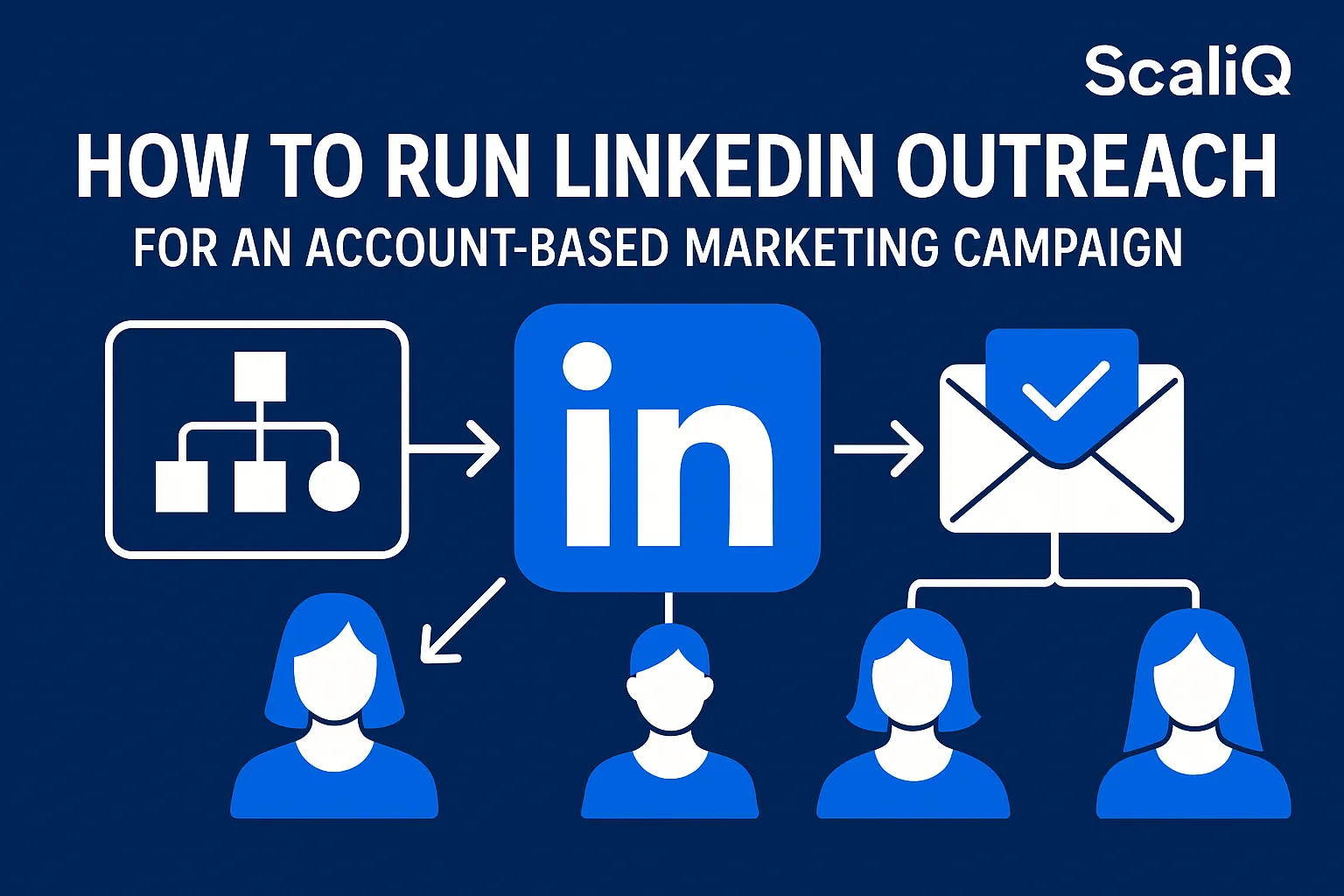
This guide provides a repeatable operational playbook for multi-threaded sales campaigns on LinkedIn. It covers the end-to-end workflow required to succeed: disciplined account selection, stakeholder mapping, messaging orchestration, reply management, and account-level measurement. Designed for mature sales and marketing operations, this framework moves beyond basic LinkedIn prospecting to establish a highly strategic, execution-driven model.
At the core of this operational shift is ScaliQ, an account-based outreach system that treats account selection, stakeholder mapping, coordinated messaging, and reply management as one unified workflow rather than a series of disconnected tasks. By orchestrating account based prospecting at scale, teams can effectively penetrate target accounts without sacrificing relevance or coordination.
Account Selection and Prioritization
Strong LinkedIn ABM outreach begins long before the first message is drafted. It starts with disciplined account selection and tiering. Poor account prioritization is the root cause of wasted personalization effort, fragmented rep activity, and low meeting yield. When teams treat all accounts equally, they dilute their resources, applying surface-level touches to high-value targets and wasting premium effort on low-value prospects.
A practical account selection process evaluates four criteria: firmographic fit, timing, potential deal value, and available engagement signals. By tiering accounts, revenue teams ensure that personalization depth matches both the account’s strategic value and the team’s operational capacity. This dictates whether ABM sales outreach should begin immediately or if the account requires further research and signal validation.
This disciplined workflow stands in stark contrast to generic volume-first prospecting approaches that prioritize list size over account quality. Relying on Gartner’s framework for ABM account selection and tiering, advanced teams know that personalization depth must align with available resources and account tier, not be applied uniformly across a massive database. Tools that support account selection and prioritization are essential for operationalizing this strategy.
Define Your Ideal Target Account Before Outreach Starts
LinkedIn outreach strategy for ABM is only effective when target account outreach focuses on a rigorously defined Ideal Customer Profile (ICP), rather than ad hoc rep intuition. A mature ICP definition encompasses firmographic fit (revenue, industry, headcount), operational triggers (new technologies installed, recent mergers), strategic relevance, and buying complexity.
Account lists must reflect both the baseline fit of the organization and the likelihood of engaging multiple stakeholders successfully. For example, a high-fit account might be a recently funded enterprise software company actively hiring a VP of RevOps (signaling budget and pain). A low-fit account might match the industry and size criteria but shows stagnant growth and uses a rigid, incompatible legacy tech stack. Focusing on the former ensures account-based marketing campaigns yield higher conversion rates.
Use Tiering to Match Effort to Opportunity
Effective account based prospecting on LinkedIn requires a clear tiering logic to operationalize effort:
• Tier 1 (1-to-1): High-value, strategic accounts. Justifies deep, manual stakeholder research, highly customized messaging, and tight cross-channel coordination.
• Tier 2 (1-to-Few): Strong-fit accounts grouped by micro-segments or shared pain points. Justifies template-based personalization adapted for specific industries or roles.
• Tier 3 (1-to-Many): Programmatic ABM accounts. Justifies automated, scalable LinkedIn prospecting based on broad firmographic triggers.
Not every account deserves the same number of engaged stakeholders or outreach depth. Top-tier accounts require mapping the entire buying committee, whereas lower tiers may only require engaging a primary decision-maker and one key influencer.
Prioritize by Signals, Not Just Static Fit
Static fit determines if an account can buy; signals determine if they are ready to buy now. Timing signals include executive hiring, funding rounds, strategic organizational changes, or visible account activity such as engaging with your company’s content.
Advanced teams use these signals to determine precisely when to activate a multi-threaded campaign. B2B LinkedIn outreach is shifting heavily toward signal-based prioritization because it drastically reduces wasted touches and improves message relevance. Reaching out the week a new VP of Engineering starts is infinitely more effective than reaching out simply because the company reached a specific revenue threshold.
Stakeholder Mapping Across the Buying Committee
Once accounts are selected and prioritized, the focus shifts to identifying the right people inside the organization. Single-threaded outreach fails because one contact rarely holds the combined authority, urgency, and internal influence required to push a complex B2B deal across the finish line.
To execute successfully, teams must build a stakeholder map based on role, influence, functional relevance, and likely position within the buying committee. This requires identifying champions, decision-makers, practitioners, influencers, and potential blockers. The number of stakeholders engaged directly correlates with the account tier and deal complexity. However, mapping must serve execution; it cannot become a theoretical exercise that delays outreach.
Understanding B2B buying group roles is critical for categorizing stakeholders accurately. For broader planning and execution guidance, teams should follow established steps to buying group success. Furthermore, when dealing with distributed authority across enterprise divisions or locations, recognizing the organizational structure of purchasing authority prevents reps from engaging the wrong regional office or subsidiary.
Identify the Core Buying-Group Roles
To operationalize stakeholder mapping for B2B LinkedIn outreach, categorize contacts into actionable roles:
• Economic Buyer: Controls the budget and signs off on the final purchase. Cares about ROI, risk mitigation, and strategic business impact.
• Champion: Drives the initiative internally. Cares about solving a specific operational pain and gaining personal/professional wins.
• End User / Practitioner: Uses the solution daily. Cares about usability, workflow efficiency, and eliminating manual tasks.
• Technical Evaluator: Vets the solution for security, compliance, or integration. Cares about architectural fit and reducing technical debt.
• Blocker: Benefits from the status quo or prefers a competitor. Cares about protecting their current processes or vendor relationships.
One generic message cannot resonate with all these roles. Outreach order and messaging must adapt to the specific context of the account.
Decide Who to Contact First
Choosing the first contact in a multi-threaded sales campaign depends on visibility, likely receptiveness, and their ability to route you internally.
Starting with a practitioner or champion is often best for discovery; they experience the daily friction and can provide ground-level intelligence that makes subsequent executive outreach highly relevant. Conversely, going directly to an executive (top-down) works best when the campaign goal is urgency creation or strategic alignment, relying on the executive to delegate the evaluation downward.
There is no universal rule for which stakeholders should be contacted first. Target account outreach must be fluid—if your goal is gathering internal referrals, start with the champion. If you have a strong executive-level timing signal, start at the top.
Map Influence, Not Just Job Titles
A lack of stakeholder mapping often stems from relying exclusively on seniority, title keywords, or rigid org-chart assumptions. In modern account based prospecting, influence does not always equal title. Influence can stem from technical ownership, change sponsorship, internal credibility, or control over a departmental budget.
Buying authority may be centralized in a single headquarters or distributed across regional divisions depending on company structure. Common mapping mistakes in LinkedIn prospecting include missing hidden blockers, engaging too many low-influence contacts without a clear path to power, and launching campaigns without a strong champion hypothesis.
Role-Based and Account-Specific LinkedIn Messaging
Weak personalization occurs when teams personalize a message to the individual (e.g., mentioning their university or recent post) but fail to personalize it to the account's business reality. Generic LinkedIn messaging yields generic results.
Strong messaging structures around four pillars: account priority, role-specific pain, proof of relevance, and a clear next step. This highlights the vital difference between shallow personalization, deep relevance, and strategic coordinated messaging across multiple stakeholders. Generic automation-led outreach simply swaps out {{FirstName}} and {{JobTitle}}. Account-based messaging adapts the core value proposition to fit the unique lens of each stakeholder.
For teams looking to operationalize their messaging strategy and outbound best practices, leveraging insights from ScaliQ's blog provides a strong foundation for crafting compelling narratives.
Build an Account Context Layer Before Writing Messages
Account-specific personalization requires an "account context layer." This means understanding strategic initiatives, market pressures, recent leadership changes, team growth, current tooling, or visible operational friction before writing a single word.
Strong LinkedIn outreach strategy for ABM connects the message directly to something meaningful happening inside the account. This context must remain consistent across all stakeholders, even as the specific angle changes by role.
Quick Account Context Checklist:
1. What is the company's current top strategic priority?
2. What recent trigger event (funding, hiring, product launch) indicates urgency?
3. What legacy tools or processes are they likely trying to replace?
4. What macro-market pressure is forcing them to act?
Adapt the Message by Stakeholder Role
An effective ABM sales outreach campaign tailors the account context to the specific concerns of each role:
• Executive Messaging: Focus on business impact, high-level priorities, risk mitigation, and strategic outcomes. (e.g., "Noticed the recent expansion into EMEA. Typically, CROs facing this scale struggle with fragmented pipeline visibility...")
• Champion Messaging: Focus on problem recognition, internal momentum, and how they can advance change. (e.g., "Looks like you're leading the new RevOps implementation. Are you finding that data silos are slowing down your deployment?")
• Practitioner Messaging: Focus on workflow pain, process inefficiency, and implementation realities. (e.g., "Saw you're managing the daily CRM hygiene. Most admins we talk to spend 10+ hours a week just deduplicating records...")
• Blocker Messaging: Focus on reducing friction, clarifying concerns, and lowering perceived risk. (e.g., "I know IT teams are usually hesitant to add another tool to the stack. We integrate directly with your existing SSO to ensure zero compliance overhead...")
Keep the Narrative Coordinated Across the Account
While B2B LinkedIn outreach must be tailored by role, every stakeholder should feel the outreach is consistent with a broader account narrative. If contacts compare notes internally—and in healthy buying committees, they will—inconsistent messages create confusion and erode trust.
Coordinated messaging means defining one core account thesis (e.g., "Acme Corp needs to unify their revenue data to support their upcoming IPO") and deploying stakeholder-specific variants of that thesis. To prevent duplicate outreach in target accounts, teams running multi-threaded sales campaigns must establish strict messaging guardrails, ensuring reps do not contradict one another or pitch entirely different value propositions to the same company.
Coordinated Multi-Threaded Outreach and Reply Management
Multi-threaded sales campaigns are defined as engaging multiple relevant stakeholders inside the same target account with coordinated timing and role-specific messaging.
LinkedIn works best for high-value accounts when it is not siloed, but rather combined with email, phone, and broader sales engagement motions. The sequencing logic must dictate who gets contacted when, through which channel, and with what specific purpose.
A massive operational gap in most outbound programs is reply management across a buying group. Having clear ownership, routing, and handoff rules once replies start coming in is what separates successful ABM from chaotic spam. ScaliQ acts as the essential coordination layer here, ensuring that multi-threaded account outreach remains synchronized, verified, and perfectly orchestrated without rep collision.
Design a Multi-Threaded Outreach Plan by Account
How do multi-threaded sales campaigns work on LinkedIn? They require a documented account plan. This plan should list the stakeholders, their roles, current status, intended message angle, channel mix, and the internal owner of that relationship.
Outreach should be staggered so contacts receive related, but not identical, messages.
• Parallel execution: Contacting the practitioner and the technical evaluator simultaneously to gather ground-level intelligence.
• Sequenced execution: Using the positive response from a practitioner to gain a warm introduction to the economic buyer.
Coordinate LinkedIn With Email and Other ABM Touches
Cross-channel sequencing is vital. LinkedIn ABM outreach should act as the primary channel for relationship building and social proof, while supporting email for longer-form value propositions or broader account-based plays.
Cross-channel outreach improves visibility with hard-to-reach stakeholders who may ignore emails but are active on LinkedIn. Furthermore, sales and marketing must align LinkedIn touches with paid ABM ads, direct mail, or broader engagement signals to create a surround-sound effect. Message consistency across all these sales engagement channels is non-negotiable.
Set Reply Routing and Handoff Rules
Account-based marketing campaigns break down when responses are handled at the individual-rep level without an account-wide view. Reply management must be centralized.
When a stakeholder replies, routing logic must dictate who owns the response, how the CRM is updated, and how meeting handoffs occur to ensure internal visibility. Most importantly, a positive reply from one contact must instantly influence the outreach to others. If the champion agrees to a discovery call, automated touches to the economic buyer should be paused, adjusted, or escalated to reference the upcoming conversation.
Avoid Rep Collision and Internal Confusion
Single-threaded LinkedIn outreach is ineffective, but uncoordinated multi-threaded outbound strategy is actively damaging. Common execution failures include duplicate connection requests to the same executive from different reps, simultaneous contradictory asks, and a lack of shared account notes.
To eliminate duplicate outreach in target accounts, enforce strict governance rules:
• Assign one definitive account owner.
• Use pre-approved, role-based message tracks.
• Maintain centralized status tracking for the entire buying group.
• Implement mandatory pause rules when a meeting is booked.
Account-Level Metrics That Matter
To mature your LinkedIn ABM outreach, measurement must shift from lead-level activity (connection rates, individual replies) to account-level progress. High activity with a single low-level contact does not indicate a healthy pipeline.
A practical measurement model centers on penetration, coverage, engagement density, and meeting creation at the account level. These metrics will naturally vary by account tier and campaign goal, but they are essential for helping revenue teams decide where to deepen, pause, or expand their outreach efforts. Relying on Gartner’s ABM buying group metrics, advanced organizations measure the health of the entire buying committee rather than isolated individuals.
Measure Stakeholder Coverage and Account Penetration
• Stakeholder Coverage: The percentage of relevant personas identified and engaged inside the target account compared to the ideal buying group profile.
• Account Penetration: How deeply the team has entered the buying group across both functional departments and seniority levels.
High activity with only one contact is a false positive. Account based prospecting requires an account scorecard that tracks whether you have successfully engaged the champion, the technical evaluator, and the economic buyer simultaneously.
Track Conversation Quality, Not Just Volume
Not all replies are created equal. Account-level engagement measurement must distinguish between passive engagement (liking a post), neutral replies ("not right now"), problem-validation replies ("we are struggling with this, but timing is bad"), and meeting-worthy replies.
Positive-reply density across the account reveals much stronger momentum than isolated responses. Earning engagement from multiple roles—such as a practitioner validating the pain and an executive agreeing to a high-level briefing—is a far more meaningful metric for ABM sales outreach than a single enthusiastic champion who lacks purchasing power. Conversation coverage across the buying committee is the true indicator of deal velocity.
Tie Outreach to Meetings and Account Progression
Ultimately, LinkedIn ABM outreach must tie back to pipeline. Measure meeting creation by account tier and track the number of engaged personas present on those initial calls.
Account progression goes beyond just booking a meeting. It includes expanded stakeholder access (a champion introducing you to their boss), internal referrals, discovery advancement, and consensus formation. Avoid lead-level vanity metrics if they do not correlate directly with these account progression milestones.
Tools, Workflow Design, and Operational Checklist
Translating this strategy into an actionable operating model requires connecting account planning, stakeholder mapping, messaging, sequencing, and measurement into a seamless ABM workflow. The winning workflow is not just about stacking tools; it is about enforcing operational discipline.
ScaliQ serves as the operational layer that bridges strategic planning and tactical execution for advanced target-account outreach teams, filling the gaps left by traditional tools that are either too theoretical, too focused on blind automation, or too contact-centric. For teams looking to build out their internal playbooks, additional resources on ScaliQ's blog can help refine these processes.
The 5-Step LinkedIn ABM Workflow
1. Select and tier accounts: Prioritize based on fit, value, and timing signals.
2. Map the buying committee: Identify the economic buyer, champion, practitioners, and blockers.
3. Create the account narrative and role-based messages: Build the account context layer and tailor the angle for each stakeholder.
4. Launch coordinated multi-threaded outreach: Execute across LinkedIn and supporting sales engagement channels with staggered timing.
5. Manage replies and review account-level metrics: Route responses cleanly, prevent rep collision, and optimize the next cycle based on account penetration data.
Operational Checklist for Teams
Before Launch:
• [ ] Account tiering logic is defined and applied.
• [ ] Minimum required stakeholders are mapped by role.
• [ ] Core account context/thesis is documented.
• [ ] Role-specific messaging variants are drafted and approved.
During Outreach:
• [ ] Outreach is staggered to prevent simultaneous identical touches.
• [ ] Cross-channel touches (email, LinkedIn) are synchronized.
• [ ] Rep collision guardrails are active (one account owner assigned).
After Engagement:
• [ ] Reply management routing rules are executed immediately upon response.
• [ ] Automated sequences are paused for the account when a meeting is booked.
• [ ] Account penetration and positive-reply density are reviewed weekly.
Conclusion
LinkedIn ABM outreach yields the highest ROI when it is run as a coordinated account operating system, not a generic sequence blasted to isolated leads. The workflow is clear but demands discipline: choose the right accounts based on signals, map the complete buying group, tailor messages by role while maintaining a unified account narrative, coordinate multi-threaded outreach, and measure progress at the account level.
Advanced teams win by combining strategic account-based marketing campaigns with rigorous execution discipline, particularly regarding coordinated messaging and reply management. Now is the time to audit your current outbound process. If you find single-threaded rep behavior, generic variable-based personalization, and lead-centric reporting, your pipeline is leaking.
To operationalize account selection, stakeholder mapping, coordinated messaging, and reply management for your target-account outreach, explore how ScaliQ can transform your account based prospecting into a repeatable, high-converting revenue engine.