

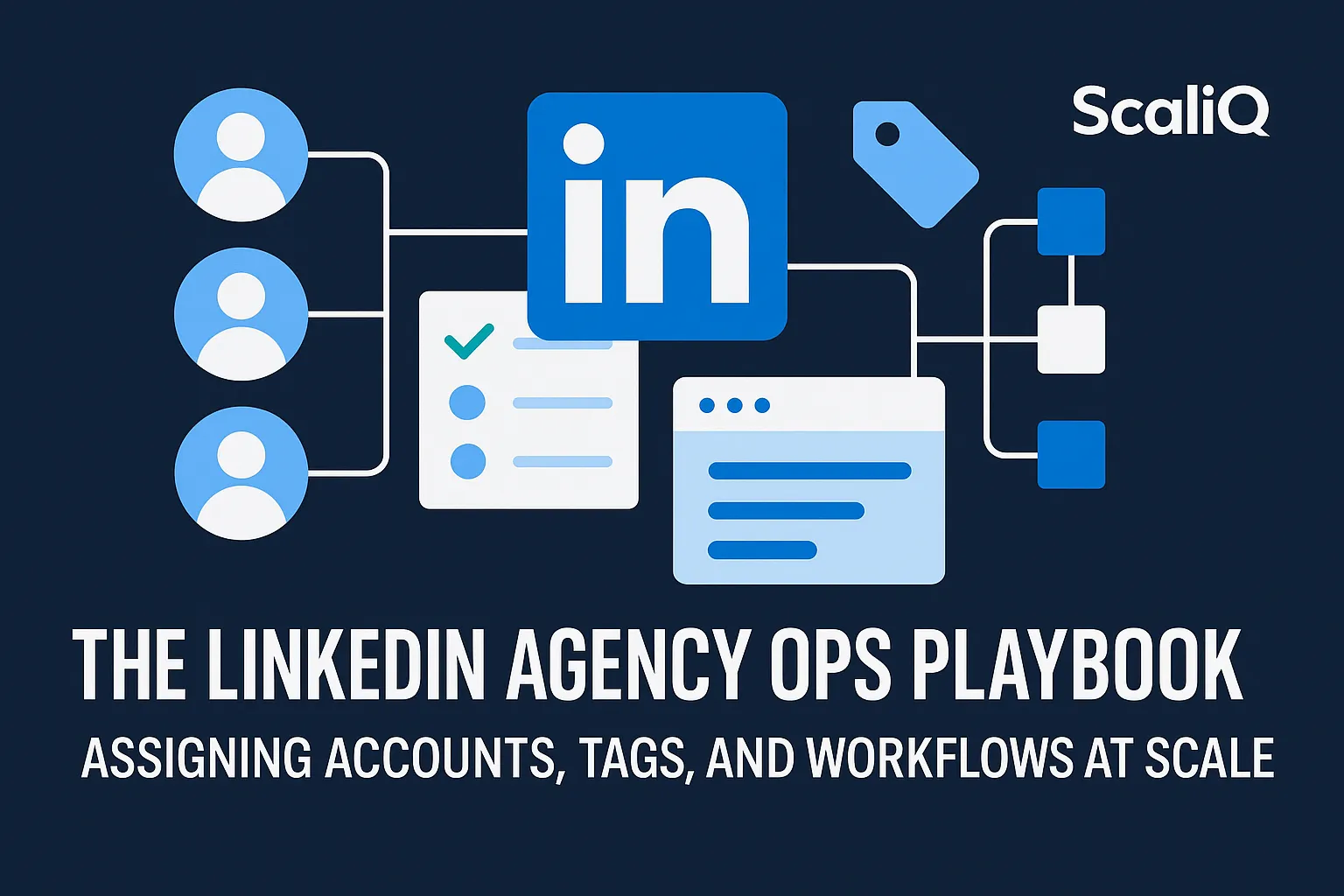
How to Structure LinkedIn Sender Ownership
Establishing a clear foundation for assigning LinkedIn sender accounts across clients, campaigns, and operators is the first mandatory step of agency scale. Without it, you risk overlap, compliance issues, and accountability gaps. Sender ownership must be strictly defined before a single campaign launches.
Agencies must assign accounts based on the client, target market, campaign objective, and operator capacity. The most effective way to govern this is through a sender ownership matrix—a centralized ledger tracking the sender account, assigned client, ICP/market, current campaign, primary operator, backup operator, and reassignment rules.
Crucially, account ownership, campaign ownership, and lead ownership are not the same thing. Treating them as identical leads to operational failure. Mastering account assignment linkedin protocols ensures that your multi-account LinkedIn outreach remains compliant and highly organized.
Define the Core Ownership Layers
To implement clean governance, agency operators must clearly distinguish between four distinct operational roles. While one prospect may touch multiple roles during their lifecycle, they should always have one definitive current owner to prevent shared, ambiguous ownership.
• Sender owner: The individual responsible for the daily health, compliance, and execution of the specific LinkedIn account.
• Campaign owner: The strategist or manager accountable for campaign setup, audience targeting, and overall performance.
• Prospect owner: The operator (often an SDR) who owns the direct relationship, inbox management, and immediate next steps.
• Client approver: The stakeholder who signs off on sensitive transitions, complex objections, or custom messaging.
By tracking campaign ownership tracking and defining these layers, LinkedIn agency management transforms from a chaotic free-for-all into a structured assembly line.
Choose Assignment Rules That Match Agency Delivery
Sender assignment must be rule-based, not ad hoc. Generic automation setups often prioritize raw volume over governance, which damages account health and client trust. A standardized LinkedIn agency workflow relies on strict logic:
• One sender pool per client segment: Isolate accounts so deliverability issues in one campaign do not infect another.
• One operator per account: Maintain conversational consistency and clear accountability.
• One backup owner: Ensure continuity during employee leave or churn.
• Capacity thresholds: Set strict limits on connection requests and active conversations before new accounts are assigned.
Depending on the client's needs, assignment should also factor in geography, persona, language, and the historical health of the sender account. Clean LinkedIn campaign operations require this level of intentional LinkedIn prospect routing.
Set Reassignment Triggers Before They Become Emergencies
Ownership confusion peaks when accounts pause, operators change, or campaigns shift. Undocumented reassignment is a primary operational failure mode for agencies, resulting in dropped leads and frustrated clients.
Common reassignment triggers include:
• An account is paused or temporarily restricted.
• The client pivots their ICP or core offer.
• Operator turnover or temporary absence occurs.
• A campaign is underutilized, or sender pools become overloaded.
• A positive reply requires immediate client-side ownership.
A clean handoff protocol ensures no momentum is lost. For example, if an operator goes on leave, the system should automatically route active conversations to the designated backup owner, update the CRM, and notify the campaign owner. For agencies managing complex lead assignment workflows and campaign ownership tracking, centralized control is essential. Discover how to streamline your LinkedIn sender management at ScaliQ's pricing page.
Prevent Duplicate Outreach Across Campaigns
Duplicate prospecting is one of the highest-friction pain points in agency operations. It typically occurs due to overlapping ICP lists, disconnected operators, concurrent campaigns, and the lack of a global ownership record.
To solve this, agencies must establish a single source of truth for prospect status and ownership. Deduplication rules must be defined before campaign launch, not after confused replies start arriving in the inbox. Implement a strict conflict resolution rule: if a prospect appears in multiple campaigns, the system defaults to the earliest active campaign or the highest-priority sender owner. This strict LinkedIn prospect routing protects the client's brand and streamlines lead ownership workflows.
The Tagging and Lead Routing Framework
A consistent tagging system is the connective tissue between sender accounts, campaigns, prospects, and downstream CRM actions. Without it, routing, handoffs, reporting, and auditability are impossible.
However, agencies must avoid over-tagging. Tags should only exist if they change a decision, shift ownership, or impact reporting. A practical taxonomy built around campaign, persona, stage, owner, source, intent, and next action is the bedrock of a scalable LinkedIn lead assignment system. Standardizing your LinkedIn prospect tagging framework is the only way to achieve scale without chaos.
The 6 Core Tag Categories Every Agency Should Standardize
Instead of abstract advice, agencies should implement a lightweight, standardized naming convention across these six core tag families:
1. Campaign tag: Identifies the specific outreach initiative (e.g., CMP-Q3-SaaS-Founders).
2. Persona/ICP tag: Defines the target audience (e.g., ICP-CTO-MidMarket).
3. Lifecycle stage tag: Tracks where the prospect is in the funnel (e.g., STG-Replied).
4. Current owner tag: Dictates who is responsible right now (e.g., OWN-SDR-John).
5. Source/origin tag: Notes where the prospect was sourced (e.g., SRC-SalesNav-ListA).
6. Next action tag: Flags the immediate required operational step (e.g., ACT-NeedsApproval).
Each tag must drive an operational function within your agency outbound operations playbook, ensuring your prospect tagging system directly supports your LinkedIn outreach operations.
Use Lifecycle Stages That Support Service Delivery
Agencies must move beyond binary "lead" versus "reply" labels. Lifecycle tags should trigger next actions and provide clear reporting visibility. Recommended stage definitions include:
• Not contacted
• Active outreach
• Replied
• Positive intent
• Awaiting approval
• Handoff to client/AE
• Follow-up scheduled
• Closed/lost/paused
These stages clarify campaign ownership tracking and LinkedIn sender management. Exceptions, such as warm leads sourced outside the campaign, client-side replies, and paused accounts, must also have designated lifecycle stages to maintain accurate lead assignment workflows.
Build Routing Rules Around Owner + Stage + Next Action
Routing should never be a manual judgment call. Lead routing becomes highly reliable when the operating system automatically checks three variables: who owns it now, what stage it is in, and what action must happen next.
For example:
• A positive reply routes immediately to an appointment setter.
• A highly technical reply routes to the strategist or client approver.
• An unqualified reply routes to the archive or a long-term nurture sequence.
• No-response prospects remain under the purview of the sender/campaign owner.
To support queue-based routing, owner assignment, and fallback logic, ops leaders should reference Salesforce lead assignment rules. Additionally, utilizing Sales Navigator CRM sync settings ensures ownership data and contact updates sync operationally, perfecting your LinkedIn prospect routing and account assignment linkedin processes.
Connect Tags to CRM and Revenue Reporting
To elevate beyond basic LinkedIn execution into true agency ops maturity, tags must map directly to CRM fields. Disconnected tagging systems create handoff errors, siloed data, and severely underreported pipeline contributions.
Campaign, owner, and stage tags support accurate attribution and transparent client reporting. By leveraging Sales Navigator CRM sync settings, agencies ensure data consistency across platforms. For teams looking to orchestrate coordinated outbound systems, exploring platforms like Repliq for agencies can further bridge the gap between LinkedIn campaign operations and CRM revenue reporting.
Inbox Management, Handoffs, and Approvals
Most agencies can launch outreach, but operational quality often breaks down in the inbox. Reply management across multiple sender accounts requires defined responsibilities across SDRs, account managers, strategists, and clients. Implementing strict SLAs, reply categorization, and approval checkpoints is non-negotiable for effective LinkedIn inbox management for agencies.
Define Inbox Ownership Before Replies Start Coming In
"Everyone checks it" usually means no one owns it. To eliminate the common failure mode of shared inbox confusion, agencies must assign specific roles before campaigns go live:
• Primary inbox responder: The first line of contact responsible for initial triage.
• Backup responder: Steps in during high volume or primary absence.
• Escalation owner: Handles complex objections or technical queries.
• Client-facing handoff owner: Manages the transition of a warm lead to the client's internal team.
Defining these roles ensures tight LinkedIn sender management and transparent campaign ownership tracking.
Create Reply Categories That Trigger Clear Next Steps
Inbox work must be a structured process, not reactive message handling. Categorizing replies maps each response to an owner, an SLA, and a definitive next action.
Standard reply categories include:
• Positive
• Maybe/later
• Referral
• Objection
• Unqualified
• Client-sensitive
• Compliance/risk
By routing these categories systematically, agencies build a resilient lead assignment workflows and a standardized agency outbound operations playbook.
Standardize Handoffs Between SDRs, Account Managers, and Clients
Solving the "warm lead dropped in transition" issue requires a standardized handoff package. When a positive reply moves from a sender operator to a client-facing owner, the transition must include:
• The complete prospect record
• Campaign and source context
• A summary of the last message and intent
• The recommended next action
• A strict deadline/SLA
• The current owner and the receiving owner
Structured ownership distribution is critical. Ops teams can look to conversation owner rotation workflows to govern these transitions, ensuring seamless LinkedIn agency management and campaign ownership tracking.
Add Approval Gates for Sensitive Messages and Client Escalations
Governance should protect the agency without unnecessarily slowing down the system. Tiered approvals—rather than requiring sign-off on every single response—keep workflows agile.
Approvals are strictly needed for:
• High-value enterprise prospects
• Strategic or unique objections
• Pricing or commercial questions
• Client-specific brand or risk concerns
• Message deviations from approved playbooks
Implementing these checkpoints stabilizes agency LinkedIn workflows. For structuring visibility in multi-step workflows, ops leaders should review workflow approval setup guidance.
Reporting, QA, and Workflow Visibility
Operational health is just as important as campaign output. Agencies require deep visibility across senders, campaigns, stages, owners, and exceptions. Quality assurance and rigorous reporting form the feedback loop that keeps the operating system trustworthy, exposing breakdowns in governance rather than just highlighting vanity volume metrics.
Track the Right Operational Metrics
Move beyond superficial reporting and into decision-useful management data. To maintain LinkedIn outreach operations and multi sender LinkedIn management, track:
• Sender utilization and capacity
• Active campaigns per sender
• Reply volume and velocity by owner
• Handoff speed and SLA compliance
• Duplicate or conflict incidents
• Lead status aging (prospects stuck in one stage)
• Client-level pipeline contribution
Distinguishing performance metrics (meetings booked) from governance metrics (SLA compliance) is vital for long-term campaign ownership tracking.
Build a QA Layer for Messaging, Routing, and Handoffs
Operationalizing consistency across dozens of operators requires a dedicated QA layer. Unlike competitor setups that focus purely on send volume, mature agencies audit for operational accuracy.
A weekly QA scorecard should review:
• Message quality and personalization compliance
• Correct owner assignment
• Accurate tag usage
• Proper handoff documentation
• SLA adherence
This standardizes the LinkedIn outreach SOP for agencies and reinforces the prospect tagging system.
Make Exceptions Visible Instead of Letting Them Live in Slack or Spreadsheets
Exceptions are inevitable, but they must be normalized as part of the system. Letting exceptions live in disjointed Slack threads or hidden spreadsheets breaks workflow visibility.
Common exceptions include paused sender accounts, warm leads awaiting client input, duplicate lead conflicts, operator absences, accounts nearing capacity limits, and client-side replies occurring outside the primary flow. These exception flags must automatically appear in the central reporting layer, ensuring tight LinkedIn sender management and a unified LinkedIn agency workflow.
Create Review Cadences for Ops Leaders
Dashboards only work if they are tied to management routines. Ops leaders must establish strict review cadences to prevent operational drift:
• Daily: Review inbox backlogs, urgent replies, and SLA misses.
• Weekly: Audit sender utilization, campaign progress, and handoff quality.
• Monthly: Conduct client reporting, capacity planning, and reassignment needs.
To enforce team-level oversight and reporting governance, utilize LinkedIn Sales Navigator admin settings. This cadence is the backbone of scalable linkedin agency ops.
How to Scale from 5 to 50+ Senders
Scaling is fundamentally a governance problem, not a tooling problem. Processes that function perfectly with 5 senders will collapse at 20+ unless ownership, permissioning, QA, and reporting are formalized.
What Works at 5 Senders
For smaller agency teams, a lightweight version of the system is sufficient. Avoid overengineering too early. A team managing 5 senders can succeed with a simple sender roster, a core tag taxonomy, clear owner fields, basic handoff SOPs, and weekly QA reporting. However, strict lead assignment workflows and LinkedIn sender management must exist from day one.
What Breaks Between 10 and 20 Senders
Between 10 and 20 senders, spreadsheets and tribal knowledge fail. Predictable systems failures emerge: capacity blind spots, rampant duplicate outreach, inconsistent reply handling, delayed handoffs, reporting discrepancies across clients, and unclear fallback owners. At this inflection point, multi-account LinkedIn outreach requires formal campaign ownership tracking to survive.
What Must Exist at 50+ Senders
At 50+ senders, agencies need operational orchestration, not just campaign launch tools. The operating model must include:
• A centralized sender inventory
• Strict permissioning and role-based ownership
• Formal escalation paths
• Automated routing logic
• Mandatory QA checkpoints
• Real-time exception dashboards
• Client-specific reporting views
ScaliQ is uniquely built around these internal operating structures, providing the exact framework agencies need. If your current stack cannot support a large sender environment, explore centralized solutions at ScaliQ's pricing page.
Capacity Planning and Utilization Rules
Advanced operational maturity requires proactive capacity planning. Agencies must review sender capacity based on client load, campaign activity, operator bandwidth, and account health. This includes maintaining reserve capacity, assigning backup operators, and scheduling planned reassignment windows. Tying capacity planning directly to service quality ensures sustainable account assignment linkedin and flawless LinkedIn campaign operations.
Tools, Templates, and Operating Documents to Standardize the System
Scalable operations require documented assets, not verbal agreements. This implementation toolkit provides the exact operating documents agency operators need to standardize their LinkedIn agency workflow.
The Essential Documents
Every scalable agency must maintain these core documents, with clearly assigned owners for each:
• Sender account roster: Tracks all active, paused, and reserve accounts.
• Ownership matrix: Maps senders to clients, operators, and campaigns.
• Tag taxonomy sheet: Defines the 6 core tag categories and naming conventions.
• Routing rules doc: Outlines automated logic for lead assignment workflows.
• Inbox SLA guide: Dictates expected response times and categorization.
• Approval workflow map: Details escalation paths for sensitive messages.
• QA scorecard: Standardizes weekly audits.
• Exception log: Tracks operational anomalies.
• Client reporting template: Unifies pipeline contribution data.
What a Good Operating System Looks Like in Practice
In a mature workflow, sender assignment, tags, inboxes, approvals, CRM sync, and reporting all connect seamlessly. There is complete auditability, continuity, and clarity across every client and team member. Unlike fragmented tool stacks that merely handle sending, a true operating system prioritizes governance. To learn more about building agency systems, workflows, and scaling delivery, visit ScaliQ's blog.
Conclusion
LinkedIn outreach at agency scale succeeds only when sender assignment, lead ownership, tagging, inbox workflows, approvals, and reporting are managed as a unified operating system. The benefits of this infrastructure are undeniable: fewer duplicates, cleaner handoffs, stronger accountability, elevated client confidence, and highly scalable delivery.
Audit your current system by asking these four questions:
1. Do we know who owns every sender?
2. Do we know who owns every prospect?
3. Do tags drive actionable routing, or do they just clutter records?
4. Can we see workflow exceptions in real time?
If the answer to any of these is no, it is time to move beyond spreadsheet-based coordination. ScaliQ specializes in the internal operating structures required for agencies managing multiple LinkedIn senders. Ready to implement centralized sender assignment and workflow orchestration? Start scaling securely at ScaliQ's pricing page.