

Introduction
For founders and lean revenue teams, the LinkedIn inbox represents a paradox: it is one of the richest sources of pipeline, yet operationally, it is treated like a chaotic catch-all. The core problem is that the LinkedIn inbox is not a pipeline queue, but most teams manage it as if it were. When sales representatives prioritize their outreach by recency rather than revenue potential, highly valuable buyer conversations get buried under a daily avalanche of recruiters, partner requests, spam, and low-fit outreach.
The business cost of this misalignment is severe. High-intent buyers expect rapid responses, and when their messages are lost in the noise, pipeline leaks. This article provides a definitive blueprint for solving this problem. You will learn how AI can transform unstructured LinkedIn DMs into an explainable, revenue-prioritized queue leveraging Ideal Customer Profile (ICP) fit, buyer intent, and real-time conversation scoring.
Unlike generic lead scoring or basic inbox sorting, this is a LinkedIn-specific framework directly tied to likely pipeline impact and next-best actions. By the end of this guide, you will understand why default inboxes fail, how ai revenue scoring differs from traditional lead scoring, what conversation signals actually matter, how to connect these scores to automated workflows, and how to maintain a trustworthy, compliant AI model.
At ScaliQ, our foundation is built on deep experience designing qualification and prioritization logic extracted directly from live sales conversations. We understand that ethical, compliant AI LinkedIn inbox prioritization is the key to scaling modern sales. If you are looking to explore more advanced revenue workflow and qualification insights, visit Blog.
Why LinkedIn Inboxes Fail as Revenue Queues
Manual message triage breaks down rapidly for advanced revenue teams because the default inbox order is a fundamentally poor prioritization system. The core failure mode of the standard inbox is that it mixes active buyers with non-revenue conversations. By defaulting to a "newest first" or "loudest first" display, the platform inadvertently forces sales professionals to make poor pipeline decisions based on timing rather than value.
For founders executing founder-led sales, SDR leaders managing high message volumes, and lean teams relying on LinkedIn as a primary pipeline source, this creates massive operational bottlenecks. Teams do not lack messages; they lack a reliable, compliant system for identifying which messages deserve immediate attention. The operational consequences include slower response times to high-intent buyers, inconsistent rep behavior, missed qualification signals hidden within short text threads, and ultimately, lower pipeline efficiency. An ideal revenue queue should rank conversations by likely deal value and buying readiness, not merely by recent activity.
The Hidden Cost of Treating Every DM Equally
Treating every incoming message equally sounds operationally fair, but it is disastrous in revenue terms. When every DM is given the same weight, critical buyer messages get buried alongside networking requests, recruiting inquiries, vendor pitches, and generic automated outreach.
Manual lead prioritization is highly subjective and varies wildly across different reps, drastically reducing a team's ability to scale. Consider a scenario where two conversations arrive simultaneously: one from a prospect asking about implementation timelines (buying urgency), and another from a peer looking to connect for a virtual coffee (exploratory networking). Treating them equally delays the revenue-generating conversation. Effective LinkedIn lead management requires separating the signal from the noise to ensure immediate sales qualification.
Why Recency and Response Order Are Weak Prioritization Rules
Sorting by recency is easy, but it is highly misleading. The latest message to hit the inbox is rarely the most valuable one. Urgency and value must be systematically separated; a loud, multi-paragraph message can be entirely low-fit, while a quiet, single-sentence message like "How does your pricing scale?" can signal immediate buying readiness.
Human reps scanning an inbox at scale frequently miss these latent buyer intent signals. AI conversation intelligence excels at detecting these nuances, identifying revenue potential scoring opportunities within brief text exchanges that a human might accidentally scroll past.
What a Revenue Queue Should Do Instead
A true revenue queue must rank conversations by their expected pipeline impact, not just inbox activity. This requires a layered evaluation approach that continuously assesses ICP fit, decision-making authority, buying urgency, commercial context, and engagement momentum.
Achieving this level of sophisticated AI LinkedIn inbox prioritization requires a shift away from basic CRM filters. It demands ai revenue scoring—a dynamic pipeline prioritization method that evaluates the context of the conversation in real-time to surface the best opportunities.
Lead Scoring vs. Revenue Scoring for LinkedIn DMs
To build a high-performing inbox, revenue teams must understand a key conceptual distinction that many tools blur: the difference between lead scoring and revenue scoring.
In simple operational terms, lead scoring is a broad estimate of whether a contact looks interesting or qualified based on static data. Revenue scoring, however, is a contextual, real-time estimate of how likely a specific conversation is to create meaningful pipeline or deal value in the near term. This distinction is critical in LinkedIn DMs, where message context often reveals commercial readiness much faster than static profile data. While lead scoring can overvalue top-of-funnel vanity activity, ai revenue scoring directly reflects real sales qualification and priority.
What Traditional Lead Scoring Misses in LinkedIn Conversations
Traditional lead scoring relies heavily on static inputs: profile data, job title, company size, or generic engagement metrics like post likes. However, it completely misses what the person is actually saying in the DM.
Message-level context radically changes lead prioritization. A prospect might have a perfect lead score based on their title, but their message might say, "We just signed with a competitor." Conversely, a lower-tier title might message, "My VP asked me to evaluate your tool for Q3." CRM-first scoring lags behind these live conversation intelligence cues. To capture explicit pain points, purchase timing, internal project ownership, and vendor-evaluation cues, you must analyze real-time buyer intent signals.
What Revenue Scoring Adds
Revenue scoring merges demographic fit with commercial intent and likely deal impact. To accurately execute ai revenue scoring, the model must evaluate several dimensions:
• Fit: Does the prospect match the ICP?
• Intent: Are they using buying language?
• Urgency: Is there a compelling event or timeline?
• Authority: Can they influence or approve the purchase?
• Use-Case Clarity: Do they have a specific problem your product solves?
• Momentum: Is the conversation advancing logically?
Revenue potential scoring is dynamic. A conversation’s rank will naturally rise or fall as new messages add context. The goal of this pipeline prioritization is not to automate human judgment away, but to focus human attention exactly where it matters most.
A Simple Comparison Framework Readers Can Reuse
To understand the operational shift, consider this narrative contrast:
• Lead Score: "Is this person broadly relevant based on their profile?" (Relies on rule-based filters and static CRM data).
• Revenue Score: "Is this specific conversation likely to generate pipeline right now?" (Relies on conversation-aware AI).
For example, a VP of Sales might have a lead score of 99/100. If they DM you to ask for a podcast guest recommendation, their revenue score for that conversation is near zero. If they DM you asking for a product demo, their revenue score spikes. Shifting from basic sales inbox automation to true linkedin inbox prioritization requires this context-aware revenue potential scoring.
The Signals AI Should Use to Rank Conversations
Effective AI does not rely on a single magic keyword to rank messages. The strongest models use layered, compliant signals drawn from publicly accessible data and explicit user interactions to build a transparent scoring matrix. This ensures reps understand exactly why a message ranks highly. Furthermore, short or incomplete messages should produce lower-confidence scores, ensuring the AI does not project false certainty. By combining buyer intent signals, conversation intelligence, and revenue potential scoring, teams can build a foolproof triage system.
ICP Fit and Firmographic Context
AI must first incorporate fit signals such as role, company type, likely segment, and use-case alignment. Fit is the foundational multiplier because high intent from a poor-fit contact is still a lower priority than qualified intent from a strong-fit buyer.
When DM text is sparse, ethical data enrichment using publicly available firmographic context can supplement the profile. Indicators of strong fit include executive seniority, relevant departmental function, matching company size, and a likely buying environment. Balancing fit with intent is the cornerstone of accurate sales qualification, effective lead prioritization, and scalable LinkedIn lead management.
Buyer Intent and Commercial Language
The raw text of the DM contains the strongest short-term revenue signals. AI must be trained to detect explicit problem statements, requests for help, timing language, evaluation criteria, and references to budgets or implementation teams.
Crucially, AI LinkedIn inbox prioritization must distinguish real purchase intent from generic curiosity or polite networking. "That sounds interesting, keep up the good work" is low intent. "How does this integrate with Salesforce?" is high intent. According to research on digital sales interaction signals, extracting value from structured and unstructured digital sales interactions is vital for accurate conversation intelligence and identifying true buyer intent signals.
Authority, Urgency, and Buying Readiness
Not all intent carries the same weight. The model must weigh whether the sender actually has the authority to influence or approve a purchase. Urgency indicators include near-term deadlines, active pain points, current vendor evaluations, and immediate next-step requests.
It is vital to separate urgency from value. A student urgently requesting data for a thesis sounds urgent but has zero commercial upside. Therefore, revenue potential scoring should utilize a weighted framework rather than a binary "hot lead" tag, ensuring precise sales qualification based on genuine buyer intent signals.
Engagement Depth and Conversation Momentum
Conversation quality evolves with every reply. AI should track the number of back-and-forth replies, the specificity of the prospect's answers, overall responsiveness, and their willingness to book a meeting.
Momentum is a powerful supporting signal, though it should never outweigh fit and intent. A short, highly specific, two-message exchange about pricing should easily outrank a rambling, twenty-message thread about industry trends. Tracking this momentum requires advanced conversation intelligence to streamline message triage and optimize pipeline prioritization.
Negative Signals and Noise Filtering
A robust model requires explicit down-ranking logic. Filtering noise is just as valuable as ranking opportunities. Common low-value categories include recruiting outreach, partnership requests, generic vendor pitching, spam, low-fit requests, and social engagement lacking buying context.
AI must avoid over-prioritizing spammy outreach that uses high-intent words superficially (e.g., an automated pitch saying, "I have budget to help you..."). Effective message triage and sales inbox automation depend entirely on the system's ability to maintain strict linkedin inbox prioritization by discarding the noise.
Building an Explainable Scoring Matrix
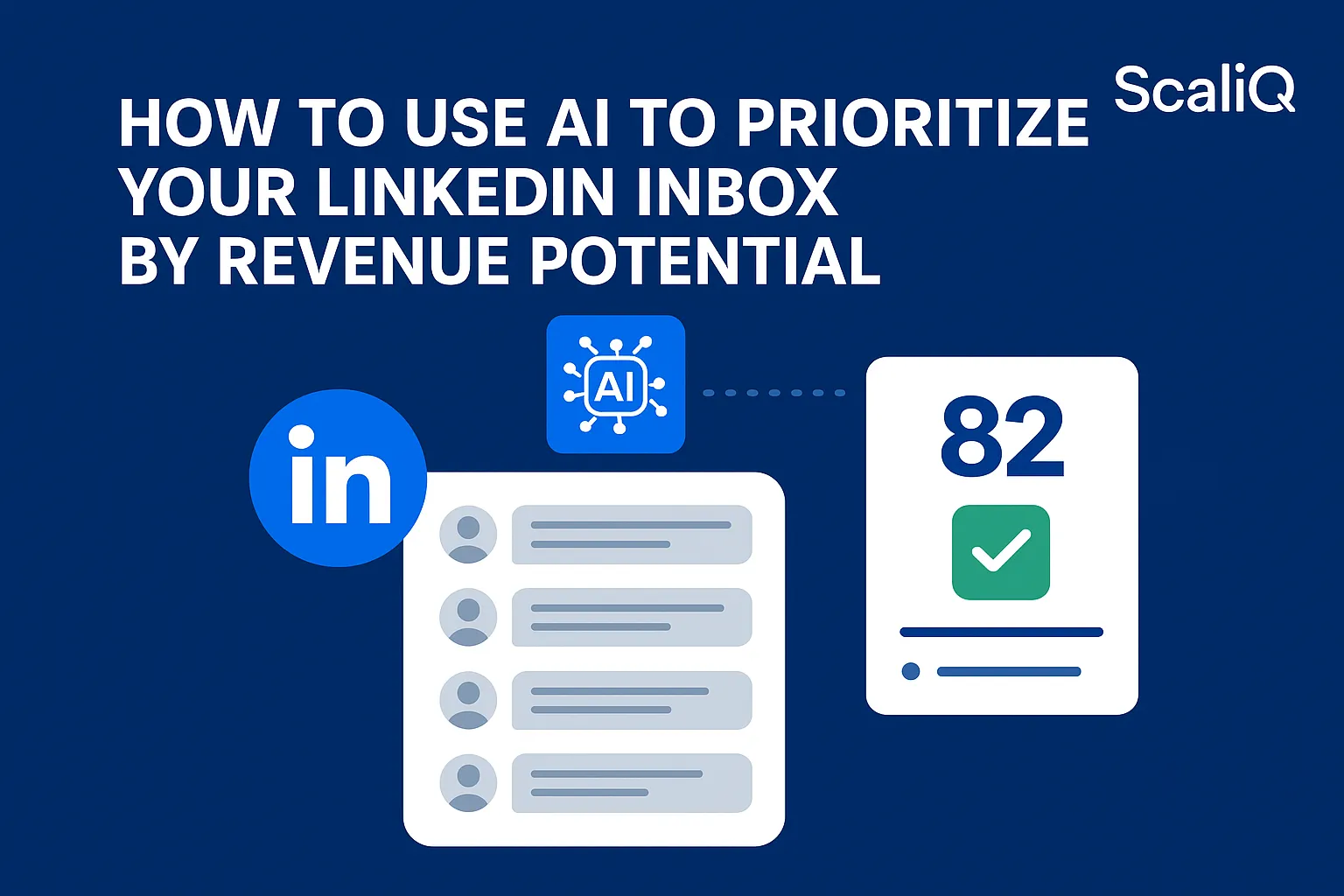
To make this actionable, teams should build a transparent scoring framework. A standard matrix should include a Fit Score, Intent Score, Urgency Score, Authority Score, Momentum Score, an overall Confidence Score, and a Recommended Next Action.
For example, if a user messages, "We are evaluating tools for Q3 and need to see your enterprise tier," the AI should visibly score High Fit, High Intent, and High Urgency, outputting a recommendation to "Reply Immediately - Route to Enterprise AE." Explainability ensures reps trust the system. To see an example of how qualification and prioritization logic translates conversation signals into actionable revenue ranking, explore ScaliQ. This approach turns theoretical ai revenue scoring and conversation intelligence into practical revenue potential scoring.
How Prioritization Connects to Routing and Follow-Up Workflows
Prioritization only creates business value when it changes revenue behavior: who responds, how fast they respond, what the next step is, and where the data goes. LinkedIn inbox scoring must become part of a broader revenue workflow rather than existing as a standalone vanity metric.
When executed correctly, this workflow leads to faster follow-up, better SLA adherence, improved pipeline focus, and drastically less rep time wasted on low-value threads. Connecting scores to action is the essence of sales inbox automation, effective pipeline prioritization, and modern LinkedIn lead management.
Routing High-Value Conversations to the Right Owner
High-scoring conversations should immediately trigger routing rules. Depending on the segment, deal size, geography, or account ownership, a message might be routed to an Account Executive, a Founder, or an SDR.
If the system detects strong fit combined with active buying intent from a targeted enterprise account, it should instantly alert the assigned Enterprise AE. This automated routing is vastly superior to manual forwarding and inbox monitoring, which are historically slow, inconsistent, and prone to human error. Automated routing ensures airtight lead prioritization, seamless pipeline prioritization, and rapid sales qualification.
Setting SLA-Based Follow-Up by Revenue Potential
Score bands should map directly to response-time expectations (SLAs).
• Highest Score: Immediate response required (under 15 minutes).
• Mid-Tier Score: Same-day review and nurture.
• Low Confidence: Human triage required or deprioritized.
This operational clarity allows teams to protect their fastest response times for likely buyers without burning out reps by forcing them to overreact to every single message. The score informs action thresholds, transforming sales inbox automation and message triage into a system driven by actual revenue potential scoring.
Triggering CRM Enrichment and Sequencing
LinkedIn should never remain a disconnected conversation silo when it is actively producing revenue signals. Scoring triggers should push compliant data into downstream workflows.
When a high-value DM is identified, the system can trigger actions such as creating or updating a CRM contact, enriching account data, assigning a deal stage, launching a specific follow-up sequence, or scheduling a human review. Integrating LinkedIn lead management with your CRM via sales inbox automation ensures that conversation intelligence translates into durable pipeline data.
Recommended Next Actions, Not Just Rankings
Advanced revenue teams need AI to suggest exactly what to do next, not just tell them which thread is important. Next-best actions might include: reply immediately, ask a specific qualification question, route to the account owner, enrich the profile before responding, deprioritize, or archive as noise.
These recommendations must reflect the AI's confidence level and highlight any missing context. Providing actionable next steps elevates AI LinkedIn inbox prioritization from a sorting tool into an active partner in sales qualification and pipeline prioritization. For teams evaluating the ROI of these revenue-prioritization workflows, view our capabilities at Pricing.
Mini Before-and-After Workflow Example
Consider a lean SDR team.
Before: The inbox is cluttered. The response order is dictated by whoever messaged last. High-revenue buyer messages are buried under 40 automated vendor pitches, resulting in missed quotas and slow follow-ups.
After: DMs enter a ranked queue. The AI instantly identifies a high-fit prospect asking about implementation. The conversation is automatically routed to the senior SDR with a "High Urgency" tag, prompting a response within three minutes.
This after-state highlights the massive advantages of AI enrichment, verification, and explainable prioritization. It perfectly encapsulates the power of linkedin inbox prioritization, ai revenue scoring, and intelligent sales inbox automation.
Risks, Calibration, and Explainability in AI Inbox Scoring
To build trust, effective AI prioritization requires strict governance, continuous evaluation, and human oversight. Black-box scoring creates distrust among sales reps and can severely damage workflows if it over-prioritizes noise or misses genuine buyers. Advanced buyers know that implementing AI is easy, but making it reliable is hard. Securing reliable ai revenue scoring demands a blend of conversation intelligence and rigorous sales qualification protocols.
Common Failure Modes
AI models can fail if not calibrated correctly. A common failure mode is misreading polite, passive interest as active buying intent. Additionally, spammy or templated outreach can game simplistic keyword-based systems by overloading messages with terms like "budget" or "decision-maker."
Furthermore, short DMs with very little context can create misleading confidence if the system is forced to score too aggressively. Not every conversation should receive a strong recommendation. Proper message triage requires an understanding of nuanced buyer intent signals to ensure accurate revenue potential scoring.
How to Use Confidence Levels and Human Review
To mitigate risks, AI should always output both a revenue score and a confidence estimate. Low-context or highly ambiguous messages should not be auto-prioritized; instead, they should be routed for human review.
Revenue leaders must define override rules, allowing reps to manually correct the system when it misinterprets a thread. This human-in-the-loop review process dramatically increases user trust and continuously improves future calibration. It is the safest way to deploy AI LinkedIn inbox prioritization, ensuring sales inbox automation enhances rather than replaces human conversation intelligence.
Calibrating the Model with Closed-Won and Closed-Lost Outcomes
Advanced teams continuously improve their scoring over time by feeding actual outcome data back into the model. By comparing which highly scored conversations actually created meetings, generated pipeline, resulted in closed-won deals, or eventually stalled out, the model learns.
Calibration must reflect real revenue outcomes, not vanity engagement metrics like reply rates. As buyer behavior changes, the scoring logic must evolve. This feedback loop is what makes ai revenue scoring a sustainable tool for pipeline prioritization and long-term revenue potential scoring.
Why Explainability Matters for Adoption
Sales professionals inherently distrust systems that dictate actions without providing reasoning. Reps trust systems more when they can clearly see why one conversation ranks above another.
Visible score drivers—such as "High ICP Fit," "Explicit Problem Statement," "Urgent Timeline," or "Decision-Maker Involvement"—must be displayed alongside the score. Explainability directly improves sales coaching, QA processes, and overall workflow adoption across revenue teams. It bridges the gap between raw conversation intelligence, identifying buyer intent signals, and practical lead prioritization.
Governance and Trustworthy AI Design
Implementing AI in sales workflows requires adherence to authoritative governance frameworks. Organizations must prioritize transparency, human oversight, continuous risk evaluation, periodic testing, and clear accountability for any automated actions.
By aligning inbox prioritization with the NIST AI Risk Management Framework for evaluation and the OECD AI Principles for transparency and human oversight, teams can deploy automation ethically and compliantly. This ensures that ai revenue scoring, AI LinkedIn inbox prioritization, and sales inbox automation remain secure, legally compliant, and highly effective.
Conclusion
By default, LinkedIn inboxes are poor revenue queues, burying valuable pipeline under layers of daily noise. However, by applying AI to evaluate conversations based on ICP fit, buyer intent, urgency, authority, and momentum, revenue teams can transform this chaos into a prioritized, explainable workflow.
The ultimate goal is not generic inbox sorting, but precise revenue scoring that reflects likely pipeline impact and dictates the next-best action. To implement this successfully, teams must define their scoring dimensions, ensure total explainability, connect scores to automated routing and SLAs, calibrate the model with real closed-won outcomes, and mandate human review for ambiguous messages.
Take a hard look at your current LinkedIn operations: is your team ranking conversations by actual revenue potential, or are they just responding to the loudest noise?
At ScaliQ, we specialize in designing the qualification and prioritization logic necessary to extract real revenue signals from live sales conversations. Stop letting pipeline slip through the cracks of a cluttered inbox. Optimize your linkedin inbox prioritization, embrace ai revenue scoring, and master AI LinkedIn inbox prioritization today.