

How to Create LinkedIn Campaigns for Different Buying Committee Members
Most enterprise deals are not won through a single great contact—they are won by building alignment across a complex buying committee. Traditional LinkedIn prospecting breaks down when sales teams treat every prospect the same, sending identical messages to every stakeholder or relying entirely on a single champion to push a deal forward. In complex B2B environments, this single-threaded approach introduces massive deal risk.
To succeed, revenue teams must pivot toward committee-aware LinkedIn campaigns. This requires precise stakeholder mapping, persona-specific messaging, multithreaded sequencing, and account-level measurement. For advanced sales professionals familiar with basic LinkedIn prospecting, the real challenge lies in the orchestration of these complex B2B deals.
This is where modern account based selling workflows become critical. By leveraging ScaliQ, teams can execute persona-specific messaging tailored explicitly for users, champions, blockers, and economic buyers. When you master multi stakeholder prospecting, your linkedin buying committee outreach transforms from a volume-based guessing game into a strategic engine for consensus creation.
Why Buying Committee Outreach on LinkedIn Is Different
Committee-aware outreach demands a fundamentally different strategy than standard one-to-one LinkedIn prospecting. Single-threaded outreach creates severe deal risk: if your sole contact lacks internal influence, goes silent, or fails to build consensus, the entire opportunity stalls. Buying decisions in complex B2B environments involve multiple roles, each harboring different goals, objections, and proof requirements.
Generic LinkedIn outreach optimizes only for a superficial reply. In contrast, account based selling optimizes for broader account penetration and internal alignment. The goal is B2B consensus selling—helping various stakeholders understand your value in terms directly relevant to their specific role. Advanced revenue teams have abandoned isolated outreach attempts, opting instead to use buying signals, persona research, and coordinated workflows to penetrate the account.
Understanding why B2B buyers act as groups is the first step in shifting from individual-lead thinking to a comprehensive buying-group strategy. Furthermore, properly executing a LinkedIn guide to buying committee mapping ensures that multithreading and stakeholder coverage are handled systematically. Unlike typical manual prospecting approaches that rely on brute-force messaging, a ScaliQ-style workflow orchestrates role-based outreach legally and compliantly, keeping the entire account narrative synchronized.
Why one-message-fits-all campaigns fail
Users, champions, blockers, and economic buyers respond to entirely different outcomes, risks, and incentives. When generic linkedin messages fail to resonate, they lower relevance and create unnecessary friction across the account. If an executive sees the exact same feature-heavy message that was sent to a junior end-user, the outreach looks careless. Repetition across stakeholders only works when the linkedin outreach strategy is rooted in persona-specific messaging that speaks to individual priorities while supporting a unified business case.
How account-based selling changes LinkedIn campaign design
Account based selling shifts the focus from contact-level outreach to account-level orchestration. In a mature linkedin account based marketing strategy, messaging, timing, and proof points are designed to support progression inside a target account, rather than chasing isolated reply metrics. This approach introduces stakeholder coverage as a primary strategic KPI. The campaign is no longer about getting one person to say "yes," but about ensuring the entire committee is educated and aligned through account-based outreach.
Map the Stakeholders Inside the Account
Before launching any outreach, you must identify who belongs in the buying committee and prioritize their engagement. Mapping stakeholders by role, influence, urgency, and likely involvement in the decision is foundational to multi stakeholder prospecting.
First, identify who should be contacted based on signals such as operational pain, workflow ownership, internal credibility, and purchasing authority. This process also highlights critical committee gaps. For example, if a deal has strong user interest but lacks an engaged executive sponsor or budget owner, the deal is highly vulnerable. Stakeholder mapping for account based selling is not a static exercise; it evolves dynamically as new signals and contacts emerge during your conversations.
To understand the core dynamics of these groups, it is helpful to see how B2B buying center roles explained categorize buyers, deciders, users, influencers, and gatekeepers. Practically, identifying budget owners, blockers, and missing stakeholders requires a structured approach, often guided by a LinkedIn guide to buying committee mapping. Operationalizing this identification, segmentation, and persona-based campaign setup is exactly what ScaliQ is built to handle.
The four stakeholder types to prioritize
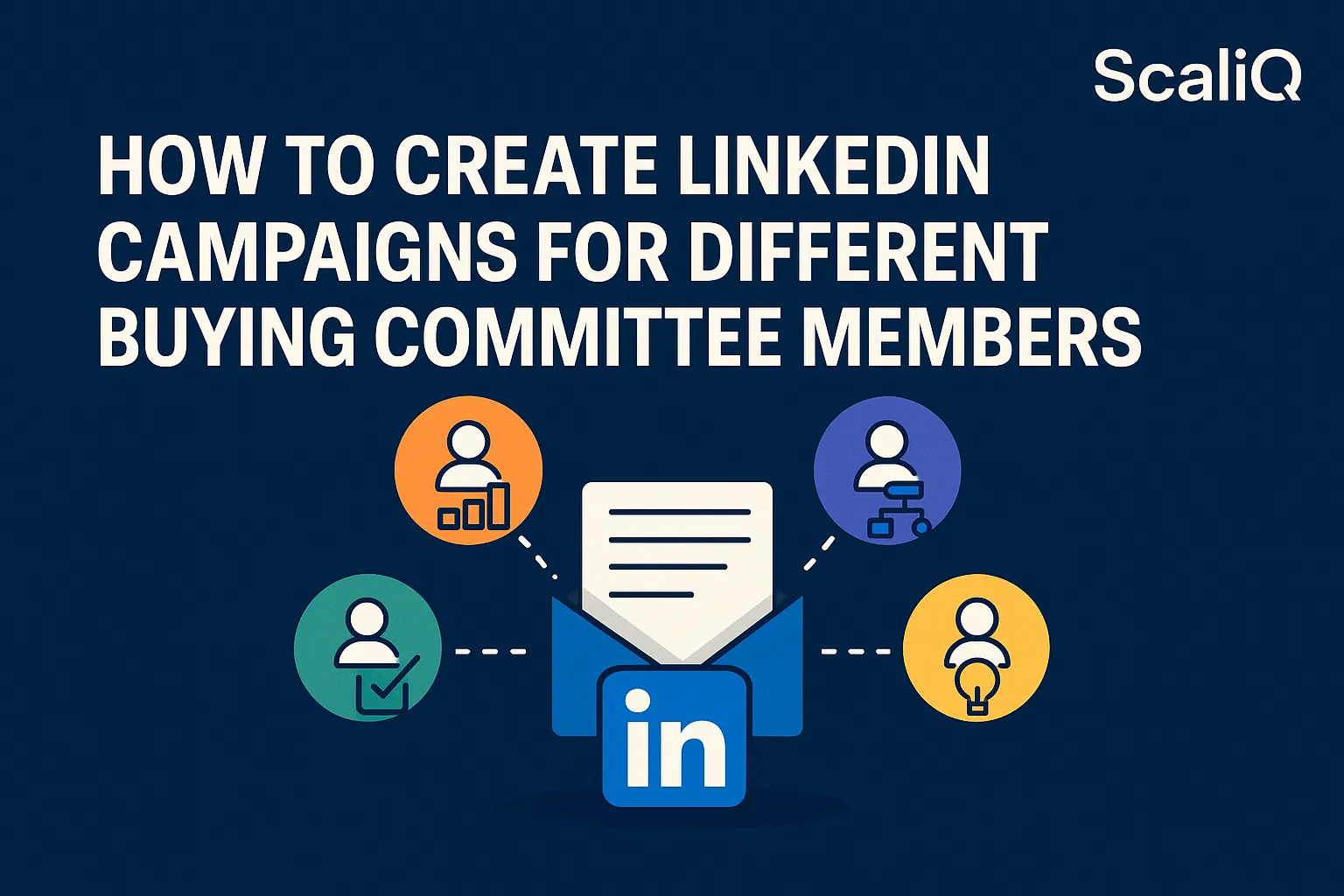
To execute effective buying committee members outreach, focus on these four core champion blocker user buyer personas:
• Users: The people closest to the workflow or day-to-day operational pain. They care about usability and efficiency.
• Champions: Internal advocates who see the strategic value of your solution and possess the credibility to influence their peers.
• Blockers: Stakeholders who may resist the deal due to perceived risk, technical complexity, process disruption, or competing priorities (e.g., IT, Security, or Legal).
• Economic Buyers: The ultimate decision-makers focused on ROI, budget allocation, and overarching business impact. Economic buyer outreach must be strictly tied to financial and strategic outcomes.
How to decide who to contact first
Prioritization logic dictates that you should start where pain is visible, influence is likely, and a conversation can naturally uncover the rest of the committee. If buyer intent signals point to operational bottlenecks, leading with users or champions makes sense. Conversely, if the signal is a top-down strategic shift, approaching economic stakeholders first is more effective.
Leverage trigger-based prioritization—such as recent hiring, company growth, role changes, or active initiatives—to determine who to contact first within a buying committee. Not every account requires the same entry point; your stakeholder mapping must dictate the initial angle of attack.
A simple stakeholder mapping framework
To operationalize your account-based outreach, use this skimmable buying committee messaging framework matrix:
Tailor Messaging for Users, Champions, Blockers, and Economic Buyers
Each stakeholder requires a distinct value narrative, specific proof points, and a tailored ask. Reusing one template across an entire account guarantees failure. Instead, build separate messaging tracks. The most effective linkedin buying committee outreach feels highly personalized at the persona level while maintaining a consistent narrative at the broader account level.
Rooting your outreach in structured B2B buyer persona research guide insights ensures your claims are based on actual buyer behavior rather than assumptions. Here is how to tailor linkedin messages for champions blockers users and economic buyers.
Messaging for users
When conducting linkedin prospecting for users, focus on workflow pain, adoption ease, operational efficiency, and practical outcomes. Users do not care about high-level ROI; they care about their daily tasks.
• Proof Points: Implementation simplicity, hours saved per week, or immediate process improvements.
• CTAs: Keep friction low. Ask for their perspective on a current process or whether a specific operational challenge is relevant to their day-to-day.
• Content: Practical guides, implementation walkthroughs, or use-case snapshots.
• Example Angle: "Noticed your team is handling [Process]. Usually, this means spending hours on [Manual Task]. Are you currently exploring ways to automate this workflow?"
Messaging for champions
Champion outreach within account based selling requires focusing on strategic upside and internal credibility. Champions need a narrative they can easily repeat internally to build momentum for your deal.
• Proof Points: Wins by similar teams in their industry, peer examples, and a concise strategic narrative.
• CTAs: Invite collaboration. "Is this worth exploring?", "Who else weighs in on this initiative?", or "Is solving [Pain] already on your roadmap for Q3?"
• Content: Business case summaries and easily forwardable strategic decks.
Messaging for blockers
Blocker identification is critical because conflicting priorities across stakeholders can kill deals late in the cycle. Blockers (like IT or Procurement) are not inherently negative; they protect the organization's stability, budget discipline, and execution quality. Focus your account-based outreach on risk reduction, complexity management, and compliance.
• Proof Points: Governance standards, implementation clarity, seamless integrations, and objection handling.
• CTAs: Lower their defensiveness. Invite their critique, ask about their specific rollout concerns, or reference common friction points they likely manage.
• Example Angle: "Usually when teams implement [Solution], IT is concerned about [Specific Risk]. We built our architecture to bypass that entirely. Open to reviewing our security brief?"
Messaging for economic buyers
Economic buyer outreach must ruthlessly focus on ROI, commercial impact, opportunity cost, and resource efficiency. Executives do not care about software features; they care about measurable business value.
• Proof Points: Financial outcomes, account-level leverage, revenue impact, and hard efficiency gains.
• CTAs: Be direct and concise. Validate strategic priority, quantify the financial impact, or ask whether this challenge is worth evaluating at the account level.
• Example Angle: "Leaders at [Similar Company] used our platform to reduce [Cost Center] by 22% in six months. Is optimizing [Strategic Metric] a priority for your board this year?"
Matching content assets to each stakeholder
Role-specific assets strengthen message relevance and act as vital sales enablement content that supports internal forwarding. When considering what content should be sent to different buying committee members on linkedin, frame your assets as enablement for consensus rather than just generic nurture material.
• Users: Implementation guidance and tactical playbooks.
• Champions: Business case summaries and ROI calculators.
• Blockers: Risk-mitigation material, security whitepapers, and integration docs.
• Economic Buyers: Executive summaries and peer-level financial case studies.
Sequence Multithreaded Outreach Without Message Collision
Multithreaded prospecting on linkedin involves engaging multiple contacts with role-specific angles, all synchronized in timing across a single account. Campaigns should expand logically from an early point of traction out to adjacent influencers and decision-makers.
The operational challenge is significant: how to avoid duplicate or conflicting outreach across the same account without creating awkward overlaps between sales reps and marketing efforts. To solve this, document your message angles by stakeholder type and maintain a single, unified account-level narrative. Utilizing proper LinkedIn ABM campaign planning ensures your account-based outreach is coordinated and logical.
Operating this strategy manually is nearly impossible at scale. ScaliQ serves as the operational layer for coordinating this persona-specific outreach across the account, ensuring verification, orchestration, and account consistency.
A practical multithreaded sequence model
The best linkedin outreach strategy for multi-stakeholder prospecting follows a structured expansion model. Begin with likely users or emerging champions to gather ground-level intelligence. Once traction is established, expand parallel outreach to adjacent stakeholders. Finally, involve blockers and economic buyers, using the intelligence gathered from the users to fuel the executive narrative. Earlier responses from champions should actively refine the later messages sent to the economic buyer.
How to keep messaging coordinated across the account
To solve the difficulty coordinating outreach across sales and marketing teams, maintain a shared account brief. This brief must track current stakeholders, active sequences, message themes, objections raised, and next steps. Persona-specific messaging means that different stakeholders should hear different language, but they must never hear different stories. The core business problem and strategic opportunity must remain identical across all touches in your account-based selling motion.
How to avoid duplicate or conflicting outreach
Single-threaded outreach creates deal risk, but uncoordinated multithreading creates brand damage. Common failure modes include multiple reps contacting the same account with different offers, recycled templates sent to adjacent stakeholders, or contradictory value propositions.
To learn how to avoid duplicate or conflicting outreach across the same account, establish strict governance rules: clear account ownership, full campaign visibility, automated suppression logic (pausing outreach to the buyer if the champion replies), and role-based sequencing. This protects your brand credibility and significantly increases your linkedin outreach strategy reply quality.
Measure Stakeholder Coverage and Account Progression
Success in buying committee outreach is not measured by raw connection rates or sheer message volume. Account based selling requires shifting away from vanity metrics and toward account-based measurement. You must evaluate whether the campaign is actively reaching the right mix of users, influencers, blockers, and economic stakeholders.
Understanding message resonance by persona—identifying which value angles, proof points, and CTAs generate meaningful engagement—is critical. Proper LinkedIn ABM campaign planning supports this account-based framing. For deeper playbooks on executing this measurement, explore Blog.
The metrics that matter most
• Stakeholder coverage: What percentage of the buying committee has been identified and engaged?
• Reply quality: Are responses substantive, or just polite declines?
• Role penetration: Are you successfully reaching across different functions (e.g., Operations, IT, Finance) and influence levels?
• Consensus signals: Are stakeholders referencing each other or forwarding your materials internally?
• Account progression: Is the account moving from isolated interest toward multistakeholder meetings and opportunity advancement?
How to spot weak points in your campaign
A lack of visibility into who influences the deal internally will quickly expose flaws in your campaign. If only users respond but no champion or buyer engages, your messaging likely lacks strategic weight. Warning signs include repeated interest without expansion, total executive silence, or blocker objections that remain unresolved. Diagnose these weak points quickly: is the issue your targeting, your buying committee messaging framework, your sequencing timing, or a proof-point mismatch?
How to optimize based on account feedback
Iterative campaign design beats fixed sequences every time. Refine your persona hypotheses as live conversations reveal new priorities. Trigger-based personalization allows you to use one stakeholder's feedback to immediately improve the next message sent to a parallel contact. This real-time optimization is the hallmark of elite linkedin buying committee outreach and highly effective persona-specific messaging.
Common Mistakes to Avoid in Buying Committee Outreach
Role-based LinkedIn campaigns fail when strategy is replaced by generic automation. Disconnected sales and marketing outreach creates internal confusion inside the target account. Message consistency matters just as much as personalization. Committee-aware campaigns require deep strategy and persona nuance, unlike generic tooling-led outreach models that prioritize volume over relevance.
The five fastest ways to stall a complex account
1. Depend on one "interested" contact: Single-threaded outreach creates deal risk; if they leave or lose power, the deal dies.
2. Skip stakeholder mapping: Flying blind guarantees generic linkedin messages fail to resonate.
3. Treat blockers as secondary: Ignoring IT or Legal until the end of the deal cycle ensures late-stage failure.
4. Use the same CTA for every role: Asking an economic buyer for a "quick demo of the UI" shows a lack of business acumen.
5. Track activity instead of account momentum: Measuring sent messages instead of account-based outreach progression hides the reality of your pipeline.
Conclusion
Winning on LinkedIn in complex B2B sales means orchestrating outreach across the entire buying committee, not just optimizing single-contact messaging. To move enterprise deals, you must map stakeholders accurately, tailor role-based messaging to specific personas, coordinate multithreaded sequences without collision, and measure true account progression.
The strongest linkedin buying committee outreach campaigns are built explicitly for internal consensus, not isolated lead capture. Evaluate your current multi stakeholder prospecting efforts: are they truly committee-aware? As a next step, audit one target account today. Map the users, champions, blockers, and economic buyers before you launch your next campaign.
For revenue teams ready to operationalize persona-specific messaging and account based selling workflows seamlessly, explore how ScaliQ supports elite role-based campaign orchestration.