

How to Prevent Multiple LinkedIn Campaigns From Targeting the Same Prospect
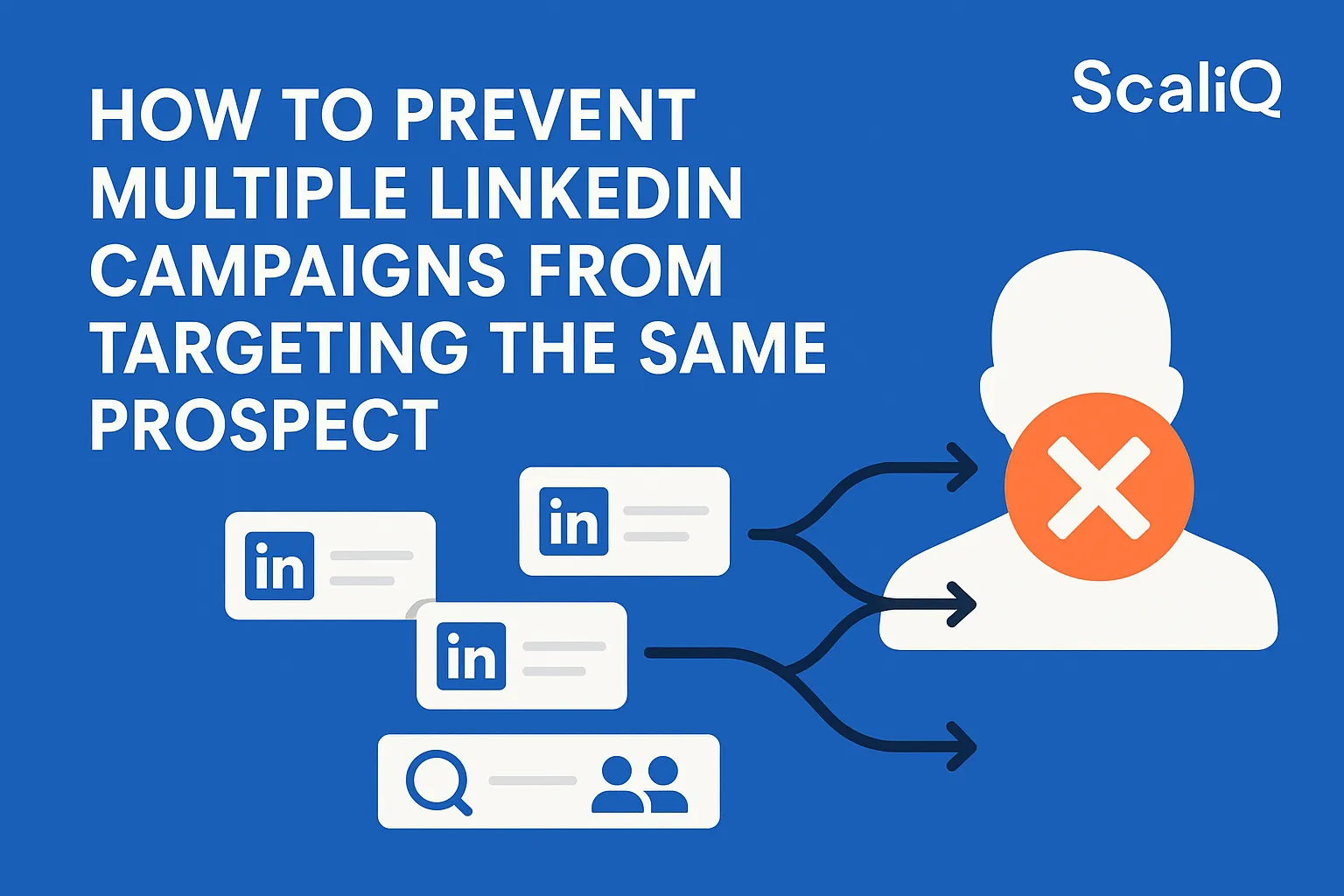
When paid social, Sales Development Representative (SDR) outreach, and Account-Based Marketing (ABM) motions run concurrently, advanced revenue teams run into a major operational bottleneck: the same buyer gets hit by multiple campaigns simultaneously. When a prospect receives an aggressive SDR cold email on the same day they are served a top-of-funnel awareness ad and an ABM expansion message, the buyer experience breaks down fast.
The business impact of this duplicate outreach is severe. It leads to wasted ad spend, muddied attribution, inconsistent messaging, and ultimately, reduced trust with your most valuable target accounts.
This article provides a practical operating model—not just a basic list-cleaning guide—to solve this portfolio-level problem. We will cover contact-level suppression, account-level deduplication, exclusion logic, CRM syncs, ownership rules, and recurring audits. Designed for advanced demand generation, paid social, ABM, and revenue operations practitioners, this guide assumes you already understand basic campaign setup and are looking for scalable governance.
Drawing from ScaliQ’s operational perspective on exclusion lists, account-level deduplication, and team coordination safeguards, this framework will help you lock down your targeting. For more insights on campaign workflows and audience governance, explore our other resources on the Blog.
Why LinkedIn Audience Overlap Happens
To avoid duplicate ad exposure on LinkedIn, you must first understand that overlap is rarely a single-campaign mistake. It is a systems issue. Duplicate targeting stems from simultaneous campaigns, recycled lists, refreshed audiences, ABM expansion efforts, and disconnected team ownership.
This is a revenue-ops problem, representing a portfolio-level multi-campaign targeting conflict rather than isolated paid media inefficiency. Even when teams believe their campaigns are perfectly segmented, underlying audience logic, data matching, and expansion settings can blur those boundaries. Understanding how LinkedIn Matched Audiences match rates function, as well as the mechanics detailed in the LinkedIn Audience Expansion overview, is critical to grasping why unintended LinkedIn audience overlap occurs.
Parallel campaigns create hidden audience collisions
Separate campaign owners often build audiences for their specific goals without checking shared suppression logic. For example, a demand generation manager might run broad awareness ads, while a lifecycle marketer runs retargeting, an SDR executes outbound sequences, and an ABM lead triggers an expansion play.
All of these motions can touch the exact same account at once. Because campaign-level segmentation does not guarantee portfolio-level separation, these parallel efforts create hidden collisions. Without a system to prevent duplicate outreach, sales and marketing outreach deduplication fails, and the multi-campaign targeting conflict damages the buyer's journey.
Contact uploads and refreshed lists can reintroduce excluded prospects
Audience refreshes, CRM exports, data enrichment workflows, and list recycling frequently bring previously excluded people back into active targeting pools.
If a prospect asks to be removed from a sales sequence, they might be manually removed from one list. However, when the marketing team runs a fresh CRM export two weeks later, that prospect is reintroduced. Manual, spreadsheet-based prospect list hygiene for LinkedIn campaigns breaks down entirely once multiple teams and frequent list updates are involved. A frequent audience refresh duplicate outreach issue proves that campaign exclusion lists must be continuously managed, not just scrubbed right before launch.
Native platform controls help, but they do not solve cross-team governance
Native LinkedIn matched audience exclusion is highly useful within the confines of a single ad account or campaign. You can easily exclude a specific uploaded list from a specific ad set.
However, native features do not automatically enforce ownership rules, integrate outbound suppression from your sales engagement platform, or facilitate account-wide coordination across disparate teams. Understanding LinkedIn audience include and exclude logic is necessary for LinkedIn Ads audience exclusion, but it does not replace a comprehensive ABM audience suppression strategy orchestrated across your entire tech stack.
Contact-Level Suppression vs Account-Level Deduplication
Many teams miss the core conceptual distinction between suppressing an individual and deduplicating an entire account. Advanced programs require both layers to function effectively.
Contact-level suppression prevents a specific individual from receiving conflicting messages. Account-level deduplication prevents multiple stakeholders within the same company from being targeted by uncoordinated, conflicting motions. While contact-only logic is necessary, it is insufficient for advanced LinkedIn programs dealing with complex buying committees.
For a deeper understanding of how the platform categorizes these entities, refer to the LinkedIn company and contact targeting overview.
What contact-level suppression solves
Contact-level suppression is designed to prevent the exact same person from appearing in multiple active motions. Common triggers for this include an active SDR sequence, recent ad engagement, existing customer status, or moving into a late-stage open opportunity.
This layer works exceptionally well for outbound campaigns, lead nurture suppression, and direct matched-audience prospect exclusion. It ensures that sales outreach suppression lists and lead list deduplication efforts keep individual buyers from being overwhelmed.
Why account-level deduplication matters for ABM teams
In ABM, multiple stakeholders from a single company are often targeted by different campaign owners simultaneously, creating a fragmented and confusing brand experience.
Account-level deduplication suppresses or coordinates all contacts from an in-flight account when another motion already owns it. For example, if an enterprise SDR claims "Acme Corp" for a highly personalized tier-1 outbound play, account-level logic ensures that Acme Corp's IT Director isn't simultaneously bombarded by generic top-of-funnel paid social ads. This is vital for territory handoffs, account expansion, and avoiding LinkedIn account targeting overlap during ABM prospect suppression.
When to use one layer vs both
To properly implement team coordination safeguards and an ABM audience suppression strategy, you must know how to deduplicate prospect lists at the account level versus the contact level.
How to Build Exclusion Logic Across Campaigns
To achieve true LinkedIn campaign deduplication, you need a repeatable framework for building suppression logic before launch and across your active campaign portfolios. Exclusions must be structured by objective, stage, and owner, rather than through ad-hoc campaign exclusion lists for duplicate outreach prevention.
Start with a suppression hierarchy
A top-down hierarchy prevents teams from creating conflicting local rules campaign by campaign. Your exact hierarchy should align with your company’s funnel stages and GTM model, but a standard team coordination safeguards hierarchy looks like this:
1. Customer and Closed-Won Exclusions: Suppress all active clients from acquisition campaigns.
2. Open Opportunity Exclusions: Suppress accounts currently in active pipeline to avoid disrupting the Account Executive's deal cycle.
3. Active SDR Sequence Suppressions: Exclude contacts actively being worked by outbound sales.
4. Active ABM Play Ownership: Protect tier-1 named accounts currently owned by specific marketing motions.
5. Retargeting and Nurture Exceptions: Allow specific, intentional overlap for middle-of-funnel engagement.
This prospect exclusion hierarchy acts as the ultimate source of truth for your sales outreach suppression lists.
Build exclusions by campaign objective and journey stage
Awareness, consideration, retargeting, expansion, and outbound campaigns all require different suppression rules. Deduplication should preserve reach where appropriate while still preventing conflicting messages.
For instance, an ABM audience suppression strategy should dictate that active opportunities are suppressed from top-of-funnel awareness campaigns, but they might be intentionally included in a highly specific late-stage "ROI calculator" retargeting campaign. Mapping exclusions to buyer journey stages is the key to preventing duplicate outreach without stifling pipeline velocity.
Use shared source-of-truth audiences, not isolated campaign lists
Centralized audiences must be managed outside individual campaign owners’ isolated spreadsheets. Shared source-of-truth audiences improve reporting clarity, reduce audience contamination, and ensure that when an account-level deduplication rule updates, it updates everywhere.
This is where an operational layer becomes critical for audience governance and coordinated exclusions. You can leverage ScaliQ to ensure your LinkedIn campaign deduplication efforts are synchronized. By relying on ScaliQ as your operational layer, centralized suppression management replaces fragmented list uploads.
Define exception handling before launch
Some audience overlaps are intentional. For example, you may want a coordinated handoff where an SDR begins outreach specifically because of a paid nurture engagement.
These exceptions must be documented with owner approval and time limits before launch. Adding an "exception reason" field or governance note prevents permanent rule drift, ensuring that a temporary team coordination safeguards exception doesn't become a permanent multi-campaign targeting conflict or a failure in prospect exclusion.
Contrast a repeatable framework with common manual failure modes
A repeatable framework stands in stark contrast to the manual CRM audience suppression workflow. One-off spreadsheet dedupes, disconnected campaign ownership, and manual CRM exports are prone to human error. A systematic approach to sales and marketing outreach deduplication offers automated verification, strict refresh control, and cross-team consistency—bringing true audience orchestration to your campaigns.
Team Ownership, CRM Sync, and Audience Refresh Workflows
Deduplication is an operating process spanning paid media, sales, ABM, and revenue operations. It is not just a targeting setting. Refreshed audiences are frequently where good plans fail in execution.
Assign audience ownership rules across teams
Every account or audience must have a clear owner of record. The core owners—paid social, demand gen, SDR leadership, ABM, and rev ops—must understand their domain. Campaign ownership rules can be split by segment, funnel stage, geography, or named-account list. Without strict team coordination safeguards, ABM prospect suppression breaks down as teams inadvertently step on each other's toes.
Sync suppression logic with CRM and outbound systems
When a prospect enters an active outbound sequence, opens an opportunity, or is placed in a protected account motion, that action should trigger suppression downstream immediately. Manual uploads lag behind real buying signals and team actions.
To automate sales and marketing outreach deduplication, your minimum data model must include: Contact ID, Account ID, Lifecycle Stage, Active Motion, Owner, and Suppression Status. This ensures both prospect exclusion and account-level deduplication happen in near real-time.
Prevent refreshed audiences from undoing your deduplication work
Audience refreshes are dangerous because they pull fresh data from the CRM, potentially reintroducing previously excluded records if the suppression tags aren't perfectly synced.
To prevent frequent audience refresh duplicate outreach, follow a strict workflow: refresh the source data, apply your dedupe rules, verify net-new records, and then sync to campaigns. Always conduct pre-refresh and post-refresh validation checks. For foundational guidance on monitoring principles and hygiene, review first-party audience refresh best practices to ensure your lead list deduplication holds up over time.
Create handoff rules for simultaneous motions
Handoff logic preserves account coverage without creating buyer confusion. Document rules for multi-campaign targeting conflict scenarios, such as:
• An SDR begins outreach after a prospect hits a specific paid engagement threshold.
• The ABM team claims a strategic account, automatically suppressing it from broad demand gen.
• An existing pipeline account is excluded from broad acquisition campaigns but enrolled in a closed-won acceleration track.
These team coordination safeguards are vital to prevent duplicate outreach during transitions.
Audit Checklist for Ongoing Deduplication Governance
Audience overlap is reintroduced by process changes and data decay, not just bad initial setup. Use this audit checklist for deduplication to prevent drift over time and maintain strict prospect list hygiene for LinkedIn campaigns.
Pre-launch audit
Before any campaign goes live, run a go/no-go check for:
• [ ] Duplicate contacts across active campaign audiences.
• [ ] Duplicate accounts across named-account motions (verifying account-level deduplication).
• [ ] Missing or outdated campaign exclusion lists.
• [ ] Undefined audience ownership.
• [ ] Unapproved or undocumented exceptions to prevent duplicate outreach.
In-flight audit
While campaigns are running, audit weekly to catch operational drift before your spend and buyer experience suffer:
• [ ] Audience growth anomalies after CRM refreshes.
• [ ] Unexplained drops in LinkedIn Matched Audiences match rates.
• [ ] New LinkedIn audience overlap between outbound and paid motions.
• [ ] Changes in account ownership or territory that invalidate current sales outreach suppression lists.
Reporting audit
Deduplication drastically improves measurement clarity by reducing audience contamination. During your monthly reporting, track:
• Overlap rate between campaigns.
• Total excluded volume.
• Active exceptions and their expiration dates.
• Account conflict count.
• Refresh failure rate.
Cleaner suppression logic leads directly to more trustworthy campaign readouts for sales and marketing outreach deduplication and account-level deduplication.
Governance checklist teams can standardize
Standardize this governance cadence to enforce your ABM audience suppression strategy and team coordination safeguards:
• Weekly: Overlap checks and refresh validation before syncing.
• Monthly: Audience ownership review.
• Quarterly: Prospect exclusion and suppression-rule hierarchy review.
Tools, Native Controls, and When You Need an Operational Layer
Understanding when native LinkedIn functionality is enough—and when broader governance tooling becomes necessary—comes down to scale and team complexity.
When native LinkedIn exclusions are enough
Native LinkedIn matched audience exclusion works well for small teams, limited campaign counts, and clearly bounded audiences. If you are a solo marketer running three campaigns, native LinkedIn Ads audience exclusion is likely sufficient for basic prospect exclusion. However, these native controls do not automatically resolve cross-team ownership, account-wide suppression, or outbound coordination.
Where manual workflows break down
As teams scale, the manual CRM audience suppression workflow fails. Spreadsheets drift, exports become stale, account naming conventions become inconsistent, and handoff rules are forgotten. This breaks lead list deduplication and bypasses team coordination safeguards entirely.
What an operational layer adds
An operational layer provides centralized audience governance, exclusion rule consistency, account-level deduplication, and workflow coordination across paid and outbound.
This is where ScaliQ steps in to help advanced teams operationalize suppression logic at scale. It is not just about automation; it is about governance and conflict prevention. By utilizing ScaliQ, revenue teams can seamlessly connect sales and marketing outreach deduplication to their broader audience orchestration strategy.
Future Trend: From One-Off List Hygiene to Always-On Audience Governance
Advanced GTM operations are moving away from reactive list cleaning and toward always-on deduplication workflows. Revenue teams increasingly view over-targeting not just as an advertising spend issue, but as a severe buyer experience risk.
Why governance is becoming part of campaign operations
Teams are formalizing team coordination safeguards, account-level deduplication, and recurring audits as standard operating practice. Centralized audience governance is now a requirement for clean reporting and effective cross-functional coordination.
What advanced teams should build next
To eliminate sales and marketing outreach deduplication errors and enforce a strict ABM audience suppression strategy, advanced teams should move toward:
• Shared audience schemas across all platforms.
• Real-time suppression signals synced directly from the CRM.
• Cross-channel ownership rules mapped to the account level.
• Standardized, automated audit cadences.
The ultimate goal is to architect coordinated buyer journeys to prevent duplicate outreach, not merely to have fewer duplicates on a spreadsheet.
Conclusion
Preventing duplicate LinkedIn outreach requires far more than campaign-level exclusions. It requires a robust operating model. To protect your buyer experience and your budget, you must understand where overlap comes from, utilize both contact-level suppression and account-level deduplication, build a clear exclusion hierarchy, sync rules with your CRM, and run recurring audits.
The strategic benefits are clear: a cleaner buyer experience, better spend efficiency, and highly trustworthy reporting. If your current setup cannot support portfolio-level audience governance, it is time to upgrade your infrastructure.
ScaliQ provides the practical, operator-focused layer needed to manage exclusion governance, account-level deduplication, and team coordination safeguards for advanced campaign operations. Discover how ScaliQ helps coordinate exclusions and prevent prospect collisions across all your campaigns.