

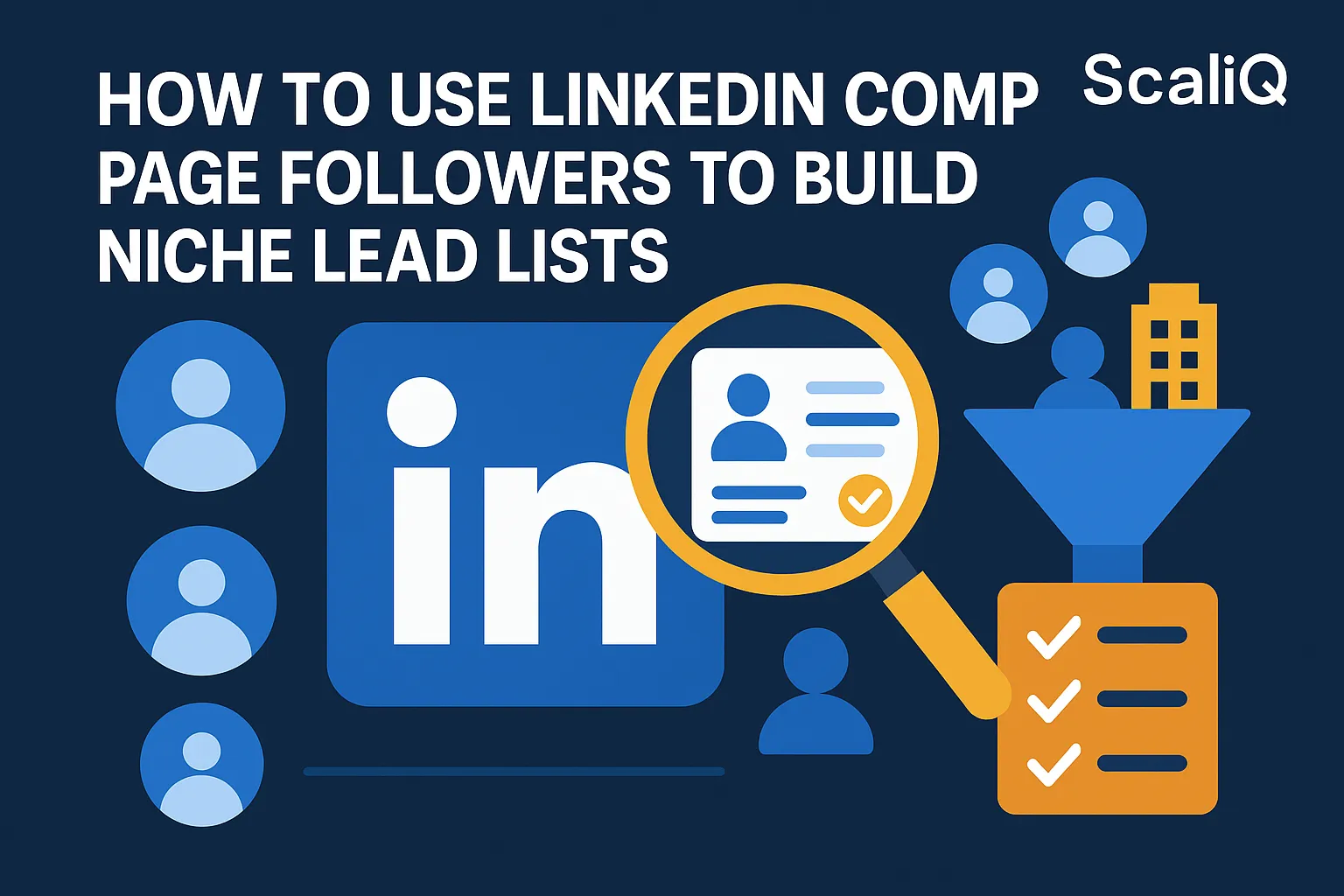
How to Use LinkedIn Company Page Followers to Build Niche Lead Lists
Broad Ideal Customer Profile (ICP) filters often create a frustrating paradox for modern revenue teams: you generate massive lists of leads, yet suffer from weak outreach relevance and dismal reply rates. When your prospecting pool is too generic, your messaging inevitably follows suit.
Many SDR leaders, B2B marketers, and Go-To-Market (GTM) operators have access to an arsenal of traditional prospecting tools, yet they still struggle to identify niche, high-fit accounts early in the buying journey. The solution lies in shifting from static database filtering to an audience-signal-first workflow.
This article provides a repeatable blueprint for leveraging LinkedIn company page followers targeting to build highly relevant B2B prospect lists. This strategy is not about vanity metrics, reckless data scraping, or merely finding followers; it is about legally and ethically transforming audience affinity signals into segmented, outreach-ready account and contact lists.
Drawing on ScaliQ’s practical experience in building niche lead lists from company audience signals, we will explore why broad prospecting underperforms, what follower signals actually reveal, how to build precise lists, when to leverage different audience types, and where ScaliQ fits into this modern workflow.
Why Broad LinkedIn Prospecting Underperforms
Relying exclusively on database-first or broad ICP list building often misses the most critical element of modern sales: relevance. Broad ICP filters—such as targeting "Marketing Directors in SaaS with 50-200 employees"—can return thousands of leads. While this looks impressive on a spreadsheet, these lists typically perform poorly on conversion because they lack context.
When generic lead lists underperform, teams experience cascading operational issues: low reply rates, forced and generic messaging, and an inability to identify which niche accounts are actually in-market. Traditional filtering still holds value, but it reaches its full potential only when paired with audience signals, such as LinkedIn company page followers targeting.
Follower behavior serves as a powerful, intent-adjacent signal. When a prospect follows a direct competitor, a category leader, a complementary product, or an industry community page, they are actively raising their hand to demonstrate market awareness. Compared to manual, database-first prospecting approaches that rely on static data, signal-based targeting allows teams to prioritize relevance over sheer volume. As highlighted by research on irrelevant B2B outreach, buyers are increasingly ignoring generic pitches, making relevance the ultimate competitive advantage in account-based prospecting linkedin motions.
For more insights on smarter, signal-driven workflows, explore our broader educational resources at Blog.
The limits of broad ICP and static database filters
Title, industry, headcount, and geography filters form the foundation of B2B lead lists, but they fundamentally fail to capture active category interest. Static database records tell you who fits your criteria on paper, but they cannot tell you who has recently demonstrated an affinity toward a specific market, methodology, or solution.
Because static filters lack behavioral context, revenue teams are often forced to over-prospect broad segments with undifferentiated, one-size-fits-all outreach. This spray-and-pray approach burns through total addressable market (TAM) without generating meaningful pipeline, proving that broad icp filters return low relevance leads and ultimately harm your linkedin sales prospecting efficiency.
Why audience signals create a stronger prospecting edge
Audience signals are behaviors or digital affinities that suggest a prospect's interest in a specific market, category, or vendor ecosystem. Among these, company audience signals stand out. LinkedIn follower targeting is one of the clearest available social-affinity inputs for building a niche prospecting strategy.
However, follower signals are not a silver bullet on their own. They become exceptionally powerful when layered with traditional firmographic and role-based filters. This multi-layered approach allows you to build niche lead lists from audience signals that are both highly targeted and contextually rich. The industry is rapidly recognizing this shift, as noted by Forrester on buying signals, which reinforces the necessity of moving toward multi-signal prospecting to reignite revenue interactions.
What Company Page Follower Signals Reveal
Understanding what a LinkedIn company page audience actually represents is the first step to leveraging it effectively. Follower audiences reveal deep market affinity across multiple dimensions, including industry concentration, company size, job function, and seniority.
However, it is crucial to differentiate between passive interest and actionable signals. Context, pattern density, and overlap with your ICP fit determine the strength of the signal. By analyzing these audiences, you can identify category-aware accounts, discover adjacent ecosystems, or pinpoint competitor-aware buyers. Raw follower data can be noisy; signal quality dramatically improves when these audiences are rigorously segmented before outreach. For baseline demographic context, LinkedIn Page follower analytics provide native visibility into how the platform categorizes these audiences.
The types of insights hidden in follower audiences
When you analyze a company’s followers, you unlock practical insights into audience dimensions like seniority, job function, industry, and company size. These dimensions inform both your list-building parameters and your messaging angles.
For example, if a complementary software tool has a follower base heavily concentrated with mid-level IT managers in the manufacturing sector, you have uncovered a highly specific niche. Pages with strong audience concentration in a narrow segment are incredibly valuable for linkedin company page followers targeting, allowing you to combine linkedin audience targeting for b2b with precise firmographic filters.
Which follower signals suggest real opportunity vs passive interest
Not every follower is a buyer. To avoid follower data noise without segmentation, you must distinguish between broad brand popularity and genuine buyer relevance. Stronger signals emerge when follower groups naturally overlap with your ideal firmographics, target roles, and a clear buying context.
For instance, a Fortune 500 brand may have millions of followers simply due to consumer popularity—this is a weak B2B signal. Conversely, a niche B2B SaaS startup with 5,000 followers likely has a highly concentrated audience of active industry practitioners. This concentrated niche audience alignment is what makes competitor audience targeting and company audience signals so effective for driving real opportunities.
Page followers vs page visitors vs engagement-based signals
It is important to differentiate between followers, visitors, and engagement as separate audience cues. Followers indicate a sustained, ongoing interest in a brand or category. Visitors and post engagements (likes, comments) provide additional context regarding timing and recent activity.
While admins can gain insights into their own page traffic—supported natively by LinkedIn Page visitor analytics—follower signals offer a more stable, long-term foundation for linkedin lead list building. Understanding the distinction helps teams prioritize accounts that show both sustained affinity (followers) and recent intent (visitors/engagement).
How to Turn Follower Audiences Into Lead Lists
Converting company page audience signals into usable, high-converting prospecting segments requires a systematic approach. The goal is never raw data extraction; the objective is to create outreach-ready, high-context micro-segments. ScaliQ’s practical experience in orchestrating these workflows demonstrates that structured refinement is the key to how to use linkedin company page followers for lead generation effectively.
Step 1 — Choose the right audience source
The workflow begins with identifying the right company pages to use as prospecting inputs. Do not default to the largest pages. Instead, select pages that map directly to a market category, a direct competitor, a complementary tool, an ecosystem partner, or a trusted industry community.
Narrower, higher-affinity audiences consistently outperform broad category pages in terms of list quality. Selecting a highly specific source is the foundational step in effective linkedin company page followers targeting and competitor follower prospecting.
Step 2 — Add firmographic and role-based filters
Once you have identified an audience source, you must refine those audience-derived accounts. Apply filters for industry, company size, geography, and business model to ensure the accounts match your ICP.
Next, add role-based filters such as department, job function, and seniority to ensure you are targeting the actual buying committee. This step is what transforms a fuzzy audience signal into a focused niche segment, proving the value of linkedin company followers with firmographic filters in modern account-based prospecting linkedin strategies.
Step 3 — Enrich accounts and contacts
With a filtered list of target personas, the next step is enrichment. Enrichment fills in the missing company and contact details (like verified email addresses and phone numbers) necessary for outbound operations.
It is vital to understand that enrichment complements audience-signal discovery; it does not replace it. While many teams use standard databases for search and enrichment, the strategic edge lies in the initial audience source signal. Enrichment simply makes your b2b lead lists and linkedin sales prospecting campaigns executable.
Step 4 — Validate list quality before outreach
Before launching a campaign, you must validate list quality to ensure the audience-derived list aligns with your objective. Evaluate the list based on audience affinity, ICP fit, messaging relevance, and niche concentration.
Because not all followers are buyers, validation acts as a critical safeguard against noisy targeting. Skipping this step leads to the exact follower data noise without segmentation that ruins a niche prospecting strategy.
Step 5 — Build outreach segments and messaging angles
A validated list should then be split into micro-segments based on the audience source and their likely motivations. Competitor-followers, partner-followers, and category-followers each require distinct messaging hooks.
Better segmentation drastically improves personalization, allowing you to scale relevance without writing fully custom emails for every single lead. This approach directly combats the low reply rates from cold outreach. For advanced message personalization and outbound execution support, integrating tools like Repliq.Co can help streamline your segmented follow-through.
Compliance, platform limitations, and safe use of audience data
Ethical execution is non-negotiable. Teams must respect platform limitations and use audience insights responsibly. Audience-signal prospecting must focus on strategic segmentation and compliant workflows, strictly avoiding reckless scraping or the misuse of personal data.
Understand what is natively supported—such as using LinkedIn Matched Audiences for ad targeting—versus what requires external, compliant workflow orchestration. Can you target followers of a linkedin company page? Yes, but it must be done through authorized data workflows that prioritize compliance and data privacy above all else.
When to Use Competitor, Partner, and Own-Brand Audiences
The quality and intent of your lead list depend heavily on the source audience selected at the top of the funnel. Different campaign goals—whether account discovery, expansion, or category education—require different audience inputs. Understanding when to deploy competitor audience targeting versus complementary linkedin audience targeting for b2b is crucial.
Competitor follower audiences
Competitor-followers are highly valuable for identifying category-aware prospects, uncovering replacement opportunities, and targeting active comparison buyers. Because these individuals already understand the problem your software solves, competitor follower prospecting is a powerful engine for net-new account discovery.
However, proceed with caution: some competitor audiences are bloated with employees, investors, or casual observers. Additional firmographic filtering is critical. Unlike standard Sales Navigator filtering, which only finds people who fit a job title, this method finds people who fit the title and have demonstrated awareness of your direct competitors.
Partner and complementary-brand audiences
Adjacent-tool or partner audiences reveal strong fit, particularly in ecosystem-driven categories. If you sell a specialized analytics tool for Shopify, targeting followers of Shopify or complementary e-commerce plugins helps uncover likely buyers who may not yet be following your direct competitors.
These company audience signals are perfect for integrations, co-selling motions, and adjacent category education, making them a staple in advanced account-based prospecting linkedin and linkedin lead list building.
Own-brand follower audiences
Your own company page followers represent a different type of opportunity. This audience is best utilized for retargeting, account expansion, warm outbound, customer marketing, and intent prioritization.
When combined with page visits, engagement data, or CRM context, your own-brand audience becomes a high-intent goldmine. This differs from competitor-based discovery; it is a motion focused on prioritization and conversion rather than net-new sourcing for linkedin lead generation.
A simple decision framework for audience selection
To streamline your niche prospecting strategy, use this framework to select your audience source:
This structure ensures you build niche lead lists from audience signals that perfectly match your sales motion.
How ScaliQ Fits Into a Modern Signal-Based Workflow
While the strategy of audience-signal prospecting is clear, the execution often breaks down across disjointed tech stacks. Many teams use separate tools for search, enrichment, and outreach, yet they still lack a purpose-built system to seamlessly build niche lead lists from audience signals. ScaliQ bridges this exact gap, serving as the orchestration layer that turns audience-derived inputs into validated, segmented prospect lists.
Where traditional tools help—and where they fall short
Platforms like Sales Navigator, broad contact databases, and enrichment tools all solve parts of the puzzle. However, they are inherently filter-first, database-first, or enrichment-first. They are rarely audience-signal-first.
The main workflow gap is the manual stitching required to move from strategic audience-source discovery to a clean, enriched niche segment. This is why broad database prospecting vs audience signal prospecting often yields vastly different results in campaign relevance.
The ScaliQ workflow advantage
ScaliQ is designed specifically to help teams identify audience-signal-based opportunities and convert them into actionable prospect lists. By automating the transition from signal to segment, ScaliQ ensures list relevance and enables micro-segmentation aligned with your specific outreach use cases.
If your team is struggling with low relevance, weak reply rates, and slow manual workflows, ScaliQ provides the necessary infrastructure to execute linkedin company page followers targeting at scale. Discover how to streamline this process at ScaliQ.
Best-fit use cases for GTM teams
This workflow is highly effective for specific GTM scenarios:
• SDR Account Discovery: Finding net-new accounts engaging with competitors.
• ABM List Building: Creating hyper-targeted lists for account-based marketing.
• Partner-Led Targeting: Sourcing leads from complementary software ecosystems.
Lean outbound teams, B2B marketers, and operators who require precision over volume will find this niche prospecting strategy transformative for their pipeline generation.
Future Trends & Expert Predictions for Audience-Signal Prospecting
GTM teams are rapidly moving toward signal-based workflows because generic outreach is becoming impossible to ignore—it is actively penalized by buyers and email providers alike. The future of prospecting relies on combining social-affinity signals with deep firmographic enrichment.
Why micro-segmented lists are becoming more valuable
Narrower, micro-segmented lists drastically improve campaign efficiency by eliminating wasted outreach. Buyers now expect hyper-personalization and deep category relevance. As generic automation loses its efficacy, the ability to build niche lead lists from audience signals will transition from a tactical advantage to a baseline requirement for avoiding low reply rates from cold outreach.
How AI and workflow automation fit the process
Artificial Intelligence is accelerating the research, segmentation, and message preparation phases of outbound sales. Once the right audience source is identified, AI-assisted prospect research can instantly analyze firmographics and suggest messaging angles. Workflow automation ensures this happens at scale and with consistency, augmenting the strategic segmentation process rather than replacing it. This is the exact intersection where platforms like ScaliQ are driving the future of linkedin lead list building.
Conclusion
LinkedIn company page followers targeting is a highly effective strategy, but only when follower affinity is used as a qualification signal, not as a standalone list. By shifting away from broad, database-first approaches, revenue teams can generate highly relevant, niche lead lists that actually convert.
The blueprint is straightforward: start with the right audience source (competitor, partner, or owned), layer on strict firmographic and role-based filters, enrich the contact data, validate the list quality, and segment your outreach based on the audience's context. This audience-signal-first approach consistently outperforms generic filtering by ensuring your messaging aligns with demonstrated market interest.
Ready to operationalize this strategy? Explore how to build niche lead lists from company audience signals with ScaliQ, or dive deeper into tactical prospecting guides at Blog.