How to Use LinkedIn Follower Scraping to Find Warm Prospects at Scale
Most outbound teams do not have a volume problem—they have a signal problem. Broad cold lists create a flurry of activity, but activity does not automatically translate into relevance. When sales representatives reach out to massive, unfiltered databases, the result is often ignored messages, burned domains, and frustrated teams. The missing ingredient is context.
Enter LinkedIn follower scraping: a highly effective method to find professionals who have already demonstrated market, brand, or category affinity, and turn that behavioral signal into segmented, high-converting outreach. This is not just about extracting raw lists of followers; it is about building a repeatable prospecting system that relies on careful capture, deep enrichment, intelligent scoring, and source-aware messaging.
Ideal for intermediate B2B sales, outbound, and growth teams already running campaigns on LinkedIn, this workflow bridges the gap between generic cold email and highly targeted social selling. In this guide, we will break down exactly why follower-based prospecting works, which audiences to target first, how to qualify these leads, and how to personalize outreach at scale while maintaining strict compliance and data quality.
Drawing from hands-on experience at ScaliQ, where we have built follower-based targeting workflows across countless outbound campaigns, this blueprint will show you how to transform raw LinkedIn follower scraping into a predictable engine for warm prospecting linkedin and advanced linkedin prospecting workflows.
Why Follower-Based Prospecting Beats Broad Cold Outreach
The fundamental difference between cold prospecting and follower based warm prospecting on linkedin lies in the starting point. Cold prospecting pulls contacts based purely on firmographics—company size, job title, and industry. Follower-based prospecting adds a crucial layer of behavioral intent.
The core signal is simple but powerful: choosing to follow a company page, a competitor brand, or a category creator suggests a baseline degree of awareness, interest, or professional alignment. When you rely solely on broad cold outbound, you face severe pain points: low response rates, weak conversational context, and noisy targeting. You are guessing what the prospect cares about.
Follower scraping is designed to add relevance before the outreach even begins. It is important to note that this does not replace the need for qualification. Instead, it ensures your qualification efforts are focused on a pool of individuals who are already looking in your direction. Compared to database-led sourcing—which offers massive scale but zero context—or manual native platform research—which offers high context but zero scale—follower-based extraction sits perfectly in the middle. It is a highly efficient way to generate b2b warm leads linkedin.
As highlighted by LinkedIn social selling research, context-rich prospecting aligns directly with modern best practices, proving that warmer outreach consistently outperforms spray-and-pray tactics.
What makes a LinkedIn follower a “warm” prospect?
In practical terms, "warmth" in outbound sales translates to awareness, affinity, intent proximity, or category education. LinkedIn company page followers are not automatically qualified leads ready to buy; they are high-signal starting points that require filtering.
Follower intent varies heavily by the source. Brand followers may already be aware of your solution and simply need a push. Competitor followers may be actively using an alternative but remain open to a better workflow. Creator followers may be problem-aware and actively seeking educational content around your category. The real value of follower-based targeting and social selling prospecting comes from combining this behavioral follower signal with strict Ideal Customer Profile (ICP) fit.
Where follower scraping fits in a modern outbound system
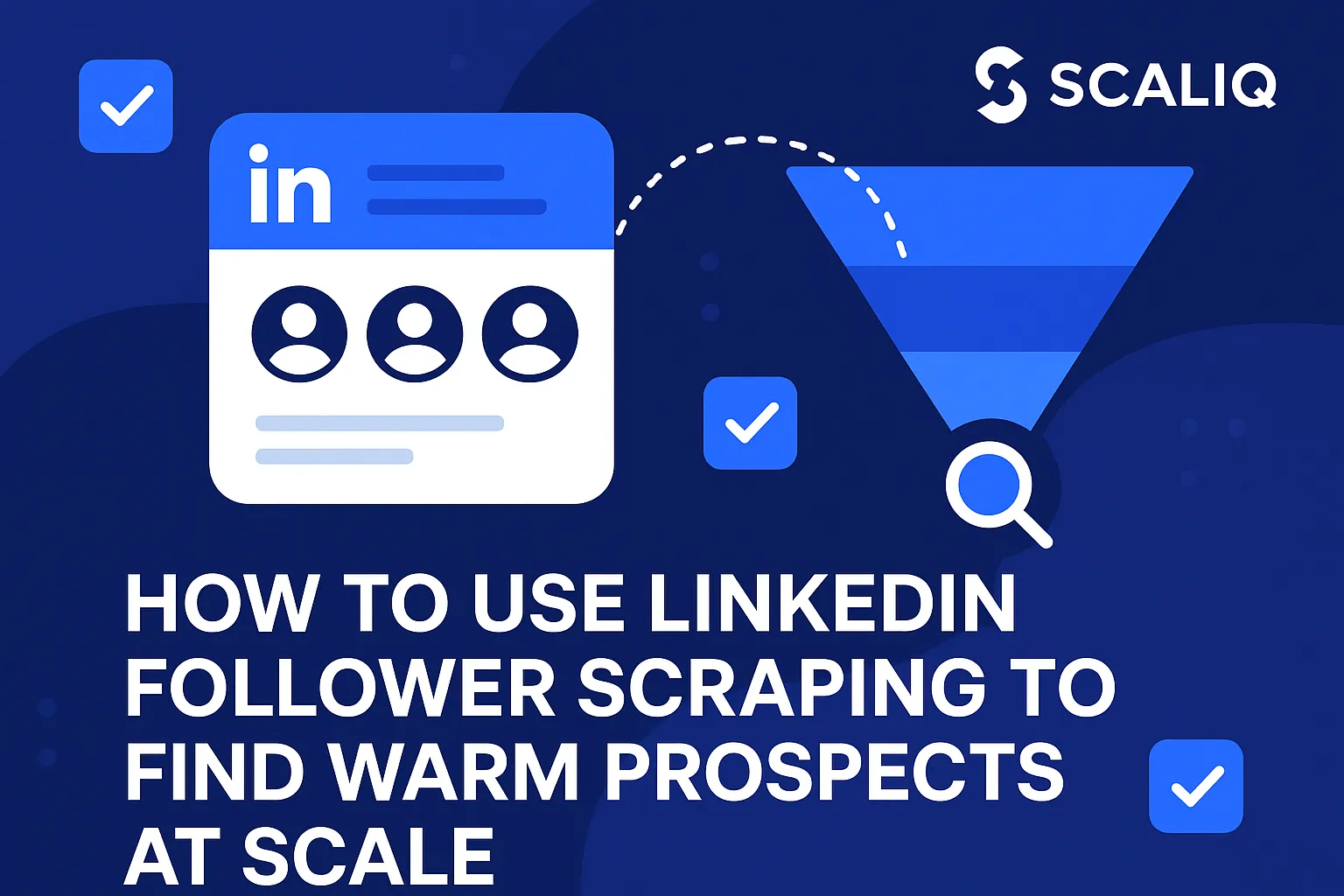
Follower scraping should never exist in a vacuum; it is one strategic input inside a larger, comprehensive outbound system. The ideal workflow operates in a clear sequence: capture the signal, enrich the records, score for fit and intent, segment the list, and finally, personalize the outreach.
This specific approach effectively solves the persistent problem that manual prospect research does not scale. By integrating linkedin prospecting workflows with modern linkedin sales prospecting automation, teams can leverage AI enrichment, automated verification, and compliance-conscious workflow design. These are critical gaps often missed by basic linkedin lead generation tools that focus only on extraction. For a deeper dive into building these robust systems, exploring ScaliQ blog resources can provide foundational outbound education.
Which LinkedIn Follower Audiences to Capture First
Scraping random pools of LinkedIn company page followers will only recreate the noise of cold outreach. To succeed, you must choose the right audience source. The three highest-value follower sources are your own brand followers, competitor followers, and category creator or influencer followers.
Each source reveals a distinctly different buying context and should dictate both your qualification criteria and your messaging strategy. Teams should prioritize their target audience based on the immediate campaign goal: reactivation, displacement, or broader demand capture. By mastering linkedin follower extraction, you can predictably find prospects from linkedin followers who align with your current sales objectives.
Your own brand followers
Your own brand followers represent the lowest-friction warm audience available. These individuals have explicitly opted in to hear from your company, making them ideal for reactivation campaigns, nurture-to-meeting motions, or engaging "aware but not engaged" prospects.
You can convert passive audience members into active conversations by using role- and company-specific messaging that acknowledges their existing familiarity with your brand. While this audience pool is typically smaller than a broad database search, it is significantly more context-rich, making it a highly effective channel for linkedin warm lead generation and social selling prospecting.
Competitor followers
Monitoring competitor followers is a powerful way to reveal active-market buyers who are already educated on your software category. This audience is highly useful for displacement messaging, comparison positioning, or alternative framing.
However, nuance is critical here. Following a competitor does not guarantee that the prospect is dissatisfied with their current vendor, but it absolutely indicates category relevance. When executing warm prospecting linkedin campaigns against this segment, avoid clumsy, invasive outreach that explicitly states, "I saw you follow our competitor." Instead, leverage this linkedin outreach targeting intelligence to shape a strategic, respectful conversation about common industry bottlenecks.
Creator and category influencer followers
Creator and category influencer followers are exceptionally valuable for capturing prospects who are problem-aware but vendor-neutral. This audience allows you to target individuals who are actively educating themselves on a specific pain point, industry trend, or workflow, without being tied to a single corporate brand.
Targeting this group is highly recommended when your goal is thought-leadership-led prospecting or broader category-based segmentation. It is a prime example of advanced social selling prospecting and follower-based targeting, utilizing linkedin audience scraping to find buyers seeking conceptual solutions rather than immediate software pitches.
How to prioritize which audience to scrape first
To determine how do you scrape linkedin followers for prospecting most effectively, use a simple prioritization framework: start with the source closest to your immediate revenue objective.
If you need quick pipeline generation from familiar faces, prioritize brand followers for reactivation. If your product has a distinct feature advantage over a rival, target competitor followers for active replacement intent. If you are launching a new feature and want to capture broader category demand, focus on creator followers. Always test your lists by segment and measure success based on meeting quality and pipeline generated, not just raw reply volume. This is the true measure of successful linkedin warm lead generation and how to find prospects from linkedin followers.
From Follower Data to ICP-Qualified Lead Lists
Extracting a list of names is only the first step. Raw scraped data is incomplete without enrichment, qualification, and segmentation. To learn how to turn linkedin followers into outreach lists at scale, you must move from raw capture to a refined pipeline.
The practical workflow requires you to collect the followers, append missing contact and firmographic fields, filter strictly for ICP fit, score them by priority, and then route them into your outreach sequencing. The goal of linkedin lead generation in this context is never maximum volume; it is highly usable, meticulously selected relevance.
Capture the follower data you actually need
When executing linkedin follower scraping, focus on pragmatic data collection rather than grabbing every available data point. The output of your linkedin company followers export must directly support outreach and qualification.
Focus on profile identity, role clues, company association, and the specific audience source. Preserving the source metadata—recording exactly who they were following when you captured them—is paramount. This metadata is the linchpin for your later segmentation and messaging strategies during linkedin audience scraping.
Enrich for role, company, geography, and fit
Enrichment is what turns a raw follower list into a viable prospecting list. You must append the fields that matter most for ICP matching: exact job title or function, company size, geography, seniority level, industry, and overall company fit.
Firmographic and contextual enrichment effectively strip away the noise from raw follower data, filtering out students, retirees, or irrelevant industries who happen to follow the page. Knowing how to filter linkedin followers by role geography or company fit is the critical bridge between raw audience signal and true sales usability within your linkedin prospecting workflows and linkedin lead generation efforts.
Score followers by ICP match and likely intent
Not all followers deserve immediate outreach. Introduce a simple lead scoring model that combines firmographic fit with behavioral signal. Practical scoring inputs should include the source type, role relevance, company match, geography, and visible category alignment.
By scoring these variables, you can categorize your list. Tier 1 prospects match your ICP perfectly and follow a high-intent source; they get immediate, highly personalized outreach. Tier 2 prospects are a partial match and should be nurtured. Tier 3 prospects should be parked or excluded entirely. This disciplined follower-based targeting ensures your b2b warm leads linkedin are actually worth your sales team's time, optimizing your overall linkedin outreach targeting.
Build segmented lists instead of one giant export
One of the main reasons personalization breaks at scale in linkedin sales prospecting automation is the tendency to collapse all warm signals into one generic sequence. To avoid this, build segmented lists split by audience source, buyer persona, region, and use case.
For example, segment your exports into "Competitor Followers in North America," "Creator Followers in RevOps," or "Brand Followers in Mid-Market SaaS." Segmentation preserves the quality of your personalization, allowing you to tailor the first touch accurately. Utilizing robust outreach platforms like Repliq can significantly support this segmentation, ensuring that linkedin prospecting workflows deliver highly relevant messaging based on the exact list criteria.
How to Personalize Outreach From Follower-Source Context
The ultimate goal of this workflow is to turn audience signal into messaging that feels remarkably relevant without sounding invasive. Personalization in sales outreach should stem from category context and likely business interest, not from awkwardly announcing that you scraped their profile.
Your messaging must adapt dynamically based on whether the prospect follows your brand, a competitor, or an industry creator. Maintaining high relevance while operating at scale is the hallmark of effective warm prospecting linkedin and sophisticated linkedin outreach targeting. As noted in industry guidelines regarding personalization in sales outreach, buyer-centered relevance is non-negotiable for modern conversion rates.
Messaging angles for brand followers
For brand followers, your messaging angles should focus on familiarity, recent company relevance, or a "you may already know us from..." approach. Acknowledge the shared context naturally, without overexplaining the data source.
Appropriate Calls to Action (CTAs) for this audience include offering a quick workflow audit, a casual fit-check, or a tailored use-case conversation based on their specific role. Because they already know who you are, the friction is lower, making this a highly efficient route for linkedin warm lead generation, social selling prospecting, and warm prospecting linkedin.
Messaging angles for competitor followers
When reaching out to competitor followers, lean into alternative framing and problem reframing. Use angles like, "Teams evaluating this category often struggle with X."
Exercise extreme caution against directly referencing the competitor follow as your opening line—it comes across as aggressive and surveillance-heavy. Instead, focus entirely on value-led messaging. Highlight your differentiation, address common workflow gaps, or emphasize speed, cost, and quality outcomes. This approach turns competitor followers into high-converting b2b warm leads linkedin through intelligent linkedin outreach targeting.
Messaging angles for creator followers
Creator followers respond best to insight-led outreach rather than direct product pitches. Open your messaging around the problem space, industry trend, or specific framework that the creator frequently discusses.
Since this audience is educated on the pain point but not necessarily looking for a vendor, use educational hooks, teardown offers, or benchmark-style CTAs. This approach aligns perfectly with social selling prospecting and follower-based targeting, turning linkedin lead generation into a consultative, value-first conversation.
How to preserve personalization at scale
The secret to ensuring that personalization breaks at scale does not happen to your team is realizing that segmentation does most of the heavy lifting before copywriting even begins.
Use modular messaging: build one core sequence but swap out source-specific intros, pain points, and proof points based on the segment. Emphasize quality controls by testing small batches per segment, monitoring reply rates, and refining your assumptions. This modular approach perfectly balances the manual prospecting extreme with the bulk automation extreme, optimizing how to turn linkedin followers into outreach lists at scale through smart linkedin sales prospecting automation.
Compliance, Data Hygiene, and Workflow Tradeoffs
Executing this strategy requires teams to balance the desire for scale with platform restrictions, outreach compliance, and rigorous data quality standards. Scraping-related workflows are powerful, but they are not without operational tradeoffs.
To succeed long-term, teams must evaluate the differences between native LinkedIn workflows, third-party extraction tools, and database-first sourcing. Understanding linkedin scraping compliance risks is vital for sustainable linkedin lead generation and safe linkedin follower scraping.
Compliance and outreach rules teams should understand
Scraping workflows create legal, platform, and operational considerations that must be evaluated with care. Compliance does not start at the moment you hit "send"—it begins at the point of collection, storage, and usage.
Focus on outreach compliance basics: ensure clear sender identification, provide easy opt-outs, engage in lawful campaign practices, and respect user data rights. For a comprehensive understanding of commercial messaging requirements, teams should strictly adhere to the FTC CAN-SPAM compliance guide. Navigating linkedin scraping compliance risks ensures your warm prospecting linkedin and linkedin outreach targeting remain both effective and lawful.
Data minimization, privacy, and responsible handling
Responsible data handling dictates that teams should collect only the data strictly necessary for a specific prospecting purpose. Avoid hoarding irrelevant personal information.
Stress the importance of purpose limitation, data accuracy, and accountability in your lead workflow. Implement clear data handling practices, strict suppression logic to avoid emailing opted-out contacts, and conduct periodic reviews of list quality. Following the OECD privacy principles provides a strong ethical framework for linkedin audience scraping, mitigating linkedin scraping compliance risks and ensuring that raw scraped data is incomplete without enrichment is handled securely.
Data quality standards for better outreach outcomes
Inaccurate or stale data destroys campaign performance and damages sender trust. When lead lists lack buying context or intent signals, bounce rates spike and domains get flagged.
Implement rigorous verification, normalization, deduplication, and periodic data refreshes. High data hygiene ties directly back to better deliverability, cleaner segmentation, and highly defensible outreach operations. Aligning your processes with NIST information quality standards ensures your linkedin prospecting workflows scale smoothly, solving the issue that manual prospect research does not scale.
Follower scraping vs Sales Navigator vs databases
When evaluating your stack, compare the three main sourcing options practically:
• Native LinkedIn Sales Navigator: Safer, natively compliant, but slower and less flexible for bulk audience capture.
• B2B Databases: Offers massive, broad coverage, but generally lacks the behavioral warmth and context of social signals.
• Follower Scraping Workflows: Provides much stronger audience signal and context, but introduces more operational complexity and compliance management.
The best setup is rarely a single source; it is a blend. Frame linkedin follower scraping as a specialized signal-capture layer inside a broader system. Understanding linkedin sales navigator vs follower scraping and apollo vs follower based prospecting helps teams build resilient linkedin prospecting workflows.
Tools, Workflow Components, and Operational Best Practices
To execute this strategy, you must assemble a practical workflow stack. The core layers include audience capture, enrichment, scoring, segmentation, and outreach execution.
Rather than getting bogged down in endless product comparisons, focus on the orchestration and usability of the data. While many guides focus purely on extraction mechanics, the true ROI of linkedin follower scraping and linkedin sales prospecting automation lies in how seamlessly you connect these components into cohesive linkedin prospecting workflows.
The core workflow stack
Break your process down into functional components. You need a reliable mechanism for scraping/extraction, a robust data enrichment provider, a lead scoring logic, a sequencing tool, and a personalization engine.
Recognizable ecosystem tools often used in these layers include Sales Navigator for native research, Apollo for database cross-referencing, Clay for deep waterfall enrichment, Phantombuster for extraction, and TexAu for automation. The exact tools matter less than the architecture; the winning workflow is the one that flawlessly preserves context from the initial source all the way to the final message. Whether you use clay enrichment for linkedin followers, phantombuster linkedin follower scraping, or texau linkedin prospecting automation, the integration must be seamless.
What most teams get wrong operationally
The most common operational mistakes include scraping audiences that are far too broad, skipping the enrichment phase, failing to save the source context, over-automating the personalization to the point of sounding robotic, and ignoring compliance standards.
Warm-signal workflows fail entirely when they are treated like volume-only lead generation. To prevent low response rates from cold outbound and ensure personalization breaks at scale does not occur, teams must build tight feedback loops around reply quality and meeting conversion rates by segment, constantly refining their approach based on actual data.
Future Trends in Signal-Based LinkedIn Prospecting
The broader trend in B2B sales is a massive shift toward signal-based outbound. Teams are increasingly mining followers, post engagement, creator audiences, and adjacent market signals to find buyers at the exact right moment.
AI personalization and advanced workflow orchestration are drastically increasing the value of smaller, warmer datasets. Follower scraping is a key part of this shift away from pure database prospecting and toward context-rich, behavioral targeting. At ScaliQ, our practical outbound workflow perspective shows that teams leveraging these nuanced signals consistently outbook competitors relying on static lists, proving that the future of linkedin warm lead generation and social selling prospecting is highly contextual.
Conclusion
LinkedIn follower scraping works best when it is treated as a strategic signal input, not merely a list-building shortcut. By choosing the right audience source, enriching and scoring for strict ICP fit, segmenting by source context, and personalizing outreach intelligently, you can build a highly predictable pipeline.
Crucially, this must all be done while keeping compliance and data quality exceptionally tight. The strategic advantage is clear: followers provide significantly stronger context than broad cold lists, making this an ideal workflow for teams frustrated by generic outbound performance.
Review your current prospecting motion today and begin testing follower-based segments alongside your existing channels. To explore a comprehensive approach to scalable, signal-based prospecting and advanced workflow design, visit ScaliQ and transform how you turn linkedin followers into outreach lists at scale.