

How to Use AI to Turn LinkedIn Activity Into Daily Prospecting Tasks
Most teams know that LinkedIn activity contains powerful buying signals, but they still rely on manual checking, scattered alerts, or generic automation that creates more noise than pipeline. The real challenge in modern sales is not tactical; it is operational. There are simply too many signals, no clear prioritization, and no consistent way to turn raw digital activity into meaningful action.
This guide provides a simple, beginner-friendly ai prospecting workflow that solves this operational bottleneck. We will define exactly which LinkedIn signals matter, show you how to convert each one into a structured daily task, explain how to score urgency, and demonstrate how AI adds crucial context. Most importantly, we will cover how to implement linkedin activity automation safely—without resorting to spammy, mass-messaging tactics.
Designed for SDRs, founders, and lean revenue teams with limited tooling, this is a practical daily system rather than a requirement for an advanced martech stack. This is not about mass messaging automation; it is about building a signal-based outreach operating system.
At ScaliQ, we have extensive experience building daily outreach systems triggered by activity signals. We focus on operational execution, ensuring that teams have a reliable structure for managing intent. Readers who want more signal-based prospecting playbooks can explore our strategies at Blog.
What Counts as a LinkedIn Intent Signal
Not every LinkedIn action deserves outreach. For beginner readers looking to separate valuable buyer-intent activity from vanity engagement, it is crucial to define an "intent signal." An intent signal is an action that suggests awareness, relevance, timing, or a potential buying motion.
The most useful signal categories include post comments, profile views, job changes, content interactions, hiring announcements, and company page activity. However, these signals are significantly stronger when tied to context, such as role fit, target account match, recent company changes, or engagement with relevant industry topics. Ultimately, LinkedIn intent signals are inputs for prioritization, not automatic reasons to send a generic message. To understand how the platform categorizes these actions, review the official LinkedIn Buyer Intent activity guidelines. Effective LinkedIn engagement tracking relies on recognizing these buyer intent signals and acting on them strategically.
High-Value Signals Worth Tracking First
For a practical and actionable start, focus on a shortlist of high-value signals. These include comments on relevant posts, profile views from ideal buyers, job changes, new connections to colleagues, company page activity, and active engagement with industry-specific content.
Comments and job changes are often stronger than passive likes because they imply higher urgency and provide clearer business context. Concrete examples of intent-rich triggers include a prospect commenting on a competitor’s post regarding a specific pain point, a target account announcing a hiring surge, or a decision-maker moving into a new role. Staying focused on these concrete, operational events is the foundation of an effective lead generation workflow. For more practical trigger examples, you can reference these LinkedIn trigger events to refine your social selling and LinkedIn prospecting automation strategies.
Low-Signal Activity That Should Not Trigger Immediate Outreach
It is easy for beginners to overreact to every notification, but low-signal activity should not trigger immediate outreach. A single like, broad content consumption, or unrelated engagement often lacks enough context for immediate action.
Weak signals should be monitored, bundled, or enriched before any task creation occurs. Using every small action as a trigger inevitably leads to spammy, low-relevance outreach. This stands in sharp contrast to competitor-style sales automation approaches that optimize for volume rather than decision quality. True signal-based prospecting follows strict LinkedIn outreach automation best practices to ensure relevance.
A Simple Signal Framework Beginners Can Remember
To make this actionable, group signals into three simple buckets: awareness signals, change signals, and urgency signals.
• Awareness Signals: Show familiarity (e.g., viewing a profile or liking a company post).
• Change Signals: Reveal timing (e.g., a job change or new funding announcement).
• Urgency Signals: Suggest immediate outreach potential (e.g., commenting on a post about a specific problem your product solves).
This framework is simple enough that a founder or SDR can apply it during a daily review without an advanced ai sales assistant. Mastering these buckets streamlines prospect research automation and helps teams accurately categorize LinkedIn intent signals.
From Activity Signal to Daily Prospecting Task
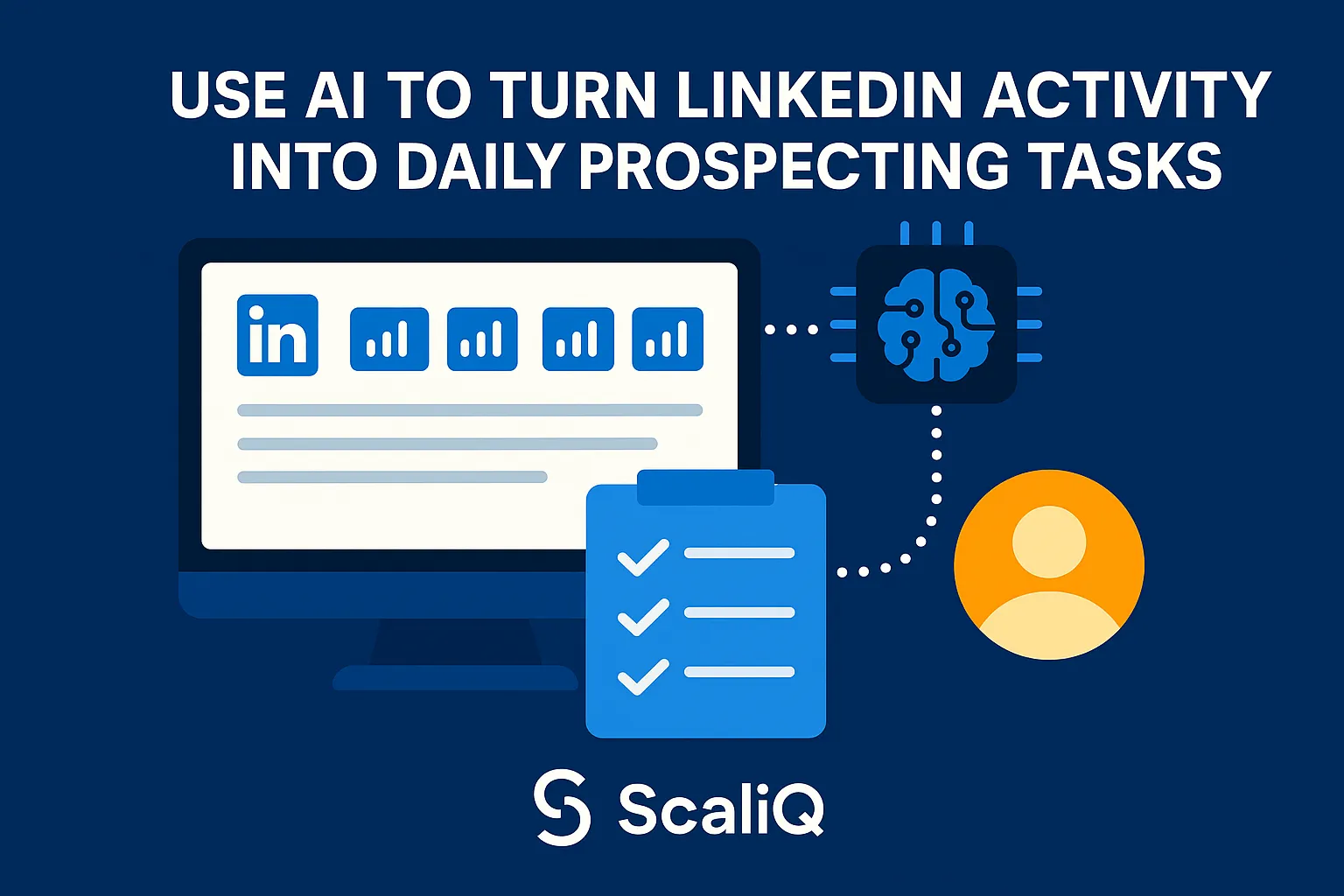
The core operating system that ScaliQ champions is the process of turning one raw activity event into a useful action item. The full journey looks like this: signal capture → qualification → AI summary → task creation → owner assignment → follow-up.
The output of this ai prospecting workflow is not an automated message. It is a structured task that tells a rep exactly what happened, why it matters, and what to do next. For an example of an operational system that turns activity signals into daily outreach queues, see ScaliQ. This level of prospecting task automation is the backbone of a modern lead generation workflow.
Step 1 — Capture the Signal
The first step is capturing the signal at the event level. The minimum fields required are the person, company, signal type, date/time, source activity, and relevant content or event details.
Clean inputs matter immensely. Poor capture creates bad summaries and weak outreach recommendations. Keeping tooling assumptions minimal ensures that this process feels accessible to beginners looking to master linkedin activity automation, signal-based outreach, and LinkedIn engagement tracking.
Step 2 — Qualify Whether the Signal Deserves Action
To prevent task overload, reps must qualify whether the signal deserves action. Basic qualification checks include: Is this person in the ICP? Is the account relevant? Does the signal align with the product’s use case? Is there enough context to personalize outreach?
Some signals should create an immediate task, while others should be stored until combined with more context. A binary or simple traffic-light system works best for beginners managing buyer intent signals through sales automation and LinkedIn prospecting automation.
Step 3 — Turn the Signal into a Structured Task
A useful AI-generated prospecting task must be highly structured. A reliable task template should include:
• Signal: The exact triggering event.
• Context Summary: Brief background on the prospect and company.
• Reason to Reach Out: Why this matters right now.
• Message Angle: A suggested hook or opener.
• Urgency Level: High, medium, or low.
• Owner: Who is responsible for execution.
• Next Step: The immediate action required.
For example: “Prospect commented on a post about scaling SDR workflows; summarize likely pain point and suggest relevant opener.” The best task outputs reduce rep thinking time and increase confidence, proving the value of an AI sales assistant in signal-based prospecting and prospecting task automation.
Step 4 — Route It Into the Daily Workflow
Routing tasks correctly ensures they get executed consistently. Options include a CRM queue, a Slack digest, a shared team inbox, or a founder task list.
Routing matters just as much as signal capture; even a brilliant signal is wasted if no owner sees it. A daily queue-based execution strategy consistently beats random alerts, making CRM, Slack, and daily prospecting tasks the central hubs of the workflow.
How to Prioritize and Score Outreach Triggers
Solving the pain point of "which signals deserve follow-up first" requires a beginner-friendly scoring model. Reps cannot treat every event equally. Prioritization should combine signal strength, account fit, contact relevance, and timing to create a reliable social selling workflow based on actual buyer intent signals and accurate signal scoring.
The 4 Inputs That Determine Priority
Scoring breaks down into four simple dimensions:
1. Signal Strength: How explicit is the intent?
2. ICP/Account Fit: Does the company match your ideal customer profile?
3. Recency: Did this happen today, or three weeks ago?
4. Available Context: Do you have enough information to craft a relevant message?
Recent comments or job changes from ideal prospects will always outrank older, passive engagement from marginal-fit leads. Score each dimension simply (e.g., 1–3 or low/medium/high) to streamline your lead generation workflow, evaluate LinkedIn intent signals, and execute signal-based prospecting.
Example Scoring Model for Beginners
A tactical rubric you can implement today looks like this:
• High Signal: Comment on a relevant topic or a job change into a target role. (Action: Same-day task)
• Medium Signal: Profile view from a target account. (Action: Review queue)
• Low Signal: Single post like. (Action: Monitor only, unless paired with other context)
Threshold-based actions keep execution clear and non-technical, optimizing your linkedin engagement tracking, signal scoring, and prospecting task automation.
When Speed Matters Most
Certain trigger events lose value quickly. Job changes, active commenting, and topical engagement tied to current business pain require swift action. Timely follow-up improves relevance because the outreach references a live event rather than a stale profile detail.
Your daily queue execution should help reps respond quickly without scrambling. For more on the timing of follow-ups, review these LinkedIn trigger events to understand how live events drive ai prospecting workflow success and modern social selling.
Avoiding False Positives and Alert Fatigue
Over-triggering creates noise, lowers trust in the system, and reduces team adoption. To avoid false positives, implement rules like minimum fit thresholds, duplicate suppression, and daily caps by rep.
Unlike tools that surface endless alerts but leave execution design to the user, a proper system filters the noise. This protects your signal-based outreach, ensures effective prospect research automation, and maintains healthy sales automation practices.
How to Add Context with AI Enrichment and CRM Routing
AI makes raw LinkedIn activity outreach-ready instead of leaving reps to do manual research. LinkedIn activity alone is rarely enough; the signal must be enriched with contact, company, and account context before it becomes a task. AI can summarize relevant context and recommend a next-best action without writing generic outreach on autopilot, powering a highly effective ai prospecting workflow and reliable prospect research automation through AI enrichment.
What Context to Add Before Outreach
The minimum enrichment layer should cover useful context such as the prospect's role, company size, recent company news, existing CRM history, account owner, and pain-point relevance.
This context helps a rep confidently answer three questions: Why now? Why this person? Why this angle? Connecting enrichment directly back to message quality and prioritization is the core function of an AI sales assistant handling CRM routing and prospect research automation.
How AI Should Summarize the Opportunity
AI should synthesize, not hallucinate. Its role is to summarize the signal, infer likely relevance, suggest a message angle, and propose a next step.
Outputs should be concise—a 2–3 sentence brief plus bullets for opener ideas and follow-up actions. AI is most valuable when it reduces manual prep, not when it replaces human judgment. For guidelines on trustworthy AI principles and human oversight in summarization, refer to the NIST AI Risk Management Framework. This ensures your signal-based prospecting and ai prospecting workflow remain credible and effective.
Routing Tasks into CRM, Slack, or Rep Queues
Routing should assign the right owner, preserve context, and create accountability. Simple routing options for beginner teams include a founder queue, an SDR queue, account owner routing, or Slack digests for review.
The system must update a central source of truth rather than create disconnected notifications. To see a practical example of routing enriched signals into actionable CRM, Slack, and daily outreach tasks, visit ScaliQ.
Example of a Finished AI-Generated Task
To make the abstract workflow tangible, here is an end-to-end example of a task a rep could act on in under five minutes:
• Trigger: Prospect commented on a relevant post about data compliance.
• Context: VP of Sales at a 200-person SaaS company; likely struggling with manual data entry.
• Reason to reach out: High intent shown regarding workflow bottlenecks; ideal ICP fit.
• Message angle: "Saw your comment on [Post Topic]—curious how your team is currently handling data compliance without slowing down outreach?"
• Next step: Connect on LinkedIn with the customized note.
This structured format bridges the gap between linkedin activity automation, lead generation workflow, and prospecting task automation.
How to Automate Safely Without Generic Outreach
Platform safety and trust are paramount. There is a clear distinction between the safe automation of research, enrichment, scoring, and task creation versus the risky automation of mass messaging or spammy engagement. Human review, personalization, and compliance guardrails must remain central to your social selling, sales automation, and LinkedIn outreach automation best practices.
What Safe Automation Looks Like in Practice
Safe automation supports monitoring, summarization, prioritization, and routing. Message approval, personalization, and final outreach decisions must remain human-in-the-loop.
Automate task preparation, not generic outreach blasts. This approach protects your brand and ensures that your linkedin activity automation, ai prospecting workflow, and signal-based outreach yield high-quality conversations.
Why Generic Auto-Messaging Backfires
Generic outreach ignores context, weakens trust, and increases spam risk. Mass-automation narratives dominate the SERP, but optimizing for volume over relevance damages reputations.
A signal-to-task model focuses on AI enrichment, verification, prioritization, and compliance. This prevents the pitfalls of sequence-first platforms and prioritizes buyer intent signals, social selling workflow integrity, and safe LinkedIn prospecting automation.
Compliance and Responsible Outreach Guardrails
Respecting platform rules, using relevant context, and avoiding deceptive claims are non-negotiable. Routing a task to a human rep is fundamentally different from blindly automating outbound at scale.
Basic controls should include review steps, logging, opt-out awareness, and transparent ownership. When email is part of the follow-up workflow, ensure commercial outreach follows applicable requirements by consulting the FTC CAN-SPAM compliance guide. Additionally, reinforce transparency and accountability in AI-assisted workflows by adhering to the OECD AI Principles, ensuring safe outreach and compliant sales automation.
Tools, Workflow Design Tips, and a Simple Starting Stack
You do not need a complex tool ecosystem to operationalize this workflow. The simplest version of the system only requires signal capture, enrichment logic, a scoring framework, and one place where daily tasks are reviewed. Keep the stack lightweight and focus first on process design. Many tools surface signals, but the real advantage comes from how teams convert them into action through a well-designed ai sales workflow, signal-based prospecting, and prospecting task automation.
The Minimum Viable Workflow for Beginners
A simple setup involves tracking a small set of signals, applying a basic score, generating a short AI brief, routing tasks to one queue, and reviewing them daily.
Consistency is more important than sophistication. Beginners should start with a narrow ICP and a few trigger types. This focused approach is the key to mastering beginner LinkedIn prospecting, daily outreach tasks, and linkedin activity automation.
How This Differs from Typical LinkedIn Automation Tools
Many tools focus heavily on list building, sequences, or automation efficiency. The signal-to-task model focuses strictly on relevance, timing, and task clarity.
Instead of workflows that prioritize scale over context, a daily execution system tied to real activity signals ensures quality. For teams interested in adding a complementary personalization layer to their outreach, explore Repliq.Co. Ultimately, focusing on signal-based outreach, an ai prospecting workflow, and intelligent LinkedIn prospecting automation yields the highest conversion rates.
Conclusion
The real opportunity is not automating LinkedIn outreach at scale, but turning real engagement and intent signals into clear, prioritized daily tasks. By following a five-step logic—identify signals, qualify them, score them, enrich them with AI, and route them into a consistent workflow—teams can dramatically improve their pipeline quality.
Beginners do not need a huge stack to start; a simple operating system always beats scattered manual checking. Review your current LinkedIn prospecting process today and identify where valuable signals are getting lost. For teams that want to operationalize signal-based outreach with daily queues and smarter task creation, ScaliQ offers a practical next step. See how to turn activity signals into actionable workflows at ScaliQ and elevate your linkedin activity automation, ai prospecting workflow, and signal-based prospecting.
Frequently Asked Questions
How can AI turn LinkedIn activity into prospecting tasks?
AI turns activity into tasks through a concise sequence: capture the signal, qualify the fit, enrich the context, score the urgency, and route a task to the right rep. AI helps summarize and prioritize the data; it should never automatically spam prospects. This is the foundation of a safe ai prospecting workflow and compliant linkedin activity automation.
What LinkedIn signals indicate buyer intent?
Key signals include comments, profile views, job changes, relevant content engagement, company page activity, and new connections to teammates. The best signals are always those paired with strict ICP fit and recent timing, making them highly actionable LinkedIn intent signals and reliable buyer intent signals.
How do you automate LinkedIn prospecting without spamming?
Automate the research, summarization, scoring, and task creation rather than auto-DMs. Emphasize human review, thoughtful personalization, and strict compliance controls to maintain trust. This adheres to LinkedIn outreach automation best practices and ensures responsible sales automation.
What should a daily prospecting task include?
Essential fields include the signal, context, why now, recommended angle, owner, and next action. The goal is immediate usability for the rep, removing friction from prospecting task automation and streamlining daily outreach tasks.
Can beginners build this workflow without a large tool stack?
Yes, a lightweight setup works perfectly if the rules are clear. Start with a few high-value signals and one daily review queue to build consistency before scaling up your beginner LinkedIn prospecting and ai sales workflow.