

Introduction
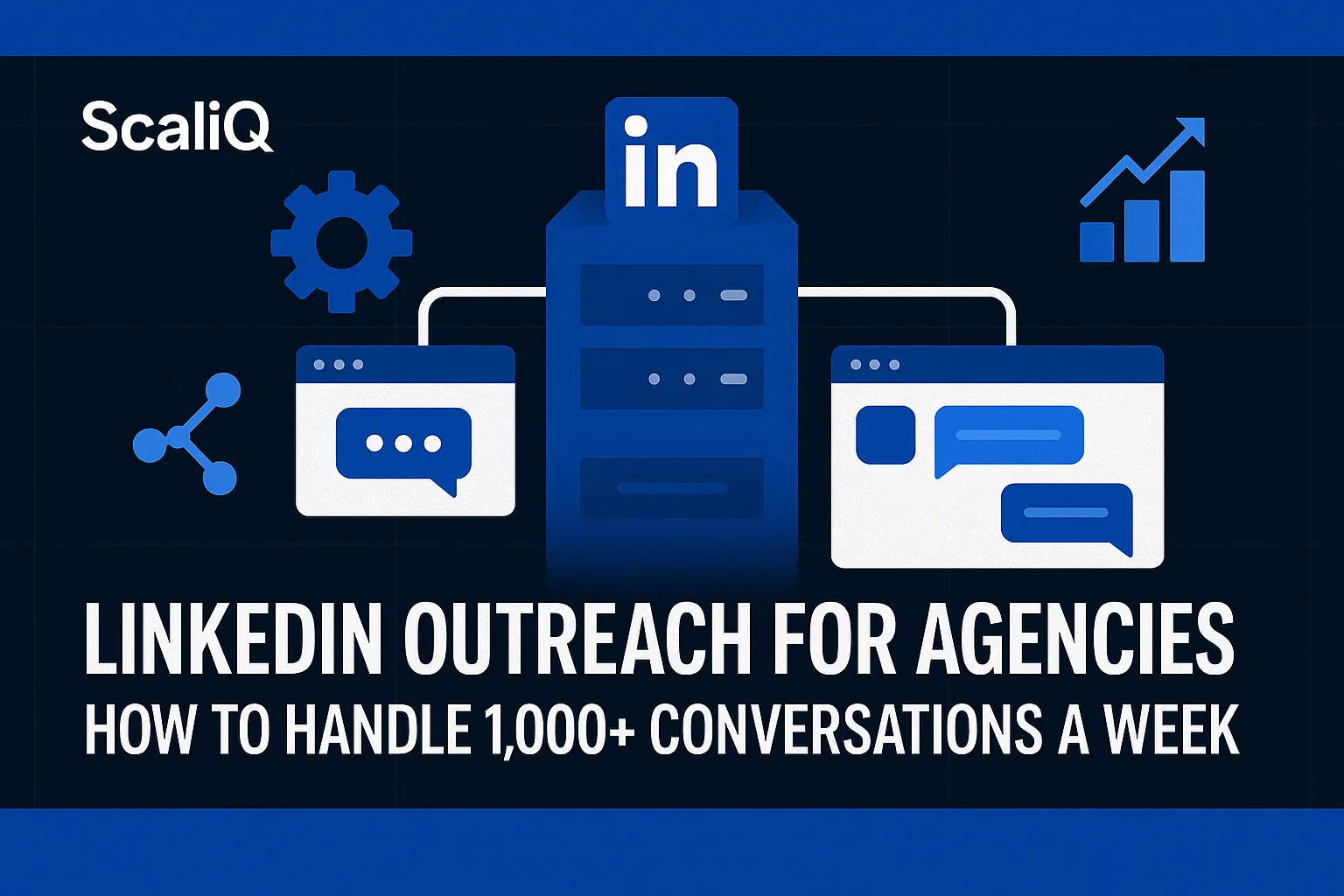
Scaling an agency often feels like a triumph until the operational reality sets in. When your outbound team moves from managing a manageable few hundred messages to handling over 1,000 LinkedIn conversations weekly, the atmosphere shifts from productive to chaotic. Inboxes overflow, high-value leads are buried under generic replies, and follow-ups—the lifeblood of conversion—are missed entirely.
This is not a failure of effort; it is a failure of infrastructure. Most agencies attempt to solve volume problems with more bodies or basic automation tools, but neither addresses the systemic complexity of high-load communication. Without a dedicated operational architecture, volume inevitably breaks teams.
This guide provides a complete, systems-first blueprint for agencies managing extreme message volume. Drawing on ScaliQ’s extensive experience building high-load LinkedIn communication systems, we will dismantle the "send more" mentality and replace it with a "manage better" framework. We will explore how to implement triage protocols, shared inboxes, and hybrid AI-human workflows that allow your agency to scale linkedin outreach without sacrificing the personalization that drives revenue.
Why Agencies Break at High-Volume LinkedIn Outreach
Most agencies operate smoothly when handling 100 to 300 weekly conversations. At this level, a single SDR or account manager can mentally track active deals. However, past the 500-conversation mark, the cognitive load exceeds individual capacity. This is the "breaking point" where operational bottlenecks begin to degrade performance.
The primary failure points are visible and costly: message overload leads to delayed responses, and critical context is lost between team members. While tools like Zopto or Expandi excel at sequencing—sending the initial connection request and follow-up—they are not built for complex conversation management. They focus on the outbound push, leaving the inbound management in a chaotic state.
Data analysis of agency performance suggests that without a centralized system, follow-up consistency drops by 40–60% once volume exceeds 500 weekly active threads. Leads that respond with "Not now, ask me in Q3" are rarely contacted again because they vanish into a disorganized inbox.
Furthermore, high-volume environments introduce significant compliance risks. When teams scramble to clear queues, they often resort to aggressive, non-compliant automation or copy-paste errors that violate LinkedIn’s spam policies. The result is a dual loss: a degradation of lead quality and an increase in account restriction risk. To succeed, agencies must shift their focus from simple sequencing to comprehensive conversation orchestration.
Automation Plus Human Review: How to Keep Quality High
The fear of scaling is often a fear of sounding robotic. However, a hybrid approach—leveraging automation for drafting and humans for context—can actually increase personalization at scale.
Strategy A — AI-Assisted Reply Drafting
The modern workflow for high-volume outreach involves AI as a drafter, not just a sender. In this model, an AI agent analyzes the incoming message and the prospect's profile to generate a draft response.
The workflow operates as follows:
1. Ingest: System receives a prospect reply (e.g., "What does your pricing look like for enterprise?").
2. Draft: AI generates a context-aware response referencing the user's specific pricing tier inquiry.
3. Review: A human operator reviews the draft, tweaks the tone if necessary, and approves it.
4. Log: The system sends the message and logs the interaction.
Research on human-AI collaboration published on arXiv suggests that human-in-the-loop systems significantly outperform pure AI or pure human workflows in complex decision-making tasks. This "automate linkedin replies without losing personalization" strategy allows a single human to approve 50 high-quality replies in the time it would take to write 10 from scratch.
Strategy B — Quality-Control Layers
When processing thousands of messages, quality control (QC) cannot be an afterthought. It must be embedded in the process.
Agencies should implement random sampling and peer review protocols during peak load times. For example, a senior manager might review 10% of all replies sent by junior SDRs weekly to ensure brand alignment. Automated scoring can also flag messages that contain negative sentiment words or are unusually short, queuing them for manual review before they are sent. This prevents the quality drop in linkedin outreach that typically plagues rapidly scaling agencies.
Strategy C — Automated Follow-Up Systems
The fortune is in the follow-up, but manual follow-ups are impossible to sustain at 1,000+ weekly conversations. An automated system must handle the "nudge" logic.
If a prospect says, "Send me more info," and the SDR sends a PDF, the system should automatically schedule a follow-up for 3 days later: "Hi [Name], did you have a chance to review the PDF?" If the prospect replies before then, the automation must instantly halt. Implementing this multi-path logic reduces manual sorting time by over 70%, fixing inconsistent linkedin follow-ups and ensuring no warm lead goes cold due to human forgetfulness.
Operational Dashboards and KPIs for Scaled Outreach
You cannot improve what you do not measure. However, at scale, vanity metrics like "connection acceptance rate" are insufficient. You need operational metrics that reflect system health.
KPI Framework for 1,000+ Weekly Conversations
To manage high-volume throughput, focus on these essential KPIs:
• Response Time SLA: The percentage of messages responded to within 2 hours.
• Routing Accuracy: How often a message is routed to the correct person without manual intervention.
• Lead-Stage Velocity: The average time it takes for a lead to move from "Replied" to "Booked Call."
• Follow-Up Adherence: The percentage of active conversations that have a scheduled next step.
These metrics reveal operational bottlenecks. A drop in Lead-Stage Velocity, for instance, often indicates that SDRs are overwhelmed and failing to nurture interested prospects effectively.
Building Operational Dashboards
An effective dashboard provides a real-time view of the outreach floor. It should include:
• Queue Load: Number of unread messages per team member.
• Volume Heatmaps: Times of day with the highest incoming traffic.
• Sentiment Analysis: Ratio of positive vs. negative responses.
Authoritative guidance from NGO operational frameworks emphasizes that dashboards must be "action-oriented"—meaning every data point should prompt a specific decision. If Queue Load exceeds 50 for any agent, the dashboard should visually alert the manager to reallocate resources.
Using Dashboards for Daily Standups & Operations Reviews
Dashboards should drive your daily operational rhythm. In a daily standup:
1. Review the Queue: "Sarah has 40 unread messages; Mike has 10. Let's re-route 15 from Sarah to Mike."
2. Check Bottlenecks: "We have 20 leads stuck in 'Draft' stage. Why aren't these being sent?"
3. Analyze Quality: "Negative sentiment spiked yesterday. Let's review the scripts used in Campaign B."
This proactive management style transforms the dashboard from a passive report into a command center.
Building a Future-Proof AI-Assisted Outreach Workflow
The future of agency outreach is "Agentic"—where AI agents perform autonomous sub-tasks within a governed framework.
Agentic Workflows for High-Volume LinkedIn
An AI-first outreach workflow moves beyond simple "if this, then that" logic. Agentic systems can assess context and make decisions. For example, an agent can analyze an incoming message, determine that the prospect is asking a technical question, and automatically draft a reply using data from your technical documentation, while simultaneously tagging the CTO for a final check. This capability enables agencies to handle complex intent classification at speeds impossible for humans.
Reputation & Compliance Safeguards
Scaling safely requires rigorous defense. Automated systems must enforce strict sending limits—varying daily volume to mimic human behavior—and utilize "safe personalization" that avoids scraping sensitive private data.
Compliance safeguards include:
• Daily Action Caps: Hard stops on messages sent per profile.
• Content Filtering: Blocking prohibited words that trigger spam filters.
• Cool-down Periods: Automatically pausing accounts that receive too many "I don't know this person" flags.
The ScaliQ Operational Blueprint
This is where ScaliQ distinguishes itself from standard automation tools. While others focus on the "send" button, ScaliQ provides the operational infrastructure for the "reply" and "manage" phases.
The ScaliQ blueprint integrates deep routing systems, shared inbox collaboration, and load balancing into a single platform. It is designed specifically for agencies that have outgrown simple sequencing and need a robust operating system for high-volume LinkedIn outreach. By centralizing control, agencies can scale to 1,000, 2,000, or 5,000 weekly conversations without adding linear headcount or risking domain reputation.
Conclusion
Scaling LinkedIn outreach is not a linear game of adding more salespeople; it is an exponential challenge of managing complexity. When an agency attempts to handle 1,000+ conversations a week without a dedicated system, they invite chaos, burnout, and missed revenue.
The solution lies in adopting a systems-first approach: rigorous triage, unified team visibility via shared inboxes, and a hybrid workflow where AI handles the drafting and humans handle the strategy. This ensures that every conversation is treated with the care of a boutique interaction, even at enterprise scale.
Agencies that master this operational architecture will dominate the market. Those that rely on manual brute force will falter. If your agency is ready to move beyond the chaos of unmanaged inboxes and build a scalable, high-performance outreach engine, explore how ScaliQ can provide the infrastructure you need.