

Introduction
Many LinkedIn campaigns fail before the first message is ever sent because the issue is not effort, but quality control. Intermediate outbound teams often have the basics in place—they know how to set up targeting, write copy, and configure automation. Yet, they still launch campaigns plagued by broad filters, weak personalization, repetitive follow-ups, and missing exclusions.
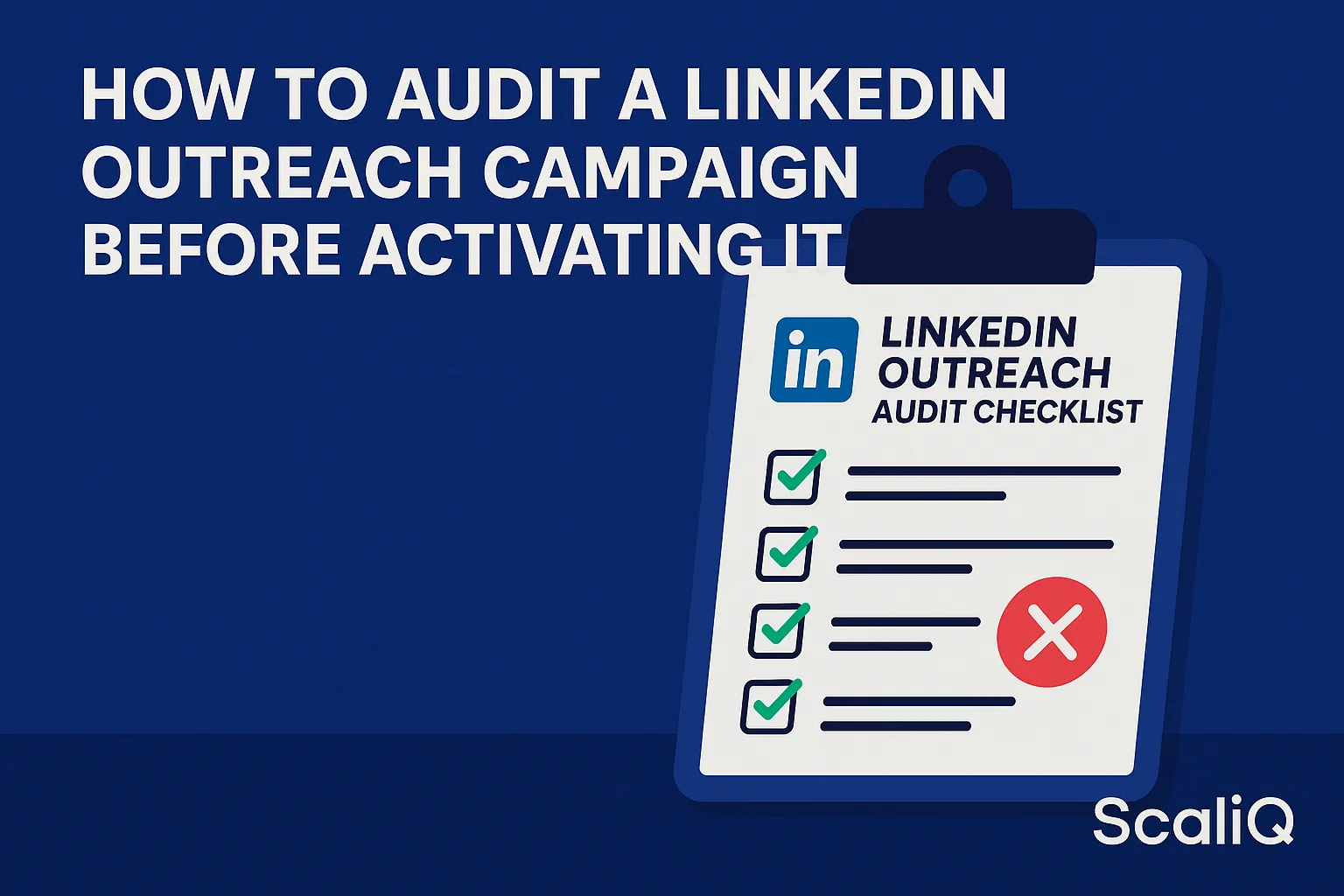
To prevent these missteps, you need a rigorous linkedin campaign audit. This article will help you audit a LinkedIn outreach campaign before launch using a repeatable review system. A comprehensive campaign launch checklist is a pre-launch QA process that drastically reduces wasted outreach volume, improves reply quality, and protects your brand perception in the market.
At ScaliQ, we believe in an operational approach to pre-launch outbound quality control. Our practical, quality-focused methodology centers on five pillars: targeting, instructions, limits, exclusions, and follow-ups. By adopting this hands-on framework, you can ensure your LinkedIn outreach checklist is built for sustainable success rather than short-term scale. For more insights on executing flawless outbound strategies, explore the Blog.
Audit ICP Fit and Targeting Filters
Poor reply rates rarely start with weak copy; they almost always begin with poor audience definition. Auditing your Ideal Customer Profile (ICP) fit and targeting filters is the first and most critical gate in any prospecting campaign QA workflow. If your campaign is not aimed at the exact right audience before outreach volume goes live, no amount of clever copywriting will save it. Conducting a thorough ICP targeting audit ensures your linkedin campaign audit is rooted in relevance.
Confirm the Campaign Objective and ICP
Before reviewing a single lead, define the intended outcome of your campaign. Are you aiming for connection acceptance, a casual conversation, a booked meeting, or basic qualification? The campaign objective must directly connect to your ICP fit. If the objective is unclear, the sequence quality usually becomes disjointed and confusing.
When reviewing the ICP, examine the industry, company size, geography, function, seniority, pain points, and likely buying context. A common failure point is a mismatch in tone and audience.
• Weak Example: Sending enterprise-grade, committee-focused messaging to SMB owner-operators who make unilateral decisions.
• Strong Example: A campaign aimed at mid-market HR Directors, with an objective to book a discovery call, using messaging specifically addressing the pain of compliance tracking in remote teams.
By aligning campaign intent with audience clarity, your LinkedIn outreach audit begins on solid ground.
Check Whether Filters Are Too Broad or Too Narrow
Your next step is to review the specific filters applied to your campaign: job titles, departments, seniority, company headcount, industry, and region. Both extremes cause campaigns to fail. Overly broad filters create irrelevant outreach that damages your reputation, while overly narrow filters make campaigns too small to generate statistically significant learnings.
Instead of relying on generic "just use Sales Navigator filters" advice, focus on decision quality over tool usage. Use this practical audit question list to evaluate your filters:
• Would this person realistically feel the pain the message addresses?
• Does the job title match the actual buying role or influence role?
• Does geography affect relevance, language, or offer fit?
• Are industry filters hiding major differences in the underlying use case?
Knowing how to review targeting and exclusions in a LinkedIn campaign separates generic outreach from high-performing, compliant LinkedIn sales outreach best practices.
Validate Segmentation Before Volume
A single, broad audience segment almost inevitably produces generic messaging and weak personalization. To drive relevance, you must validate segmentation before scaling volume. Segment-level campaign design means creating different campaigns based on persona, use case, industry, or specific buying triggers.
For example, instead of targeting "Sales Leaders in Tech," segment into "VP of Sales at Series B SaaS" versus "CROs at Enterprise Hardware." This allows you to tailor the pain points without overcomplicating the setup.
A practical outreach quality checklist rule: if the same first message could be sent unchanged to every segment in your campaign, your segmentation is probably too weak. This precision sharply contrasts with the scale-first approaches many competitors emphasize. Broad, low-relevance outreach creates significant account risk, which is why adhering to LinkedIn invitation restrictions and relevance guidance is non-negotiable. To see how structured campaign setup and segmentation review can be seamlessly managed, check out ScaliQ.
Review Lead List Quality and Exclusions
Ensuring your campaign is launched against a clean, eligible, high-fit contact list is paramount. List quality is not just a data hygiene task; it is fundamentally a performance and brand-risk issue. Poor list management leads directly to wasted outreach volume, contact fatigue, and low-quality conversations. A rigorous lead list verification process is a mandatory step in your LinkedIn campaign review.
Verify Lead-List Quality and Fit
Intermediate teams often make the mistake of trusting list exports blindly. Before launch, you must manually inspect a sample of your list to review titles, company match, geography, duplicate records, and obvious poor-fit contacts. Data-quality issues—like inserting a legally registered company name (e.g., "Acme Corp LLC Inc.") instead of a conversational name—can make your messaging seem robotic and much worse than it really is.
Implement a simple spot-check process for your prospecting campaign QA:
• Review 20–30 records manually.
• Check if the prospects' titles accurately align with the campaign message.
• Confirm the company type and size fit your ICP.
• Remove mismatches, stale records, and ambiguous roles.
Build Exclusion Logic Before Launch
Exclusions are a critical part of campaign governance, not an optional cleanup step. Launching without them damages trust both internally (with your sales team) and externally (with your prospects). You must build logic to exclude current customers, active opportunities, recent replies, recently contacted prospects, competitors, duplicate contacts, and existing conversations.
Imagine the embarrassment of an overlapping audience causing a current, happy customer to receive a cold introductory pitch from a different campaign. To prevent this, use a checklist of exclusion sources: your CRM, prior campaign lists, booked meetings, suppression lists, and manual account exceptions. Responsible use of prospect data, list quality, and use limitation aligns with foundational OECD privacy and data quality principles. Handling exclusions properly is how to review targeting and exclusions in a LinkedIn campaign effectively during an outbound campaign audit.
Set Limits to Reduce Fatigue and Waste
In a pre-launch audit, "limits" refer to daily volume, connection pacing, message pacing, and audience overlap control. When automation is involved, these limits act as essential quality safeguards. Operators must prove campaign quality and relevance before ever increasing volume.
To maintain deliverability and compliance, follow this guidance:
• Start smaller if the segmentation or messaging is untested.
• Avoid launching multiple overlapping campaigns to the exact same audience.
• Review recent touch history before enrolling any prospect.
Safe-launch guidance is supported by LinkedIn invitation restrictions and relevance guidance, reinforcing that relevance and volume discipline matter deeply. For a system designed around these safeguards, ScaliQ provides a quality-first outbound infrastructure for your campaign launch checklist.
Check Message Personalization and Proof Points
The next phase of the audit evaluates whether the campaign copy feels relevant, credible, and worth replying to. This is where "AI-generated" or heavily templated outreach most often fails human review. Personalization is not merely token customization (like inserting a first name or company); it is true audience-message fit.
Review the Opening Line and Relevance
Your opening line must sound observant, specific, and audience-aware rather than synthetic or forced. You can scale personalization at the segment level—not every message needs deeply handcrafted, individual research, but it must feel native to the prospect's world.
• Weak Example: "I saw your profile and was impressed by your background in marketing." (Generic, vague flattery).
• Strong Example: "Noticed your team is scaling the partner channel this quarter—usually, that breaks traditional lead attribution models." (Specific context tied to role and likely problem).
A practical audit question for your LinkedIn personalization checklist: If you removed the prospect’s name and company, would the message still feel highly relevant to that specific persona? If not, rewrite it.
Strengthen Proof Points and Claims
Your sequence must earn credibility before asking for a prospect's time. Review whether your proof points are present, believable, and relevant to the ICP. There is a vast difference between generic claims ("we help companies grow revenue") and trust-building specifics tied to exact outcomes, categories, or use cases.
During your campaign review, check the following:
• Is the proof point relevant to this specific audience?
• Is the claim too broad or hard to believe?
• Is social proof used naturally rather than stuffed in awkwardly?
• Does the sequence earn credibility before asking for time?
Avoid unsupported performance claims or misleading testimonials. Ensure all factual claims align with FTC truth-in-advertising guidance, and that any customer logos or quoted outcomes comply with FTC guidance on endorsements and testimonials.
Improve CTA Clarity and Natural Tone
Many campaigns fail because the Call to Action (CTA) appears too early, feels too heavy, or repeats unchanged across every step of the sequence. Review whether your ask matches the current relationship stage: are you asking for a connection, a simple reply, a short discussion, or a formal meeting?
Practical criteria for CTA clarity:
• Use only one clear ask per message.
• Align the CTA with the value you have already delivered in the copy.
• Favor natural, conversational language over hard-sell phrasing.
• Eliminate repeated “quick chat?” asks that offer no added context.
A softer, context-aware CTA dramatically improves reply quality and is a staple of cold outreach personalization examples.
Validate Sequence Logic, Follow-Ups, and Stop Conditions
What happens after message one matters just as much as message one. This section is your "campaign mechanics" audit. The goal is to review whether the campaign sequence is coherent, progressive, and safe to activate, emphasizing value progression over sheer repetition.
Ensure Each Step Adds Value
Every step in a follow-up sequence should introduce a new angle, a fresh proof point, or a distinct reason to care. If every message repeats the same ask, the sequence has not been audited properly.
Use this mini framework for sequencing:
• Step 1: Relevance and context.
• Step 2: Pain or opportunity framing.
• Step 3: Proof point or practical insight.
• Step 4: Low-friction CTA.
Teardown Example: A sequence that says "Did you see my last message?" in Step 2, and "Bumping this to the top of your inbox" in Step 3 adds zero value. A strong sequence pivots in Step 2 to share a brief case study, and in Step 3 offers a relevant industry resource.
Decide How Many Follow-Ups the Sequence Needs
A common question is: how many follow-ups should a LinkedIn outreach campaign have? There is no universal perfect number. The campaign should have enough follow-ups to test value progression without becoming repetitive or aggressive.
For intermediate operators, keep this guidance practical:
• Match your follow-up count to audience warmth, offer complexity, and message variation.
• Remember that fewer, higher-quality touches almost always outperform more repetitive ones.
• Review whether each step actually earns its place in the sequence.
The exact count is less important than whether the sequence has a genuine, value-driven reason to continue.
Add Stop Conditions and Reply Handling
Missing stop conditions are one of the clearest signs of an immature outreach process. It is vital to stop automated outreach when a prospect replies, books a meeting, asks not to be contacted, or enters another workflow. This requires both technical configurations in your platform and operational alignment with your team.
Ensure your prospecting campaign QA accounts for reply states that should trigger a review and halt the sequence:
• Positive reply / meeting booked.
• Not now / reach out later.
• Referral to another stakeholder.
• Opt-out / negative response.
Understanding sequence constraints for non-connections and respecting prospect boundaries aligns with LinkedIn message request limits. Unlike tool-led content that focuses purely on automation setup, a mature LinkedIn outreach compliance strategy prioritizes reply-safe workflow control.
Score Launch Readiness with a Repeatable QA Checklist
To turn this advice into an operational framework you can reuse before every launch, you need a structured scoring system. This is what separates generic best practices from an executable outbound campaign audit.
Use a Pass/Fail Scorecard
Organize your sales outreach QA checklist around ScaliQ’s practical framework: Targeting, Instructions, Limits, Exclusions, and Follow-ups. By standardizing this, teams running multiple campaigns can maintain strict consistency.
Create a scorecard with the following fields:
• Audit Item: (e.g., "Are current customers excluded?")
• Status: Pass / Revise / Fail
• Risk Level: Critical / High / Medium
• Owner: (Who is responsible for the fix)
• Required Fix Before Launch: Yes/No
This operational, quality-focused methodology ensures your linkedin campaign audit is grounded in real-world execution rather than theory. To learn more about structured outbound execution workflows, visit ScaliQ.
Define Severity, Owners, and Go/No-Go Rules
Not every issue carries the same risk level. Some can be tweaked after launch, while others must absolutely block activation. Define severity tiers to make clear Go/No-Go decisions:
• Critical: Wrong audience, missing exclusions, no stop conditions. (Do not launch).
• High: Generic first message, weak proof point, unclear CTA. (Revise before launch).
• Medium: Minor segment overlap, nonessential copy improvements. (Monitor and optimize).
Assign clear ownership so campaigns do not launch with unresolved issues sitting in limbo between Sales, RevOps, and SDR teams.
Decide When to Scale Volume
Campaign quality must be proven at low-to-moderate volume before scaling. Launch readiness does not simply mean "campaign built = campaign ready."
Look for early quality signals before increasing limits:
• High relevance of prospect replies.
• Strong acceptance quality (right titles, right companies).
• Positive response themes.
• Absence of complaints or negative feedback.
Final rule of thumb: if your targeting, exclusions, and sequence logic are not clearly defensible to your leadership, do not scale the volume.
Future-Proofing Your LinkedIn Outreach Process
As outbound marketing evolves, prioritizing quality-over-volume, conducting human QA on AI-generated copy, and enforcing stronger exclusion logic are becoming absolute necessities. Mature revenue teams do not rely on ad hoc manual reviews; they build audit workflows directly into their campaign operations.
By adopting a systems-oriented approach—focusing heavily on launch gating, verification, quality control, and compliance-minded review—you future-proof your deliverability and compliance. This structured methodology consistently outperforms tactics that focus merely on scaling mechanics without proper safety nets.
Conclusion
A LinkedIn outreach campaign should always be audited before activation, not diagnosed after it delivers poor results. By rigorously applying a campaign launch checklist, you protect your domain, your brand, and your pipeline.
To recap the five critical review areas:
1. ICP fit and targeting: Ensure precision audience alignment.
2. Lead-list quality and exclusions: Verify data and remove conflicting contacts.
3. Personalization and proof points: Craft credible, segment-relevant messaging.
4. Sequence logic and stop conditions: Drive value progression and halt safely on replies.
5. Final launch-readiness scoring: Use a pass/fail scorecard to govern activation.
Implementing this linkedin campaign audit results in fewer wasted touches, better-fit replies, stronger brand protection, and highly repeatable campaign performance. Make this framework your default pre-launch process today. If you want a more structured, quality-first outbound workflow to manage this seamlessly, explore the resources at Blog.
Author Note: ScaliQ’s practical outbound execution philosophy relies on checklist-led quality control, ensuring every message sent is compliant, relevant, and designed to convert.