

The Exact Workflow to Turn LinkedIn Conversations Into Booked Meetings Using AI
Generating leads is often celebrated as the hardest part of sales, but the real silent killer of revenue is the "Reply-to-Meeting" gap. Most beginners lose up to 70% of potential meetings not because their initial outreach was bad, but because they simply forgot to reply, missed a buying signal, or followed up too slowly.
Outreach is relatively easy to automate, but managing the chaos of an active LinkedIn inbox is where most campaigns fail. You get a reply, you mark it as "unread" to deal with later, and three days pass. By then, the prospect’s interest has cooled.
The solution isn't working harder or hiring a virtual assistant to stare at your inbox all day. The solution is a structured, AI-driven workflow designed to convert replies into booked calls systematically.
In this guide, we will break down the exact linkedin meeting workflow used by high-performing SDR teams. We will show you how to leverage ai conversation management to classify messages, detect intent, and execute the perfect follow-up strategy—all while maintaining the personal touch required to build trust. Drawing from ScaliQ’s expertise in building conversion workflows for sales teams, this is your blueprint for how to turn linkedin conversations into meetings.
Why Most LinkedIn Conversations Don’t Convert
Before fixing the problem, we need to understand the mechanics of the failure. For most beginners and founders, the LinkedIn inbox becomes a graveyard of missed opportunities due to "inbox fatigue."
When you are sending 50 to 100 connection requests or messages a day, a 10% reply rate sounds fantastic—until you realize that managing those 10 conversations requires distinct cognitive loads. Some are objections, some are "send me more info," and some are referrals. Manually sorting through this noise leads to decision paralysis.
The primary reason conversations don't convert is a lack of consistent follow-up. Data consistently shows that 80% of leads require 5+ follow-ups to convert after the initial contact. However, most humans give up after one or two unresponded messages.
This is where linkedin follow-up fatigue sets in. You don't want to be annoying, so you stop chasing. Or, you simply lose track of who needs a nudge because the LinkedIn inbox interface is not built for CRM-style pipeline management.
While general automation tools can send the initial blast, they often fall short when the conversation starts. They lack the nuance to organize linkedin inbox conversations based on context. They treat a "Not right now" the same as a "Maybe next quarter," causing you to either drop a qualified lead or harass a disinterested one.
At ScaliQ, we have observed patterns across dozens of SDR teams: those who rely on memory or basic spreadsheets to manage replies have a meeting booking rate that is 40% lower than those using intelligent workflow automation.
The Core AI Workflow That Turns Replies Into Meetings
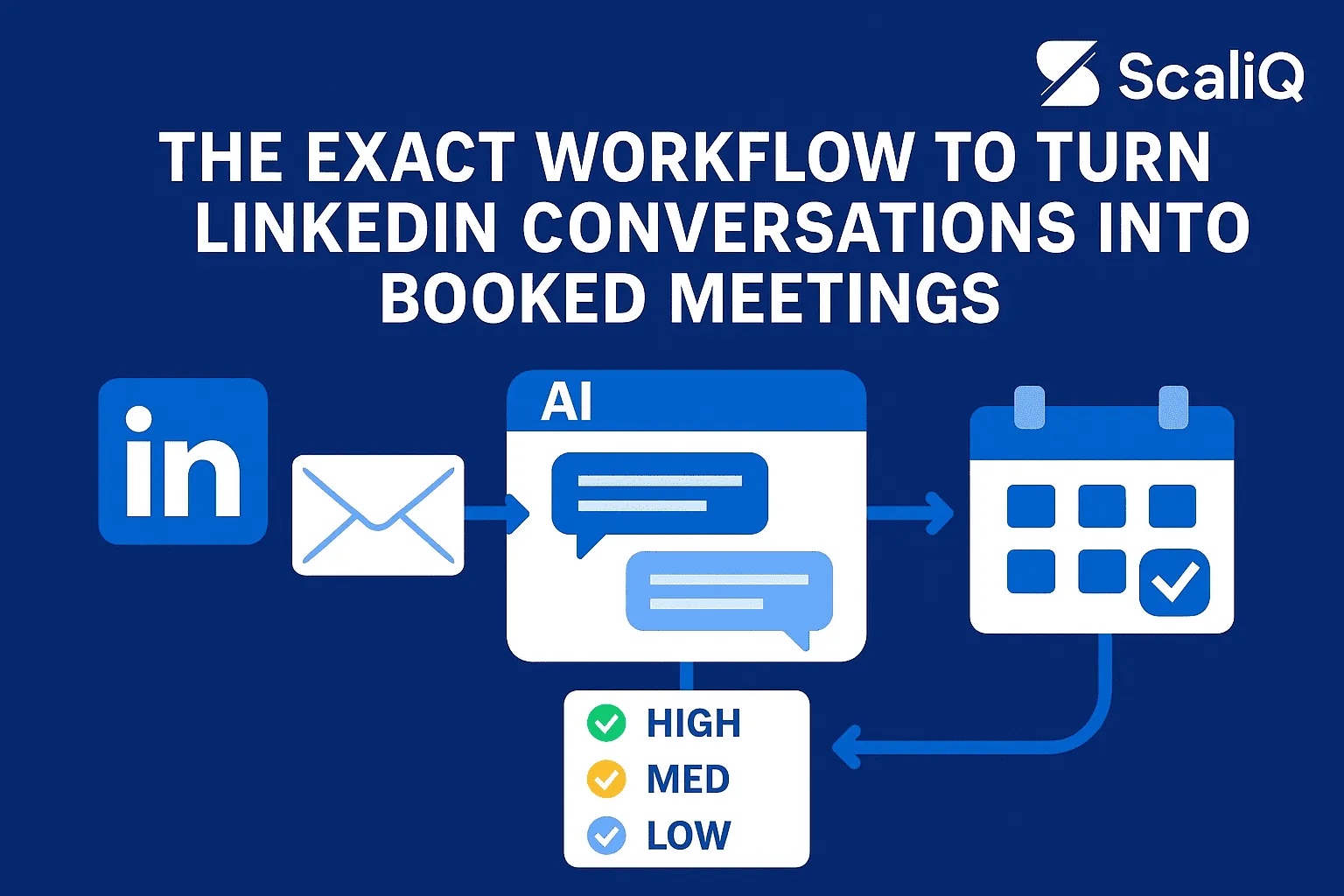
To fix the leak in your pipeline, you need a system that operates with machine precision but communicates with human empathy. This is the core AI workflow that transforms a chaotic inbox into a meeting-booking machine.
Step 1 — AI Message Classification
The first step in ai conversation management is immediate classification. You should never have to manually read a message just to determine if it is a hard "no."
AI tool to manage linkedin messages can now instantly analyze incoming text and bucket replies into clear categories:
• Positive: "Sounds interesting, tell me more."
• Neutral/Curious: "How much does it cost?" or "Send a PDF."
• Objection: "We already use a competitor."
• Referral: "Speak to my CTO, Jane."
• Ignore/DND: "Stop messaging me."
By automating this classification, you remove the clutter. You only need to focus your energy on the Positive, Neutral, and Referral buckets, saving hours of mental energy every week.
Step 2 — AI Prioritization and Queue Management
Once messages are classified, they must be prioritized. In sales, speed to lead is everything. A positive reply that sits unanswered for 24 hours is a dying lead.
An effective ai sales workflow utilizes "triage logic." It scans your classified positive replies and ranks them based on urgency and potential deal size. For example, a reply asking "Can we talk tomorrow?" is flagged as Critical Priority, whereas "Send me a deck" is marked as High Priority.
This solves the biggest hurdle for beginners: knowing who to reply to first. Instead of reading messages chronologically (which is inefficient), you read them strategically. ScaliQ’s approach to linkedin outreach automation is built entirely around this concept of prioritization—ensuring the hottest leads are always at the top of your queue.
Explore how ScaliQ’s AI triage features streamline your inbox
Step 3 — Intent Detection and Meeting Trigger Logic
Classification tells you what they said; intent detection tells you what they mean. This is where ai to qualify linkedin leads becomes a superpower.
Advanced AI models analyze conversational cues to detect "Buying Signals." These are subtle indicators that a prospect is ready to move forward, even if they haven't explicitly asked for a meeting.
• Surface Level: "I am free Tuesday." (Obvious intent)
• Deep Level: "Does your tool integrate with HubSpot?" (Implied intent—they are visualizing using your product).
Intent scoring linkedin conversations allows you to assign a numerical value to a chat. As the score rises, the workflow triggers different actions.
It is vital that these systems are built on trustworthy frameworks. As outlined in the NIST AI standards plan, reliable AI systems must be valid and reliable, ensuring that the intent detected is accurate and not a "hallucination" of the model. This ensures you don't aggressively pitch someone who was merely being polite.
Step 4 — Triggering the Meeting Sequence
Once intent is verified, the workflow must trigger the closing sequence. This is the delicate dance of converting a chat into a calendar invite.
A robust linkedin booking system does not just paste a Calendly link the moment someone says "hi." That is a rookie mistake. The workflow should:
1. Acknowledge and Validate: "Glad to hear you use HubSpot."
2. Micro-Follow-up: "Would it be worth 15 minutes to show you how that integration saves 5 hours a week?"
3. The Link Drop: Only after they agree to the micro-commitment do you send the link.
The best workflow for booking calls from linkedin automates the timing of these messages, ensuring you don't reply too fast (looking desperate) or too slow (looking unprofessional).
How AI Qualifies Leads and Detects Intent
Understanding how AI "reads" your prospects is crucial for trusting the system. It’s not magic; it’s pattern recognition.
Qualification Signals AI Evaluates
To effectively use ai to qualify linkedin leads, the system evaluates three specific layers of data:
1. Pain Point Recognition: Does the prospect mention keywords related to the problem you solve? (e.g., "manual entry," "slow process," "too expensive").
2. Buying Keywords: Direct inquiries about pricing, implementation time, or contracts.
3. Engagement Depth: The AI analyzes the length and speed of the reply. A prospect who types three paragraphs explaining their situation within 10 minutes of your message has a much higher linkedin intent detection score than someone who replies "k" three days later.
Real Examples of AI Interpreting Messages
Here is how ai conversation management interprets ambiguity:
• Message: "We are currently reviewing our Q4 budget, but this looks interesting.", AI Interpretation: Neutral-Positive. Timing objection detected (Q4), but interest is present., Suggested Action: Do not push for a meeting now. Schedule a follow-up for the start of Q4.
• Message: "I'm not the right person, but we struggle with this. Maybe try Sarah?", AI Interpretation: Referral + Validation. The pain point is confirmed ("we struggle with this"), and a decision-maker is provided., Suggested Action: High priority. Ask for an introduction to Sarah.
• Message: "Is this compliant with GDPR?", AI Interpretation: Buying Signal (Objection Handling). Security questions usually come from serious buyers., Suggested Action: Send compliance doc and propose a call to review security specs.
When AI Pushes for a Meeting
The "Booking Motion" is the threshold where the AI suggests it is time to ask for the call. If the intent score crosses a specific line (e.g., 75/100), the system prompts you to send the booking link.
However, this automation must remain human-centric. According to the OECD AI Principles, AI systems should be robust, secure, and safe, functioning in a way that respects human autonomy. This means the AI should suggest the meeting push, but (especially for beginners) allow the human to approve the final send, ensuring the context is perfect.
Common Mistakes Beginners Make in LinkedIn Outreach
Even with the best tools, a bad strategy will fail. ScaliQ’s approach is designed to prevent the common pitfalls that other linkedin outreach automation tools ignore.
1. Over-Automation Without Context: Sending a generic "Let's meet" message to someone who just asked a specific technical question. This kills credibility instantly.
2. Asking for Meetings Too Early: This is the "Pitch Slap." You must earn the right to ask for 15 minutes of their time. Beginners often skip the qualification phase.
3. Ignoring Neutral Replies: Many beginners only reply to "Yes." They ignore "How does it work?", missing out on 50% of their potential pipeline.
4. Forgetting Micro-Follow-Ups: If a prospect stops replying after showing interest, beginners often feel "ghosted" and stop. A proper workflow continues to nudge them gently.
5. Treating LinkedIn Like Email: Email is formal; LinkedIn is a chat. Long, blocky paragraphs do not work.
Competitor tools often focus purely on volume—how many messages can you send? ScaliQ focuses on conversion—how many replies can you turn into meetings? The missing link in most tools is the intent scoring and reply triage we discussed earlier.
Ready-to-Use LinkedIn Meeting Workflow Template
To help you implement this immediately, here is a linkedin meeting workflow template you can adapt.
Message Flow Overview (From Initial Reply → Booked Meeting)
1. Inbound Reply Received → AI Classification (Positive/Neutral/Negative).
2. If Positive: → Intent Check (Is it a direct "yes"?)., Yes: Send Booking Link immediately., No (Curious): Send Value Statement + Soft Ask ("Want to see how?").
3. If Neutral: → Qualification Question ("Is [Pain Point] a priority for you right now?").
4. If No Reply to Follow-up: → Enter Automated Nudge Sequence.
This structure ensures you know exactly how to turn linkedin conversations into meetings without guessing.
Template Scripts for Common Reply Types
Scenario A: The "Send me more info" (Neutral/Curious)
• Template: "Sure thing, [Name]. I can send a PDF, but it’s usually easier to show the workflow in action so you can see if it fits your specific setup. Would you be open to a 7-min demo video instead?"
• Why it works: It pivots from a passive PDF to an active demo.
Scenario B: The "How much is it?" (Buying Signal)
• Template: "We have packages starting at [Price], but it depends on [Variable]. Are you looking to solve [Problem A] or [Problem B] primarily?"
• Why it works: It answers the question but immediately re-engages them in qualification.
Scenario C: The "Not interested right now" (Soft Objection)
• Template: "Understood, [Name]. I won't keep bothering you. I'll keep you in the loop if we release [Feature relevant to their industry]. Have a great Q3!"
• Why it works: It leaves the door open for future ai sales workflow reactivation.
Automated Follow-Up Cadence
To combat linkedin follow-up fatigue without being annoying, use this cadence:
• Day 0: Immediate reply to their message.
• Day 2: Value Add (send a case study or relevant tip).
• Day 4: The "Bumping this" (short and polite).
• Day 7: The Break-up ("Assuming this isn't a priority, I'll close this file").
This automated persistence is essential. However, it must be ethical. As highlighted in the report on OECD trustworthy AI in the workplace, automated systems used in work settings (including sales) should be transparent and fair. Your follow-ups should look and feel human, respecting the recipient's time and digital space.
Tools & Resources for Running the Workflow
You can attempt to run this workflow manually using spreadsheets and calendar reminders, but it scales poorly. Once you hit 10 active conversations, things fall through the cracks.
ScaliQ offers the simplest, beginner-friendly implementation of this exact workflow. It acts as the orchestration layer for your inbox, handling the classification, intent scoring, and follow-up reminders so you can focus purely on the meeting itself.
For SDR teams, founders, and solopreneurs, ai sdr tools are no longer a luxury; they are a necessity to compete. The difference between a crowded inbox and a full calendar is often just the tool you use to bridge the gap.
Future Trends in LinkedIn AI Conversations
The landscape of ai for linkedin is evolving rapidly. We are moving beyond simple automation into the era of "Co-pilots."
• Real-Time Inbox Copilots: Soon, AI will draft responses in real-time as you type, suggesting the psychological triggers most likely to convert that specific persona based on their profile data.
• Auto-Booking Agents: We will see a rise in AI agents that can negotiate time slots directly with the prospect's AI agent, removing the "When are you free?" dance entirely.
• Hyper-Accurate Intent Scoring: Models will predict churn or purchase probability with frightening accuracy based on syntax and typing speed.
As these technologies develop, adherence to standards is critical. The NIST AI standards overview emphasizes the need for consensus-based standards to ensure AI innovation remains safe and effective. Staying aligned with these standards ensures your future of ai outreach remains compliant and effective.
Conclusion
Most beginners fail at LinkedIn outreach not because they can't find leads, but because they can't manage the conversation. They lose 70% of their potential revenue in the chaotic "middle mile" between the first reply and the booked meeting.
By implementing a structured linkedin meeting workflow, you remove the guesswork. You stop relying on memory and start relying on a system. Whether you are a solopreneur or leading an SDR team, ai conversation management allows you to handle 80% of the inbox labor automatically, leaving you free to handle the 20% that actually generates revenue—closing the deal.
If you are ready to stop losing leads in your inbox, ScaliQ provides the architecture to turn those forgotten replies into your next best customers.