

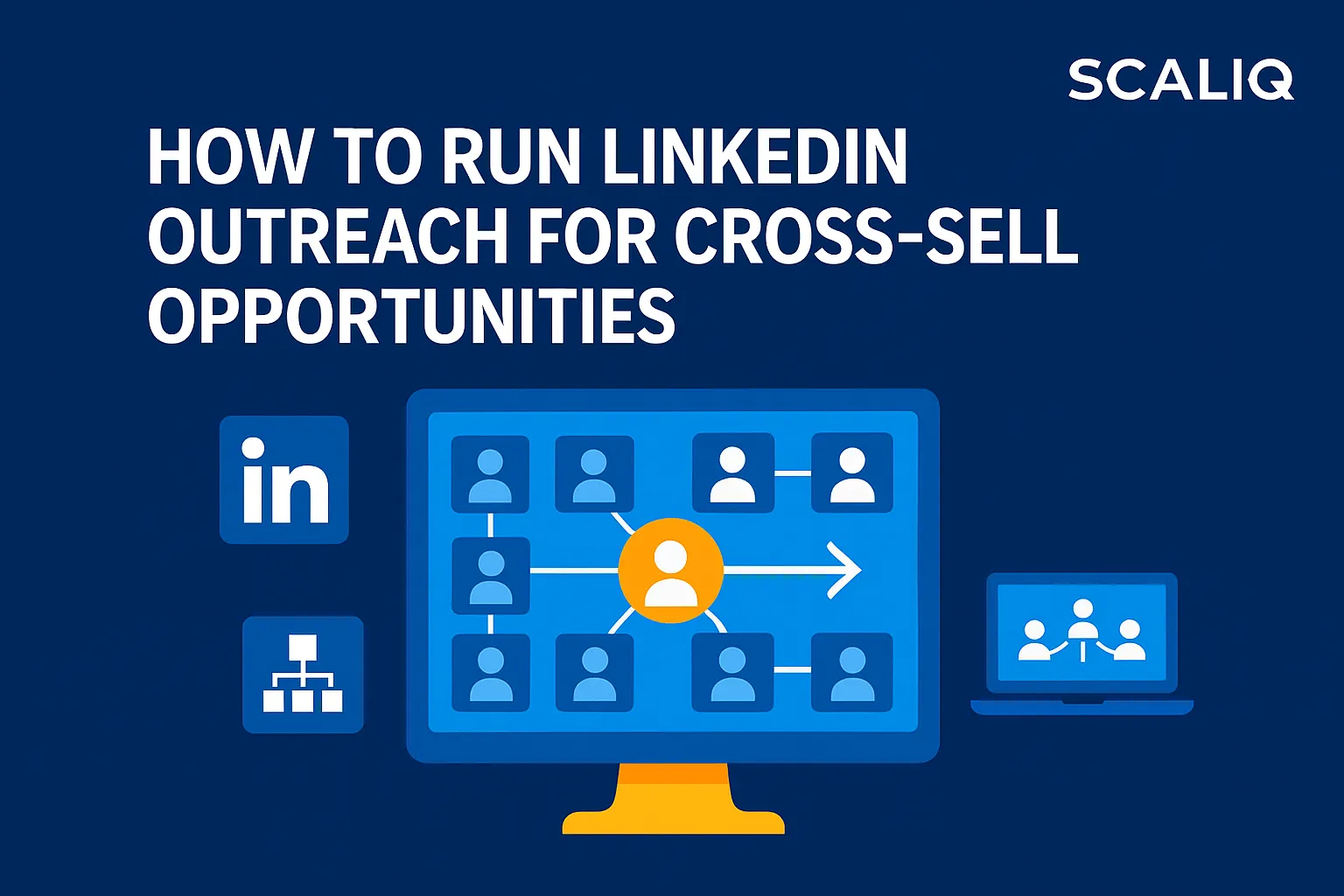
How to Run LinkedIn Outreach for Cross-Sell Opportunities
Most expansion opportunities are missed not because the account lacks potential, but because revenue teams only talk to the people they already know.
Many B2B SaaS teams understand the "land-and-expand" model in theory. Yet, when it comes to execution, they struggle to identify adjacent stakeholders, time their outreach correctly, and avoid stepping on active customer conversations. If you are an Account Executive (AE), Account Manager, Customer Success Manager (CSM), or RevOps leader, you already know that existing customer sales are rarely as simple as sending a quick email to your champion.
This article provides a repeatable, LinkedIn-specific workflow for finding and capturing cross-sell opportunities inside your existing accounts. Instead of using LinkedIn merely for outbound volume, this playbook positions the platform as a strategic channel for stakeholder discovery, signal monitoring, and warm personalization.
By following this framework—account mapping, white-space discovery, signal-based prioritization, internal coordination, and tailored outreach—you can confidently drive account expansion prospecting without jeopardizing your current customer relationships. As an account-focused prospecting solution, ScaliQ is designed to help revenue teams identify adjacent buyers and relevant use cases seamlessly, ensuring your cross sell LinkedIn outreach is targeted, timely, and compliant.
Why LinkedIn Matters for Account Expansion
When it comes to existing customer sales, generic net-new prospecting channels often fall short. CRM data is notoriously siloed; it rarely captures the full, evolving picture of a company's organizational chart. LinkedIn is exceptionally useful for account expansion because it helps teams uncover hidden buying groups, organizational changes, and adjacent functions that never make it into your CRM cleanly.
Executing a successful land and expand strategy requires more than just managing renewals or pushing traditional upsells to the same buyer. It requires rigorous prospecting discipline to target new teams or business units. While you have the advantage of existing account context, you still need high relevance and careful coordination. LinkedIn research on buyer expectations and personalization underscores that buyers demand tailored, relationship-driven engagement. Unlike generic social selling advice that preaches high-volume connections, a strong LinkedIn outreach strategy for expansion focuses entirely on precision execution inside current customer accounts.
Cross-Sell Outreach Is Different From Net-New Prospecting
In the context of existing customers, cross-selling means introducing a new product, targeting a new team, establishing a new workflow, or solving a new use case within the same account.
Familiarity with your brand does not automatically equal awareness across the wider buying group. A current champion in the marketing department may have zero influence over adjacent departments like IT or sales. Multi-threading existing accounts is critical because modern B2B buying groups frequently span multiple functions, geographies, or business units. Account-based sales motions must treat these adjacent teams as distinct entities that require tailored value propositions, even if the parent company logo is already in your "Closed Won" column. Unlocking these cross-sell opportunities means treating internal expansion with the same strategic rigor as outbound sales.
What LinkedIn Does Best in Existing Customer Accounts
LinkedIn excels at stakeholder discovery. It is the premier platform for finding adjacent leaders, operators, and influencers beyond your current contact set.
By monitoring public profile changes, role updates, promotions, and team growth, sellers can pinpoint the exact timing for expansion outreach. Furthermore, LinkedIn supports warm outbound to existing customers by allowing you to personalize your messaging with role context, functional priorities, and shared company initiatives. It is important to remember that LinkedIn should be used as an intelligence layer—one vital input alongside your CRM history and customer team intel—to inform your customer account mapping and adjacent team prospecting efforts.
Map Adjacent Stakeholders and White Space Inside the Account
To execute account expansion prospecting successfully, you need a practical framework for identifying who else to target and where expansion potential actually exists. Mapping an account requires looking at the organization by function, geography, business unit, and adjacent workflows.
You must move beyond current champions to identify likely end-users, technical evaluators, budget owners, and internal influencers. For example, in a typical SaaS environment, a deployment in the sales department naturally touches adjacent functions like marketing, RevOps, and customer success. Taking a structured approach to stakeholder prioritization, as supported by Harvard Business Review on stakeholder strategy, ensures you are targeting the right people with the right message. For further insights into building these workflows, exploring a ScaliQ educational resource can help refine your customer account mapping and adjacent team prospecting.
Start With the Current Customer Footprint
Before prospecting anyone new, you must thoroughly review the current customer footprint. Analyze active product usage, engaged contacts, open support tickets, deal history, and upcoming renewal context.
Identify exactly where your current solution is delivering measurable value and where adjacent workflows may intersect. Document exactly which teams are already engaged so your outreach does not overlap with existing conversations. This historical account context must shape your expansion hypothesis long before your LinkedIn research begins. In existing customer sales, understanding the present is the only way to accurately predict customer expansion sales opportunities and execute effective account mapping for sales.
Identify Adjacent Teams by Function and Workflow
Once you understand the current footprint, map the logical neighboring teams based on the active use case.
If a regional sales team uses your product, RevOps or sales enablement are highly adjacent. If marketing is the primary user, field marketing or marketing operations may be highly relevant. Focus on use-case thinking instead of title-only targeting. The goal is to identify the "white space"—the specific departments or workflows where your company’s relationship has not yet expanded. Pinpointing these cross-sell opportunities is the foundation of a proactive account expansion strategy and adjacent team prospecting.
Build a Stakeholder Map on LinkedIn
Use LinkedIn to identify economic buyers, functional leaders, middle managers, and daily practitioners inside each target team.
Look closely at reporting lines, role seniority, regional ownership, and recent job moves. Differentiate between stakeholders who are likely decision-makers and those who could serve as potential internal champions. Create a simple stakeholder matrix for your LinkedIn sales prospecting for account management: note the person, their role, their team, their likely pain point, their active conversation status, and the designated outreach owner. This structured approach is the key to multi-threading customer accounts effectively.
Validate White Space Before Outreach
Before launching a campaign, confirm whether a perceived opportunity is real or just internal guesswork.
Cross-reference your LinkedIn findings with CRM notes, call summaries, CSM input, support history, and product adoption data. Not every adjacent team is expansion-ready, and there is a massive difference between finding an "interesting contact" and validating a "credible use case." Validating your white space mapping ensures your existing customer prospecting remains relevant and aligns with a mature customer expansion playbook.
Use Signals to Prioritize Outreach Timing
Knowing who to target is only half the battle; knowing when to reach out determines your success rate. Outreach timing should be driven by account signals, not just a sales rep's availability to send messages.
LinkedIn activity often reveals internal momentum, organizational change, or shifting business priorities. Tying your outreach timing to these signals ensures better message relevance and drastically lowers the risk of awkward, out-of-touch communication. Leveraging LinkedIn Economic Graph work change research shows that role changes, promotions, and workforce movements are highly reliable, observable outreach triggers. Furthermore, as noted by McKinsey on digital go-to-market and RevOps, data-driven prioritization is essential for modern account expansion strategy and warm outbound to existing customers.
High-Value Expansion Signals to Watch
Group your signals into strategic, organizational, and operational categories. High-value triggers include hiring spikes, promotions, new leadership hires, organizational restructuring, major product launches, regional expansions, and funding announcements.
These signals usually indicate new process needs, shifting budgets, or an openness to adjacent solutions. Trigger-based outreach is incredibly effective because these signals are strongest when paired with the known customer value from your existing deployment. Monitoring these events allows you to identify cross-sell opportunities and execute timely account expansion prospecting.
Which LinkedIn Behaviors Matter Most
Sellers should monitor public LinkedIn behaviors such as profile updates, role changes, the formation of new teams, and engagement with industry content.
However, engagement alone is not enough; context matters. Use LinkedIn as a validation layer rather than the sole source of truth. For instance, if a company promotes an operations manager to a leadership role, or hires a new Head of RevOps, that public profile change creates a distinct expansion opening. Monitoring these LinkedIn profile changes and tracking signal monitoring helps you accurately target adjacent stakeholders.
Match Signals to Use Cases
Every signal must be connected to a specific expansion hypothesis.
If you notice rapid team growth, the hypothesis might be a need for workflow standardization. If a new leader is hired, they may be open to process redesign or technology consolidation. If a company launches a new product, it may create cross-departmental coordination gaps your software can solve. Outreach timing is strongest when the signal and the relevant use cases are tightly linked. Avoid generic "I noticed your company is growing" messaging; instead, tie the growth to a clear business reason for account-based sales and customer expansion sales.
Coordinate With CSMs, AEs, and RevOps Before Anyone Reaches Out
One of the biggest pain points in existing customer sales is duplicate or conflicting customer conversations. Expansion prospecting must be governed, not improvised.
Customer-facing teams must align on ownership, timing, exclusions, and message boundaries before a single message is sent. McKinsey on customer success as a growth engine highlights the necessity of cross-functional learning between post-sales and revenue teams. Coordinated outreach quality matters far more than sequence volume when multi-threading existing accounts and conducting account expansion prospecting.
Create Rules of Engagement for Expansion Prospecting
Define clear rules of engagement for who must approve or review outreach before it goes live.
Clarify ownership by segment, account tier, geography, or product line. Establish strict rules for suppression: do not prospect into accounts undergoing active implementation, dealing with active escalations, facing at-risk renewals, or currently engaged in executive sponsor conversations. Document clear account statuses such as "safe to contact," "wait," and "do not contact" to maintain strict account governance and build a reliable customer expansion playbook.
What AEs, CSMs, and RevOps Each Own
A successful expansion motion requires clearly defined roles. Typically, AEs own the expansion strategy and commercial execution. CSMs provide relationship context, adoption metrics, and sentiment analysis. RevOps maintains the process, data visibility, and system guardrails.
If SDRs or expansion reps are involved, their handoffs and approval processes must be clearly documented. Establish a simple operating model for approvals and CRM updates, ensuring that no one relies on LinkedIn outreach in a silo. RevOps coordination and customer success alignment are vital to a smooth account management workflow.
Run a Pre-Outreach Account Check
Before initiating contact, run a mandatory pre-flight checklist. Review current active contacts, open opportunities, support tickets, upcoming QBR timing, recent customer sentiment, and product adoption health.
This check protects the customer relationship and drastically improves message accuracy. Use a simple yes/no decision tree: proceed now, coordinate first, or hold. Leveraging platforms like ScaliQ can help automate this coordination, allowing teams to identify expansion targets without duplicating outreach, ensuring expansion-safe outreach and respectful existing customer prospecting amidst active customer conversations.
Personalize Cross-Sell Messages by Team and Use Case
Personalization in cross-sell outreach must reflect both the existing customer relationship and the new stakeholder’s specific priorities. Your messaging should reference the customer value you are already delivering carefully, without sounding assumptive or invasive. LinkedIn research on buyer expectations and personalization confirms that role awareness is critical to breaking through the noise in upsell and cross-sell outreach.
The Core Messaging Formula
Use a repeatable structure for your LinkedIn outreach strategy:
1. Relevant trigger or context
2. Why this specific team may care
3. Proof from the existing customer relationship
4. Low-friction next step
Acknowledge the broader account relationship without assuming internal alignment. Use modest, specific language—avoid arrogant phrasing like "your company already loves us." Instead, offer a call-to-action (CTA) that invites exploration rather than applying sales pressure. This is the essence of warm outbound to existing customers and uncovering cross-sell opportunities through precise message personalization.
Personalize by Department
Different departments care about different outcomes. When targeting adjacent team prospecting, tailor the message:
• Operations: Focus on process friction, efficiency, and bottleneck removal.
• Marketing: Focus on lead velocity, brand consistency, or campaign ROI.
• Sales: Focus on quota attainment, deal cycles, and pipeline visibility.
• RevOps: Focus on data hygiene, system integration, and forecasting accuracy.
The same platform solves different problems for different teams. Furthermore, ensure your messaging is role-aware: a VP cares about strategic outcomes, while a manager cares about daily process execution. This nuance is critical for department-specific use cases and account-based sales.
How to Reference the Existing Relationship Without Overreaching
Mention the current customer footprint tactfully.
• DO: Say, "We’ve been supporting the [X] team on [Y] workflow..."
• DON'T: Say, "Since [X] team uses us, you should use us too."
Never imply internal endorsement unless a champion has explicitly given you permission to use their name. Overreaching can damage the trust the CSM has worked hard to build. Keep your cross-sell messaging grounded in relationship-led outreach and respectful existing customer sales practices.
Sample LinkedIn Message Angles
Here are strategic angles for your LinkedIn messages to uncover cross-sell opportunities and drive customer expansion sales. Tools like RepliQ can be complementary resources for creating these tailored, relevant outreach experiences at scale.
• The Newly Hired Leader Angle: "Hi [Name], saw you recently stepped into the VP of Ops role—congratulations. We currently support your sales team with [Specific Value], and I’m curious if standardizing [Adjacent Workflow] is on your radar as you evaluate the current tech stack. Open to a brief intro?"
• The Growing Team Angle: "Hi [Name], noticed the rapid headcount growth in your RevOps team. Often, that kind of scaling creates [Specific Bottleneck]. We’ve been helping your marketing colleagues solve a similar data routing issue. Worth exploring if this could support your team’s expansion?"
• The Adjacent Workflow Angle: "Hi [Name], we’ve been partnering with [Champion Name]’s team to streamline [Workflow A]. I know your department handles [Workflow B], which often overlaps. Is [Pain Point] a priority for your team this quarter?"
A Simple 5-Step LinkedIn Workflow for Cross-Sell Prospecting
To turn this strategy into an actionable process, follow this compact, repeatable playbook. This 5-step framework synthesizes the core principles of cross sell LinkedIn outreach and serves as a reliable customer expansion playbook for account expansion prospecting.
Step 1: Review Account Context
Pull your CRM history to understand the current customer footprint, active conversations, and product value already realized. Confirm all exclusions and verify customer health with the CSM before prospecting. (Keywords: existing customer sales, CRM context)
Step 2: Map White Space
Identify adjacent teams, likely stakeholders, and plausible use cases based on the initial deployment. Build a simple stakeholder matrix and prioritize the most likely buying centers. (Keywords: customer account mapping, adjacent team prospecting)
Step 3: Monitor Signals
Use LinkedIn to validate role changes, company growth, and other relevant triggers. Prioritize accounts where the timing of the signal perfectly aligns with a credible use case. (Keywords: signal detection, LinkedIn outreach strategy)
Step 4: Align Internally
Run the pre-outreach check with AEs, CSMs, and RevOps. Confirm the outreach owner, establish message boundaries, and agree on next-step rules of engagement. (Keywords: RevOps coordination, rules of engagement)
Step 5: Launch Personalized Outreach
Send tailored, signal-based LinkedIn outreach, followed by the right multichannel next step if appropriate. Capture all responses and update the account map for future expansion plays. (Keywords: warm outbound to existing customers, upsell and cross-sell outreach)
Common Mistakes in Cross-Sell LinkedIn Outreach
Avoid these preventable process errors that damage trust and reduce response quality during account expansion prospecting.
Mistake 1: Contacting New Stakeholders Without Internal Alignment
Reaching out blindly creates confusion, political friction, and duplicate outreach. It can severely damage the existing relationship. Fix: Require a lightweight internal approval and suppression check with customer success alignment before any messages are sent.
Mistake 2: Treating Existing Accounts Like Net-New Prospects
Using generic outreach templates wastes the warmth of the existing account relationship and ignores the context you already own. Fix: Anchor your outreach in known account context and a department-specific hypothesis to highlight real cross-sell opportunities.
Mistake 3: Prioritizing Titles Instead of Use Cases
Seniority alone does not equal relevance. Targeting a C-level executive without a clear reason will result in being ignored. Fix: Target adjacent stakeholders based on actual workflows, specific pain points, and relevant use cases tied to trigger events.
Mistake 4: Reaching Out Too Early or Too Late
Poor outreach timing—messaging when there is no trigger, or months after a major organizational change—kills momentum. Fix: Implement signal-based prospecting. Use LinkedIn and internal account data to time your outreach around real, observable change.
Conclusion
LinkedIn works best for cross-sell prospecting when it is utilized strategically to map adjacent stakeholders, validate white space, time outreach with organizational signals, and coordinate internally before messaging. The goal of this playbook is not to generate more random activity inside customer accounts, but to facilitate precise, expansion-safe conversations that drive revenue.
By operationalizing this workflow across AEs, CSMs, and RevOps, you transform land and expand from a buzzword into a predictable revenue engine. Evaluate your current process today: can your team identify adjacent teams and use cases without duplicating active conversations? If not, it is time to upgrade your account expansion prospecting. Discover how ScaliQ helps revenue teams uncover white space and coordinate seamless cross sell LinkedIn outreach for expansion inside existing customers.