

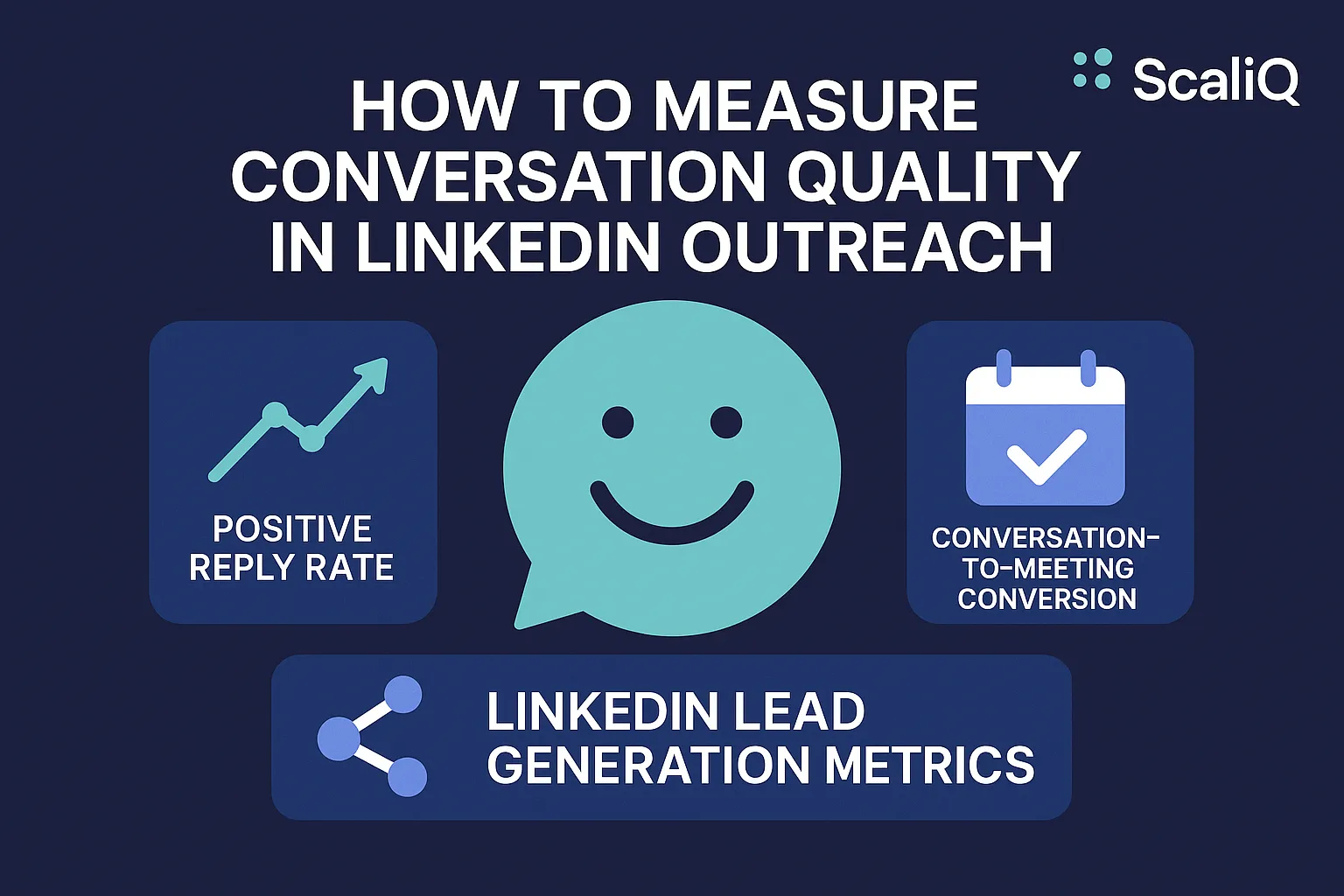
How to Measure Conversation Quality in LinkedIn Outreach
Most LinkedIn outreach dashboards over-report success because they treat every reply as equal, even when many responses are objections, brush-offs, or unqualified interest. If your team sent 1,000 messages and generated 100 replies, a 10% reply rate might look like a win on paper. But if 85 of those replies are “not interested,” “unsubscribe,” or “check back next year,” that metric is actively deceiving your revenue leadership.
Raw reply rate and connection acceptance rate are useful activity metrics, but they do not reliably predict qualified pipeline. To build a predictable outbound engine, modern SDR leaders, RevOps professionals, sales operators, and demand gen teams need revenue-relevant diagnostics. You must measure what happens inside the inbox.
This article provides a LinkedIn-native framework to measure positive reply quality, qualification depth, meeting intent, and conversation-to-meeting conversion. Unlike generic KPI roundups that only measure volume, this approach focuses entirely on scoring conversation quality inside LinkedIn threads.
At ScaliQ, our platform is centered on LinkedIn conversation intelligence and revenue-focused measurement, helping teams evaluate positive-reply quality, qualification depth, and meeting-intent. By shifting your focus from vanity metrics to revenue signals, you can scale outbound predictably. For more deep dives into advanced outbound performance, visit our blog.
Why Reply Rate Alone Fails
To build a predictable outbound engine, you must reframe your measurement model. There is a fundamental difference between activity metrics (what you do), engagement metrics (how the market reacts), and revenue-aligned conversation metrics (what actually drives pipeline).
Counting all replies equally distorts performance analysis because negative, neutral, referral, and high-intent replies are blended into one misleading percentage. A campaign with a 4% reply rate but strong meeting intent will routinely outperform a campaign with a 12% reply rate and weak qualification. When you optimize for raw replies, you often end up optimizing for clickbait messaging that generates noise rather than pipeline.
The solution is quality-weighted outreach scoring. According to NIST guidance on performance measurement, effective organizations must distinguish between simple leading indicators and decision-useful metrics that align with strategic objectives. While typical outreach tools stop at volume and acceptance rates, leaving a massive gap in downstream pipeline linkage, a quality-weighted approach connects inbox activity directly to revenue.
The Problem With “Any Reply = Success”
Raw response counts are inherently noisy. In reply analysis, responses like “not interested,” “send me info,” and “let’s talk next Tuesday” should not carry the same analytical weight.
When “any reply” equals success, misleading reply totals create bad optimization decisions. SDRs receive praise for high volume rather than high intent, marketers double down on the wrong targeting criteria, and sales coaching focuses on driving more responses rather than better conversations. To accurately gauge sales prospecting KPIs, you must isolate the positive reply rate from the noise.
Vanity Metrics vs Revenue Signals
Activity metrics still have a place: they are helpful for diagnosing deliverability issues, broad targeting fit, or volume constraints. However, they must be separated from true revenue signals. Tracking your connect linkedin activity to pipeline requires distinguishing between what looks good and what pays the bills.
By shifting focus toward linkedin lead generation metrics that prioritize quality, you ensure your outreach performance metrics align with actual business goals.
The LinkedIn Conversation Quality Framework
To move beyond raw volume, teams must adopt a LinkedIn Conversation Quality Score composed of three core pillars: sentiment, qualification depth, and meeting intent.
This requires a repeatable rubric rather than ad hoc rep judgment. The framework must be simple enough for leadership reporting but nuanced enough to guide SDR optimization. When teams rely on structured outbound conversation scoring, they eliminate the guesswork of response quality scoring.
The operating model behind ScaliQ's features is built precisely on this methodology, allowing teams to operationalize reply scoring, intent detection, and quality measurement seamlessly.
Metric 1 — Positive Reply Rate
Positive reply rate is the share of total replies that indicate real openness, relevant interest, or viable next-step potential.
This is a far better first-level quality filter than total reply rate. When you identify positive replies in outbound prospecting, you exclude polite brush-offs like "Thanks for reaching out, but we're good" or ambiguous responses like "Ok." A true positive reply contains a clear signal of interest or a willingness to engage with the premise of your outreach. Tracking your positive reply rate is the foundational linkedin outreach metrics baseline for conversation quality.
Metric 2 — Qualification Depth
Qualification depth measures how much useful buying context appears in the message thread before a meeting is even booked.
High-quality linkedin conversation quality involves uncovering dimensions such as ICP fit, pain relevance, authority, urgency, current process, or constraints directly in the chat. Crucially, qualification emerges incrementally across multiple replies, not in a single message. Effective reply analysis looks for these compounding details. As noted in research on conversational buying signals, textual cues regarding need, specificity, and time references are strong indicators that separate serious buyers from casual browsers.
Metric 3 — Meeting Intent Rate
Meeting intent rate defines the explicit or implicit willingness of a prospect to continue the sales conversation on a call.
This metric separates the "curious but passive" prospect from the one who is "open to next steps." Meeting intent analysis linkedin workflows should look for phrases that signal scheduling readiness ("Do you have time next week?"), internal referral ("Speak to my VP of Ops"), or timing alignment ("We are actually evaluating this right now"). High meeting intent directly correlates with a higher meeting booking rate and validates your positive reply rate.
Metric 4 — Conversation-to-Meeting Conversion
Conversation-to-meeting conversion is the ultimate bridge metric between message quality and booked outcomes.
Formula: (Meetings Booked / Qualified Conversations) * 100
This metric exposes whether your messaging creates actual sales momentum or just conversational engagement. High engagement with low conversion means your messaging is interesting but lacks a compelling business case. Measuring how conversation quality metrics connect to meetings booked is essential. According to sales development conversation tiers, progression-based measurement is critical for understanding how relationships evolve from initial contact to pipeline-generating meetings, making this one of the most vital linkedin lead generation metrics.
How to Classify Replies and Buying Signals
To turn this framework into an operational taxonomy, teams must categorize replies consistently across all reps and campaigns. Many generic tools report outcomes at a campaign level but lack a LinkedIn-native methodology for thread-level quality.
By classifying outbound conversation scoring into structured categories, you eliminate subjective rep interpretations and build a reliable dataset for reply analysis.
Build a Practical Reply Taxonomy
To combat the lack of standardized conversation scoring, build a taxonomy where each reply class is defined in one clear sentence:
• Positive: Prospect expresses clear interest in the value proposition.
• Neutral: Prospect responds with ambiguous or non-committal language (e.g., "Thanks for the info").
• Negative: Prospect explicitly states a lack of interest or asks to be removed.
• Referral: Prospect directs the rep to a more appropriate contact within the organization.
• Unqualified: Prospect engages but reveals they do not fit the ICP (e.g., wrong company size).
• Objection: Prospect pushes back on a specific premise (e.g., "We already use Competitor X").
• High-Intent: Prospect explicitly asks for a meeting, pricing, or next steps.
Documenting anonymized examples for each category prevents overlap and keeps reply classification for prospecting consistent across the floor.
Identify High-Value Buying Signals
Beyond basic sentiment, you must identify specific buyer signals within the text. Look for pain specificity, urgency, authority, timing, budget context, current workflow details, and explicit next-step language.
One signal alone may not prove readiness, but combinations (e.g., pain specificity + timing) indicate strong qualification signals in message threads. It is also important to distinguish signal presence (mentioning a tool) from signal strength (expressing frustration with that tool). As supported by MSI research on B2B digital sales conversations, the specific textual cues used in digital sales conversations are highly predictive of downstream revenue outcomes. Meeting intent analysis linkedin models must account for these cues.
Separate Positive, Neutral, Negative, and Referral Replies
When conducting reply analysis, keep categories distinct. Neutral replies can be useful for learning how prospects communicate, but they should never inflate your positive reply rate.
Referrals deserve their own category because they create pipeline without direct buyer intent from the original contact. Negative replies, while not revenue-generating, produce critical messaging insights for optimization. Understanding the reply rate vs positive reply rate distinction ensures you are optimizing for the right outcomes.
Example Scoring Model for a Message Thread
To standardize response quality scoring, implement a 0–100 rubric combining sentiment, fit, and next-step readiness.
This linkedin conversation quality model ties directly back to rep coaching and campaign optimization, proving that outreach performance metrics must weigh intent heavier than volume.
How to Connect Conversations to Meetings and Pipeline
Message-level scoring is only useful if it translates into funnel reporting that leadership trusts. Conversation quality metrics must connect to meetings booked, opportunity creation, and pipeline contribution.
The goal is better decision-making on targeting, messaging, and rep execution. Referencing LinkedIn conversion tracking documentation reinforces that conversation activity can—and must—be connected to downstream conversions to prove ROI.
Core Formulas to Put on the Dashboard
Your dashboard must separate leading indicators from lagging revenue indicators. Use these core formulas to track sales prospecting KPIs:
These linkedin outreach metrics provide a transparent view of how conversations turn into cash.
Map Conversation Stages to Funnel Outcomes
To connect linkedin activity to pipeline, map outbound conversation scoring to strict funnel stages:
Sent Message → Reply → Positive Reply → Qualified Conversation → Meeting Intent → Meeting Booked → Opportunity.
Attribution gets messy in multi-touch and cross-channel workflows. Maintain consistency by defining exactly when a LinkedIn thread qualifies as the primary source of a meeting. Tracking these linkedin lead generation metrics ensures SDRs get proper credit for inbox relationship building.
Use Quality Metrics for Messaging Decisions
Quality metrics dictate message personalization strategy. Compare message angles by positive reply rate and meeting intent, not just raw responses.
If Variant A gets a 15% reply rate but a 1% intent rate, and Variant B gets an 8% reply rate but a 4% intent rate, Variant B is the winner. Furthermore, tracking objection patterns through reply analysis signals mismatched offers or weak targeting. Prioritize messages that produce qualified momentum.
Use Quality Metrics for Leadership Reporting
When presenting to leadership, translate this framework into executive language: buyer intent, meeting quality, pipeline efficiency, and conversion health.
This reporting creates far more trust than screenshots of activity volume. A simple dashboard layout should segment which linkedin kpis indicate pipeline potential by team, campaign, and funnel stage. When executives see outreach performance metrics tied to pipeline rather than just "messages sent," they buy into the outbound strategy.
How to Segment Performance by Persona, Campaign, and Rep
Advanced operators know that averages lie. To diagnose what actually drives high-quality conversations, performance must be segmented.
Basic KPI tools lack standardized conversation scoring and AI enrichment, leaving gaps in analysis. By segmenting linkedin outreach metrics by persona, campaign, offer, and rep, you can optimize how to measure linkedin outreach success accurately.
Segment by Persona and ICP Fit
Executives, managers, and practitioners produce different reply patterns. An executive might yield a lower reply rate, but their positive reply rate and meeting intent carry massive pipeline weight.
A 3% reply rate from a VP of Sales is a stronger outcome than a 12% reply rate from an entry-level SDR if your product is enterprise software. Tie persona segmentation back to qualification signals in message threads to ensure you are engaging the right authority levels. These linkedin lead generation metrics dictate where your team should spend their time.
Segment by Campaign and Offer
Different offers produce different quality outcomes even if reply rates look identical. A campaign offering a $50 gift card might generate immense curiosity, but a campaign offering a highly specific industry benchmark report will generate better qualification depth.
Compare campaign themes by positive reply rate, qualification depth, and conversation-to-meeting conversion. This surfaces which outreach performance metrics and message personalization tactics actually create pipeline.
Segment by Rep and Execution Quality
Rep-level variation reveals follow-up skill, objection handling, and next-step conversion effectiveness.
If Rep A and Rep B have the same positive reply rate, but Rep A has a 30% higher conversation-to-meeting conversion, Rep A is better at navigating the inbox. Ensure fair benchmarking by normalizing for persona mix and account quality. Position this reply analysis as a coaching tool to improve linkedin conversation quality, not just a scoreboard to punish low performers. By focusing on sales prospecting KPIs that matter, SDR managers can coach to the conversation, not just the dial.
Build a Standardized Reporting Cadence
To cure the lack of standardized conversation scoring, build a reliable reporting cadence. Conduct weekly operational reviews to spot-check reply classification for prospecting, and monthly strategic reviews to assess overall outbound conversation scoring trends. Document all scoring rules so teams do not drift in how they classify replies, and use a shared taxonomy to audit examples for consistency.
Best Practices for Operationalizing Conversation Quality Measurement
Making this framework usable at scale requires practical implementation. Overcomplicating the measurement model will result in poor rep adoption.
Start simple, establish baseline consistency, and leverage technology where appropriate. Using automation features can help scale this process, and platforms like ScaliQ are designed to make LinkedIn-native conversation analysis effortless.
Start With a Minimum Viable Scorecard
Do not track 15 metrics on day one. Recommend 3–4 primary metrics first: positive reply rate, qualification depth, meeting intent, and conversation-to-meeting conversion.
Too many required CRM fields reduce adoption and data consistency. Let SDRs get comfortable with basic linkedin conversation quality logging, and refine definitions only after collecting a sample of real conversations.
Use AI Carefully for Classification
AI is incredibly powerful for reply analysis, helping to classify sentiment, detect buyer signals, and summarize objections at scale.
However, operators still need quality control. Human-in-the-loop review is necessary for ambiguous cases and category calibration. To maintain trust, AI response quality scoring must be auditable, consistent, and validated against real outcomes like meetings and opportunities. Automated meeting intent analysis linkedin workflows are highly effective, provided the taxonomy definitions are crystal clear.
Benchmark With Context, Not Absolutes
When asked what metrics matter beyond reply rate on linkedin, remember that benchmark ranges vary wildly by ICP, message type, offer, seniority, and market.
Avoid unsupported universal benchmarks. Instead, emphasize internal baselines over time. Frame "good" performance by the progression of your linkedin lead generation metrics—if your positive reply rate improves month-over-month, your sales prospecting KPIs are moving in the right direction.
Conclusion
Reply rate is a useful surface metric, but LinkedIn outreach performance must be judged by the quality and revenue potential of the conversations it generates. By adopting a framework focused on positive reply rate, qualification depth, meeting intent, and conversation-to-meeting conversion, teams can stop optimizing for noise and start optimizing for pipeline.
LinkedIn conversations deserve their own measurement methodology, not a copy-paste of generic outbound KPIs.
Audit your current reporting today. Strip out the vanity metrics and replace them with quality-weighted conversation analysis. At ScaliQ, our platform is purpose-built for measuring positive-reply quality, qualification depth, and meeting-intent metrics for LinkedIn outreach. To continue learning how to optimize your RevOps and outbound strategies, explore our blog.