

Introduction
Advanced go-to-market (GTM) teams already track buyer intent, but many still miss the earlier, subtle signals that show a market is moving long before buyers actively raise their hands. While intent data illuminates the bottom of the funnel, it often leaves revenue teams reacting to demand rather than anticipating it. The reality is that market shifts happen in plain sight on professional networks, but the activity is rich yet highly fragmented across posts, comments, profile updates, hiring activity, role changes, and engagement spikes.
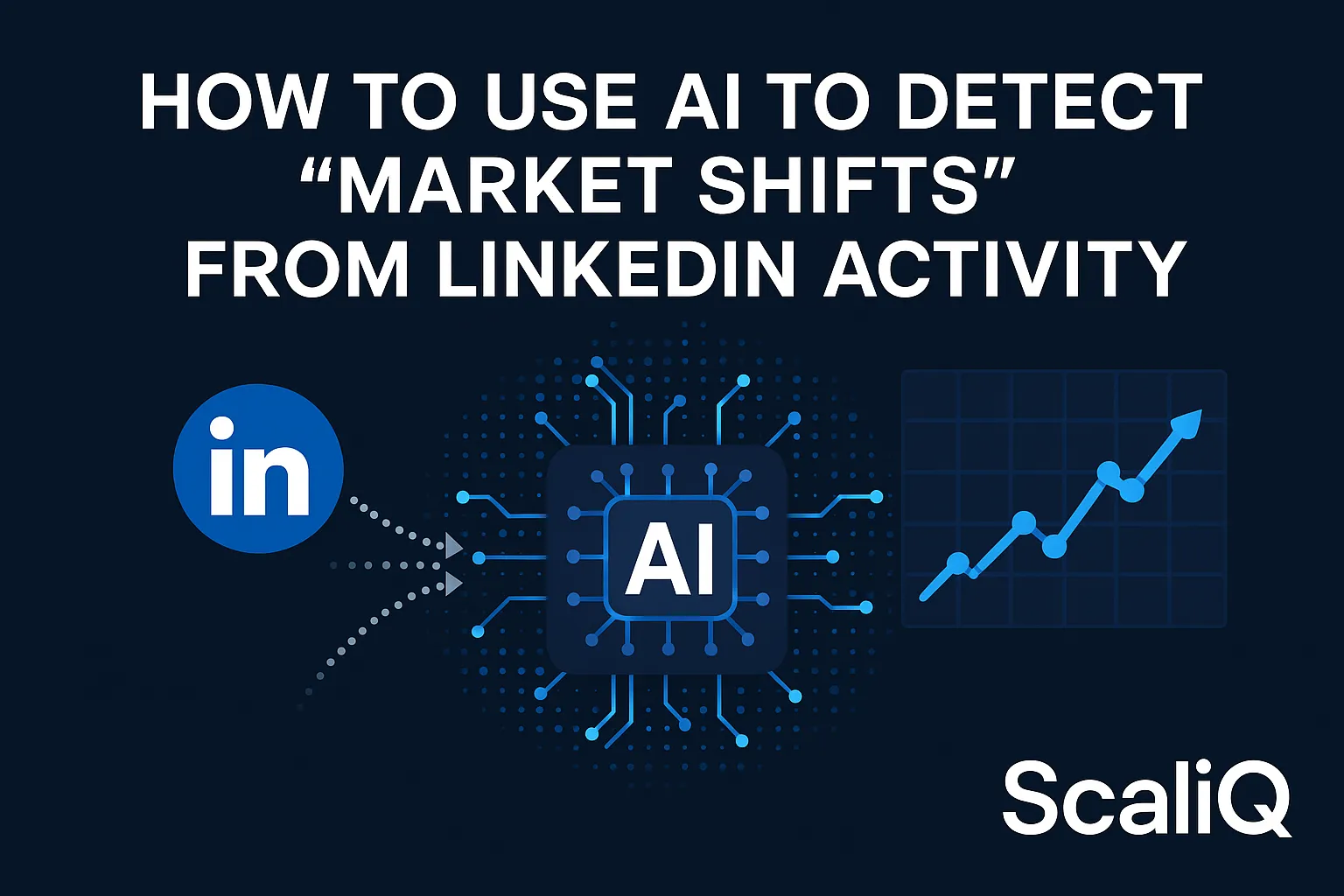
The challenge lies in making sense of this scattered data. This is where AI market shift detection from LinkedIn activity becomes a game-changer. By leveraging predictive intelligence, AI can turn weak, disconnected LinkedIn activity into explainable, validated market-shift intelligence that directly informs outreach, prioritization, and messaging.
For advanced professionals in sales, marketing, RevOps, and competitive intelligence, standard lead scoring is no longer enough. This methodology goes beyond simple account-level trigger events. It focuses on detecting earlier-stage market movement from clustered patterns, providing a strategic advantage. Platforms like ScaliQ provide the ideal environment for this, utilizing predictive intelligence and explainable signal detection to track observed patterns compliantly and ethically. By translating complex market signals on LinkedIn into actionable AI trend detection outreach, GTM teams can capture emerging demand before the competition even realizes the market has shifted.
What LinkedIn Signals Reveal Market Shifts
Professional platforms serve as an early-warning layer for emerging demand, category movement, and changing buyer priorities. However, not every social action reflects immediate buying intent. Some LinkedIn activity signals indicate broader shifts in company direction, team priorities, or industry narratives. To operationalize this data compliantly, teams must classify these go-to-market signals into a practical framework: people signals, company signals, and market-shift signals. When interpreted carefully, this public data provides highly authoritative context for emerging trend detection.
People Signals That Often Appear Before Market Demand Becomes Obvious
People signals—such as job changes, executive profile updates, posting frequency shifts, and changes in thought-leadership themes—often precede formal corporate announcements. When leadership and practitioner activity shifts, it hints at strategic pivots.
The key is distinguishing between isolated profile changes and repeated patterns. For example, if multiple supply chain leaders within the manufacturing vertical suddenly begin posting about the same operational challenge—such as nearshoring logistics—it is no longer a personal update; it is an emerging market priority. Tracking these LinkedIn activity signals through prospect research automation allows revenue teams to identify sales trigger events before official budgets are even allocated.
Company Signals That Suggest Strategic Repositioning
Company signals provide macro-level insights into strategic repositioning. These include hiring velocity, role mix changes, new department buildouts, specific recruiting language, and posting themes from both company pages and employees.
When a software company suddenly hires for compliance specialists and updates its corporate messaging to emphasize data security, it signals category expansion and changing investment priorities. Similarly, changes in external engagement around company content reveal whether a new theme is gaining market traction. Manually monitoring these inputs across hundreds of accounts is impossible, which is why automated account intelligence and market monitoring are essential for scalable competitive intelligence on LinkedIn.
Market-Shift Signals That Emerge Across Multiple Accounts
Market-shift signals occur when patterns emerge across an entire segment, region, or category, rather than within a single account. For instance, if you observe hiring spikes in data engineering, coupled with executive posting about AI governance, and a sudden change in engagement patterns appearing across several mid-market financial firms simultaneously, a broader category shift is underway.
These patterns matter far more for strategic planning than isolated buying signals because they highlight where an entire industry is heading. Because these correlations are virtually impossible for humans to detect manually at scale, AI is required. As noted in NBER research on social media as an early market signal, digital social activity functions as a powerful leading indicator for market movement, making market signals on LinkedIn critical for predictive prospecting and social selling intelligence.
How AI Separates Noise From Meaningful Patterns
Turning messy, high-volume LinkedIn activity into useful intelligence requires sophisticated filtering, classification, anomaly detection, and prioritization. The core pain point for GTM teams is that social data is noisy and incredibly easy to overinterpret when viewed one signal at a time. The true value of AI sales signals is not simply monitoring more activity, but identifying statistically and contextually meaningful changes to drive signal-based outreach and precise market monitoring.
Start With Signal Classification, Not Just Collection
To prevent data overload, AI must first sort public activity into distinct categories: people, company, intent-adjacent, and broader market-shift signals. Classification creates a vastly superior downstream analysis compared to dumping all events into a single, chaotic feed.
Context is everything. A post about a new hiring initiative from a startup founder carries entirely different strategic weight than a generic employee resharing a company blog post. Advanced teams use account intelligence tools to define exactly which classes of LinkedIn intent data and go-to-market signals matter separately for sales, marketing, RevOps, and competitive intelligence.
Detect Anomalies and Pattern Changes Over Time
Once classified, AI should identify deviations from normal activity baselines. This includes sudden increases in role-specific hiring or an abrupt pivot in executive content themes. Rather than treating all events equally, AI evaluates recency and historical trendlines.
Anomaly detection must also be segment-aware; a hiring spike that is highly unusual for a legacy healthcare provider might be standard operating procedure for a hyper-growth SaaS startup. Timing is critical for outreach, and recognizing these shifts early enables proactive strategy. Robust methodologies, such as the NIST anomaly detection framework, support the rigorous identification of these deviations, triggering event monitoring and emerging trend detection that powers AI trend detection outreach.
Filter Weak Signals Before They Become False Positives
Reacting to single, isolated signals frequently leads to bad prioritization and mistimed outreach. AI must filter out common false positives—such as vanity engagement, isolated job changes, or one-off viral posts—before they trigger a workflow.
By suppressing low-confidence events until corroborating evidence appears, AI prevents sales teams from chasing ghosts. This rigorous filtering connects directly to the need for confidence scoring and signal governance, ensuring that buyer intent signals and social selling intelligence genuinely contribute to accurate predictive sales analytics.
Explainability Matters More Than a Black-Box Score
GTM teams need to understand exactly why a market-shift alert was surfaced before they reallocate budgets, change messaging, or shift territory focus. An explainable output clearly details which signals contributed to the alert, over what specific time period, and at what confidence level.
This transparency is a core differentiator for platforms that prioritize observed pattern tracking over vague, black-box "AI found an opportunity" alerts. Unlike typical intent platforms that prioritize opaque scoring outcomes, explainable AI empowers account intelligence and predictive prospecting by providing the transparent reasoning required for confident decision-making.
Signal Clustering, Scoring, and Validation
The methodological depth of market-shift detection lies in how advanced teams combine multiple weak LinkedIn signals into stronger, validated hypotheses before acting. The goal is not to seek absolute certainty from a single data source, but to generate high-confidence inferences from multiple coordinated indicators. Through precise signal clustering, confidence scoring, and AI market shift detection from LinkedIn activity, teams can build a highly reliable predictive engine.
How to Cluster Weak Signals Into a Stronger Market Hypothesis
Clustering involves combining seemingly disparate data points—such as hiring changes, leadership posting themes, engagement pattern shifts, and network movement—across similar accounts. Correlation across multiple accounts drastically increases confidence compared to viewing isolated events.
For example, if multiple companies within the logistics vertical simultaneously begin hiring compliance officers, while their executives start posting about new regulatory frameworks, AI clusters these weak signals into a strong hypothesis: the vertical is facing a new operational priority. This signal clustering can be organized by segment, geography, role group, or competitor set, driving highly targeted signal-based outreach, uncovering market signals on LinkedIn, and fueling competitive intelligence on LinkedIn.
Weight Signals by Relevance, Recency, and Breadth
A practical scoring model must account for signal importance, freshness, and the breadth of the pattern. Different signal classes require different weights. An executive narrative shift, for instance, carries far more strategic meaning than passive employee engagement and should be weighted accordingly.
Furthermore, repeated activity over a sustained period holds more weight than a single, isolated spike. Breadth across multiple accounts indicates a category-level shift rather than an isolated anomaly. By applying rigorous confidence scoring, teams can trust their predictive sales analytics and separate genuine buyer intent signals from market noise.
Validate LinkedIn-Derived Signals Against Other Data Sources
To reduce the risk of overfitting GTM decisions to platform-specific behavior, LinkedIn patterns must be cross-checked against other data sources, including CRM history, web intent data, external hiring boards, funding signals, and relevant industry news.
Validation should be a repeatable workflow, not an ad-hoc analyst exercise. By adhering to rigorous standards like the NIST AI evaluation and validation guidance, teams ensure their AI models are reliable. Furthermore, validating these insights against macroeconomic indicators, such as U.S. Census business formation data, proves that LinkedIn-derived market momentum aligns with official market realities, enriching account intelligence and market monitoring.
Build Confidence Thresholds Before Triggering GTM Action
Not all detections warrant the same operational response. Some shifts justify passive monitoring, others justify message testing, and only the highest-confidence clusters justify immediate outbound scaling or budget reallocation.
Establishing confidence thresholds maps directly to actions across sales, marketing, and RevOps using a simple framework: watch, validate, test, prioritize, and scale. Human review remains essential for high-impact decisions, ensuring methodological rigor and trust in signal-based outreach, go-to-market signals, and account prioritization.
Turning Market Signals Into GTM Action
Insights are only valuable if they are operationalized. Detected market shifts must fundamentally change prioritization, messaging, campaign design, and outreach timing. By bridging analysis to execution, different GTM functions can leverage the same signal layer to drive strategic outreach, refine account prioritization, and execute highly relevant signal-based outreach.
Prioritize Accounts and Segments Earlier Than Intent Tools Alone
Market-shift detection elevates target segments before direct buying intent becomes obvious. This provides immense value for territory planning, named-account focus, and prospecting queue design.
Unlike traditional trigger-based workflows that focus exclusively on bottom-funnel activity, early market signals give revenue teams a strategic head start. By knowing where demand is forming, teams can utilize predictive prospecting and account intelligence to engage accounts before they trigger standard buyer intent signals.
Update Messaging Based on Emerging Themes
Clustered LinkedIn activity reveals changing buyer language, emerging pain points, and shifting category narratives. Marketing and sales teams can transform these insights into new message hypotheses, targeted campaign angles, and deep outreach personalization.
If engagement shifts suggest a new narrative focus—such as a sudden industry-wide concern over AI compliance—GTM teams must adapt their language to match. Testing these message changes is crucial, as not every shift is durable. For best practices on message adaptation and personalization, teams should consult resources like Blog to refine their AI trend detection outreach, social selling intelligence, and application of market signals on LinkedIn.
Improve Outreach Timing With Signal Windows
Recency and momentum create far better timing cues than static, persona-based sequencing. Outreach should align perfectly with signal windows where awareness, urgency, or strategic focus is visibly increasing.
Understanding signal decay is equally important; old signals must lose their influence over time to prevent reps from referencing stale data. By mapping these outreach timing signals to SDR, AE, and ABM workflows, teams can capitalize on sales trigger events and AI sales signals at the exact moment of maximum relevance.
Align Sales, Marketing, and RevOps Around a Shared Signal Layer
A unified signal model eliminates fragmentation between GTM teams. When everyone operates from the same intelligence, marketing can update campaigns, sales can reprioritize accounts, RevOps can adjust scoring logic, and competitive intelligence can track category movement seamlessly.
This cross-functional alignment is where strategic value truly compounds. While many tools surface basic account-level triggers, they severely underplay shared market-sensing workflows. By leveraging platforms like Www.Notiq.Io for orchestration, routing, and workflow automation, teams can seamlessly connect RevOps, go-to-market signals, and account intelligence tools into one cohesive revenue engine.
Market-Shift Detection vs Buyer Intent Tools
To build a truly predictive revenue engine, teams must understand where buyer-intent tools end and market-shift detection begins. While both are critical, they serve distinctly different strategic purposes within the revenue intelligence landscape.
Buyer Intent Signals Tell You Who May Be In-Market Now
Classic buyer intent tools excel at identifying active demand and engagement close to the purchase consideration phase. They track bottom-funnel activities like software review site visits or targeted web searches.
While this intent data is highly useful for immediate account prioritization, it is usually stronger later in the buying journey. Market-shift detection is not a replacement for these tools; rather, it is a complementary, earlier-stage layer that enhances overall buyer intent signals.
Market-Shift Detection Tells You Where Demand Is Forming
LinkedIn-based market sensing identifies rising priorities, changing narratives, and category movement long before explicit intent is registered. This foresight is critical for ICP expansion, territory focus, partner strategy, and long-term campaign planning.
This early-warning capability is a major strategic differentiator. By capturing market signals on LinkedIn and executing emerging trend detection, teams can utilize predictive prospecting to build pipeline before the competition even knows the market is active.
Why Most Competitor Workflows Stop Too Late
Typical vendor approaches center entirely on trigger-event monitoring, lead discovery, or downstream buying signals. They suffer from weak explainability, limited validation depth, and almost no attention to market-level pattern emergence.
Advanced market-shift detection workflows close these gaps through superior AI enrichment, rigorous validation, transparent confidence scoring, and strategic GTM application. This transforms basic signal-based outreach and competitive intelligence on LinkedIn into proactive AI trend detection outreach.
Best-Fit Use Cases for Each Approach
The most mature GTM teams stack early market signals with downstream intent for comprehensive full-funnel visibility.
• Market-Shift Detection: Best for early category sensing, expansion planning, messaging updates, and initial outbound timing.
• Buyer Intent Tools: Best for bottom-funnel conversion, immediate lead routing, and late-stage deal acceleration.
Using both approaches simultaneously optimizes buyer intent signals, market monitoring, and holistic account intelligence.
Practical Toolkit for Building a Repeatable Signal Workflow
To operationalize this framework, GTM teams need a structured, actionable plan. This toolkit transforms theory into a repeatable prospect research automation and signal workflow, powered by predictive intelligence.
Step 1: Define the Signal Taxonomy
Begin by outlining the specific categories of compliant, public LinkedIn activity the team will monitor. Clearly map these signals into people, companies, and market shifts. Document exactly which teams care about which signals to ensure alignment. This taxonomy forms the foundation for tracking LinkedIn activity signals, go-to-market signals, and account intelligence.
Step 2: Set Scoring and Confidence Rules
Define the rules for weighting, recency windows, breadth thresholds, and confidence bands. Keep the framework transparent and explainable so reps trust the data. Advanced teams should continuously revisit and adjust these weights as market conditions evolve, ensuring highly accurate confidence scoring, predictive sales analytics, and signal clustering.
Step 3: Create a Validation Layer
Before launching a major GTM response, verify detected patterns against CRM data, hiring boards, intent platforms, funding announcements, and news sources. Establish clear governance regarding who owns this validation and how quickly it must happen. Relying on frameworks like the NIST AI evaluation and validation guidance ensures disciplined AI validation, creating a robust market monitoring and validation workflow within your account intelligence tools.
Step 4: Route Signals Into GTM Plays
Validated signals must automatically trigger specific actions: monitor, research, personalize, reprioritize, launch a campaign, or adjust messaging. Map these actions by function across sales, marketing, RevOps, and competitive intelligence. Utilizing systems like ScaliQ to surface these explainable market-shift signals, and orchestrating the execution through platforms like Www.Notiq.Io, automates signal-based outreach, account prioritization, and AI trend detection outreach, eliminating analyst bottlenecks.
Step 5: Review Outcomes and Retrain the Model
Continuously measure whether detected signals actually led to better timing, stronger messaging, or improved prioritization. Close the loop on false positives, missed signals, and signal decay. This iterative learning and model refinement ensures the long-term accuracy of predictive prospecting, signal quality, and market-shift detection.
Conclusion
LinkedIn activity becomes a profound strategic asset when AI transforms scattered, weak signals into explainable, validated market-shift intelligence. By identifying the right public signals, filtering out the noise, clustering patterns, validating hypotheses, and routing insights directly into GTM action, revenue teams can fundamentally change how they go to market.
Advanced teams must stop treating professional networks solely as a lead source or a basic trigger-event feed. Instead, they must leverage it as a powerful, early market-sensing layer. It is time to think beyond "who is in-market now?" and begin asking "where is demand forming next?"
Evaluate your current workflow today. If your systems cannot detect AI market shift detection from LinkedIn activity before standard intent tools make them obvious, you are leaving pipeline on the table. Embrace the predictive intelligence of observed pattern tracking to master market signals on LinkedIn and elevate your signal-based outreach.