

Introduction
Most LinkedIn prospecting workflows are built to find visible people, not overlooked revenue opportunities. Sales teams and agencies often scrape basic search filters, build massive lists, and launch automated campaigns targeting users with specific job titles. However, high engagement, strong titles, or active posting do not automatically mean a profile is monetizing its influence, expertise, or market demand well.
The goal of modern outbound strategy is not building bigger lead lists, but spotting profiles with strong upside and weak monetization signals. When you can identify a creator, consultant, or business leader who commands attention but lacks the infrastructure to convert it into revenue, you uncover a highly specific, high-leverage outreach opportunity.
This framework is built for advanced B2B sales teams, agencies, SaaS operators, and founder-led outbound teams that already use LinkedIn but want better prioritization. Rather than blasting generic pitches, you can leverage publicly available, compliant data to diagnose execution gaps.
In this article, we will define what makes under-monetized LinkedIn profiles so valuable, identify the key signals to look for, and explain how to score them using AI. We will then validate these findings and turn them into highly tailored LinkedIn outreach opportunities.
At the center of this shift is the need for an opportunity-intelligence layer. Platforms like ScaliQ serve as this intelligence layer, focusing on identifying commercially promising profiles that standard prospecting workflows overlook, ultimately transforming monetization gaps LinkedIn users display into booked meetings.
What Makes a LinkedIn Profile Under-Monetized?
To build a highly targeted outreach engine, we must first clearly define what an under-monetized LinkedIn profile is. This allows you to distinguish high-potential prospects from profiles that are simply inactive, low-quality, or a poor fit for your services.
An under-monetized LinkedIn profile has visible authority, audience relevance, expertise, or commercial fit, but lacks the conversion systems, packaging, or positioning to capture that value. These individuals have built the hardest part of the equation—attention and trust—but are failing to capture the economic upside.
It is critical to understand the difference between:
• High visibility vs. high conversion potential: A post with 1,000 likes means nothing if the audience cannot easily buy a relevant product or service.
• Active profiles vs. revenue-ready profiles: Someone posting daily might be active, but if their headline is vague and they lack a clear call-to-action (CTA), they are not revenue-ready.
• Weak monetization vs. low overall opportunity: A profile with no audience and no expertise is a low opportunity. A profile with deep expertise and an engaged niche audience but no booking link suffers from weak monetization.
For outreach, these under-monetized profiles often have a sharper pain point and a more compelling reason to respond. Opportunity-based targeting beats volume prospecting when resources are limited and personalization matters. When you reach out to solve a visible revenue leak, your message cuts through the noise.
The Practical Definition of an Under-Monetized Profile
In practical terms, under-monetization appears as a stark mismatch between perceived authority and monetization readiness. It is the gap between the value a person provides to their network and the systems they have in place to capture revenue from it.
Common examples include a consultant with deep industry expertise but a weak CTA, a SaaS founder with an engaged audience but no clear offer, or a service provider with high authority but zero funnel infrastructure.
The Monetization Gap Checklist:
• [ ] Does the profile demonstrate clear niche authority?
• [ ] Is there an engaged, relevant audience?
• [ ] The Gap: Is the profile missing a clear value proposition, lead magnet, or booking link?
• [ ] The Gap: Is the service packaging ambiguous or difficult to find?
If you check the first two boxes but find the latter two missing, you have found an under-monetized profile. This is the foundation of effective sales intelligence and LinkedIn profile analysis.
What Under-Monetized Does Not Mean
These profiles are not simply inactive, incomplete, or bad-fit leads. A user who hasn’t logged into LinkedIn in two years is not under-monetized; they are absent.
Furthermore, do not confuse vanity metrics with opportunity. High engagement does not equal revenue readiness. A meme account or a professional posting generic motivational platitudes might get thousands of likes, but they often lack ideal customer profile matching for B2B services.
Conversely, highly polished profiles with flawless funnels, clear CTAs, and optimized link-in-bios may actually be saturated. They are already maximizing their inbound flow, making them less attractive for an agency pitching growth services than a quieter, under-leveraged account with untapped potential. Signal-based prospecting requires looking for the gap, not just the gloss.
Why This Segment Is Valuable for Sales and Agencies
Profiles with latent demand are significantly easier to personalize against than generic lead lists. Because you are diagnosing a visible business problem, your outreach is instantly relevant.
• Agencies can pitch immediate revenue lifts by optimizing the prospect's funnel.
• SaaS teams can frame their software as the missing link in the prospect's workflow gaps.
• Founder-led outbound teams can open with a sharper commercial insight, proving they have actually studied the prospect's business.
This sharply contrasts with standard database-driven prospecting, which prioritizes contact access over opportunity explanation. For example, in ScaliQ’s experience, many profiles look perfectly average on surface filters (e.g., "Consultant in Chicago"). However, when AI scores their monetization signals—revealing high niche engagement but zero inbound infrastructure—they emerge as top-tier LinkedIn outreach opportunities with massive upside.
Signals That Reveal High Potential but Weak Monetization
To automate and scale this approach, you need a measurable framework for identifying monetization gaps using profile, engagement, and business context signals. By organizing these signals into clear categories, you can move from observable, compliant public data to powerful commercial inference.
No single signal is enough. The true opportunity appears in combinations and mismatches. Here is an actionable checklist of signals that show a LinkedIn profile has high potential but low monetization.
Profile Signals
The most immediate indicators of an execution gap are visible directly on the profile. Look for weak headline positioning, an unclear offer, a missing CTA in the "Featured" section, incomplete service framing, limited proof elements, or generic summary language.
When a profile demonstrates a rich career history and deep industry knowledge but uses a headline like "Helping businesses grow," it suggests the expertise exists, but the monetization infrastructure is weak. Profile completeness and positioning quality directly affect perceived conversion readiness. A prospect cannot convert inbound interest if their profile acts as a dead end rather than a landing page.
For foundational benchmarks on what constitutes a complete and optimized presence, refer to the LinkedIn profile strength meter. Profiles that fall short structurally while holding high authority are prime targets for personalized outreach.
Engagement and Audience Signals
Engagement must be analyzed for quality, not just volume. Key signals include posting frequency, niche relevance, audience composition, and creator/operator authority markers (such as thoughtful comments from industry peers).
The opportunity lies in the mismatch pattern: meaningful engagement or niche authority without a clear monetization path. If a fractional CFO consistently posts brilliant cash-flow analyses and receives comments from SaaS founders, but has no link to book a consultation, they are leaving money on the table.
Distinguishing between broad attention and commercially useful audience attention is critical for LinkedIn lead generation with AI. As supported by Harvard research on professional network signals, the structure and quality of a professional's network connections often indicate hidden commercial value that surface-level metrics miss.
Offer-Fit and Conversion-Readiness Signals
These are the strongest indicators of monetization gaps LinkedIn users face. Look for signs like:
• No lead magnet or email capture.
• A weak or non-existent booking path (no Calendly or direct contact method).
• Unclear service packaging (saying "I consult" instead of offering a specific outcome).
• No funnel entry point in the "Featured" section.
• A lack of audience-to-offer alignment.
These are stronger signals than engagement alone because they represent the actual mechanics of revenue generation. A profile that looks highly credible but creates no obvious path to conversion is a prime target for agencies and SaaS platforms that solve bottleneck issues.
Firmographic and Business Context Signals
Profile analysis alone can mislead without company context. You must evaluate company size, hiring momentum, role seniority, service model, and ICP fit.
For instance, a VP of Sales at a rapidly growing company who has a poorly optimized profile represents a different opportunity than a solo consultant. The solo consultant needs funnel infrastructure; the VP of Sales might need recruitment branding or lead generation automation. Firmographic signals shape the opportunity score, ensuring your B2B prospecting automation targets the right pain points.
Trust, Credibility, and Compliance Signals
Finally, evaluate trust assets. Weak social proof, unclear endorsements, vague testimonials, and ambiguous expertise claims indicate that a profile is under-leveraging its credibility.
If a consultant has worked with Fortune 500 brands but only lists generic skills without concrete case studies, their weak trust assets create a commercial opportunity for an agency to step in and revamp their positioning. When dealing with testimonials and proof, it is always important to ensure your outreach and the prospect's marketing align with transparent practices, such as the FTC endorsement guidance.
How AI Scoring Improves Prospect Prioritization
Manually hunting for these mismatches is tedious. AI turns scattered signals into a repeatable, scalable scoring system for better prioritization. However, AI should augment human judgment, not replace it. The focus of AI sales prospecting LinkedIn workflows must be on scoring logic, explainability, and validation.
Building a Monetization-Gap Scoring Model
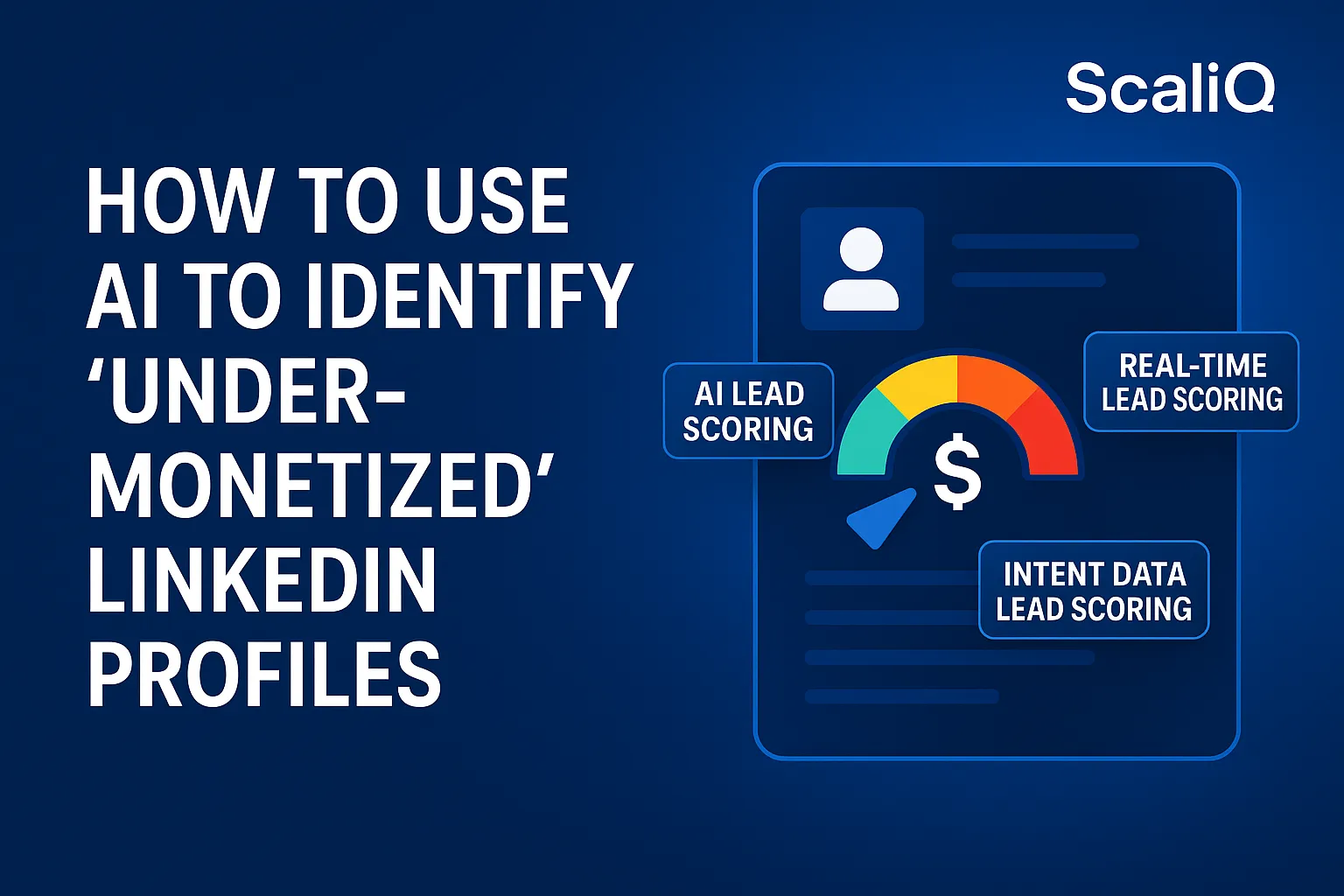
A robust AI lead scoring model requires a weighted framework across profile quality, audience quality, offer clarity, engagement, firmographics, and conversion readiness. The best models combine upside signals (high authority) with execution-gap signals (missing funnels).
Sample Monetization-Gap Scoring Rubric:
Profiles scoring above a certain threshold (e.g., 75/100) are classified as highly under-monetized LinkedIn profiles and prioritized for outreach.
Layering LinkedIn Data with Enrichment and ICP Matching
Profile-first analysis becomes exponentially more useful when combined with firmographic validation. Enrichment improves confidence by adding company revenue, tech stack, role, market, and fit context.
The ideal workflow follows this path: LinkedIn Profile → Data Enrichment → AI Scoring → Prioritized Shortlist.
By layering these data points, you ensure that the person you are contacting actually has the budget and business model to hire you. For a deeper dive into how enrichment transforms raw data into actionable sales intelligence, explore this resource on Blog.
Reducing False Positives with Validation Steps
Before launching a campaign, you must validate AI-identified opportunities. Explainable scoring is more trustworthy than a black-box ranking system.
Recommended validation checks include:
• Recent activity review: Are they still active in their current role?
• Website/offer consistency: Does their website have a funnel even if their LinkedIn doesn't?
• Company relevance: Does their current business model align with your services?
Maintaining explainability and governance in your AI lead scoring ensures you are reaching out based on reality, not hallucinated data. Adhering to standards like the NIST AI Risk Management Framework helps teams build trustworthy, transparent scoring practices that reduce false positives.
Why Scoring Beats Manual Review at Scale
Manual prospect qualification for LinkedIn leads is slow, inconsistent, and prone to human bias. AI-assisted scoring dramatically improves time-to-insight and consistency.
The true benefit is not just speed, but better reasoning. When an AI model scores a profile, it tells you why that profile deserves outreach (e.g., "High engagement + Missing CTA"). This contrasts sharply with basic data tools that simply return enriched lists but leave the complex monetization-gap logic entirely to the user.
Turning Monetization Gaps Into Personalized Outreach
Once you have diagnosed the gap, your outreach must reflect that specific insight. Generic personalization tokens (like "Loved your recent post about [Topic]") fall flat. Better insight creates more relevant first messages and higher response quality. Here is how to map the gap to the message.
Outreach Angle 1 — Weak CTA or Offer Clarity
When you identify unlocked demand suffering from unclear positioning or a poor call-to-action, frame your outreach around the missed conversion opportunity. Use language focused on potential, not criticism.
Example Formula:
"Hey [Name], I’ve been following your content on [Niche Topic]—the engagement you’re getting from [Target Audience] is impressive. I noticed your profile doesn't currently point them to a specific offer or booking link. We help creators in your space capture that exact traffic and turn it into booked calls. Open to seeing how it works?"
This proves you analyzed their LinkedIn profile monetization effectively, showing them a revenue leak they can fix.
Outreach Angle 2 — Strong Authority, Weak Funnel Infrastructure
This angle is perfect for consultants, creators, and service operators who have clear expertise and traction but no visible capture mechanism.
Example Formula:
"[Name], your recent breakdown of [Industry Trend] was spot on. It’s clear you have deep authority here, but I noticed there isn't a clear funnel entry point on your profile to capture the founders engaging with your posts. We build automated inbound systems for consultants like you. Worth a quick chat to see how much latent demand you could capture?"
This uses sales intelligence to pinpoint exactly where their business is bottlenecking.
Outreach Angle 3 — Audience-Offer Mismatch
Sometimes the audience is highly relevant, but the offer does not match their likely demand. If a software engineer has a massive audience of junior developers but is trying to sell enterprise consulting, there is a mismatch.
Your outreach can frame a repositioning or packaging opportunity. Point out the specific demographic engaging with their content and suggest a productized service or community offer that matches that audience's actual buying power.
Outreach Angle 4 — Hiring or Growth Signals with Weak Positioning
Company growth (like a sudden spike in headcount) indicates urgency. If a company is expanding but the founder's public profile does not reflect a scalable commercial story, they are missing out on inbound talent and enterprise deals.
Tie firmographic signals to the message to make it timely: "Noticed [Company] just expanded the sales team—congrats on the growth. Usually, at this stage, founders need their personal profiles to act as automated lead-gen assets, but your current setup is missing a clear enterprise CTA..."
Personalization Principles That Keep Outreach Relevant
When executing personalized outreach, adhere to specificity, restraint, and evidence-based insights. Focus on one observable gap per message rather than overwhelming the prospect with a list of everything they are doing wrong.
Generic LinkedIn outreach underperforms because it lacks commercial relevance. By rooting your message in a monetization-gap insight, you transition from a vendor to an advisor. For more advanced strategies on crafting high-converting messaging based on profile data, review this guide at Blog.
Manual Prospecting vs Filters vs Opportunity Intelligence
To understand where this methodology fits into the broader B2B landscape, we must compare it to common alternatives based on speed, precision, context depth, personalization potential, and revenue upside.
Manual Prospecting
Manual LinkedIn prospecting is slow and hard to scale. While it allows for high nuance and intuition, it is inconsistent and often biased toward highly visible profiles, causing sales reps to miss quieter accounts with massive latent demand.
Basic Filters and Database-First Workflows
Basic filters in traditional databases help narrow lists by title, company, geography, and broad fit. However, these methods still miss monetization inefficiencies. A filter can tell you someone is a "Marketing Director in New York," but it cannot tell you if their profile is leaking revenue due to a missing inbound funnel.
Opportunity Intelligence Scoring
Opportunity intelligence is the next layer: it reveals not just who fits the ICP, but who has upside and why. By turning raw profile data into a reasoned outreach opportunity, it allows teams to execute signal-based prospecting at scale, identifying under-monetized LinkedIn profiles systematically.
What Competitor Tools Do Well — and Where the Gap Remains
Platforms like Sales Navigator, Apollo, Clay, and ZoomInfo are undeniably useful for filtering, data enrichment, and workflow assembly. If you need a list of 10,000 emails for a specific job title, they excel.
However, the missing layer is monetization-gap interpretation and outreach-angle generation. They provide the raw ingredients but leave the commercial inference up to the user. This is where an opportunity intelligence platform like ScaliQ bridges the gap, taking enriched data and applying the specific logic required to detect revenue opportunities.
Tools, Validation, and Workflow Tips
To operationalize this framework, you need a practical implementation layer that your outbound team can use immediately. This should be treated as a repeatable operating system, not a one-off tactic.
A Simple Workflow for Teams
1. Source Profiles: Use basic filters to pull a broad list of ICP-aligned profiles.
2. Extract Signals: Scrape publicly available, compliant profile data (headlines, featured sections, recent post metrics).
3. Enrich Context: Append firmographic data (company size, hiring trends).
4. Score Opportunities: Run the data through your AI lead scoring model to detect monetization gaps.
5. Validate: Perform manual spot-checks on the top 10% of scored profiles.
6. Personalize Outreach: Deploy campaigns using the specific gap identified by the AI.
Suggested Data Inputs for Better Scoring
Richer inputs create better opportunity explanations. Ensure your scoring model is ingesting:
• Profile copy (Headline, About section)
• Role and title seniority
• Content activity and posting frequency
• Engagement quality (comments vs. just likes)
• CTA presence (Booking links, newsletters)
• Website quality (Does the link in bio lead to a dead page?)
• Company data and ICP fit
Common Mistakes to Avoid
• Overweighting vanity engagement: Do not target someone just because a post went viral if their audience is entirely outside your ICP. Wasting time on low-fit LinkedIn prospects ruins campaign ROI.
• Ignoring offer quality: A profile with no engagement but a highly optimized funnel is not under-monetized; they just need traffic.
• Skipping validation: Always have a human review the highest-scored prospects before sending a message.
• Automating outreach too early: If your AI score is slightly off, fully automated sending will result in generic or mistimed messaging.
Future Trends in Signal-Based Prospecting
Prospecting is rapidly shifting from static list-building to dynamic opportunity detection. As outbound becomes more competitive, teams that can act on latent demand faster will win.
From Static Lists to Dynamic Opportunity Scoring
The market is moving toward continuously updated signals instead of fixed prospect databases. A profile might not be under-monetized today, but if they launch a new podcast next week and fail to set up a lead capture form, a dynamic scoring system will instantly flag them as a new opportunity.
Personalization Grounded in Observable Signals
The future of outbound is not generic AI writing (e.g., asking ChatGPT to write a polite email), but better insight extraction from real prospect data. The AI's highest value is in diagnosing the monetization gap, which then allows a human (or a highly constrained AI prompt) to write a hyper-relevant, insight-driven message.
Why Explainability Will Matter More
As teams rely more on AI to find outreach opportunities on LinkedIn at scale, they will demand to know why a profile is prioritized. Black-box scoring will be replaced by transparent AI that provides clear reasoning. This aligns with broader governance trends, such as the NIST framework mentioned earlier, ensuring that sales intelligence remains trustworthy, compliant, and highly actionable.
Conclusion
The best LinkedIn opportunities are not always the loudest, most polished profiles. Often, the highest-leverage targets are those with visible authority and weak monetization systems.
By defining what under-monetization looks like, identifying the right profile and engagement signals, and scoring them with AI, you can transition from volume-based spam to highly targeted, value-driven outreach. The workflow is simple but powerful: source, extract, enrich, score, validate, and convert those gaps into tailored messages.
Opportunity intelligence consistently beats list-first prospecting when the goal is higher-upside outreach. It allows you to approach prospects not as a vendor begging for time, but as an advisor diagnosing a visible revenue leak.
If your team is ready to move beyond basic filters and build a more systematic way to find under-monetized LinkedIn profiles, explore how ScaliQ can serve as your AI-driven opportunity detection layer.