

The LinkedIn “Relevance Loop”: Keeping Conversations Alive Longer
Most LinkedIn outreach advice is obsessed with getting the first reply. Teams spend countless hours A/B testing subject lines, connection requests, and opening hooks just to get a prospect to say "hello." But for outbound teams, the real pipeline value often comes from what happens after that first response.
Unfortunately, many promising threads die prematurely because sales reps default to generic check-ins, push for a meeting too early, or fail to build on the context the prospect already revealed. Getting a reply is an event; sustaining a conversation is a process.
Enter the LinkedIn Relevance Loop: a practical, repeatable framework for extending live conversations through context, value, and low-friction next steps. This guide will show you exactly why threads stall and how to structure your follow-ups using live signals. We will provide concrete message examples and reveal how to measure conversation quality far beyond your initial reply rate.
Whether you are an SDR, sales leader, or growth marketer looking to move from basic responses to deeper, more qualified conversations, mastering LinkedIn conversation longevity is the key. At ScaliQ, we specialize in building outbound loops that extend conversations well beyond the first reply, turning surface-level engagement into a predictable pipeline. Readers can explore more tactical outbound and LinkedIn workflow content here: Blog.
Why LinkedIn Threads Die After the First Reply
First-reply optimization is not the same as conversation longevity. Many outbound teams have mastered the art of getting a prospect to respond, but they lack the operational strategy to sustain relevance across multiple turns. When LinkedIn conversations stall after the first reply, it is rarely because the prospect suddenly lost interest; it is usually because the follow-up strategy introduced friction.
The most common thread-killers include:
• Sending generic "just following up" or "bubbling this to the top" messages.
• Slow or awkward timing that breaks the natural rhythm of the conversation.
• Repeating the original pitch without adding any new context or value.
• Asking for a 30-minute discovery call before trust or relevance is established.
• Ignoring valuable signals hidden in the prospect’s message or LinkedIn profile.
Dead-end follow-ups create friction because they force the prospect to do the mental heavy lifting of continuing the conversation. If your message does not offer a clear, easy way to respond, the prospect simply won't. This translates directly to business impact: stalled threads mean weaker qualification, lower trust, and less efficient pipeline creation.
While common market advice focuses heavily on static cadences and rigid templates, professional follow-up requires dynamic conversation management. As highlighted by Harvard networking best practices, effective professional follow-ups must remain relationship-oriented and other-focused. Unlike static sequencing that blasts the same message regardless of context, a loop-based approach adapts to the prospect's reality.
The Difference Between a Reply and a Real Conversation
To improve your LinkedIn outreach strategy, you must distinguish between:
• A surface-level response: A polite dismissal or a brief acknowledgment (e.g., "Thanks for reaching out, we're good for now").
• A meaningful second turn: The prospect answers a question or shares a piece of context about their current workflow.
• A qualified multi-turn conversation: A back-and-forth exchange where pain points are acknowledged, value is exchanged, and trust is built.
Reply rates alone can be highly misleading if your threads are shallow or unproductive. "Thread depth"—the number of meaningful exchanges within a single conversation—is a far more accurate lens for measuring prospect nurturing and outbound quality.
The 5 Most Common Failure Modes in LinkedIn Follow-Ups
When evaluating your conversation follow-up, watch out for these five tactical failure modes:
1. No context carryover: The rep ignores what the prospect just said., Bad Example: Prospect says, "We just implemented Salesforce." Rep replies, "Great, do you have 15 minutes to talk about our CRM tool?"
2. No new value: The rep asks for time without earning it., Bad Example: "Just checking in to see if you had time to review my last message."
3. High-friction CTA: Asking for a high-commitment action too early., Bad Example: "Here is a link to my calendar, please book 45 minutes for a demo."
4. Robotic personalization: Using obvious automation tokens without genuine relevance., Bad Example: "I see you work at [Company] in the [Industry] space. We help [Industry] companies..."
5. Sequence-first instead of signal-first thinking: Blindly following a pre-scheduled cadence rather than adapting to the live conversation.
The LinkedIn Relevance Loop Framework
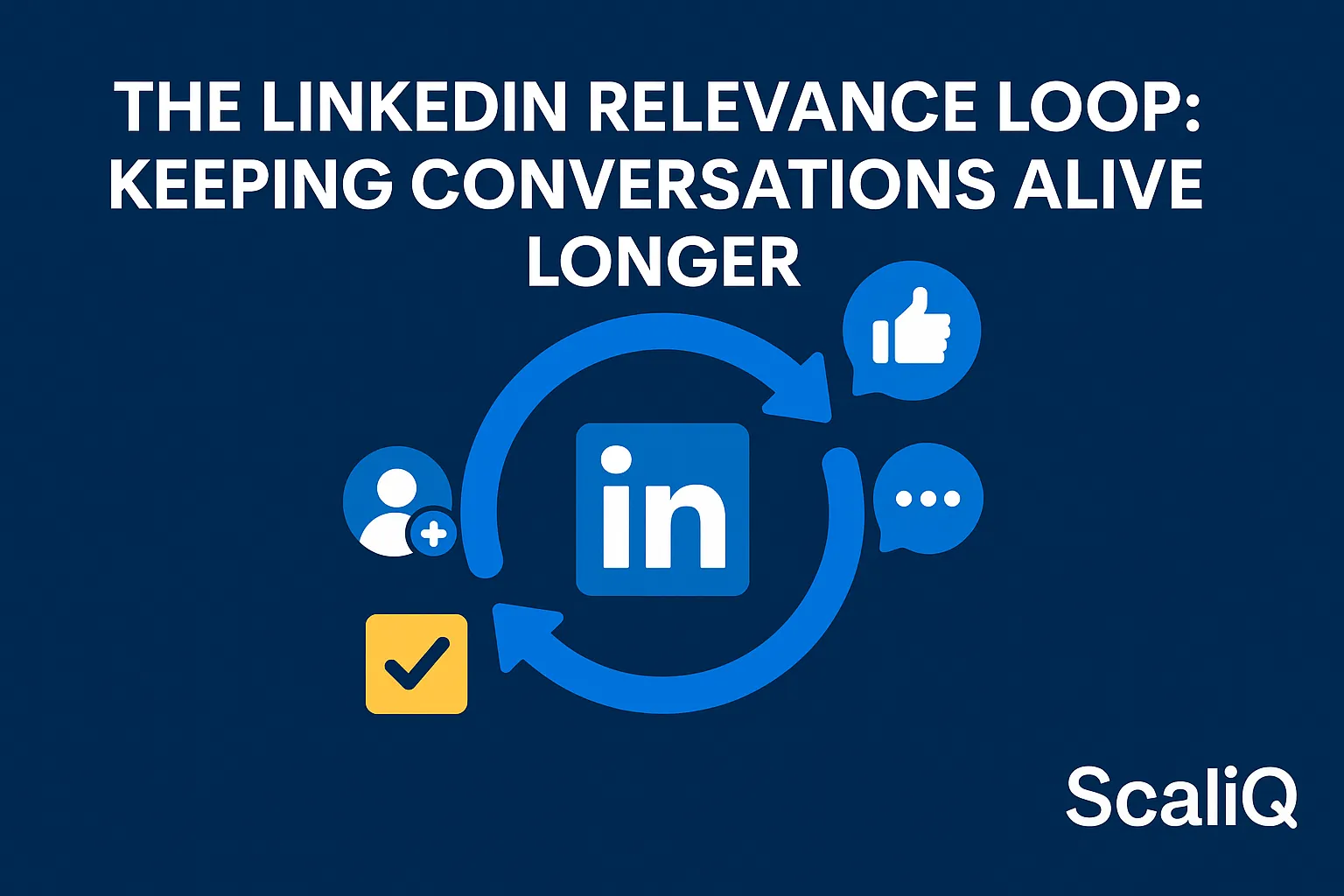
The LinkedIn Relevance Loop is a system designed to extend live LinkedIn conversations through five distinct stages: Trigger, Response, Context Expansion, Value Drop, and Next-Step Prompt.
Unlike traditional sales cadences, this is a live-thread operating model based entirely on what the prospect does, says, and signals. Every message you send should earn the right to the next interaction by adding relevance, reducing friction, or increasing curiosity. This system seamlessly connects broader social selling principles with multi-touch engagement strategy.
At ScaliQ, we treat this framework as an operational necessity, not just a theoretical concept. Teams can explore how to operationalize loop-building and adaptive follow-ups here: ScaliQ.
Stage 1 — Trigger
Strong follow-up starts with observation, not automation for automation's sake. The trigger dictates both the timing and the angle of your next message. Valid triggers include:
• The prospect’s actual reply in the thread.
• Recent profile changes or job promotions.
• Content engagement (liking or commenting on a relevant post).
• New role or company context (e.g., the company announced a new funding round).
• A prior pain point the prospect mentioned earlier in the thread.
Using these prospect signals ensures your personalized outreach on LinkedIn is timely and highly relevant.
Stage 2 — Response
Your response must acknowledge the prospect’s message in a way that proves active listening. A strong response mirrors the prospect's tone, references specific context they shared, and strictly avoids defaulting back to your original pitch.
If a prospect says, "We are currently struggling with data silos," your response should directly validate that specific pain point before moving forward. This context carryover is the foundation of effective B2B conversation follow-up tactics.
Stage 3 — Context Expansion
Context expansion is where you naturally broaden the conversation by exploring adjacent pain points, goals, workflows, or constraints. Instead of pushing for a binary outcome like booking a call, focus on micro-commitments. Ask follow-up questions that are easy to answer and useful for qualification.
According to research on reciprocal self-disclosure online and a comprehensive meta-analysis on self-disclosure and liking, balanced, relevant back-and-forth communication significantly deepens interpersonal trust. By asking thoughtful, low-stakes questions, you encourage the prospect to open up further.
Stage 4 — Value Drop
Every follow-up message must contribute one new, useful element to the conversation. Sending generic value props disconnected from the prospect’s context will kill the thread.
A relevant insight, a short example, a reframed problem, or a lightweight suggestion keeps the lead nurturing process valuable for the buyer.
Stage 5 — Next-Step Prompt
End each message with a low-friction next step that matches the temperature of the thread. Early meeting asks shut conversations down. Instead, use:
• A simple yes/no prompt ("Is this something your team is currently looking at?")
• A short opinion question ("Do you agree with that approach?")
• An either/or choice ("Are you focusing more on inbound or outbound right now?")
• A lightweight permission ask ("Mind if I send over a quick resource on that?")
Knowing how to keep LinkedIn conversations going longer relies entirely on making the next step effortless for the prospect.
Signal-Based Follow-Ups That Feel Personal
Personalization in sales messaging must go beyond first-name tokens and broad company references. True personalization comes from live signals. Signal-based outreach workflows bridge the gap between relationship-driven social selling and scalable, operational outbound.
By tying your follow-up to a specific, compliant, and publicly accessible signal, you give the prospect a compelling reason to respond now.
Signals You Can Use to Shape the Next Message
When monitoring LinkedIn engagement, look for high-value, publicly available signals:
• Verbal context: Exactly what the prospect last said or asked in the thread.
• Profile signals: Recent profile updates, job changes, or new skill endorsements.
• Content signals: Recent posts, articles, or comments they have engaged with.
• Role signals: Specific pain points typical for their current job title.
• Company signals: Public initiatives, hiring activity, or company news.
Focus strictly on ethical, practical signal use—leveraging public business context to provide better value.
Timing: When to Follow Up Without Killing Momentum
The golden rule of message sequencing is to respond while the context is still warm, without forcing unnecessary touches when there is no new relevance. "Fast and relevant" will always beat "scheduled and generic."
Your timing should depend on:
• Thread temperature: Hot threads (rapid back-and-forth) require immediate replies.
• Reply content: If they ask a specific question, answer it promptly.
• Urgency: If the signal is time-sensitive (e.g., a post they just made), act fast.
• New context: Wait to follow up until you have a genuinely new piece of value to drop.
How to Scale Personalization Without Sounding Automated
To avoid sounding robotic on LinkedIn, teams must standardize their logic while customizing their wording. Build message blocks around specific scenarios, triggers, and micro-commitments rather than relying on one rigid, copy-pasted script.
There is a massive difference between "personalization theater" (inserting a company name into a generic pitch) and meaningful context adaptation (changing the core value proposition based on the buyer's actual workflow). For teams looking to scale context-rich outreach and personalized messaging workflows effectively, tools like Repliq.Co provide excellent infrastructure for adaptive logic.
Message Examples for Extending or Reopening Threads
The best follow-up strategy for LinkedIn outreach relies on scenario-based messaging. Below are side-by-side examples showing how to transform weak, friction-heavy messages into strong, engaging relevance loops.
Example 1 — Extending a Positive First Reply
Scenario: The prospect replies politely but vaguely: "Thanks for reaching out. We are looking into this, but it's early days."
• Weak Message: "Great to hear! Let's jump on a quick 15-minute call next Tuesday so I can show you a demo. Does 10 AM work?" (Fails because it creates high friction and asks for time without adding value).
• Stronger Message: "Makes sense that it's early days. Usually, when teams start looking into this, they are either trying to fix [Pain Point A] or scale [Pain Point B]. Which camp are you falling into right now?"
Why it works: It creates thread continuation by adding industry context and asking a low-friction, either/or follow-up question.
Example 2 — Reopening a Stalled Thread
Scenario: The prospect showed initial interest but hasn't replied in two weeks.
• Weak Message: "Just bubbling this up to the top of your inbox. Let me know if you still want to chat." (Fails because it is a generic LinkedIn follow-up that adds zero value).
• Stronger Message: "Hi [Name], I saw [Company] just posted a new opening for an SDR Manager. Usually, when teams are expanding that unit, ramping time becomes the biggest bottleneck. Is that something you're actively trying to solve this quarter?"
Why it works: It uses a fresh, public signal (hiring data) to reopen stalled LinkedIn threads with immediate, role-specific relevance.
Example 3 — Moving From Interest to Qualification
Scenario: The prospect is engaged and answering questions, and you need to assess fit.
• Weak Message: "Awesome. We can definitely help with that. Here is my calendar link to discuss pricing and implementation." (Fails because it rushes the sale).
• Stronger Message: "That aligns perfectly with what we see. Out of curiosity, are you currently managing that process manually in spreadsheets, or do you have a legacy tool in place? Just want to make sure I send over the most relevant case study."
Why it works: It uses a micro-commitment prompt (diagnostic question) to assess fit and guide the prospect nurturing process without over-pitching.
Swipeable Message Patterns by Scenario
Rather than relying on static scripts, build modular message patterns based on these categories:
• Curiosity-led follow-up: "I noticed [Signal]. Does that mean you are focusing on [Trend]?"
• Pain-point expansion: "Most leaders in your role struggle with [Pain]. Is that a priority for you right now?"
• Insight-led nudge: "Since we last spoke, our team published data on [Topic]. The biggest takeaway was [Insight]. Worth a quick look?"
• Permission-based next step: "I have a 2-page checklist on how to solve [Problem]. Mind if I send the link over?"
• Reactivation with fresh relevance: "Saw your recent post about [Topic]. It reminded me of our chat last month regarding [Related Topic]. Have you made any headway there?"
How to Measure Conversation Depth and Qualification
To build a truly qualified pipeline, outreach teams must evaluate the quality of conversations, not just the existence of responses. Reply rates tell you if your hook worked; conversation depth tells you if your value proposition is resonating.
As supported by research on measuring communication quality, assessing qualitative communication metrics provides a much clearer picture of relationship development than vanity metrics alone.
Core Metrics to Track
Move beyond basic open and reply rates by tracking:
• Reply-chain length: The average number of back-and-forth messages per engaged prospect.
• Number of meaningful turns: How many times the prospect actually provided context or answered a question.
• Micro-commitment rate: The percentage of prospects who agree to a low-friction ask (e.g., watching a video or reading a resource).
• Positive response progression: Tracking the shift from neutral curiosity to active interest.
• Qualification depth: How many BANT (Budget, Authority, Need, Timing) or MEDDIC criteria are uncovered naturally in the thread.
The goal of LinkedIn engagement is not to send more messages, but to facilitate more productive turns.
What a Healthy LinkedIn Thread Looks Like
You can identify a healthy, high-momentum thread through qualitative signs:
• The prospect freely shares internal context or workflows.
• They directly answer your follow-up questions.
• They reveal timing, current priorities, or internal buying processes.
• They eagerly engage with your low-friction next steps.
Contrast this with fake-positive signals—like short, polite replies ("Thanks for the info")—that never deepen into actual business conversations.
How to Connect Thread Depth to Pipeline Outcomes
Deeper conversations lead directly to better qualification and highly efficient sales meetings. When you measure conversation depth, you can compare the opportunity quality of shallow-reply leads versus multi-turn leads.
Inevitably, prospects who engage in a robust Relevance Loop show up to discovery calls pre-qualified, highly educated on your value, and ready to buy. Conversation longevity is the ultimate upstream signal of sales engagement loops and pipeline generation efficiency.
Best Practices to Make the Relevance Loop Repeatable Across a Team
To scale LinkedIn conversation longevity, the Relevance Loop must become an operational team playbook, not just an individual rep's hidden talent. Blending human judgment with adaptive systems ensures continuity across your entire multi-touch engagement strategy. You can explore how to operationalize loop logic across your outbound workflows here: ScaliQ.
Build a Library of Triggers, Value Drops, and Micro-Commitments
Document reusable components without forcing cookie-cutter messaging. Create a shared team library organized by persona, sales stage, or common objections.
• Trigger Library: A list of public signals (e.g., new funding, hiring, software implementation) and what they mean.
• Value Drop Library: Approved one-pagers, 60-second micro-demo videos, and industry statistics.
• Micro-Commitment Library: A master list of low-friction, either/or questions reps can pull from when they need to keep a thread moving.
Review Real Threads, Not Just Dashboards
Dashboards tell you that a thread died; transcripts tell you why it died. Teams should regularly review real conversation transcripts to understand momentum shifts. Look for the exact moments where context was lost, where a rep failed to mirror the prospect, or where a high-friction next-step prompt caused the prospect to ghost.
Conclusion
Winning on LinkedIn is not just about getting replies; it is about building relevance across multiple turns. By leveraging the LinkedIn Relevance Loop—Trigger, Response, Context Expansion, Value Drop, and Next-Step Prompt—you can fundamentally transform how your team approaches conversation follow-up.
The biggest mindset shift you can make today is to stop treating follow-ups like a static, scheduled cadence. Start treating them like adaptive conversation management. When you prioritize relevance and low-friction interactions, better conversation longevity naturally leads to deeper qualification, stronger trust, and significantly better pipeline quality.
At ScaliQ, we are dedicated to helping teams build outbound loops that extend conversations far beyond the first reply. We invite you to review your current follow-up process through the lens of thread depth and relevance.
For more tactical outbound insights, visit our blog at Blog, or explore how ScaliQ helps teams operationalize adaptive outbound loops at ScaliQ.