

Introduction
Many recruiters want to scale their LinkedIn outreach, but they quickly encounter a frustrating reality: the moment messages start sounding copied and pasted, response rates plummet and candidate trust vanishes. This creates a core tension in modern talent acquisition. Recruiters desperately need repeatable systems to manage their workload, but candidates respond exclusively to relevance, not automation.
This guide provides a complete, beginner-friendly workflow for linkedin recruiter outreach. It covers everything from initial candidate segmentation to first-touch messaging, follow-up logic, and safe, AI-assisted drafting. Whether you are dealing with passive candidates, executing high-volume hiring campaigns, or sourcing for hard-to-fill roles, this article offers practical, use-case-driven examples to streamline your daily operations.
Rather than just handing out static templates, this guide introduces a dynamic workflow designed to help recruiters sound human at scale. By leveraging targeted ai recruiting messages and structured LinkedIn outreach workflows for recruiters, you can maintain authenticity without sacrificing efficiency. Drawing on ScaliQ’s extensive experience in creating adaptable outreach structures for talent acquisition professionals, this approach ensures your messaging resonates. Learn more about building these adaptable systems with ScaliQ.
Why LinkedIn Recruiter Outreach Gets Ignored
Before building a new workflow, it is critical to diagnose why current recruiter outreach underperforms. Generic, pitch-heavy, and profile-blind messages feel automated even when a recruiter types them out manually. The core problem is not just "automation" itself, but rather irrelevant messaging, poor timing, and a complete lack of candidate context.
Beginners often face a specific set of pain points: low response rates, overwhelming manual effort, uncertainty about exactly what to personalize, and confusion regarding when and how to follow up. Thoughtful, targeted outreach stands in stark contrast to the automation-first, "spray and pray" messaging often associated with mass-send tools. According to NACE research on authentic candidate communication, authenticity directly influences candidate trust and the overall quality of responses, proving that a human touch is non-negotiable in candidate outreach messages.
When personalized LinkedIn messages are replaced by automated recruiting outreach that lacks context, candidates simply hit delete.
The Most Common Reasons Recruiter Messages Fail
Recruiter messages consistently fail due to recurring missteps: vague role descriptions, zero proof of relevance to the candidate's background, overly long introductions, and asking for a major commitment (like a 30-minute call) too soon. Passive candidates, who are not actively looking for jobs, are especially quick to ignore talent acquisition outreach that feels like a bulk send.
Furthermore, relying on one-size-fits-all recruiter outreach templates often creates the exact "robotic" tone recruiters are trying to avoid. Sending the same block of text to a senior engineer and a junior developer guarantees poor candidate engagement. This highlights the absolute necessity of segmentation and modular personalization, which will be covered later in this workflow.
What “Sounds Automated” Actually Means to Candidates
To a candidate, a message "sounds automated" when it contains synthetic signals: generic compliments ("I was impressed by your profile!"), no clear role-candidate fit, templated urgency, and repetitive phrasing. Candidates do not need a fully custom essay detailing their entire work history; they simply need proof that the recruiter noticed something specific and relevant.
Consider this "bad vs. better" framing:
• Bad: "I saw your impressive background and have an urgent role." (Feels like automated ai recruiting messages).
• Better: "I saw your recent transition to a senior backend role and thought you'd be a fit for our scaling data team." (Feels like personalized LinkedIn messages integrated into a thoughtful recruitment messaging workflow).
Why Personalization Beats Volume-Only Outreach
Personalization is the primary differentiator in successful outreach. A minimal amount of true relevance goes much further than lengthy copy or an aggressive number of touchpoints. The goal of a modern linkedin recruiter outreach strategy is scalable relevance, not painstakingly handcrafted messaging for every single candidate.
When a personalized recruiter outreach strategy is applied, it directly impacts hiring success. As supported by NACE findings on authenticity and offer outcomes, authenticity matters far beyond initial reply rates; it influences whether a candidate ultimately accepts an offer. A well-structured candidate outreach sequence builds this trust from the very first interaction.
A Step-by-Step LinkedIn Outreach Workflow for Recruiters
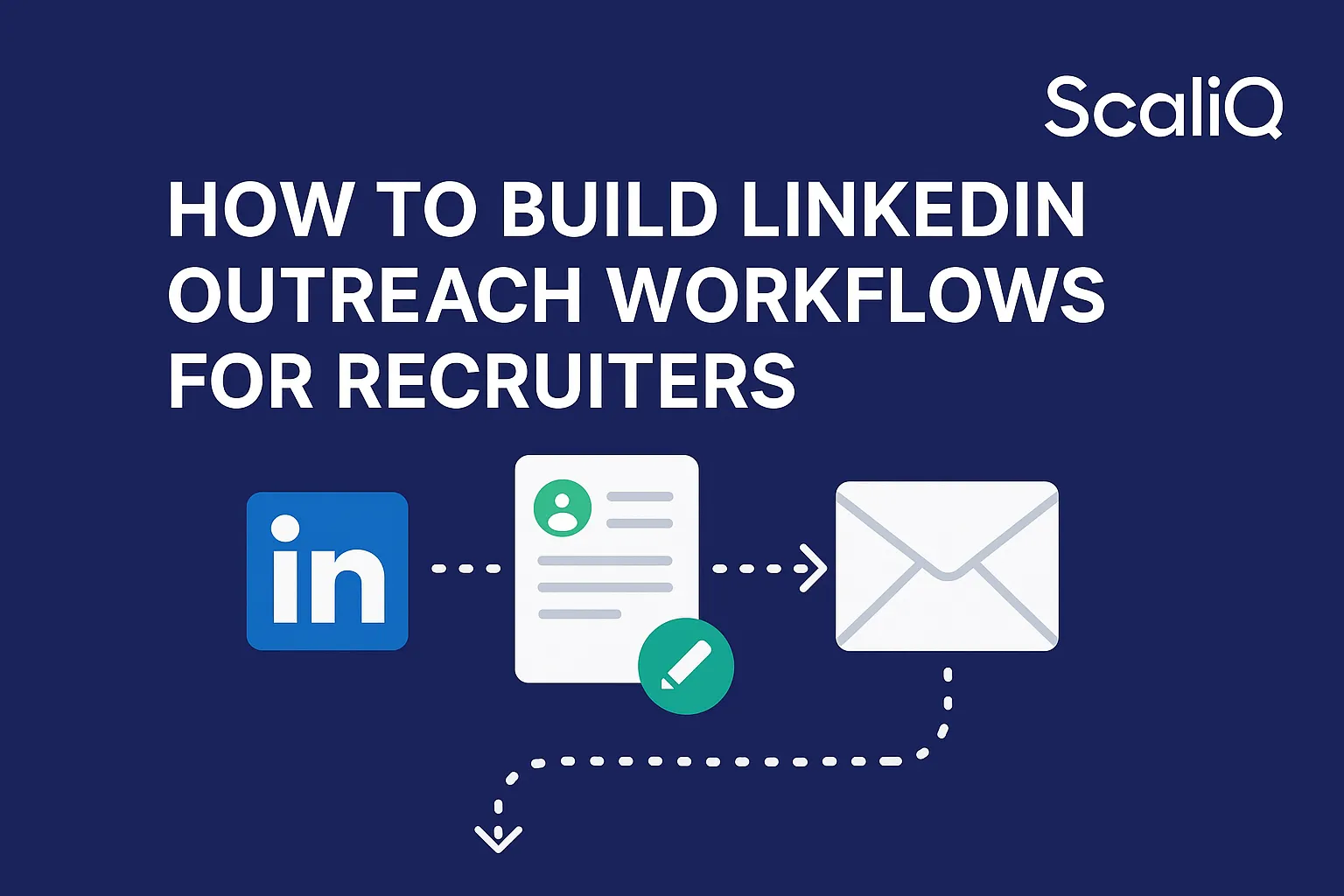
To fix broken messaging, you need a structured framework. This step-by-step workflow covers everything from candidate selection to message sequencing and reply handling. Designed to be highly actionable for beginners, each step reduces manual effort while preserving an authentic tone. This simple sequence can be adapted based on the role, urgency, and candidate type, forming the foundation of effective LinkedIn outreach workflows for recruiters.
Step 1: Segment Candidates Before Writing Anything
Before drafting a single word, recruiters must group candidates by role, seniority, hiring urgency, and outreach context. Beginners often skip this step, blast a single message to 500 people, and then wonder why their templates underperform.
Useful segments include: passive senior candidates, recently active job seekers, warm re-engagement targets (past applicants), and high-volume outreach pools. Segmentation drastically improves both personalization and follow-up logic, elevating overall candidate engagement and streamlining your talent acquisition outreach and candidate outreach sequence.
Step 2: Define the Goal of the First Message
The first message should aim for a low-friction response, not a full commitment to a job change. Define a clear goal: are you trying to start a casual conversation, validate their interest in a specific technology, or simply earn permission to share a job description?
Message goals must vary by use case. A message to a passive candidate should focus on networking and curiosity, while outreach to an active applicant can be more direct. Aligning the goal with the audience is a cornerstone of effective linkedin recruiter outreach, resulting in better candidate outreach messages and adherence to LinkedIn InMail best practices.
Step 3: Choose the Right Channel for First Contact
While this guide focuses on LinkedIn, it is important to choose the right channel based on visibility and candidate activity. LinkedIn is often the best first touch for passive talent, as it provides immediate professional context and mutual connections. However, email might be better for candidates who explicitly list their contact information or rarely log into social platforms. Following LinkedIn InMail best practices ensures your talent acquisition outreach lands effectively when utilizing linkedin recruiter outreach.
Step 4: Build a Simple Message Sequence
A basic, effective recruitment messaging workflow consists of a connection request (or InMail), a first follow-up, a second follow-up, and a reply-handling process. Each step must accomplish something new, rather than just repeating the initial pitch.
For timing, wait 3 to 4 days after the first message before sending follow-up one, and another 5 to 7 days before follow-up two. This simple candidate outreach sequence prevents you from overwhelming the candidate while maximizing the utility of your recruiter outreach templates.
Step 5: Create a Reply-Handling Path
Workflow quality is not just about outbound messaging; it is about how you manage the conversation once a candidate replies. Beginners need a clear path for handling responses:
• Interested: Immediately offer a few low-friction times for a brief introductory call.
• Unsure: Provide additional context, a company video, or answer their specific questions without pressure.
• Unavailable / Not Now: Ask to stay in touch and tag them in your system for future talent sourcing outreach workflow efforts.
• No Reply: Move them to a long-term nurture sequence or close the loop gracefully.
For more insights on optimizing these systems, explore Blog to learn about advanced candidate engagement, linkedin recruiter outreach, and AI-supported execution.
How to Personalize Messages at Scale
Personalizing messages at scale bridges the gap between static templates and true relevance. The secret is "modular personalization"—a practical middle ground between writing every message from scratch and relying on robotic automation. By using beginner-friendly heuristics, recruiters can make their outreach feel human while maintaining high efficiency.
The Best Personalization Signals to Use
The most effective personalization signals are those that tie directly to why you are reaching out right now. Useful signals include the candidate's current role, years of experience, a recent career move or promotion, highly relevant niche skills, location, recent LinkedIn activity (like a post they commented on), and mutual connections.
Referencing a shared connection or a specific project mentioned on their profile feels authentic. Conversely, generic compliments about their "impressive background" feel forced. Using strong signals elevates candidate outreach messages into highly personalized LinkedIn messages that drive talent acquisition outreach success.
A Simple Personalization Framework for Beginners
To implement modular personalization, use this simple framework: Relevance + Role Context + Why Them + Low-Friction CTA.
Keep the core structure of your recruiter outreach templates stable, but swap out the "Why Them" module based on the candidate's specific signals. This allows for scalable linkedin recruiter outreach that still drives high candidate engagement without requiring you to rewrite the entire message every time.
What to Personalize by Role, Seniority, and Hiring Context
Personalization must match candidate expectations. Outreach to a senior executive should focus on strategic impact and company vision, whereas outreach for early-career or high-volume hiring pools might focus on growth opportunities, culture, and immediate perks.
Urgency and role complexity also change the wording. A hard-to-fill technical role requires mentioning specific tech stacks to prove you understand their work. Adapting your LinkedIn outreach workflows for recruiters based on these factors ensures your candidate outreach sequence and recruitment messaging workflow always hit the right note.
Side-by-Side Example: Generic Message vs Human-Sounding Message
Small edits drastically improve tone. Notice how removing fluff, adding relevance, shortening the ask, and referencing a real signal changes the dynamic:
• Generic (Automated): "Hi [Name], I came across your impressive profile and we are urgently hiring a Software Engineer. We offer great benefits. Do you have 30 minutes to chat tomorrow?"
• Human-Sounding: "Hi [Name], noticed you've been leading the backend migration at [Current Company] for the last year. We're tackling a similar scaling challenge right now. Open to a quick, low-pressure chat about it later this week?"
While AI can help generate these personalized LinkedIn messages, human review remains mandatory to ensure ai recruiting messages sound natural and accurate within your recruiter LinkedIn message examples.
Follow-Up Sequences That Add Value Instead of Noise
Following up consistently is vital, but doing it without sounding repetitive, desperate, or spammy requires strategy. Follow-ups work best when each message has a distinct purpose and adds new value. Because passive candidates are not actively looking, timing and value-addition are the two primary factors that improve response likelihood in any candidate outreach sequence.
How Many Follow-Ups Recruiters Should Send
There is no rigid magic number, but a practical recommendation is to send 2 to 3 follow-ups after the initial message. The exact number depends on role urgency, candidate seniority, and the strength of the relevance signal. Endless nudges that add no new information will quickly get you blocked. When wondering how many follow-ups should recruiters send on LinkedIn, prioritize quality over quantity to maintain LinkedIn InMail best practices and a healthy candidate outreach sequence.
What Each Follow-Up Should Do
Break your follow-up sequence into clear, evolving goals:
• Follow-up 1: A light reminder combined with a new piece of relevance (e.g., linking to a recent positive news article about your company).
• Follow-up 2: Add new value, such as specific role context, a quote from the hiring manager, or insight into the team structure.
• Follow-up 3: A respectful "close-the-loop" message that leaves the door open for future contact.
Follow-ups must evolve, not repeat. For "not now" scenarios, pivot immediately to long-term networking rather than pushing the current role. This elevates candidate engagement and improves the overall recruitment messaging workflow.
Timing and Cadence for Passive Candidates
Passive candidates require more breathing room than active applicants. A cadence of Day 1, Day 4, Day 10, and Day 18 provides enough space to avoid annoyance. Tie your timing to the candidate experience rather than pure recruiter efficiency. A respectful, context-aware cadence is the hallmark of effective passive candidate outreach and professional linkedin recruiter outreach.
Follow-Up Mistakes That Make Recruiters Look Automated
The fastest way to look automated is to send repeated message bodies, say you are "just circling back" without offering new value, use fake familiarity ("Hope you had a great weekend!"), or create artificial urgency without context. Value-led sequences differentiate thoughtful personalized recruiter outreach from the spammy candidate outreach messages generated by poorly managed automated recruiting outreach tools.
AI-Assisted Templates and Message Examples
AI is a powerful drafting and workflow support layer, accelerating recruiter outreach without replacing human judgment. When used correctly, AI improves speed and consistency. The key is to use AI to generate a strong baseline, which the recruiter then refines.
Where AI Helps Most in Recruiter Outreach
AI excels at drafting first versions of messages, adapting tone by segment (e.g., changing a message from "casual" to "executive"), summarizing dense profile signals into a single sentence, and generating follow-up variants.
However, AI tends to fail when asked to write the final product entirely on its own. It often relies on generic compliments, writes overlong messages, invents details (hallucinations), and uses forced enthusiasm. AI is a tool for ai recruiting messages and recruitment messaging workflow efficiency, not a substitute for the authenticity required in automated recruiting outreach.
A Human Review Checklist for AI-Generated Recruiter Messages
Always pass AI drafts through a human review process to ensure trustworthy use. Use this checklist:
1. Is the message actually relevant to this specific candidate?
2. Does it mention a real, verifiable profile signal?
3. Is the ask small, clear, and low-friction?
4. Does it sound like something a recruiter would naturally say in a real conversation?
5. Is there any exaggerated claim or assumed detail that should be removed?
Human oversight is critical. The NIST AI risk management playbook and NIST guidance on trustworthy and transparent AI emphasize the need for transparency, accountability, and meaningful review when utilizing AI for candidate outreach messages and personalized LinkedIn messages.
Recruiter Message Templates by Use Case
Here are practical recruiter outreach templates. Note what stays fixed and what must be personalized:
Passive Candidate First-Touch: "Hi [Name], I noticed your recent work on [Specific Project/Skill] at [Current Company]. We are currently building a team to tackle [Similar Challenge] and your background stood out. Would you be open to a brief, exploratory chat this week?"
(Personalize: Project/Skill, Current Company, Similar Challenge)
Re-Engagement Message: "Hi [Name], we spoke back in [Month/Year] regarding a [Previous Role] position. I saw you recently moved to [New Company]—congratulations! We just opened a [New Role] that aligns perfectly with your new experience in [Specific Skill]. Open to reconnecting?"
(Personalize: Month/Year, Previous Role, New Company, New Role, Specific Skill)
Follow-Up After No Response (Value Add): "Hi [Name], knowing how busy things get, I wanted to share a quick look at what our [Team Name] team is working on: [Link to Engineering Blog / Company Video]. If the timing isn't right to chat about the [Role] position, no worries at all. Let's stay connected."
(Personalize: Team Name, Link, Role)
These recruiter LinkedIn message examples ensure your candidate outreach messages remain concise and effective.
Example AI Prompt for Drafting Better Recruiter Outreach
To generate better first drafts, use a structured prompt that prevents the AI from inventing details:
"Act as a professional technical recruiter. Write a 50-word LinkedIn outreach message to a passive candidate. The candidate currently works as a [Job Title] at [Company]. The role I am hiring for is [Open Role] which requires [Specific Skill]. The tone should be confident, concise, and respectful. Do not use generic compliments like 'impressive profile'. Do not invent any profile details. End with a low-friction question asking if they are open to a brief chat."
This structure ensures your ai recruiting messages and LinkedIn outreach workflows for recruiters maintain high candidate engagement.
Compliance and Fairness Guardrails for AI in Recruiting Outreach
AI-assisted recruiting workflows require strict adherence to fairness, judgment, and compliance. AI should never be used to make autonomous decisions about candidate suitability or to automate sensitive hiring judgments. Its role is strictly to assist with communication drafting.
Maintaining trustworthiness and responsible use is vital in employment-related communications. For more information on maintaining compliance, refer to the EEOC guidance on AI and algorithmic fairness in hiring. When designing AI-assisted process workflows with human-in-the-loop review, orchestration platforms like Www.Notiq.Io can help maintain these essential talent acquisition outreach guardrails.
Tools, Workflow Tips, and What to Measure
To operationalize your outreach workflow and improve it over time, you must focus on process rather than just accumulating software tools. A strong linkedin recruiter outreach strategy is measured by the quality of conversations it generates, not just the sheer volume of messages sent.
The Minimum Outreach System a Beginner Recruiter Needs
Beginners do not need a complicated tech stack to start. You need four things: a repeatable process, organized candidate notes, modular templates, and a daily review habit. Document your candidate segments, save your successful message variants, map out your follow-up timing, and use outcome tags (e.g., "Interested," "Not Now") in your ATS or spreadsheet. This keeps the recruitment messaging workflow simple, implementable, and scalable within your LinkedIn outreach workflows for recruiters.
Metrics Beyond Reply Rate
Relying solely on reply rates is misleading; a 50% reply rate means nothing if every response is a rejection or from an unqualified candidate. Track metrics that indicate quality:
• Positive reply rate
• Conversation-to-screen rate
• Follow-up response rate
• Quality-of-fit signals from hiring managers
Authenticity and relevance improve downstream outcomes. By focusing on candidate engagement and talent acquisition outreach quality, your linkedin recruiter outreach will yield better actual hires, not just vanity metrics.
How to Improve Your Workflow Over Time
Continuous improvement requires periodic review. Every month, review your outcomes by segment, message type, and role category. Test one variable at a time—change your opening line, adjust the CTA, or alter your follow-up timing. Recruiters should learn from data patterns without reducing every candidate interaction to a rigid script, ensuring the recruitment messaging workflow and personalized recruiter outreach evolve naturally alongside the candidate outreach sequence.
Future Trends in Recruiter Outreach
Recruiter messaging is evolving rapidly. Understanding where the industry is heading reinforces the long-term value of building human-sounding, structured workflows today.
Personalization at Scale Will Keep Replacing Pure Automation
The market is aggressively moving away from mass automation toward signal-based outreach and human-reviewed AI drafting. As candidates become increasingly blind to generic spam, authenticity concerns are increasing, not decreasing. The workflows detailed in this guide—blending modular templates with ai recruiting messages—represent the future of personalized LinkedIn messages and automated recruiting outreach done correctly.
Recruiters Will Need Better Cross-Channel Workflow Thinking
While this guide focuses on LinkedIn, future talent sourcing outreach workflow strategies will increasingly blend LinkedIn, email, and ATS touchpoints. Message consistency across all these channels will matter more over time. Recruiters who master LinkedIn outreach workflows for recruiters now will be perfectly positioned to integrate cross-channel candidate engagement seamlessly.
Conclusion
Recruiter outreach does not need to be fully manual to feel personal, but it absolutely requires structure, relevance, and human review. By implementing a systematic approach, you can scale your efforts without sacrificing the authenticity that candidates demand.
To recap the workflow: segment your candidates before writing, define a clear goal for each message, personalize using real profile signals, follow up with added value rather than just noise, and use AI strictly as a drafting aid rather than a replacement for your own professional judgment. This is a recruiter-specific LinkedIn workflow designed to generate real conversations, not just a bundle of generic scripts.
Build a simple, repeatable system first, and then optimize it with AI support. To explore how to build adaptable outreach structures tailored specifically for recruiter and talent acquisition workflows, visit ScaliQ.