

How to Use AI to Segment LinkedIn Prospects by Communication Style
For advanced outbound teams, the core problem is no longer finding the right accounts—it is figuring out how to speak to the people inside them. Generic LinkedIn outreach fails because prospects differ wildly in their tone preferences, trust thresholds, message length tolerance, and decision-making styles. Sending the same value proposition to a data-driven CFO and a vision-oriented CMO using identical framing is a recipe for low conversion.
Most revenue teams already have enough firmographic and technographic data, yet they still struggle to convert it into relevant messaging because behavioral nuance is missing from their workflow. They know who they are targeting, but not how those targets prefer to process information.
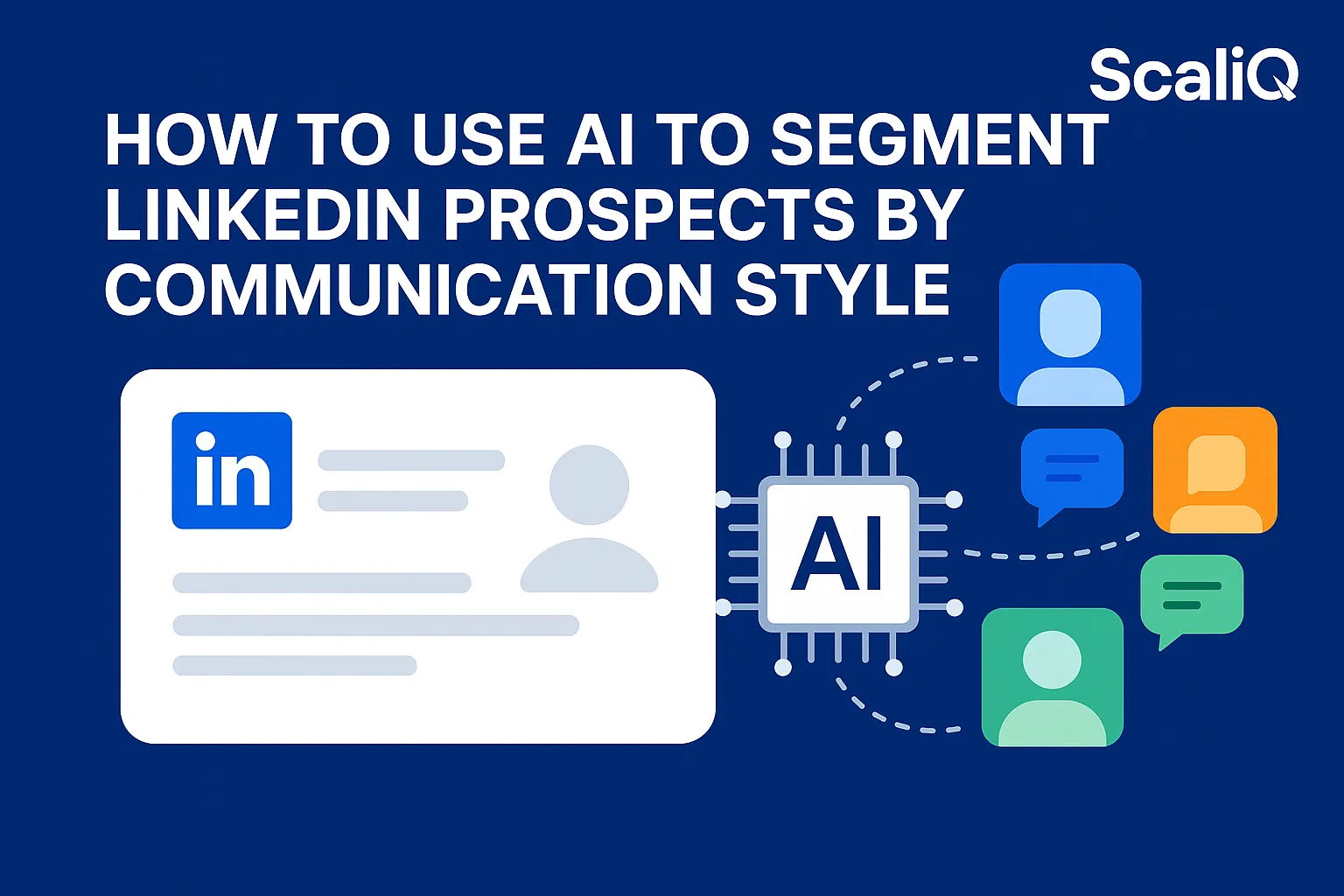
This guide provides a practical, explainable framework detailing how to use AI to segment LinkedIn prospects by communication style. We will show you how to classify buyers into actionable segments and turn those insights into better outreach. Designed for SDR leaders, outbound teams, and revenue operators, this approach delivers scalable personalization without resulting in robotic, inauthentic messaging.
Unlike generic "personalize better" advice, this methodology focuses entirely on observable LinkedIn signals, explainable AI logic, and measurable workflow impact. For instance, ScaliQ, a behavioral segmentation platform, is built specifically around this concept—focusing on AI-driven prospect segmentation driven by tone and communication patterns, rather than generic automation.
Why Generic LinkedIn Outreach Underperforms
Firmographic segmentation alone is too shallow for advanced outreach. Knowing a prospect is a "VP of Sales at a mid-market SaaS company" dictates the business problem you solve, but it does not tell you whether that VP wants a three-bullet ROI summary or a nuanced story about team culture.
Generic personalization often fails because it merely references surface-level details—such as a recent funding round or a shared university—while completely ignoring how the prospect prefers to process information. For example, a generic message might read: "Saw your company just raised a Series B, congrats! We help companies like yours scale..." This approach causes low reply rates from generic outreach because it lacks behavioral resonance.
The operational bottleneck here is time. Manual behavioral research is simply too slow for SDR teams to execute consistently. A rep cannot spend 15 minutes analyzing a prospect's past ten comments to deduce their communication style before sending a connection request. Conversely, the risk of over-automation is equally dangerous. When AI is used to write messages without an underlying behavioral segmentation framework, outreach sounds unnatural, leading to reputational damage.
This is why behavioral segmentation sales prospecting is critical. Aligning your messaging style with the buyer's natural communication preferences significantly improves rapport. This is supported by language style matching research, which demonstrates that matching linguistic patterns fosters trust. Furthermore, a linguistic style accommodation study highlights that adapting to a counterpart's communication style increases persuasive impact.
By upgrading your linkedin prospect segmentation, you move beyond tools that merely check grammar or rewrite copy, and instead build a system that systematizes style detection. To understand why traditional segmentation misses this behavioral nuance, explore ScaliQ's insights on the topic.
What AI Can Actually Detect From LinkedIn Signals
To successfully implement this strategy, you must understand which signals on linkedin help classify a prospect's communication preferences. AI should focus strictly on observable communication cues—how a person writes and interacts publicly—rather than making broad, unverifiable personality claims.
The primary signal categories include profile wording, posting tone, comment behavior, engagement patterns, job history context, and, when available, first-party message-response signals. By combining these communication cues with standard role, industry, and intent data, signal quality drastically improves.
It is vital to recognize that one signal alone is weak; multiple signals create stronger, more reliable inferences. Furthermore, any prospect tone analysis must adhere to ethical standards. Segmentation should be based on documented cues and transparent reasoning, rather than opaque personality scoring. As outlined by the OECD AI transparency and explainability principles, AI workflows must be understandable and accountable.
Profile Wording Signals
The language prospects use in their headline, "About" section, and experience descriptions is a goldmine for prospect tone analysis. An AI classifier can extract patterns related to brevity, specificity, abstraction level, and proof orientation.
For example, a profile heavily utilizing concise, results-oriented language ("Scaled ARR from $5M to $20M in 18 months") indicates a different messaging preference than one using detailed, process-oriented language ("Passionate about fostering collaborative environments that empower cross-functional teams").
By mapping these linkedin communication styles, AI can suggest whether a buyer communication preferences lean toward hard metrics or relationship-building narratives. Teams must remember to use these insights strictly for outreach relevance, not to infer deeper personal identity traits.
Activity and Engagement Signals
Posts, comments, and visible engagement behaviors provide richer context than static profile text. A prospect's posting style often reveals whether they prefer big-picture ideas, direct and contrarian opinions, social proof, or analytical depth.
Communication pattern analysis can evaluate comment length, argument style, and how the prospect reacts to industry content. For instance, a prospect who frequently leaves long, nuanced comments exploring the "why" behind an industry trend requires a different outreach approach than someone who simply comments "Great framework" on tactical posts. When optimizing linkedin outreach personalization, understanding these behaviors directly informs how to design your hooks and calls-to-action (CTAs).
Message History and Response Signals
For teams with existing outreach data, first-party message history provides the highest-value signal set. Analyzing response length, speed, objection framing, and question style creates a powerful feedback loop.
When considering what data sources are best for ai-based prospect segmentation, historical CRM and inbox data are paramount. If a prospect consistently replies with one-sentence answers, the AI sales outreach personalization engine can update its segment confidence, ensuring future touchpoints remain brief and direct. Sales segmentation ai thrives on this iterative feedback, though teams must ensure message-history data is used responsibly and in compliance with privacy regulations.
How to Build Explainable Communication-Style Segments
Turning noisy LinkedIn signals into repeatable, operational segments is the core of behavioral segmentation for outreach. The goal is to create categories that reps can trust and use effortlessly. Based on observable evidence patterns, we can define four practical segments: analytical, direct, relational, and visionary.
Unlike black-box personality models, communication-style segmentation focuses on actionability. Every classification must be explainable. If a rep asks, "Why was this prospect tagged as Analytical?", the system should point directly to metric-heavy profile wording and structured comment history. This explainability is a massive competitive advantage and aligns with the NIST AI Risk Management Framework, which champions accountable, well-documented AI workflows.
Here is how do you segment prospects by tone and messaging behavior across the four primary styles.
Segment 1 — Analytical
Analytical prospects prefer logic, structure, precision, and evidence. Indicators of this style include metric-heavy language, detailed posts, a strong process orientation, and a tendency to ask for specifics in comments.
When structuring buyer personas by communication style, outreach to analytical prospects must be concise but substantive.
• What to emphasize: Industry benchmarks, clear methodologies, definitive proof, and risk-reduction strategies.
• What to avoid: Vague claims, overfriendly fluff, and exaggerated urgency.
Segment 2 — Direct
Direct prospects value speed, clarity, efficiency, and action. Observable indicators include short-form communication, outcome-first wording, and clear, unfiltered opinions.
When executing personalized linkedin outreach for this segment, the prospect tone analysis dictates a low-friction reading experience.
• What to emphasize: Extreme brevity, direct CTAs, and fast value articulation.
• What to avoid: Long context-setting paragraphs, excessive qualifiers, and meandering introductions.
Segment 3 — Relational
Relational prospects respond best to trust, context, credibility, and human connection. Indicators include collaborative language, community-oriented posts, frequent team mentions, and relationship-centric framing.
Behavioral segmentation sales prospecting for this group requires a softer touch.
• What to emphasize: Contextual personalization, empathy, relevance, and social proof.
• What to avoid: Hard-driving urgency and transactional, immediate conversion asks before trust is established.
Segment 4 — Visionary
Visionary prospects engage with innovation, growth, strategic framing, and future-oriented ideas. Indicators include transformational language, broad market commentary, bold viewpoints, and a focus on overarching strategic themes.
To succeed with ai segmentation outreach for visionary buyer communication preferences, you must anchor your message in upside.
• What to emphasize: Big-picture framing, strategic relevance, differentiated thinking, and compelling possibilities.
• What to avoid: Tactical overload too early in the sequence, or overly granular framing lacking broader context.
How to Score Confidence and Handle Hybrid Profiles
Not every prospect fits perfectly into one box. To prevent overconfidence, sales segmentation ai must use confidence scoring based on the number, consistency, and recency of signals.
If a prospect exhibits both direct and visionary traits, the system can tag a primary and secondary style. Reps should rely on practical thresholds rather than demanding perfect certainty. If AI confidence is low, or if fresh conversation signals contradict the AI's initial communication pattern analysis, reps should be empowered to override the system. Regular QA reviews for edge cases ensure the prospect tone analysis remains accurate over time.
How to Tailor Outreach for Each Communication Style
Understanding a prospect's style is only half the battle; translating that segmentation into actual messaging changes is where revenue is generated. Personalization must combine communication style with role, industry, and intent signals to improve relevance and reply quality.
Here is exactly how do you personalize outreach for analytical vs direct prospects, and how to adapt your hooks, proof points, and CTAs across all segments.
How to Adapt the Hook
The opening line of your personalized linkedin outreach dictates whether the prospect keeps reading.
• Analytical: Lead with a specific data point or benchmark. (e.g., "Noticed your team is scaling operations; most SaaS leaders at this stage see a 15% drop in efficiency.")
• Direct: Lead straight to the relevance or outcome. (e.g., "Reaching out because we help outbound teams double their meeting rate.")
• Relational: Lead with relationship context or shared community. (e.g., "Loved your recent post on team culture—it aligns perfectly with what we're seeing in the market.")
• Visionary: Lead with a strategic angle or market shift. (e.g., "Outbound is shifting from volume to behavioral relevance; curious how you're adapting your Q3 strategy.")
Applying prospect tone analysis to the first sentence creates an immediate tone match.
How to Adapt Proof Points
Evidence must be selected differently based on buyer communication preferences. The same value proposition should be framed four different ways:
• Analytical: Use hard data, process details, and ROI metrics.
• Direct: Use rapid customer examples and clear outcomes.
• Relational: Use peer validation, testimonials, and recognizable logos.
• Visionary: Use strategic upside and case studies highlighting market transformation.
By matching the proof style to the buyer's trust threshold, ai sales outreach personalization becomes highly persuasive. Sales messaging frameworks by persona ensure your evidence actually resonates.
How to Adapt Tone and Structure
Sentence length, formality, pacing, and CTA style must align with linkedin communication styles.
• Analytical: Use bullet-friendly messages, logical flow, and a soft CTA asking to share a resource or methodology.
• Direct: Use short paragraphs, decisive language, and a crisp, low-friction CTA.
• Relational: Use a warmer, more conversational tone, standard paragraph structures, and an exploratory CTA.
• Visionary: Use dynamic pacing, confident language, and a CTA focused on discussing high-level strategy.
Communication pattern analysis ensures that style matching remains natural and brand-consistent, preventing the linkedin messaging personalization from feeling forced.
Sample Message Variants by Segment
To make this framework concrete, let's look at one scenario—selling a sales intelligence tool—rewritten for the four segments.
• Analytical Variant: "Hi [Name], our data shows outbound teams lose 20% of their pipeline to poor targeting. We built a platform that cross-references intent data with behavioral signals, increasing meeting booked rates by 1.5x. Open to reviewing our methodology brief?" (Focus: Metrics, logic, low-pressure resource CTA).
• Direct Variant: "Hi [Name], generic outreach is killing your SDRs' conversion rates. We automate behavioral segmentation so your team books more meetings in less time. Worth a quick chat?" (Focus: Speed, outcome, direct CTA).
• Relational Variant: "Hi [Name], saw your comment on building trust in outbound sales. I couldn't agree more. We're helping teams like [Peer Company] bring a more human, tailored approach to their prospecting. Would love to connect and share how they're doing it." (Focus: Empathy, peer proof, conversational CTA).
• Visionary Variant: "Hi [Name], the era of spray-and-pray outbound is over. The next wave of revenue growth belongs to teams leveraging behavioral AI to anticipate buyer needs. We're helping forward-thinking revenue leaders lead this shift. Open to exploring the strategy?" (Focus: Future state, transformation, strategic CTA).
For more examples on optimizing outreach copy and workflows, check out Repliq's blog.
How to Operationalize Segmentation in a Real Sales Workflow
Moving from concept to repeatable execution requires an operating model, not just a fragmented tool stack. A successful system combines lead discovery, behavioral classification, and message generation into one fluid motion.
This is where ScaliQ excels, providing a streamlined workflow that operationalizes tone and communication-pattern segmentation, ensuring AI recommendations support reps rather than replacing their judgment.
Step 1 — Collect and Normalize Prospect Signals
The first step is gathering the right inputs. When determining what data sources are best for ai-based prospect segmentation, teams must collect profile text, post content, comments, engagement behavior, and historical response data. Standardizing these signal categories ensures the communication pattern analysis is reliable before classification begins.
Step 2 — Classify Style With Explainable AI Logic
Next, the AI must process the normalized data to generate both a segment label and a reason summary. Sales segmentation ai is only adopted by reps if they understand it. The output should include a confidence score and a supporting evidence field (e.g., "Classified as Direct: 85% confidence based on short profile wording and brief comment history"). This prospect tone analysis builds rep trust.
Step 3 — Activate Segments Inside Outreach
Segment data should automatically shape templates, AI prompts, and rep guidance within the CRM or sales engagement platform. Templates must dynamically shift based on the style tag. Crucially, linkedin messaging personalization should always include a rep review stage to prevent robotic outputs and ensure the personalized linkedin outreach feels authentic.
Step 4 — Feed Results Back Into the Model
To improve accuracy over time, teams must track what metrics show whether communication-style segmentation is working. Positive replies, meeting conversions, and rep feedback serve as learning signals. If behavioral segmentation sales prospecting yields recurring objections from a specific segment, the sales segmentation ai model can be refined to adjust its logic and messaging prompts.
How to Measure, Validate, and Improve Performance
Without validation, segmentation is just a theory. Revenue operations teams must prove that communication-style segmentation outperforms generic baselines. This requires rigorous measurement of both effectiveness and operational efficiency.
Following the NIST guidance on measuring AI systems, teams should document learnings for ongoing model improvement. Accountability and benchmarking are further supported by the NIST AI Risk Management Framework, ensuring your AI sales outreach personalization drives actual ROI.
Core Metrics to Track
Do not rely on vanity engagement metrics. The KPIs that matter are:
• Positive Response Rate: Quality matters more than sheer reply rates.
• Meeting Booked Rate: The ultimate indicator of meeting conversion.
• Message-to-Reply Time: Direct and Analytical prospects often reply faster to well-tailored messages.
• Rep Research Time Saved: Operational efficiency gained by automating style detection.
How to Design a Useful Test
To prove the value of linkedin messaging personalization, design a simple holdout test. Compare your communication-style segmentation against a firmographic-only baseline.
• Group A (Control): Standard role/industry personalization.
• Group B (Test): Role/industry + communication style adaptation.
Run A/B variants within specific segments to isolate variables. Be careful not to change your core offer and your behavioral segmentation sales prospecting approach simultaneously, as this obscures what caused the lift.
What to Do When the Model Is Wrong
Misclassification will happen. Building trust requires addressing these failures openly. Implement rep override workflows, log exception cases, and use iterative retraining to improve the explainable ai. When a rep corrects a prospect tone analysis from "Visionary" to "Analytical" based on a live conversation, that data must feed back into the sales segmentation ai. Human review improves both trust and long-term model quality.
Responsible AI, Transparency, and Trust in Prospect Segmentation
Responsible segmentation requires clear boundaries on what the system should infer. AI should only analyze observable communication cues for the explicit purpose of outreach relevance. It should never be used to make sensitive, intrusive, or legally protected claims about a prospect's personal identity.
Governance is not just a compliance burden; it is a business advantage. Adhering to the OECD AI transparency and explainability principles ensures your communication pattern analysis is fair, transparent, and respectful of privacy. Furthermore, leveraging the NIST AI Risk Management Framework guarantees explainability for rep trust, manager QA, and long-term model governance.
Many adjacent tools offer recommendations without enough transparency into their signal logic or measurement. By prioritizing ethical constraints and observable public data, you build stronger adoption internally and better trust with your future customers.
Conclusion
AI-based LinkedIn prospect segmentation works best when it classifies observable communication patterns into explainable, testable segments. The days of treating every VP of Marketing identically are over.
To recap the core takeaways:
1. Generic outreach underperforms because it ignores behavioral processing preferences.
2. LinkedIn signals are highly usable if you focus on public communication cues.
3. Segments must be explainable and transparent to gain rep trust.
4. Messaging—hooks, proof points, and CTAs—must adapt dynamically by style.
5. Performance must be rigorously measured against generic baselines.
Communication-style segmentation helps teams scale relevance without falling into the trap of robotic automation. By aligning your message with your buyer's natural linkedin communication styles, you elevate the quality of every interaction.
If you are ready to move beyond generic ai segmentation outreach and operationalize tone-based behavioral segmentation for your advanced sales team, learn how ScaliQ can transform your linkedin prospect segmentation workflow today.