

Introduction
Sales and marketing teams share a common, growing frustration: they painstakingly personalize names, job titles, and company details in their connection requests, yet still get ignored. In today’s B2B landscape, buyers are overloaded with messages that look customized but feel entirely generic. The reality is that timing and context matter far more than knowing where a prospect went to college or spotting that their company recently hired three people.
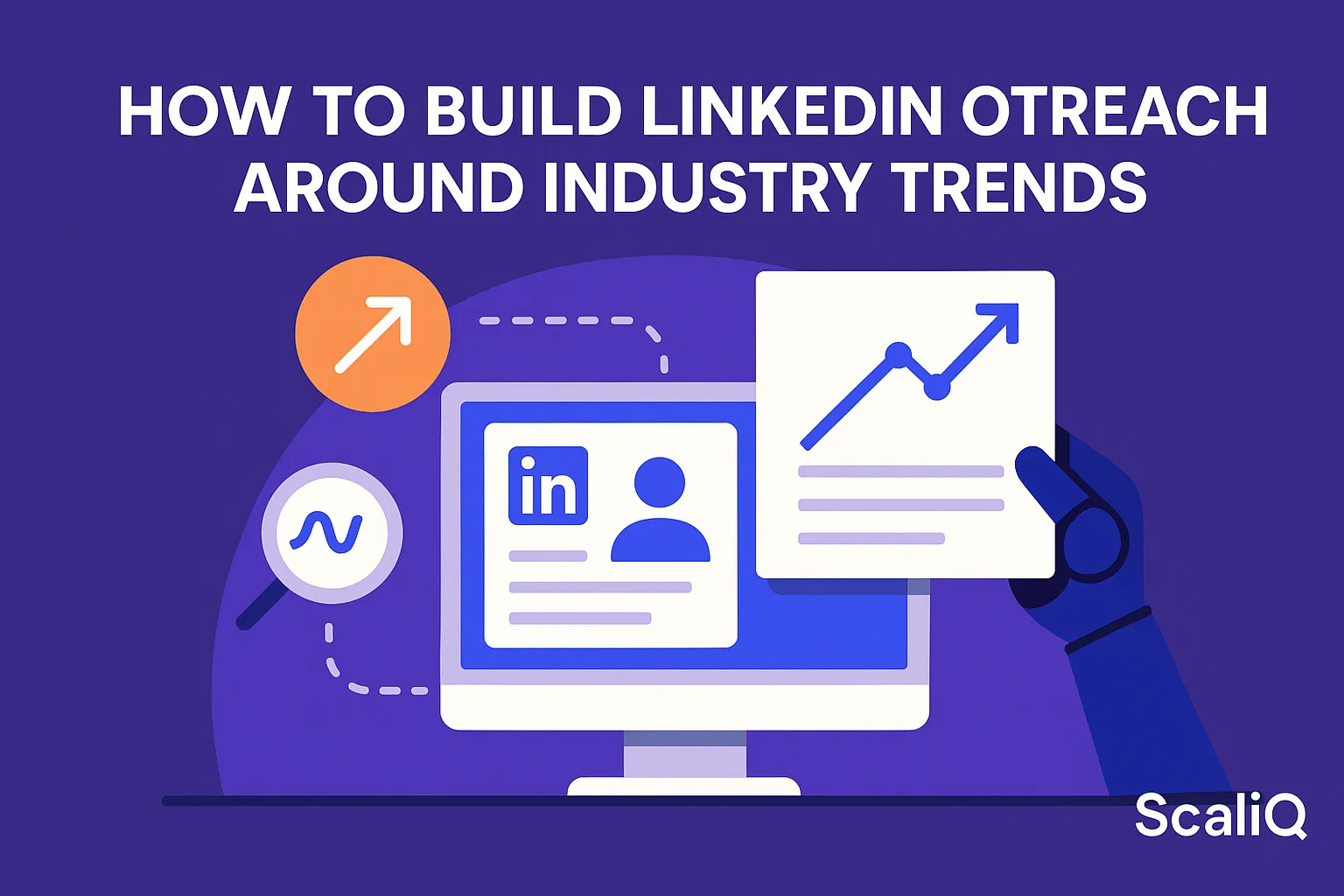
This article provides a practical blueprint for an AI-assisted LinkedIn outreach strategy that relies on trend relevance instead of shallow personalization. By the end of this guide, SDRs, founders, marketers, and sales leaders will learn how to identify meaningful market signals, connect those trends to role-specific pain points, use AI to accelerate research, and draft messages that feel distinctly human and timely.
The ScaliQ methodology is built on this exact premise: trend-led outreach relevance outperforms generic AI personalization every time. Leading sales education sources universally agree that relevance, timing, and genuine personalization are the pillars of modern prospecting. If you want to explore more about signal-based outreach and prospecting ideas, Blog is an excellent place to start. Embracing a trend-based LinkedIn outreach framework is the key to cutting through the noise and securing high-value conversations.
Why Generic LinkedIn Outreach Fails
Surface-level personalization is not the same as situational context. Inserting first-name tokens, mentioning "I noticed your company is growing," or pasting generic value propositions into a template no longer feels relevant to a modern buyer.
When outreach is not tied to an active business priority, the failure points are obvious:
• Low reply rates from generic LinkedIn outreach: Buyers instantly recognize and delete templated pitches.
• Poor timing: Reaching out without a trigger signal means you are guessing when a buyer might be in-market.
• Empty polish: AI-generated copy that sounds perfectly grammatical but lacks a concrete business hook falls flat.
There is a stark contrast between static personalization based strictly on firmographics (company size, industry, revenue) and timely relevance based on trends, market triggers, and role-specific pain. Better outreach starts with asking, "What changed?" rather than simply asking, "Who fits our ICP?"
According to Gartner research on irrelevant B2B outreach, buyers overwhelmingly prefer rep-free experiences when outreach fails to provide contextual value. Unlike broad AI prospecting advice that prioritizes raw speed and volume over context, the ScaliQ-style workflow emphasizes thoughtful, signal-driven engagement.
Generic Personalization vs. True Relevance
Personalization is adding personal details; relevance is demonstrating situational awareness. Buyer relevance comes from understanding current business conditions, not just scraping profile data.
Consider this before-and-after comparison:
• Weak (Generic): "Hi [Name], I saw you are the VP at [Company] and have a great background. We help companies like yours save 20% on software costs. Want to chat?"
• Better (Relevant): "Hi [Name], noticed the recent shift toward vendor consolidation in the logistics sector. Usually, that puts pressure on VPs to audit legacy tech stacks. Are you currently evaluating your renewal overlaps?"
The second example leverages trend-based outreach on LinkedIn to start a business conversation, rather than delivering a premature pitch.
Why Timing Changes Response Quality
Outreach tied to a fresh event or market shift feels more like a useful intervention and less like an intrusive interruption. Timing dictates response quality.
Poor timing looks like messaging a prospect before a need is visible (wasting effort) or messaging them long after a trend has lost relevance (appearing out of touch). Trigger-based outreach ensures that you are reaching out precisely when intent signals suggest a prospect is most likely to be receptive to your solution.
Which Trend Signals Should Trigger Outreach
Not every trend is actionable. For a signal to be useful, it must be relevant, recent, and directly tied to a likely business impact. Chasing broad macroeconomic news without an account-level connection will not improve your reply rates.
Here are the practical categories of signals that should trigger outreach:
• Hiring and labor trends: Rapid team expansion, leadership turnover, or hiring freezes.
• Funding or budget shifts: Recent Series B/C rounds, acquisitions, or budget cuts.
• Product launches and GTM changes: New market entries, feature rollouts, or rebranding.
• Regulatory or compliance changes: New industry laws, privacy mandates, or reporting standards.
• Tech adoption and AI adoption shifts: Migrations to new platforms or integration of AI tools.
• Market pressure, layoffs, or efficiency moves: Competitor layoffs or public drives for profitability.
• Earnings commentary and strategic priorities: Public statements about quarterly goals or pivot strategies.
Trend-based outreach works best when the signal changes urgency, creates a likely pain point, and allows you to connect that signal directly to the recipient’s daily role. Do not use a trend signal if it is old, unverified, too broad, or completely unrelated to the buyer’s operational priorities.
When discussing workforce shifts, authoritative data is crucial. Tracking BLS job openings and labor turnover data can reveal macro hiring signals, while platform-scale insights like the LinkedIn AI talent trend data help identify tech adoption shifts. Emphasizing signal quality and relevance over sheer data volume is what separates top-tier industry trend monitoring from spam.
High-Value Signal Categories for LinkedIn Outreach
To operationalize intent-based prospecting, sales teams should monitor specific signals before initiating outreach.
How to Validate Whether a Signal Is Outreach-Worthy
Before drafting a message, run the signal through these validation criteria:
1. Is the signal recent? (Ideally within the last 30–60 days).
2. Is it specific? (Does it apply directly to the account, segment, or industry?).
3. Can you connect it to an operational pain point?
4. Can you explain "why now" in one sentence?
If you cannot answer these questions, the signal is too vague. Vague macro trends with no account-level tie-in destroy buyer relevance.
Signal-to-Use Cases by Outreach Situation
Different situations require different signals.
• Market shift affecting a whole segment: Use regulatory changes to message an entire vertical.
• Company event affecting one account: Use an M&A announcement to message specific stakeholders about integration challenges.
• Role change creating urgency: Use a promotion to congratulate a prospect while tying it to the new KPIs they now own.
This is how you master social selling on LinkedIn: by matching the right intent signals to the right outreach situation.
How to Turn Trends Into Persona-Specific Pain Points
One of the biggest hurdles in account-based outreach is connecting a high-level trend signal to an actual reason someone would care. The core rule of buyer relevance is this: the exact same trend means entirely different things to different roles.
To make how to use industry trends in LinkedIn outreach actionable, you must move through a specific progression: Trend → Business Implication → Role-Specific Pain Point → Message Hook.
This role-based interpretation is what makes outreach feel insightful rather than templated. Most generic advice stops at "personalize more," but true relevance requires persona-level interpretation.
A Simple Mapping Framework: Trend → Pain Point → Hook
This repeatable 3-step framework ensures your prospect research automation yields human-sounding results:
1. Identify the signal: (e.g., The industry is facing a widespread hiring freeze).
2. Translate into business pressure: (e.g., Companies must hit the same revenue targets with fewer resources).
3. Tailor to the recipient: (e.g., A VP of Sales needs higher rep productivity; a RevOps leader needs better automation).
Example Persona Mapping: VP Sales
• Signal: Market-wide pipeline pressure and hiring slowdowns.
• Likely Pain: Need for more efficient pipeline creation, pressure to improve existing rep productivity, and a mandate to increase meeting quality over sheer volume.
• Outreach Angle: Focus on strategic outcomes. "Noticed the recent shift toward lean growth in SaaS. Usually, that puts pressure on VPs to increase pipeline without adding headcount. Are you currently looking at ways to improve rep conversion rates?"
Example Persona Mapping: RevOps Leader
• Signal: Rapid adoption of AI workflows and new tech integrations.
• Likely Pain: Tooling sprawl, fragmented workflows, data quality degradation, and inconsistent attribution across the go-to-market team.
• Outreach Angle: Focus on systems and efficiency. "With the recent push toward AI tooling in your sector, many RevOps leaders are dealing with fragmented data across their CRM. How are you maintaining process consistency right now?"
Example Persona Mapping: SDR Leader or Founder-Led Outbound Team
• Signal: Market saturation and dropping cold email deliverability.
• Likely Pain: Team productivity dropping, coaching inconsistency, and struggling to maintain message quality at scale.
• Outreach Angle: Focus on repeatability. "Given the recent drops in outbound connect rates across the industry, many SDR leaders are pivoting to highly personalized cold outreach. Are you currently exploring ways to help your team personalize at scale without losing volume?"
An AI-Assisted Workflow for Research, Prioritization, and Message Drafting
Competitors often leave the operational side of AI prospecting abstract. The ScaliQ-style workflow replaces manual, disjointed processes with a cohesive, compliant, and highly efficient system.
The process follows six steps: Monitor, Identify, Summarize, Prioritize, Draft, and Human-Edit.
In an AI sales workflow, AI excels at summarizing changes quickly, surfacing patterns, generating first-draft hypotheses, and creating variant messaging for different personas. Humans must still own verification, nuance, tone, and the final judgment on relevance.
Following NIST trustworthy AI guidance ensures that your use of AI in prospect research automation remains reliable, transparent, and accountable. AI accelerates the heavy lifting, but human review protects accuracy and brand authenticity. For teams looking to operationalize this repeatable research-to-outreach workflow across departments, Www.Notiq.Io serves as an excellent workflow orchestration layer.
Step 1 — Monitor Relevant Industry and Account Signals
Signal collection relies on compliant, publicly available data sources. Rather than relying on unlawful scraping, teams should monitor:
• Market research and industry reports.
• Labor market data and job board postings.
• LinkedIn-visible company activity (e.g., public posts, hiring updates).
• Public company news, press releases, and earnings calls.
Emphasize selecting only signals that are directly relevant to your target segment to ensure your industry trend monitoring yields high-quality intent signals.
Step 2 — Use AI to Summarize What Changed and Why It Matters
AI can convert raw signal data into a usable outreach brief in seconds. Feed the public data into your AI tool to generate:
• A one-sentence summary of the signal.
• The core business implication.
• The likely impacted teams.
• A suggested urgency level.
Example AI Brief: "Signal: Acme Corp acquired TechCo. Implication: Tech stack consolidation likely. Impacted Teams: IT and RevOps. Urgency: High (90-day window)."
Step 3 — Prioritize Accounts and Contacts Based on Relevance
Not all triggered accounts deserve immediate outreach. Prioritize based on:
• Signal strength and recency.
• ICP (Ideal Customer Profile) fit.
• Role relevance.
• Messaging clarity.
Create a simple scoring criteria that SDRs or founders can use to separate high-priority intent-based prospecting targets from low-priority noise.
Step 4 — Draft LinkedIn Messages With AI, Then Refine
Use AI to generate connection request drafts, first-message variants, and follow-up angles. The AI draft is a starting point, not the final send. Keep messages concise, specific, and role-aware. Use AI to overcome the blank page, but never copy-paste without refinement to avoid the trap of AI-generated outreach sounding robotic.
Step 5 — Add Human Judgment Before Sending
Human review is the ultimate safeguard. Your review checklist should ask:
• Is the trend accurate?
• Is the pain point plausible for this specific role?
• Is the tone natural and conversational?
• Is the message too generic or overly aggressive?
• Is the claim supportable?
Implementing strong governance, oversight, and review aligns with the NIST generative AI risk management profile, ensuring your personalized cold outreach remains trustworthy and brand-safe.
Real Examples, Prompts, and Human Review Best Practices
To make this methodology concrete, you need practical examples. Below are side-by-side comparisons, prompt templates, and best practices that outperform competitor content by being more persona-specific and operational.
Example 1 — Weak Generic Message vs. Trend-Led Message
• Weak Message: "Hi Sarah, I see you are the VP of Marketing at CloudCorp. We help marketing teams increase ROI by 30%. I'd love to show you how. Do you have 15 minutes next week?", Critique: Empty personalization, zero timing, highly assumptive.
• Trend-Led Message: "Hi Sarah, noticed CloudCorp just announced the expansion into the European market. Usually, that puts a strain on marketing teams to localize content at scale. Are you currently evaluating tools to speed up that localization workflow?", Critique: High specificity, perfect timing, relevant to her role, and brief.
Example 2 — One Trend, Three Persona Angles
Trigger Event: A mid-market SaaS company announces a 15% reduction in workforce to focus on profitability.
• VP Sales Version: "Noticed the recent shift toward leaner operations. Often, this means you’re tasked with hitting the same revenue targets with fewer reps. Are you currently focused on increasing individual rep pipeline generation?"
• RevOps Version: "Saw the recent company update regarding operational efficiency. Usually, this forces RevOps to automate manual CRM tasks to save time. How are you handling the tooling consolidation right now?"
• SDR Leader Version: "Noticed the pivot toward leaner growth. With fewer SDRs on the floor, maintaining high connect rates becomes critical. Are you exploring ways to improve message quality at scale?"
Prompt Templates for AI Research and Drafting
To power your AI sales workflow, use these prompts for AI-assisted LinkedIn outreach around industry trends:
• For Research: "Summarize this recent industry trend [Insert Public Data] and outline its likely operational impact on a VP of Sales at a mid-market SaaS company. List three assumptions I should verify."
• For Drafting: "Turn this trigger event [Insert Trigger] into a concise, 50-word LinkedIn connection request aimed at a RevOps leader. Focus on the pain point of data fragmentation."
• For Variants: "Generate three message variants for this trend with different pain-point angles: one focused on cost savings, one on speed, and one on compliance."
Human Review Checklist to Avoid Robotic Outreach
Authenticity comes from editorial judgment, not prompt complexity. Before hitting send, ensure you:
• Remove all jargon and marketing fluff ("synergy," "cutting-edge").
• Verify the signal is factual.
• Cut claims that sound assumptive ("I know you are struggling with...").
• Match the tone to LinkedIn norms (casual, peer-to-peer).
• Make the ask low-friction (ask a relevant question, don't ask for a 30-minute demo).
For further reading on improving message quality and outreach refinement best practices, Blog offers excellent personalization examples.
Tools, Resources, and Workflow Extensions
Building an AI sales workflow requires a few core assets. While tool stacks vary, the underlying resources you build will dictate your success. For additional workflow, prospecting, and trend-signal thought leadership, Blog is a vital resource.
Recommended Internal Assets to Build
To ensure repeatability across SDRs and founder-led motions, teams should build:
• A trend-to-pain-point matrix: A living document mapping common industry signals to your specific buyer personas.
• A message hook library by persona: A repository of tested opening lines based on specific triggers.
• A scoring model for outreach priority: A simple rubric (1-5 scale) to help reps decide which signals warrant immediate outreach.
If you are discussing operationalizing repeatable research-to-outreach workflows across teams, Www.Notiq.Io provides the infrastructure to manage these assets efficiently.
What to Measure Beyond Reply Rate
Basic campaign metrics are no longer enough. To gauge the true success of your intent signals and B2B lead generation, track:
• Response quality: Are prospects engaging in meaningful dialogue, or just saying "no thanks"?
• Positive reply rate: The percentage of replies that lead to next steps.
• Meeting relevance: Are the booked meetings actually tied to an active pain point?
• Speed to first personalized touch: How fast can you responsibly message a prospect after a signal occurs?
• Conversion by signal type: Which trends (e.g., hiring vs. funding) yield the best pipeline?
Future Trends in Signal-Based LinkedIn Prospecting
The landscape of B2B outreach is shifting rapidly. Emerging patterns indicate that AI agents will soon handle the bulk of prospect research and signal summarization autonomously. We will see more signal integration across diverse public sources, bringing together hiring data, earnings calls, and social activity into single dashboards.
However, as AI-assisted LinkedIn outreach becomes more accessible, there will be greater pressure for authenticity. Buyers will apply more scrutiny to AI-generated sales messaging. The competitive advantage will not come from having more automation, but from possessing better interpretation skills.
Why Human-in-the-Loop Will Matter More, Not Less
As more teams adopt AI-generated outreach, generic AI copy will become the new spam—easy to spot and easier to ignore. Signal interpretation, nuanced communication, and strict quality control will become the real differentiators. A human-in-the-loop ensures that your social selling best practices remain empathetic, accurate, and highly relevant to the human reading the message on the other side of the screen.
Conclusion
Generic personalization is no longer enough to win the attention of modern B2B buyers. Better LinkedIn outreach starts with identifying relevant trends and actionable trigger events. While AI is an incredible asset for accelerating research, summarization, prioritization, and drafting, it is the human element that keeps the final message accurate, specific, and trustworthy.
Start today by choosing two or three signal types relevant to your industry. Build a simple trend-to-pain-point matrix, and test your message variations across different personas.
For teams ready to think more systematically about trend-led outreach and signal-based prospecting, ScaliQ provides the methodology and focus required to make every outreach effort more relevant and actionable. Stop guessing, start monitoring, and let market signals drive your pipeline.