

Introduction
There is a glaring mismatch between how revenue teams measure pipeline and how B2B buyers actually make purchasing decisions. If you look at a traditional CRM dashboard, an opportunity seemingly materializes out of thin air the moment a prospect requests a demo or fills out a contact form. In reality, that "sudden" conversion is the culmination of a journey that began weeks or months earlier. Modern opportunities begin with silent post reads, thoughtful comments, profile visits, and private direct messages long before a formal hand-raise ever occurs.
Traditional funnel dashboards overvalue these visible, late-stage conversion points while drastically undervaluing the trust-building micro-interactions happening natively on LinkedIn. When you optimize exclusively for what is easy to track, you miss the vast majority of your addressable market currently educating themselves in the shadows.
This article defines the “LinkedIn invisible funnel.” We will break down exactly how this conversational sales approach works, how to operationalize hidden buying signals, and how to accurately measure conversation-assisted influence. Designed for B2B founders, revenue leaders, marketers, and outbound teams, this framework provides a blueprint for generating high-intent pipeline on LinkedIn without ever sounding like a pushy salesperson relying on cold pitches.
At ScaliQ, our perspective is not simply to "post more on LinkedIn." Drawing on our direct experience building funnel-less conversation systems for outbound teams, we advocate for a holistic, integrated approach that seamlessly connects content, behavioral signals, contextual outreach, and revenue measurement. This is an operational model, not just a theoretical concept.
Readers looking to dive deeper into how to operationalize these strategies can explore ScaliQ’s broader thinking on conversation systems, discover our core platform at ScaliQ, or explore related personalization tooling at RepliQ after the framework is introduced below.
What the LinkedIn Invisible Funnel Really Is
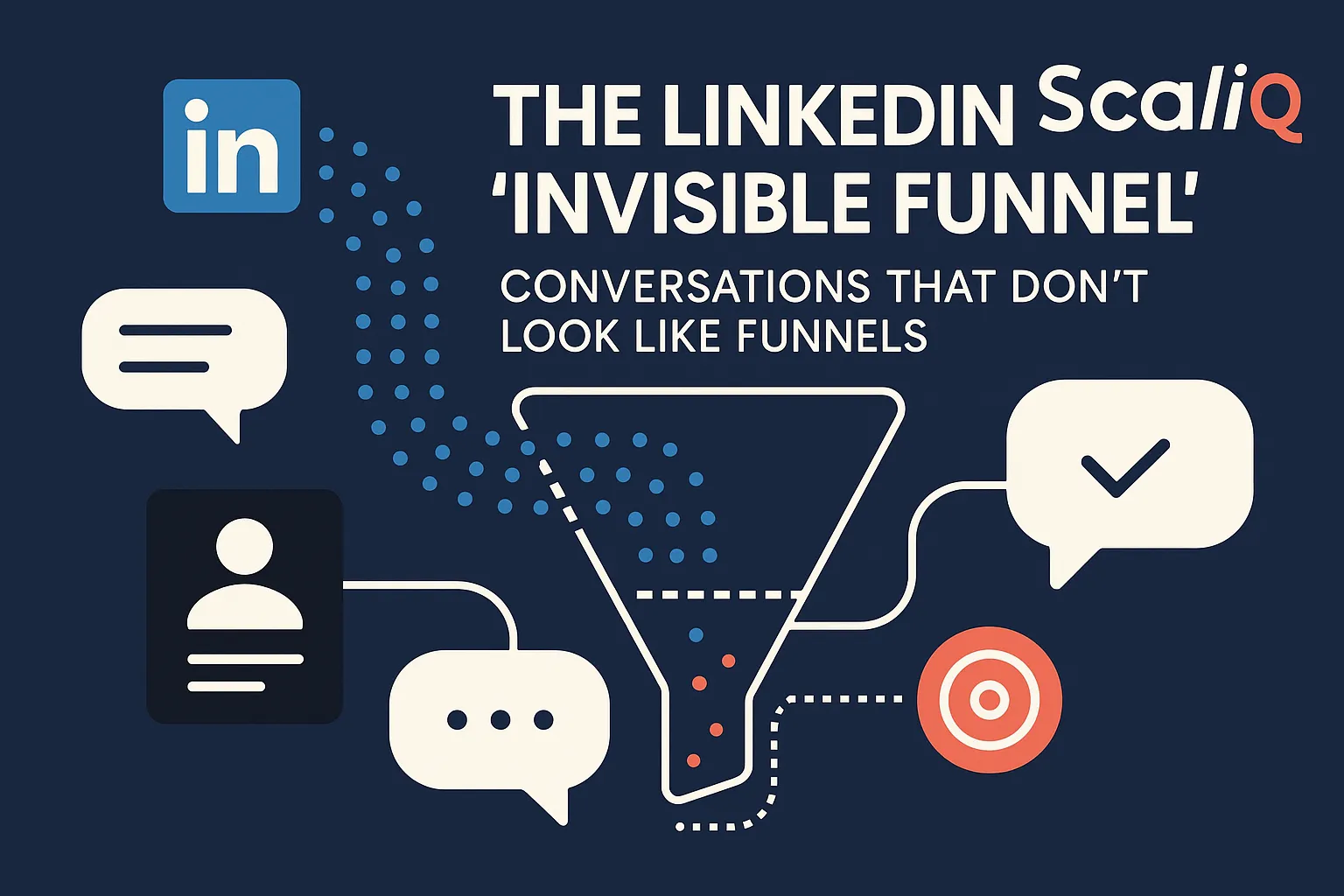
The LinkedIn invisible funnel is a sequence of trust-building micro-interactions that heavily influence pipeline generation before buyers ever enter a visible tracking stage—like a form fill, a booked demo, or an opportunity creation in Salesforce.
Unlike classic lead-generation funnels that force buyers through gated content, or generic social selling that relies on random acts of engagement, the invisible funnel treats LinkedIn as a distributed top-of-funnel ecosystem. Here, content consumption, insightful comments, profile visits, post saves, DMs, and off-platform sharing all actively shape buyer intent.
Calling it "invisible" does not mean it is unmanageable. It simply means the buyer journey is partially hidden from standard, linear marketing dashboards and requires a fundamentally different operating model. Rigid funnel assumptions expect a linear progression: awareness, lead capture, nurture, meeting. The reality is far more complex. This is a conversation-driven pipeline system, not merely a messaging tactic.
According to peer-reviewed research on buyer-led B2B journeys, modern B2B purchasing paths are highly nonlinear, shaped by continuously orchestrated touchpoints rather than forced marketing sequences. Furthermore, Gartner research on the new B2B buying process validates that buyers conduct substantial, self-guided research and consensus-building before they ever directly engage a supplier's sales team.
Why Traditional Funnel Thinking Misses What Actually Happens on LinkedIn
Standard funnel models are entirely dependent on visible hand-raises. They are built to measure clicks, downloads, and form submissions. However, influence on LinkedIn often begins with low-friction interactions that do not look like traditional "leads."
This creates a massive reporting gap. A prospect might read your founder's post, visit their profile to verify credibility, engage privately with a peer in a Slack community about your framework, and then convert three months later through an organic branded search. The CRM credits Google Search, completely missing the dark social B2B demand generation that actually won the deal. This false negative in attribution causes revenue teams to chronically underinvest in relationship-based selling and LinkedIn lead generation.
How the Invisible Funnel Differs From Social Selling and Traditional Outbound
While "social selling" is often treated as a vague mandate for sales reps to build personal brands, the invisible funnel is highly operational, measurable, and directly tied to pipeline movement.
Similarly, it contrasts sharply with classic outbound sequences. Traditional outbound relies on list volume and automated cadences. Funnel-less outbound ensures that outreach is triggered exclusively by relevance, context, and observed behavior. It blends sales execution, marketing narrative, and signal interpretation into a single, unified motion rather than keeping them siloed.
A Simple Buyer Journey Example to Make the Model Concrete
Consider this scenario: A VP of Sales sees a post from your founder about outbound inefficiencies. Intrigued, she checks the founder’s profile (semi-visible). Over the next two weeks, she likes another post and reads the comments (invisible to CRM). Based on this engagement, she receives a context-aware DM referencing the specific outbound challenge discussed in the post. They exchange two messages. A month later, she goes directly to your website and books a meeting.
Traditional reporting sees a "Direct Traffic" conversion. The invisible funnel model recognizes a demand generation via conversations victory, proving that LinkedIn prospecting and a conversation-driven pipeline are what actually secured the opportunity.
How to Run Warm, Non-Spammy LinkedIn Outbound
Turning hidden signals into actual pipeline requires a delicate touch. The goal is to initiate a conversational sales approach without sounding automated, premature, or intrusive.
The most effective conversation-first process follows a distinct path: Observe Signal → Engage Publicly → Personalize Context → Send a Relevant DM → Continue the Conversation Based on Buyer Response.
The objective is never to force a meeting in the first message. The goal is to reduce friction, build trust, and uncover a problem. Low response rates from cold, templated outreach almost always stem from weak context and poor timing. By ensuring your LinkedIn outbound without cold pitching is anchored in relevance, you completely bypass the friction of traditional outreach. Funnel-less conversation systems operationalize these steps, moving away from rep-by-rep improvisation toward a reliable, scalable motion that vastly outperforms rigid, volume-first sequencing.
Start With Public Engagement Before Private Messaging
Engaging with a prospect’s content or contributing meaningfully to adjacent discussions creates familiarity before you ever send a DM. This solves the classic "who are you and why are you messaging me?" problem inherent in cold social selling.
If a prospect posts about the challenges of remote onboarding, do not immediately DM them a pitch for your HR software. Instead, leave a thoughtful comment sharing a specific tactic your team uses to reduce time-to-ramp. This adds value to their network, validates their post, and establishes you as a peer, making how to start sales conversations on LinkedIn feel entirely organic and rooted in relationship-based selling.
Personalize Around Role, Trigger Event, or Content Interaction
When you do transition to a direct message, anchor it in reality. Use a recent hiring announcement, a market shift, or a repeated engagement pattern as your foundation.
Personalization must create actual relevance, not just mimic familiarity. Shallow personalized messaging—such as "I see you are the VP of Marketing at [Company], we help VPs of Marketing..."—is immediately recognized as automated LinkedIn lead generation. Instead, tie their role to a specific insight: "Noticed your team just expanded the SDR function. Usually, when that happens, pipeline attribution gets messy. How are you tracking conversation-driven pipeline right now?"
What a Non-Salesy Message Should Actually Do
An effective message should continue an existing context, ask a low-friction question, or offer a relevant idea. It should never pitch immediately. The tone must be conversational, specific, and hyper-aware of the buyer's current state.
• Premature Pitch: "Thanks for the connection! We help companies scale outreach. Do you have 15 minutes next Tuesday for a demo?"
• Context-Rich Opener: "Appreciate the connection. I saw you saved that post on outbound deliverability earlier this week. Are you actively troubleshooting spam issues, or just gathering research for next quarter?"
This subtle shift is the essence of conversational marketing and relationship-driven prospecting.
Common Outreach Mistakes That Make LinkedIn Feel Like Spam
The fastest way to ruin your brand on LinkedIn is to rely on templated connection requests, instant meeting asks upon acceptance, irrelevant offers, and aggressive follow-ups that provide no new value.
These spammy LinkedIn outreach tactics cause brand fatigue, destroy trust, and result in abysmal reply rates. Persistence is valuable, but following up four times with "just bubbling this to the top of your inbox" is intrusion. True funnel-less outbound adds a new insight, resource, or observation with every touchpoint.
Turning Warm Conversations Into a Repeatable System
To scale this approach, teams must codify signal criteria, messaging triggers, content themes, and follow-up logic so that warm outreach becomes operational rather than random.
This is exactly where funnel-less conversation systems prove their worth: they connect content, engagement, and outreach into one unified workflow. To see how AI-assisted personalization and signal-based prospecting can be operationalized to capture conversation-led demand, revenue leaders can explore ScaliQ's methodology, implement the ScaliQ platform, or enhance outreach media with RepliQ.
Why Funnel-Less Conversation Systems Outperform Rigid Outreach Sequences
Rigid, volume-based sequences are failing on LinkedIn because they ignore context, flatten buyer intent into a binary "yes/no," and introduce far too much friction far too early in the relationship.
Conversely, conversation systems compound trust over time by intelligently linking content distribution, social proof, behavioral engagement, and contextual outreach. This is not a "sales only" or "marketing only" motion—it is a coordinated, cross-functional system.
This shift aligns with broader market movements. OECD guidance on shifting digital communication toward engagement highlights that modern digital communication is rapidly evolving from one-way broadcast distribution to two-way, engagement-based models.
ScaliQ’s approach leverages legal, compliant AI enrichment, signal interpretation, and workflow orchestration to verify intent before outreach occurs. This highly targeted, funnel-less outbound vastly outperforms manual prospecting or the brute-force automation typical of legacy sequence-heavy tools.
Where Sequence-First Outreach Breaks Down
Volume-first outreach creates sameness. When every prospect receives the exact same automated pitch, relevance plummets, and trust declines. Buyers on LinkedIn are acutely sensitive to premature pitches because the platform is inherently relational. When outreach feels like spammy prospecting, prospects simply block and ignore, destroying your total addressable market one cold outreach mistake at a time.
How Trust Compounds Across Micro-Interactions
Trust is not built in a single cold email; it compounds across micro-interactions. Repeated exposure to your brand’s relevant ideas, insightful comments on industry posts, verified profile credibility, and low-pressure direct conversations create deep familiarity. By the time a formal sales step is introduced, the prospect already views you as an authority. This compounding logic is the very engine of the LinkedIn invisible funnel and the core of effective social selling.
The Operational Advantage of a Conversation System
A true conversation system connects behavioral signals, outreach timing, personalization data, and revenue measurement in a repeatable, compliant workflow. It eliminates the guesswork.
To operationalize modern outbound around relationships rather than static funnel mechanics, teams can leverage ScaliQ's conversation systems. As the implementation layer for funnel-less outbound, ScaliQ orchestrates AI workflows seamlessly, while tools like RepliQ add the necessary personalized media to make every touchpoint resonate.
Future Trends in LinkedIn-Led Demand Generation
The B2B market is shifting rapidly. The rise of dark social attribution, AI-assisted personalization, signal-based prospecting, and founder-led content are not temporary fads; they are durable shifts in how pipeline is generated.
The long-term advantage belongs to revenue teams that can seamlessly connect market insight, public engagement, and private outreach, rather than relying on a single channel or a single direct-response metric. The invisible funnel is the future of LinkedIn conversational marketing.
AI Will Improve Timing and Relevance, Not Replace Human Context
While AI is incredibly powerful for identifying hidden signals, extracting compliant public data, and improving message relevance, trust fundamentally depends on contextual, human-feeling communication. AI-assisted personalization should be used for smarter orchestration and signal-based selling, not for deploying robotic, mass-automated conversational sales approaches.
Founder-Led and Employee-Led Content Will Matter More
Distributed credibility across leadership and team profiles drastically strengthens the invisible funnel. Buyers trust people and peer conversations long before they trust polished company landing pages. Founder-led content and employee advocacy are non-negotiable pillars of modern relationship-based selling.
Conclusion
LinkedIn pipeline rarely starts with a direct demo request. It begins in invisible, trust-building micro-interactions—content views, profile visits, and private conversations—that traditional funnels completely fail to capture.
Revenue teams must stop treating LinkedIn as a pure direct-response channel. Instead, success requires building a conversation-first system rooted in observing signals, adding value through engagement, executing context-rich outreach, and accurately measuring assisted influence. By defining the invisible funnel, identifying hidden intent, running warm outreach, measuring dark social, and operationalizing the entire workflow, you can generate high-intent pipeline without ever sounding like a traditional salesperson.
Stop relying on rigid sequences that alienate your buyers. Rethink your outbound model and turn conversation-led demand into a repeatable pipeline engine by exploring the insights on the ScaliQ blog, discovering the orchestration power of ScaliQ, and personalizing your approach with RepliQ.