

Introduction
The core problem facing modern B2B outreach is undeniable: LinkedIn is noisy. Decision-makers are inundated with generic connection requests and "pitch-slap" InMails that scream automation. As a result, reply rates are plummeting. The era of "spray and pray"—sending thousands of identical templates in hopes of a 1% conversion—is effectively over.
However, the solution isn't to abandon LinkedIn; it is to evolve how we use it. Enter AI outreach agents. Unlike static automation tools that blindly execute a script, AI agents function as intelligent digital workers. They analyze prospect data, adapt messaging in real-time, and orchestrate complex workflows across multiple profiles without triggering spam filters.
This guide explores the definitive blueprint for using multi-account LinkedIn outreach to reverse the trend of declining engagement. We will examine how AI agents deliver the nuance of manual prospecting at scale, positioning platforms like ScaliQ as the next evolution in sales technology—moving beyond basic automation to deep, intelligent orchestration.
Why LinkedIn Reply Rates Are Falling and Where AI Helps
The decline in LinkedIn engagement is not a mystery; it is a direct result of market saturation. When every SDR uses the same three templates found on Google, prospects develop "inbox blindness." The human brain is wired to filter out repetitive patterns, and generic outreach triggers this filter immediately.
AI personalized LinkedIn messaging at scale bridges this gap. By leveraging Large Language Models (LLMs) and behavioral analysis, AI can generate messages that feel bespoke to the individual. It moves away from "I saw you work at [Company]" to "I noticed your team recently scaled its engineering department, which often creates friction in [Specific Process]."
According to industry benchmarks, shifting from static templates to AI-driven contextual outreach can yield a 20–40% lift in reply rates. Research from Stanford HAI (Institute for Human-Centered AI) suggests that AI systems designed to augment human communication—rather than replace it with robotic scripts—significantly improve reception and trust in digital interactions.
The Core Factors Behind Declining Response Rates
Several tactical failures contribute to the current slump in performance:
• Template Fatigue: Prospects receive the same opening lines dozens of times per week.
• Poor Segmentation: Outreach often targets the wrong persona with the wrong pain point.
• Inconsistent Timing: Manual follow-ups are often missed or sent at suboptimal times.
• Lack of Context: Messages fail to reference recent company news or prospect activity.
These factors combine to ruin LinkedIn reply optimization efforts before they even begin.
Where AI Makes the Biggest Impact
AI agents solve these friction points through real-time adaptation.
1. Contextual Relevance: AI analyzes a prospect’s recent posts or company news to craft a relevant "hook."
2. Sequence Improvement: Agents can detect if a specific value proposition is being ignored and swap it for a different angle in the next follow-up.
3. Cross-Profile Consistency: For teams running LinkedIn automation AI, agents ensure that multiple team members aren't messaging the same prospect simultaneously, preserving brand reputation.
How AI Agents Personalize Messages Across Multiple Profiles
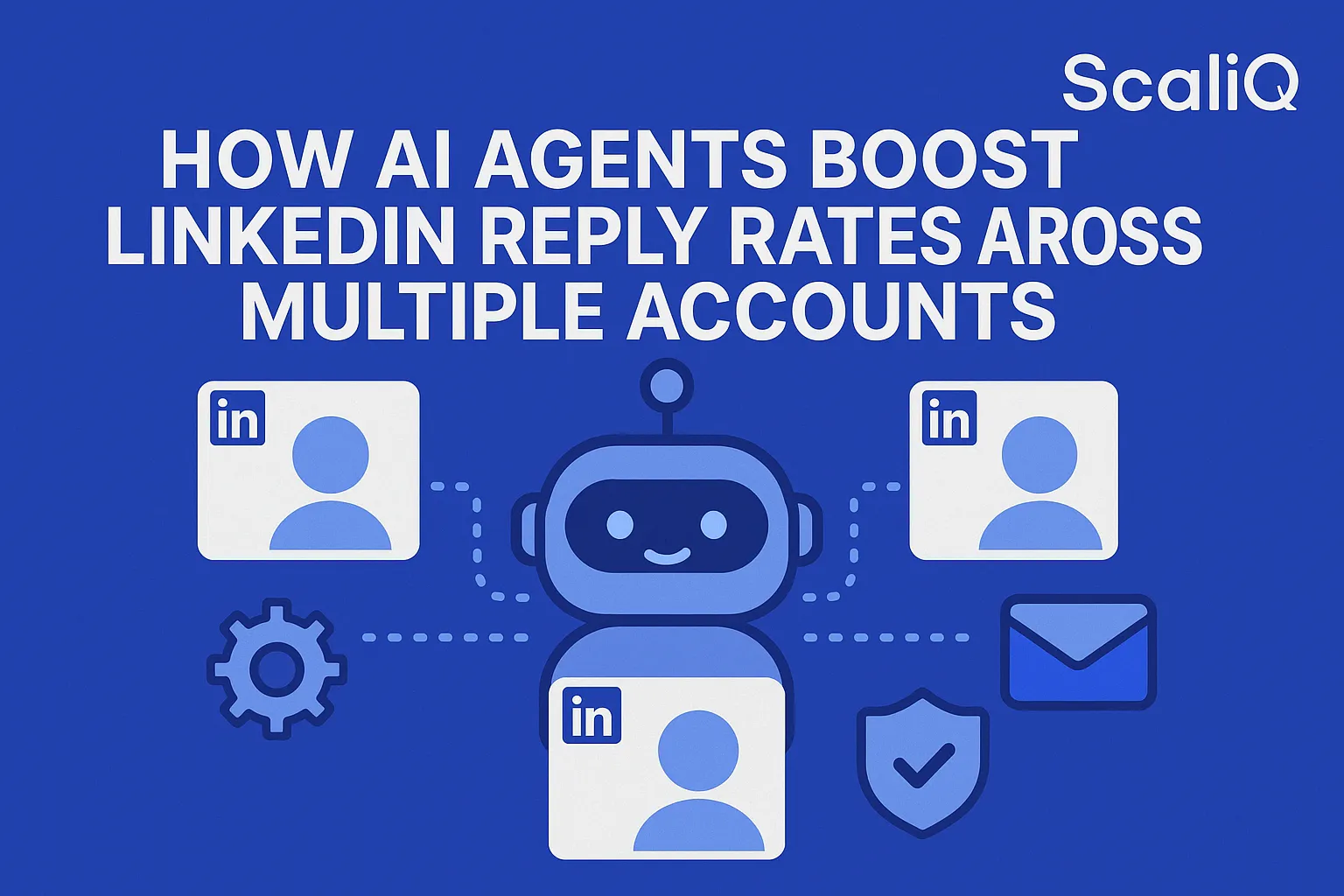
Scaling outreach often leads to a degradation in quality. However, advanced AI agents allow for multi-account LinkedIn outreach that maintains, or even exceeds, the quality of manual writing. The key lies in orchestration—using AI to manage the flow of data and messaging across several user profiles (e.g., a founder, a sales lead, and an SDR) simultaneously.
To achieve this, AI agents read prospect signals—such as job changes, skills endorsements, and public content—and synthesize this data into a coherent outreach strategy.
For a deeper look at how this personalization engine functions, you can explore ScaliQ’s approach to intelligent outreach.
Ethical considerations are paramount here. As noted in research from Harvard University regarding digital communication ethics, the goal of AI should be to enhance relevance and utility for the recipient, not to deceive. Effective AI outreach agents use public data to be helpful, not invasive.
Multi‑Account Data Unification
One of the biggest risks in scaling is collision—two SDRs messaging the same VP of Sales on the same day. AI agents solve this through multi-account data unification.
• Centralized Brain: The AI maintains a single "source of truth" for all prospects.
• Exclusion Logic: If Profile A connects with a prospect, Profile B is automatically blocked from contacting them.
• Data Normalization: The AI cleans and standardizes data from different sources, ensuring that manage multiple LinkedIn accounts AI workflows remain error-free.
Dynamic Personalization Logic
True personalization goes beyond {{First_Name}}. AI LinkedIn response rate improvement comes from dynamic variable injection.
• Industry-Specific Jargon: The AI detects the prospect is in "FinTech" and uses terms like "compliance" or "ledger" instead of generic business speak.
• Role-Based Value Props: A CTO receives a message about "security architecture," while a VP of Sales receives a message about "revenue velocity."
• Activity-Based Triggers: "I loved your comment on the future of SaaS pricing..."
This logic ensures every message feels hand-typed.
Behavioral Sequencing and Optimization for Higher Responses
Sending a message is just the first step. The magic of LinkedIn reply optimization happens in the follow-up. Traditional automation sends follow-ups at fixed intervals (e.g., "Wait 3 days, send Message B"). AI agents utilize behavioral sequencing, where the action of the prospect dictates the reaction of the agent.
If a prospect views your profile but doesn't reply, the AI might trigger a soft "nudge" sooner than scheduled. If they open the message multiple times but don't reply, the agent might infer interest but hesitation, sending a case study to build credibility.
Predictive Timing & Trigger‑Based Follow‑Ups
AI models can be trained on vast datasets of engagement patterns to predict the optimal time to send a message.
• Time Zone Optimization: Sending when the prospect is most likely to be active.
• Engagement Triggers: If a prospect accepts a connection request on a Saturday, the AI can intelligently decide whether to message immediately or wait for Monday morning business hours.
Teams utilizing AI outreach agents for predictive timing often report 3x efficiency compared to standard drip campaigns.
Continuous A/B Testing and Sequence Improvement
Legacy LinkedIn automation AI requires humans to manually A/B test scripts. AI agents can do this autonomously.
• Self-Correction: If "Subject Line A" has a 15% open rate and "Subject Line B" has 45%, the agent will automatically route traffic to B.
• Step Rewriting: Advanced agents can identify that Step 3 in a sequence is causing unsubscribe rates to spike and can flag it for rewriting or attempt to generate a variant that is softer in tone.
Safety, Compliance, and Avoiding LinkedIn Spam Flags
When operating multi-account LinkedIn outreach, safety is the single most critical variable. LinkedIn’s algorithms are aggressive in detecting non-human behavior. If you exceed velocity limits or generate high "ignore" rates, your accounts will be restricted.
AI agents are designed to mimic human behavior patterns—pausing, varying click speeds, and respecting daily limits. This aligns with the NIST AI Risk Management Framework and FTC guidance, which emphasize the importance of designing AI systems that manage risk and operate within transparent, safe boundaries.
How AI Detects Unsafe Patterns
To prevent LinkedIn spam detection flags, AI agents monitor several health signals:
• Velocity Control: Ensuring connection requests don't spike unnaturally (e.g., 0 to 100 in one day).
• Content Repetition: AI rewrites messages slightly for each recipient so that the exact same hash/text string isn't sent hundreds of times, a common trigger for spam filters.
• Pending Request Limits: Automatically withdrawing old connection requests to keep the pending queue clean.
The Multi‑Account Safety Challenge
Managing one account safely is hard; managing ten is exponentially harder.
• IP Management: AI agents often integrate with dedicated proxies to ensure each LinkedIn profile logs in from a consistent, local IP address.
• Device Fingerprinting: Ensuring that browser fingerprints remain consistent for each specific user profile.
By handling these technicalities, multi-account LinkedIn outreach becomes a viable, long-term channel rather than a high-risk gamble.
How ScaliQ Elevates Multi‑Account Outreach Beyond Basic Automation
While tools like Expandi or Dripify offer robust automation, they are primarily execution tools—you tell them what to do, and they do it. ScaliQ represents a shift toward intelligent agency. It doesn't just execute; it orchestrates.
ScaliQ is built for teams that need to scale AI personalized LinkedIn messaging at scale without losing the "human touch." It combines a sophisticated personalization engine with safety-first architecture.
You can view the full breakdown of these capabilities here.
AI‑Driven Cross‑Profile Coordination
ScaliQ utilizes a "Team Inbox" mentality powered by AI.
• Load Balancing: If one SDR's account hits its weekly limit, the AI agent can intelligently route new leads to another SDR with capacity, ensuring the campaign never stalls.
• Unified Context: The AI remembers that a prospect was contacted by the Founder last year, preventing a new Sales Rep from awkwardly pitching them as a cold lead.
This coordination is essential for maximizing AI LinkedIn response rates across a company.
The ScaliQ Workflow Architecture
The ScaliQ workflow operates like a pipeline:
1. Ingestion: Import leads from Sales Navigator or CSV.
2. Enrichment: The AI agent scrapes public data to build a profile of the prospect.
3. Generation: Personalized hooks and messages are crafted using LLMs.
4. Orchestration: Messages are dispatched via the appropriate user profile.
5. Optimization: Response data feeds back into the system to refine future messages.
Case Studies & Real‑World Examples
To understand the power of AI outreach agents, we look at three distinct implementations.
1. The Solo Founder (1 Account)
• Scenario: A SaaS founder struggling to balance product dev with sales.
• Strategy: Used AI agents to automate 20 highly personalized connections/day.
• Result: 45% acceptance rate, 25% reply rate. The AI handled the initial back-and-forth, allowing the founder to step in only for booked calls.
2. The SDR Team (5+ Accounts)
• Scenario: A mid-market sales team facing territory overlap issues.
• Strategy: Implemented multi-account LinkedIn outreach with exclusion logic.
• Result: Eliminated internal collision. Increased total qualified meetings by 150% in Q1 by optimizing send times.
3. The Lead Gen Agency (20+ Profiles)
• Scenario: An agency managing outreach for multiple clients.
• Strategy: Used ScaliQ to orchestrate campaigns, integrating multimedia personalization tools like Repliq to send custom videos/images at scale.
• Result: Achieved a consistent 12-18% positive reply rate across diverse industries, significantly above the 3-5% industry average.
Tools, Metrics & Benchmarks
Success in LinkedIn reply optimization requires tracking the right data. Vanity metrics (like total views) are less important than conversion metrics.
How to Measure Quality vs Quantity
Don't just measure "Messages Sent." Focus on:
• Connection Acceptance Rate: Should be >30%. If lower, your targeting or profile optimization is off.
• Reply Rate: Good is >10%. Excellent is >20%.
• Sentiment Analysis: Use AI outreach agents to classify replies as "Interested," "Not Interested," or "Later." A high reply rate means nothing if 90% are "Stop messaging me."
Recommended Tech Stack
To build a fully autonomous engine, consider this stack:
• Orchestration & AI Agents: ScaliQ (for safe, multi-account management).
• Data Enrichment: Tools that verify email and LinkedIn URLs.
• CRM Integration: HubSpot or Salesforce to sync data bi-directionally.
• Visual Personalization: Tools that generate custom images/videos to embed in messages.
Future Trends in AI‑Driven LinkedIn Outreach
The future of AI LinkedIn response rate optimization is autonomous. We are moving toward "Level 5" autonomy where agents not only write messages but completely manage the relationship lifecycle.
• Real-Time Rewriting: Agents that rewrite sequences on the fly based on breaking news about the prospect’s company.
• Multi-Modal Personalization: Agents that can leave voice notes or generate personalized video intros.
• Governance & Ethics: As cited in the OECD AI Principles, future tools must prioritize robustness, security, and accountability. The platforms that win will be those that balance aggressive growth with strict ethical compliance and data privacy.
Conclusion
The decline in LinkedIn reply rates is a signal that the old ways of automation are dead. To succeed in a saturated market, you must be relevant, timely, and personal. AI agents offer the only scalable path to achieve this.
By leveraging multi-account LinkedIn outreach strategies, behavioral sequencing, and platforms like ScaliQ, businesses can transform their outbound efforts from a spam cannon into a precision engine. The result is not just more replies, but more meaningful conversations that drive revenue.
Ready to upgrade your outreach? Explore how ScaliQ orchestrates intelligent agents to drive results at ScaliQ.ai.