

Introduction
For lead generation agencies and high-growth sales teams, the ability to scale outreach often hits a hard ceiling: the risk of account restrictions. As agencies expand from managing five accounts to fifty or five hundred, the complexity of maintaining account health does not grow linearly—it compounds exponentially.
In 2025, LinkedIn’s anti-abuse algorithms are more sophisticated than ever. They no longer just look for spammy content; they analyze network fingerprints, device consistency, and behavioral patterns to detect organized automation. Conventional tools that rely on simple browser extensions or shared cloud IPs are failing, resulting in "chain bans" where entire fleets of accounts are restricted simultaneously due to footprint linking.
This article provides a technical, step-by-step blueprint for scaling LinkedIn outreach without compromising safety. We will move beyond basic limits and explore a compliance-first, multi-account architecture that utilizes isolation, behavioral throttling, and advanced orchestration.
By adopting the infrastructure standards used by enterprise security teams, you can turn a fragile outreach process into a robust, scalable revenue engine.
Why Safe LinkedIn Scaling Matters
Scaling outreach safely is significantly harder today than it was just a few years ago. LinkedIn has evolved from simple rate-limiting to deploying complex heuristic models capable of identifying "coordinated behavior." For an agency, this means that the actions taken by one account can negatively impact the reputation of every other account under your management if they are technically linked.
The pain points are familiar but the consequences are severe:
• Chain Bans: A single flagged account leads to a review of all accounts accessing LinkedIn from the same IP subnet or device fingerprint.
• Identity Verification Loops: Accounts are frequently locked, requiring ID verification that disrupts campaigns for days.
• Inconsistent Pipeline: When 20% of your accounts are in "cooldown" mode, your lead flow becomes unpredictable, leading to client churn.
Unlike typical automation tools that focus solely on "how many invites per day" you can send, a true safety strategy focuses on infrastructure. It treats every LinkedIn profile as a high-value asset that requires protection.
According to guidelines on Privileged Account Management (PAM) from the National Institute of Standards and Technology (NIST), high-value accounts require isolated environments and strict access controls to prevent compromise. Applying these enterprise security principles to LinkedIn outreach is the only way to scale beyond a handful of accounts without incurring massive risk.
Core Infrastructure for Multi‑Account Safety
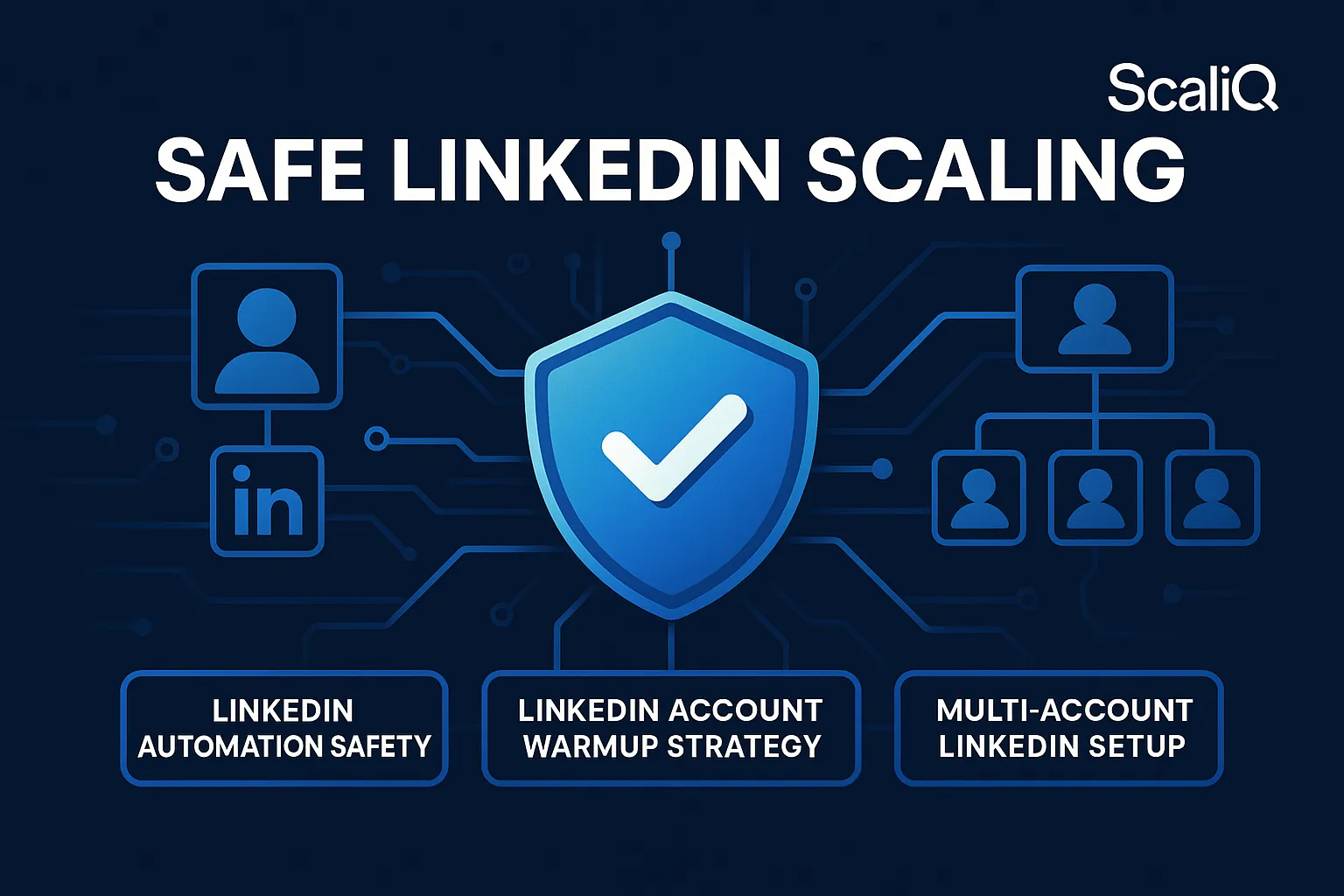
To scale safely, you must adopt an "isolation-first" architecture. This means every LinkedIn account under your management should operate in a completely independent digital environment, unaware of the existence of the others.
Most entry-level tools fail here because they rely on shared resources. They might run multiple accounts from a single server IP or use a standard browser that leaks the same device fingerprint across different logins.
A compliant, safe infrastructure requires:
1. Dedicated IP Addresses: Using high-quality residential or mobile proxies rather than datacenter IPs, which are easily flagged.
2. Isolated Browsers: Each account runs in a sandboxed environment with unique cookies, cache, and local storage.
3. Device Fingerprint Separation: Ensuring that hardware signatures (Canvas hash, WebGL, AudioContext) do not overlap between accounts.
This approach mirrors the Digital Footprint guidance from Carnegie Mellon University (CMU), which emphasizes that reducing data leakage between sessions is critical for maintaining distinct digital identities.
Identity Isolation and Stable IP Architecture
"Identity isolation" in the context of LinkedIn means that the network traffic for Account A must never cross paths with Account B.
The gold standard for this is Static Residential IPs. Unlike rotating proxies that change your IP with every request (triggering security alerts for "impossible travel"), a static residential IP assigns a consistent, legitimate ISP connection to an account. This mimics the behavior of a real user working from a home office.
• Risk of Overlap: Never allow two accounts to use the same IP address simultaneously.
• Geographic Consistency: The IP location should match the profile's stated location to avoid flagging.
Isolated Browser / Virtual Environment Setup
Network isolation is useless if your browser leaks your identity. Modern browsers broadcast a "fingerprint"—a unique combination of your screen resolution, installed fonts, and hardware configurations.
To scale safely, you must use virtualized browser environments where these parameters are masked or randomized for each account. This ensures that LinkedIn sees 50 distinct devices accessing 50 accounts, rather than one computer toggling between 50 tabs.
The Cybersecurity and Infrastructure Security Agency (CISA) recommends strict session hygiene to prevent cross-contamination of data. In outreach terms, this means ensuring that cookies and local storage from one session are never accessible to another, effectively walling off each account's history.
Warmup, Throttling, and Behavior‑Based Limits
Infrastructure protects you from detection; behavior protects you from restriction. Even with perfect proxies, an account that sends 100 connection requests the moment it is created will be banned.
Safe scaling requires a shift from fixed rules (e.g., "always send 20 invites") to behavior-based throttling. This approach adjusts activity levels dynamically based on the account's age, the acceptance rate of connection requests, and the volume of incoming replies.
Smart Warmup Sequences
A proper warmup sequence is a marathon, not a sprint. It builds "trust score" with LinkedIn's internal algorithms.
• Weeks 1-2: Focus on profile completion and passive engagement (liking posts, viewing profiles). Zero outreach.
• Weeks 3-4: Begin sending 5–10 highly targeted manual connection requests per day.
• Weeks 5+: Gradually ramp up volume, adding 2–3 requests per day only if the acceptance rate remains above 30%.
Critical Mistake: Many agencies jump straight to automation. A sudden spike in API calls on a "cold" account is the fastest way to trigger a restriction.
Behavioral Throttling Algorithms
Human behavior is not linear. Humans do not send exactly one message every 180 seconds for 8 hours straight. To remain compliant and safe, your automation must simulate human unpredictability.
• Randomized Intervals: Vary the time between actions (e.g., 45 seconds, then 3 minutes, then 90 seconds).
• Session Clustering: Group activity into "work hours" with natural breaks for lunch or meetings.
• Responsive Throttling: If your connection acceptance rate drops below 20%, the system should automatically halt new invites and switch to "cooling mode" (only viewing profiles) for 48 hours.
This aligns with the NIST Identity and Access Management framework, which suggests that access patterns should be monitored and throttled when they deviate from established baselines to prevent abuse.
Preventing Account Linking and Footprint Overlap
"Account linking" occurs when a platform determines that multiple accounts are controlled by a single entity. Once accounts are linked, a violation on one account poisons the reputation of the entire cluster.
To prevent this, you must dismantle the bridges that connect your accounts. The most common linking traps are shared IP pools, centralized login hubs that leak metadata, and aggressive tab switching in a standard browser.
Credible sources like CMU and CISA highlight that digital footprint reduction is a multi-layer process. You cannot secure just one layer; you must secure the entire stack.
The Four-Layer Footprint Separation Framework
To guarantee safety, apply isolation across these four layers:
1. Network Layer: Dedicated, static residential IP for every account. No shared subnets.
2. Device Layer: Unique hardware fingerprints (User Agent, Canvas, WebGL) for every instance.
3. Application Layer: distinct cookies, local storage, and cache for every session.
4. Behavioral Layer: distinct activity schedules (e.g., not all accounts logging in at exactly 9:00 AM).
Proxies, Sessions, and Anti-Linking Procedures
Session boundaries are critical. When an automation task finishes, the session state (cookies/tokens) must be preserved securely, but completely unloaded from the browser environment before a different account is loaded (if you are rotating slots, though simultaneous isolation is preferred).
Furthermore, intelligent routing logic is required to ensure that traffic is always directed through the correct proxy interface.
Centralized Management and High‑Scale Orchestration
Managing 50 isolated environments individually is operationally impossible. You need a centralized orchestration layer that aggregates control without merging the underlying identities.
Orchestration platforms allow agencies to manage inboxes, campaigns, and safety settings from a "Mission Control" dashboard while the actual execution happens in isolated, safe environments in the background.
Read more about advanced orchestration workflows for high-volume agencies on the ScaliQ blog.
Centralized Inbox & Reply Management
Logging into LinkedIn natively for 50 accounts every day is a security risk and a productivity nightmare. A unified inbox pulls messages from all accounts via API or secure browser synchronization into a single interface.
• Role-Based Access: Team members can reply to leads without ever knowing the LinkedIn password or accessing the raw session, preventing accidental footprint leaks.
• Tagging & CRM Sync: Consolidate data hygiene without manual data entry.
Automated Risk Monitoring & Compliance Controls
Reactive safety is not enough. You need proactive monitoring.
• Anomaly Detection: The system should alert you if an account's location suddenly shifts or if an IP becomes flagged by third-party databases.
• Auto-Kill Switches: If LinkedIn updates its DOM or detection algorithms, the orchestration layer should instantly pause all campaigns globally to prevent mass bans.
Referencing NIST's guidelines on continuous monitoring, automated systems must have real-time visibility into account health metrics to respond to threats before they result in permanent access loss.
Future Trends in Safe LinkedIn Scaling
As we look toward the future of outreach, safety will become synonymous with personalization.
• AI-Driven Adaptive Throttling: Future tools will not just randomize delays; they will use AI to read the context of a conversation and determine the "most human" moment to reply.
• Distributed Identity Management: Agencies will move toward fully decentralized identity wallets for client accounts, ensuring that even the agency itself cannot accidentally cross-contaminate data.
• Privacy-First Outreach: With regulations like GDPR and CCPA tightening, "scraping" will be replaced by "intent-based networking," where outreach is strictly limited to compliant, public data sources.
Conclusion
Scaling LinkedIn outreach is no longer a numbers game; it is an infrastructure game. The era of running a generic Chrome extension on a shared office Wi-Fi is over. To protect your clients and your revenue, you must adopt a compliance-first architecture.
By implementing strict isolation, respecting behavioral limits, and utilizing centralized orchestration, you can scale to hundreds of accounts without fear of chain bans. The investment in safety today is the insurance policy for your agency’s growth tomorrow.
Ready to scale without the risk? Adopt ScaliQ’s compliance-first infrastructure to manage your multi-account outreach securely.