

Why Personalization Beats Spintax (Data From Real Campaigns)
If you have noticed a sharp decline in your LinkedIn reply rates recently, you are not alone. The era of "spray and pray" messaging is officially over. For years, sales professionals relied on spintax—simple text rotation formulas—to bypass spam filters. Today, those same tactics are the fastest way to get your account flagged and your messages ignored.
There is a growing confusion among outreach professionals: does spintax still work, or is it actively harming your campaigns? The data is clear. Generic automation is being outperformed by AI-driven personalization that understands context, nuance, and human behavior.
This article breaks down exactly why spintax is failing, backed by reply-rate data and detection insights. We will cover real examples of what to avoid, how modern detection algorithms work, and simple, beginner-friendly frameworks to implement AI personalization that actually converts.
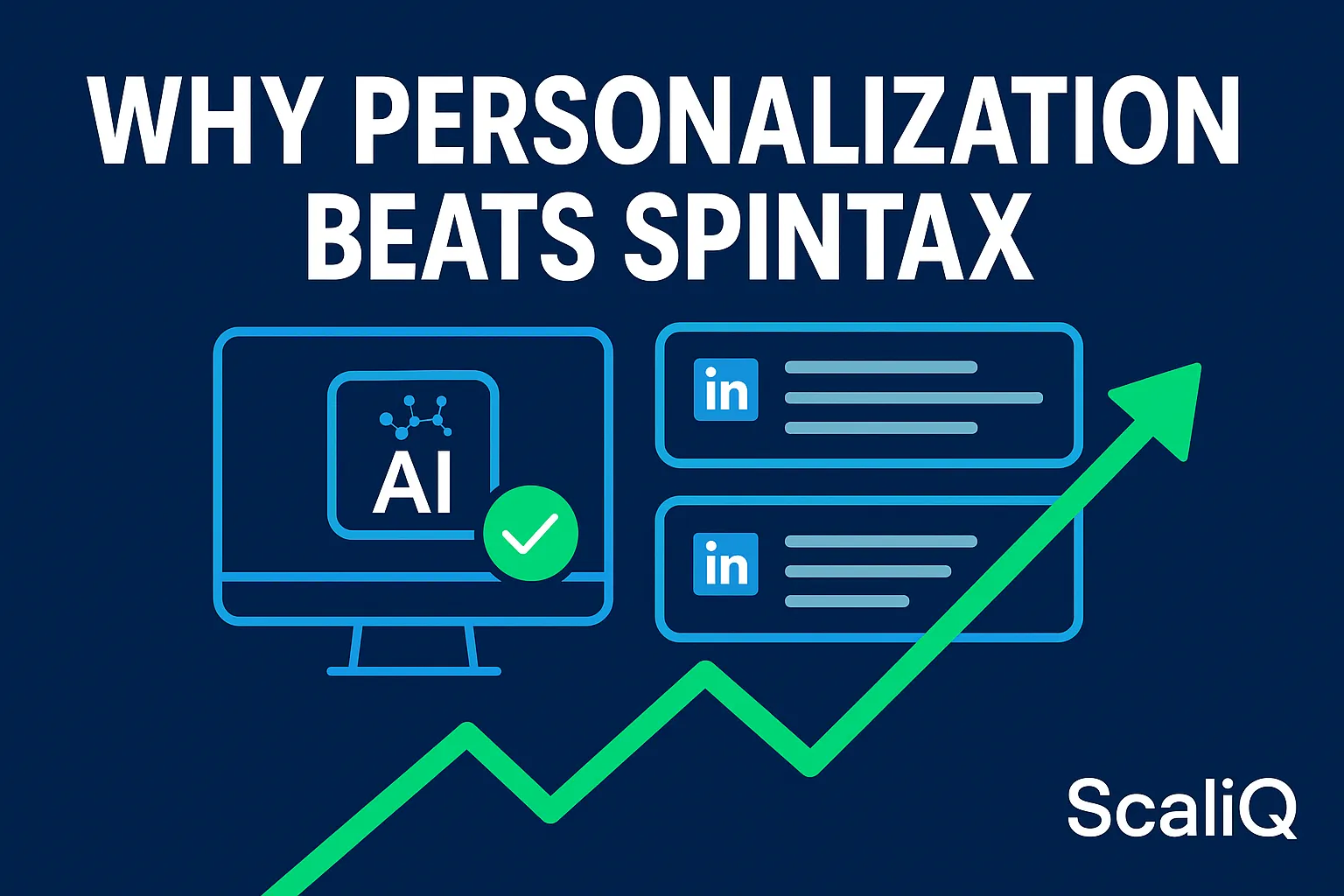
Industry benchmarks now show that truly personalized messaging generates 2–5x higher reply rates compared to generic spintax templates.
Why Spintax No Longer Works on LinkedIn
To understand why your campaigns might be failing, you first need to understand what spintax is. Spintax (short for "spinning syntax") is a formatting style used to create variations of a sentence. It typically looks like this: {Hello|Hi|Hey} {First Name}, I {hope|trust} you are {doing well|having a great week}.
Historically, this was popular because it allowed high-volume senders to generate thousands of "unique" messages from a single template, theoretically tricking spam filters that look for identical blocks of text.
However, LinkedIn has evolved. The platform’s modern anti-automation systems are no longer just looking for identical text; they are analyzing semantic patterns and structural velocity. For beginners, this shift results in three major pain points:
1. Abysmal Reply Rates: Prospects can smell a robotic message from the first line.
2. "Robotic" Tone: Even with variations, the syntax often feels disjointed and impersonal.
3. Automation Detection: High volumes of structurally similar messages trigger safety flags.
Volume-based outreach is dying because platforms prioritize genuine user interaction. If your strategy relies on sending 100 generic messages to get 1 reply, you are fighting a losing battle against algorithms designed to stop you.
For a deeper dive into modern outreach strategies that prioritize quality over quantity, check our guide on the ScaliQ blog.
It is also critical to ensure your outreach complies with platform rules. You can review the official LinkedIn automation policy to understand the boundaries of compliant activity.
The Technical Reason LinkedIn Flags Spintax
LinkedIn’s algorithms have moved beyond simple text matching. They now utilize advanced pattern recognition that detects repetitive structures, even when the words change.
When you use spintax, you are essentially feeding the algorithm a predictable mathematical pattern. If you send 50 messages that all follow the structure [Greeting] + [Generic Compliment] + [Pitch], the underlying "fingerprint" of the message remains the same.
These repetitive structures, combined with random synonym rotations, create a signal that is easy for AI to categorize as non-human behavior. When these patterns are identified, they trigger automated engagement penalties, which can range from your messages being silently filtered into the "Other" inbox to temporary restrictions on your account.
Why Spintax Fails Emotionally and Linguistically
Beyond the technical risks, spintax fails the most important test: the human test.
Spintax often produces unnatural syntax combinations. A sentence that makes grammatical sense in one variation might sound clunky or bizarre in another. For example, a rotation might accidentally produce: "I trust you are having a top-notch existence," which no human would ever actually say in a professional context.
This inconsistency destroys trust. In cold outreach personalization, trust is your currency. If the tone shifts from casual to formal within the same paragraph because of a bad spintax rotation, the prospect immediately disconnects. They know they are being sold to by a bot, and the opportunity for a genuine conversation is lost.
How AI Personalization Delivers Higher Reply Rates
If spintax is the old way, AI personalization is the new standard. Unlike spintax, which shuffles words blindly, AI personalization uses Large Language Models (LLMs) to understand the content of a prospect's profile.
AI tools can analyze a prospect's summary, recent posts, work history, and company news to craft a message that is relevant to them specifically. This creates human-like variation because the message is generated based on unique data points, not a pre-set template.
For beginners, the worry is often: "Does this take too long?" The answer is no. Modern AI tools automate this research and writing process, allowing you to scale personalized outreach without spending hours writing manual emails.
Recent AI personalization research suggests that LLM-generated content that adapts to user context significantly outperforms static templates in engagement metrics.
Why Personalization Increases Replies 2–5x
The math is simple: relevance drives action. Industry benchmarks consistently show that personalized messages receive 2–5x higher reply rates than generic ones.
• Emotional Resonance: When you mention a specific challenge a prospect posted about, you validate their experience.
• Proof of Work: A personalized note proves you aren't a bot spamming thousands of people. It shows you did your homework.
• Comprehension: AI can bridge the gap between your solution and their specific problem, making the value proposition immediately clear.
Scaling Personalization Without Sounding Robotic
The goal of using AI is not to remove the human element, but to amplify it. The most effective workflow for scalable personalization follows this path:
1. AI Analysis: The tool scans the profile for "hooks" (e.g., a recent promotion, a shared connection, a specific post).
2. Draft Generation: The AI drafts a message connecting that hook to your value proposition.
3. Human Review: You quickly review the draft to ensure tone alignment.
4. Platform-Safe Sending: The message is sent using safe, randomized intervals.
This is where tools like ScaliQ differ from legacy spintax tools. ScaliQ uses an AI-first approach to generate unique message structures for every prospect, whereas older tools just rotate synonyms. For teams looking to implement this contextual approach at scale, platforms like Repliq also enable deep personalization capabilities that go beyond simple text replacement.
Real Examples — Spintax Messages vs Personalized Messages
To truly understand the difference, we need to look at the output side-by-side. Below is a comparison of a typical spintax message versus a high-performing personalized message.
Bad Spintax Example (Before)
The Setup: {Hi|Hello} {First Name}, I {saw|noticed} your profile and was {impressed|intrigued} by your work at {Company Name}. We {help|assist} companies like yours {grow|scale} revenue. {Let's chat|Are you free} next week?
The Result: "Hello John, I noticed your profile and was intrigued by your work at Acme Corp. We assist companies like yours scale revenue. Are you free next week?"
Why It Fails:
• Generic Compliment: "Intrigued by your work" means nothing. It is a filler phrase.
• Unnatural Phrasing: "Assist companies like yours scale revenue" is grammatically stiff.
• Zero Context: It could be sent to a CEO or an intern; it lacks specificity.
• Detection Risk: The structure is identical to thousands of other spam messages.
High‑Performing Personalized Message (After)
The Setup: AI analyzes John’s profile. It sees he recently posted about the challenges of moving from Founder-led sales to a sales team.
The Result: "Hi John, just read your post about the friction of handing off sales from founder to team—that transition is notoriously tough. Since you're building out that first SDR layer at Acme Corp, I thought you might find our playbook on 'Founder-to-Sales-Team Handoffs' useful. Open to a quick look?"
Why It Works:
• Specific Hook: Mentions a specific post and topic.
• Relevance: The offer (playbook) is directly tied to his current pain point.
• Natural Tone: It reads like a peer sending a helpful resource, not a bot asking for a meeting.
Data, Platform Detection, and What Outreach Tools Don’t Tell You
Many outreach tools on the market still heavily promote spintax features. Why? Because it is cheap to build and easy to sell to beginners who want "quick fixes." But they often omit the reality of platform detection.
LinkedIn’s detection mechanisms rely on identifying syntactic similarity and sending velocity. If you send 50 messages in an hour that share 80% syntactic similarity (which spintax does), you are waving a red flag.
You can read more about how these systems flag behavior in the official LinkedIn detection mechanisms documentation.
Competitive Gap: Why Most Tools Give Generic Advice
Most legacy tools (like early versions of Lemlist or Reply.io) built their infrastructure around templates and spintax. Their advice often centers on "A/B testing your subject lines" or "optimizing your spintax," because that is what their software allows.
ScaliQ and modern AI-first platforms take a different approach. We don't encourage you to hide a template; we encourage you to generate a unique message. The competitive gap lies here:
• Old Way: Hide the pattern.
• New Way: Eliminate the pattern entirely by generating unique content.
What the Data Actually Shows (Reply Rate Comparison)
Internal data and broader industry studies reveal a stark contrast:
• Spintax Campaigns: Average reply rate of 1–3%. High risk of account restriction.
• AI Personalized Campaigns: Average reply rate of 8–15% (up to 25% for highly targeted lists).
Furthermore, the data shows a massive reduction in flagged messages. Because AI generates human-like text variation naturally, the "fingerprint" of your outreach activity looks organic, keeping your domain and account health safe.
Best Practices for Beginners (Simple, High‑Impact Personalization)
You don't need to be a prompt engineer to start personalizing. You just need a framework. Here are simple ways to improve your outreach immediately.
The 10‑Second Rule for Personalization
If you are doing this manually or validating your AI’s output, use the 10-Second Rule. Scan a profile for 10 seconds and look for one thing:
1. A recent post: "Loved your take on..."
2. A career gap or shift: "Congrats on the move to..."
3. A shared technology: "Saw you're using HubSpot..."
Script: "Hi [Name], saw you're using [Tech Stack]. Usually, teams using that struggle with [Pain Point]. Is that on your radar right now?"
Safe Sending Practices to Avoid Detection
Even with perfect personalization, you must respect platform limits.
• Warm-up: Never start at full speed. Gradually increase volume.
• Variability: Ensure your messages vary in length and structure.
• Daily Limits: Keep connection requests under 20-30 per day if you are new.
Always prioritize account safety over speed. Refer back to the LinkedIn automation policy to ensure your workflow remains compliant.
Conclusion
The debate between spintax vs personalization is settled by the data. Spintax is a relic of an older internet—risky, robotic, and increasingly ineffective. AI personalization is the future, offering a way to scale authentic human connection without triggering detection algorithms.
For beginners, the shift requires a mindset change: stop thinking about "how many" messages you can send, and start thinking about "how relevant" you can be. By leveraging AI tools to do the heavy lifting, you can secure 2–5x more replies and build a pipeline based on trust, not spam.
If you are ready to move away from risky templates and start sending outreach that actually converts, explore personalization-focused workflows that put quality first.