

Introduction
The era of "spray and pray" on LinkedIn is effectively over. For years, sales teams relied on static automation tools to blast thousands of identical connection requests, hoping for a 1-2% conversion rate. Today, that strategy is not just failing—it is actively damaging brand reputations and risking account suspensions. Response rates are plummeting as decision-makers become blind to templated outreach, while platform algorithms are becoming increasingly sophisticated at flagging non-human behavior.
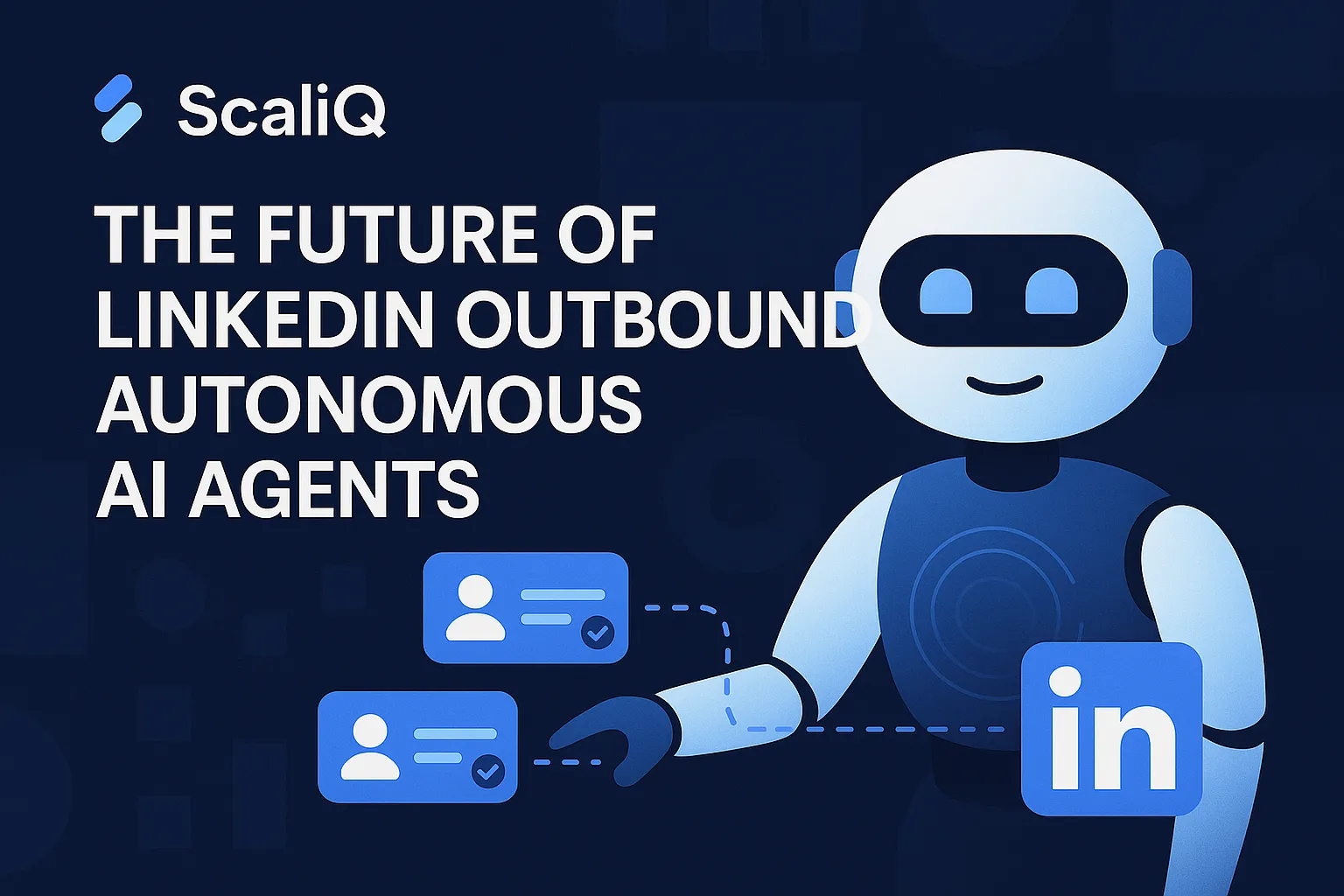
We are witnessing a fundamental shift in outbound strategy: the transition from rigid, rule-based workflows to autonomous agents capable of complex decision loops. Unlike traditional bots that blindly follow a linear path, autonomous outreach agents observe, interpret, and adapt in real-time. They function less like software scripts and more like high-performing Sales Development Representatives (SDRs) that never sleep.
In this blueprint, we will dismantle the mechanics of autonomous LinkedIn outreach. We will explore how these systems leverage real-time data pipelines to outperform human teams in personalization, ensure rigorous compliance, and redefine the future of B2B prospecting. As innovators in agent-run outbound systems, ScaliQ is leading this charge, moving the industry toward a future where outreach is intelligent, adaptive, and human-centric by design.
Why Traditional LinkedIn Automation Is Failing
The collapse of legacy automation is driven by two converging forces: user fatigue and platform vigilance. Decision-makers are inundated with generic pitches, training them to ignore any message that lacks immediate, hyper-relevant context. Simultaneously, LinkedIn has tightened its grip on platform integrity, rendering the "volume-first" approach obsolete.
Traditional automation relies on "If-This-Then-That" (IFTTT) logic. It is linear and blind. If a prospect accepts a request, wait 24 hours, then send Message A. It does not care if the prospect just posted about a layoff, a promotion, or a company acquisition. It cannot read the room. This lack of context leads to tone-deaf messaging that alienates potential buyers. Furthermore, relying on static scripts creates identifiable patterns that platform algorithms easily detect, leading to "jail" time for accounts.
Manual SDR workflows, while safer and more personalized, face a different bottleneck: scale. A human can only research and write effectively for a handful of prospects per day. Autonomous agents bridge this gap, offering the volume of automation with the nuance of human observation.
For a deeper dive into how the landscape of outbound sales technology is shifting away from these outdated automation trends, it is crucial to understand the metrics behind the decline.
To understand the legal framework governing these restrictions, one must review the LinkedIn User Agreement, which explicitly prohibits the use of software that scrapes or automates activity in ways that degrade the user experience.
The Decline of Engagement in B2B LinkedIn Outbound
The data is stark: B2B outbound decline is measurable across every major industry. Acceptance rates for generic connection requests have dropped significantly over the last 24 months. More critically, reply rates to initial messages have fallen as users leverage LinkedIn’s "I don't know this person" feature to filter out noise.
This LinkedIn engagement drop is not accidental; it is a feature of the platform’s behavior-based filtering. The algorithm prioritizes interactions that generate meaningful dialogue and suppresses accounts that exhibit high-volume, low-engagement activity. If your outreach does not generate replies, your visibility is throttled, creating a diminishing return on traditional automation efforts.
Compliance Pressure and Account Restrictions
Safety is the new currency in outbound sales. Unsafe automation patterns—such as bursting high volumes of messages in short timeframes, aggressive profile scraping, and simultaneous batch actions—are the fastest route to a permanent ban.
LinkedIn compliance relies on monitoring behavioral deviations. A human does not view 500 profiles in 10 minutes. A human does not send messages at exact 60-second intervals. Traditional tools often fail to mimic the chaotic, non-linear nature of human browsing. This creates a "bot signature" that triggers rate-limit thresholds. Automation safety now requires systems that understand these thresholds not as static limits, but as dynamic boundaries that shift based on account health and historical activity.
What Makes Autonomous Outreach Agents Different
To understand the future, we must distinguish between automation and autonomy. Automation is doing the same thing repeatedly, faster. Autonomy is the ability to make decisions based on changing variables without constant human intervention.
Autonomous outbound agents are distinct because they possess agency. They do not just execute a script; they navigate a workflow. They utilize an architecture similar to what ScaliQ deploys, where the system observes the environment (a prospect's profile), interprets the data (recent posts, job changes), decides on the best course of action (wait, like a post, or send a specific message), and then acts.
Autonomous Decision Loops Explained
The core of an AI-powered LinkedIn outreach system is the "Agent Decision Loop." This loop consists of four stages:
1. Observe: The agent scans the prospect's digital footprint—profile bio, recent activity, company news.
2. Orient: It contextualizes this information against the value proposition it is tasked with delivering.
3. Decide: It selects the optimal engagement strategy. For example, if a prospect just posted a hiring update, the agent might decide to reference that specific role in the outreach rather than sending a generic pitch.
4. Act: It executes the message or engagement action.
This adaptive outreach ensures that every interaction is relevant to the current state of the prospect, drastically increasing the probability of a positive response.
How Agents Learn and Adapt Outreach
Unlike static templates, AI SDR tools utilize adaptive sequencing. If an agent sends a connection request and the prospect views the sender's profile but does not accept, the agent can interpret this as "interest but hesitation."
In response, the agent might switch strategies—perhaps engaging with the prospect's content to build familiarity before attempting to connect again. This ability to pivot based on feedback signals allows for a fluid, natural engagement style that competitors using rigid linear sequences cannot match.
How AI Agents Deliver Real-Time Personalization
The "Hello {{FirstName}}" era is dead. True hyper-personalization requires real-time prospect intelligence that goes beyond basic demographic fields. Autonomous agents construct a dynamic understanding of the prospect by synthesizing data from multiple sources instantly.
Prospect Intelligence Pipelines
Effective prospect intelligence relies on safely accessing and interpreting public data. Agents utilize sophisticated pipelines to gather context without violating terms of service. This involves analyzing semantic data from "About" sections, interpreting the sentiment of recent comments, and identifying intent signals such as hiring spikes or technology adoption.
By building a context-aware outreach model, the agent understands why a prospect might need a solution now, rather than just knowing who the prospect is. This shifts the dynamic from cold outreach to warm, relevant consultation.
Dynamic Message Generation with Behavioral Context
Once the intelligence is gathered, the agent moves to AI message generation. This is not "filling in the blanks." It is generative writing based on behavioral context.
If the prospect is a CTO who frequently posts about "technical debt," the agent will generate a message that mirrors that terminology and addresses that specific pain point. It adjusts tone—formal for a bank executive, casual for a startup founder—and selects relevance weighting to prioritize the most compelling arguments. This contextual personalization eliminates the robotic feel of standard templates, ensuring the message resonates on a human level.
Ensuring Compliance and Safety on LinkedIn
In the pursuit of autonomy, safety cannot be an afterthought. ScaliQ and similar advanced platforms prioritize compliance-aware outreach by embedding risk management directly into the agent's logic. This approach aligns with broader industry standards for safe AI deployment.
For instance, the NIST AI Risk Management Framework outlines the importance of mapping, measuring, and managing AI risks—principles that are critical when deploying agents that interact with public platforms.
Behavior-Safe Execution
To navigate LinkedIn's strict ecosystem, agents employ behavioral mimicry. This involves:
• Natural Pacing: Varying the time between actions to simulate human "think time."
• Time-of-Day Matching: Operating only during the prospect’s likely active hours (local time).
• Randomized Delays: Introducing micro-pauses and irregular intervals so that activity never looks like a scripted loop.
This attention to rate limit safety ensures that the account remains healthy and trustworthy in the eyes of the platform's algorithms.
Transparent AI + Human Control
While agents operate autonomously, they must not be "black boxes." AI transparency is essential for trust. Advanced systems provide detailed logs of every decision made by the agent—why it chose to like a post, why it delayed a message, and what data it used to generate copy.
Furthermore, risk mitigation requires human override capabilities. Users can set "guardrails" (e.g., "never contact competitors," "never use aggressive sales language") that the agent must respect. This aligns with the FTC AI guidance overview, which emphasizes that companies are responsible for the claims and actions of their AI tools.
The Future of Zero‑Touch, Multi‑Channel Outbound
The evolution of outbound does not stop at LinkedIn. The future lies in zero-touch, multi-channel AI outreach where agents coordinate across platforms to surround the prospect with value.
Agentic Multi-Step Workflows
We are moving toward multi-agent workflows where specialized agents hand off tasks to one another.
• Research Agent: Scours the web for intent data and verifies contact info.
• Strategy Agent: Determines the best angle and channel.
• Copywriting Agent: Drafts the content for LinkedIn, Email, or X.
• Scheduling Agent: Manages the timing of delivery.
This "assembly line" of intelligence allows for a level of scale and precision that human teams cannot physically sustain.
Multi-Channel Adaptive Sequencing
Effective AI outreach orchestration involves adaptive sequencing across channels. If a prospect is active on LinkedIn but unresponsive to email, the system shifts focus to social engagement.
Tools like Repliq are instrumental here, allowing for the creation of personalized assets (images, videos) that can be deployed across these channels to break through the noise. By monitoring engagement signals everywhere, the agent ensures that the prospect receives a cohesive narrative, not disjointed pestering.
Tools & Resources
To build a robust AI SDR stack, you need tools that offer more than just message scheduling. Look for platforms that provide:
1. Contextual Relevance Score: A metric that predicts how well a generated message fits the prospect's profile before it is sent.
2. Adaptive Response Score: Tracking how often the agent successfully pivots strategy based on prospect behavior.
3. Risk Index: Real-time monitoring of account health and proximity to platform rate limits.
Investing in autonomous outreach tools that provide these analytics is the only way to optimize the "black box" of AI decision-making.
Future Trends & Expert Predictions
As we look toward the horizon of autonomous sales agents, several key trends are emerging:
• Real-Time Intent Prediction: Models that don't just react to data, but predict buying windows based on subtle macroeconomic and firmographic signals.
• Prospect Digital Twins: Creating a virtual simulation of a prospect to test pitch strategies before sending the actual message.
• Autonomous Negotiation: Agents capable of handling initial objection handling and even preliminary scheduling negotiation without human input.
• Hyper-Contextual Follow-Ups: Agents that monitor news continuously and trigger a follow-up only when a specifically relevant event occurs (e.g., "Saw your competitor just raised Series B...").
The future of B2B prospecting is not about sending more messages; it is about sending the right message at the exact moment of need, identified by AI.
Conclusion
Autonomous agents are not merely a better form of automation; they are a new category of workforce. They represent a shift from "doing" to "reasoning." By leveraging decision loops, real-time data, and behavioral mimicry, these systems are solving the crisis of engagement that plagues traditional outbound methods.
ScaliQ stands at the forefront of this revolution, providing the architecture necessary to run safe, compliant, and highly effective agentic workflows. The future of autonomous LinkedIn outreach is here, and it is rewiring how businesses grow. It is time to stop automating failure and start engineering success.