

Introduction
For advanced outbound teams, the primary challenge is rarely “who fits our ideal customer profile?” Instead, the friction lies in answering “why now?” and “what has changed within this organization to justify outreach?” Identifying a great fit is only half the battle; identifying the exact moment they are ready to buy is what drives conversion.
Tracking company headcount changes in LinkedIn prospecting offers a high-signal timing layer when interpreted correctly. However, a simple notification that a company is hiring is not enough. This data must be parsed by function, velocity, and broader business context to be actionable.
This is not another generic list of linkedin sales triggers. It is a definitive framework designed to help you distinguish between true expansion, contraction, and replacement hiring. By understanding these nuances, you can translate workforce shifts into precise account prioritization and highly relevant messaging strategies.
Designed for advanced SDRs, Account Executives, RevOps leaders, and outbound operators who already rely on sales-intelligence workflows, this guide will elevate your signal interpretation. We will cover strict interpretation rules, department-level guidance, timing advice, and multi-signal validation to ensure your outreach lands perfectly.
At ScaliQ, our signal-driven prospecting platform is built on the practical experience of using growth and contraction trends to perfect campaign timing. By moving beyond static lists and embracing dynamic organizational change, you can capture demand exactly when it surfaces.
Why Headcount Changes Matter for Prospecting
Headcount movement is far more than an interesting company metric; it is a foundational timing and prioritization signal that reveals the internal realities of an organization.
Why workforce change often precedes buying activity
Growth, contraction, and role-specific hiring rarely happen in a vacuum. These shifts almost always precede major operational events: process overhauls, tooling evaluations, team restructuring, or budget reallocations.
Employee growth tracking is immensely valuable because it surfaces operational pressure much earlier than static firmographic filters ever could. When a company rapidly scales its sales team, the subsequent need for better enablement software or CRM optimization is inevitable. As supported by BLS JOLTS job openings and hiring data, hiring activity reliably reflects real labor-market movement and shifting organizational demand.
However, hiring is not definitive proof of buying intent on its own. It is a directional signal. These headcount growth signals become exponentially stronger when tied to specific role types, hiring pace, and adjacent company events. By monitoring these buyer timing signals, teams can transition from working static prospect lists to executing dynamic account prioritization based on real-time organizational change.
Why LinkedIn is especially useful for this signal
LinkedIn prospecting surfaces company growth and hiring activity precisely where reps are already working. It integrates seamlessly into the workflows reps use for account mapping, persona research, and outreach execution.
The true value of this platform is not just seeing a binary "hiring" status, but observing exactly where the growth is concentrated and how quickly it is happening. Monitoring company hiring outreach natively on LinkedIn becomes a strategic advantage when analyzed over time. Unlike one-off snapshots, tracking these sales prospecting triggers historically reveals the true trajectory of an account, allowing you to time your outreach with precision.
The real limitation: signal ambiguity
The greatest risk in monitoring workforce data is signal ambiguity in hiring data. Relying on the fact that company-wide headcount growth can be misleading without function-level context leads to wasted outbound effort.
Common false positives plague basic outreach strategies. Seasonal hiring, backfills for departing employees, internal reorganizations, or hiring in departments completely unrelated to your solution can all trigger false alerts. In the modern landscape of sales intelligence, signal interpretation is the ultimate differentiator. While many platforms can expose raw hiring data, mastering the methodology to decide what action to take—and when to take it—is what separates top-performing teams from the rest.
How to Read Growth vs Contraction vs Replacement Hiring
To leverage headcount changes effectively, you need a practical taxonomy for interpreting workforce movement accurately.
Expansion hiring: what it usually signals
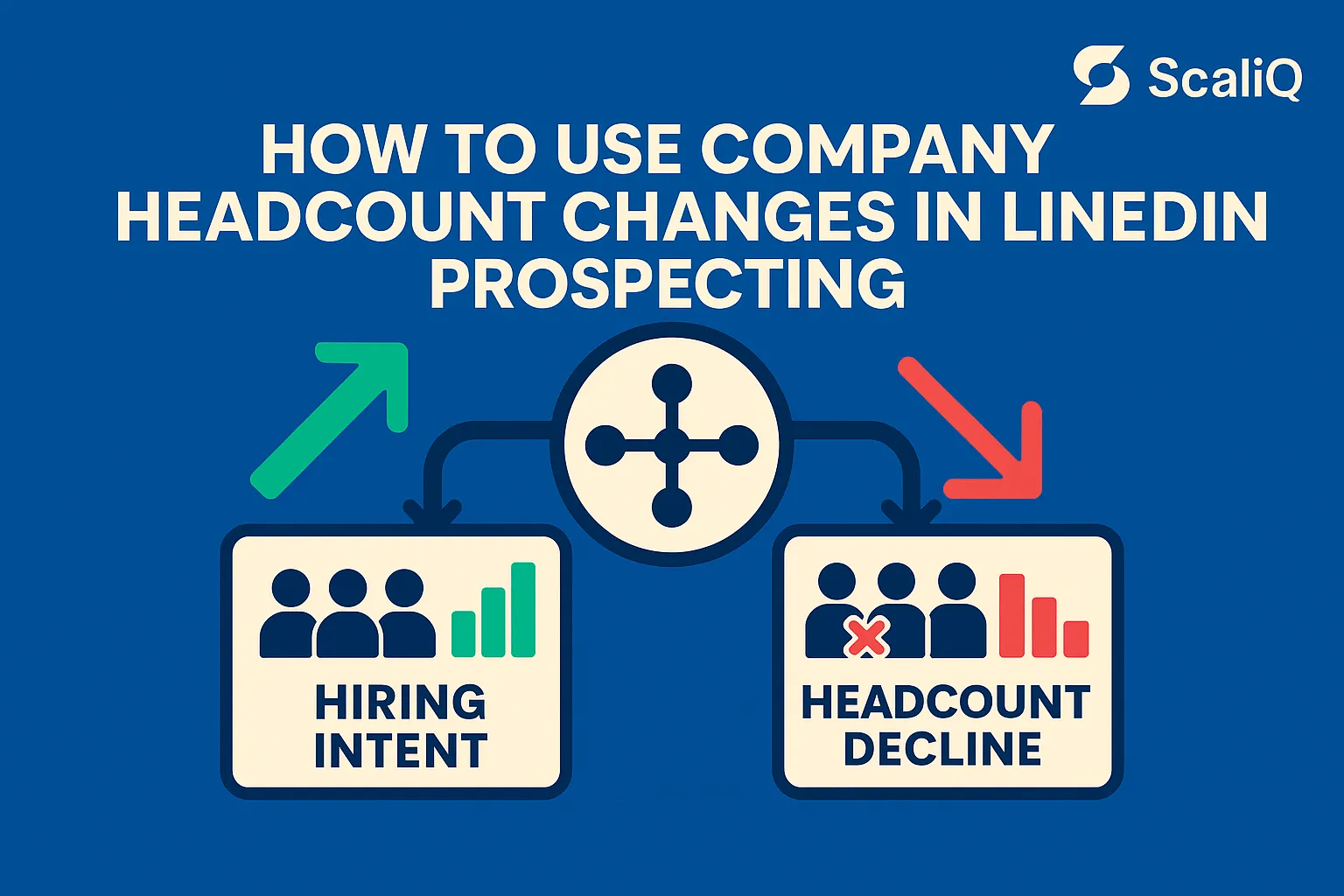
Expansion hiring represents the creation of net-new capacity, rather than simply replacing departed employees. Sustained headcount growth signals usually indicate fundamental shifts: aggressive new revenue targets, geographic market expansion, onboarding stress, increasing reporting complexity, or a demand for greater process maturity.
When evaluating hiring intent signals, look for consistency over time rather than isolated bursts of hiring. A steady month-over-month increase in a specific department is a strong indicator of scaling pain. Outreach in these scenarios should aggressively target the challenges of growth: enablement, productivity, cross-team coordination, and workflow automation. Understanding expansion hiring vs replacement hiring ensures you are targeting companies actually experiencing growing pains.
Contraction: when shrinking headcount is still a valid trigger
A decline in headcount should not automatically disqualify an account. In fact, contraction can be a highly lucrative trigger if approached correctly.
Shrinking teams frequently create urgent demand for efficiency, vendor consolidation, cost control, workflow simplification, risk reduction, and better executive visibility. As highlighted by the BLS analysis of quits vs layoffs, not all labor movement means the same thing; healthy churn and strategic restructuring differ vastly from financial distress.
When conducting company hiring outreach, contraction changes the angle, not necessarily the opportunity. Figuring out what messaging works when a company is shrinking requires tact. Ensure your messaging is respectful, evidence-based, and focused on doing more with less, elevating your account prioritization strategy.
Replacement hiring: the most common source of false positives
Replacement hiring is the act of backfilling churn, turnover, or maintaining role continuity. It does not signify team expansion.
Identifying replacement hiring requires looking for specific patterns: repeated job postings for the exact same role, a flat total headcount despite active job listings, or isolated openings without broader departmental growth. These are classic false positives from seasonal hiring or standard attrition.
While replacement hiring might matter for highly specific product categories (like onboarding software for new hires), it generally implies significantly less urgency than sustained expansion. Advanced outbound teams should score these hiring intent signals lower unless they are corroborated by broader organizational changes.
What level of change is meaningful enough to trigger outbound?
When asking what level of headcount growth is meaningful enough to trigger outbound, avoid rigid, universal thresholds. A 5% growth rate means something entirely different for a 50-person startup than it does for a 5,000-person enterprise.
Instead, utilize a relative framework based on recency, velocity, department concentration, and persistence. A meaningful trigger is sustained or highly concentrated change. Create a simple decision model for your SDRs and RevOps teams:
• Weak Signal: Isolated job posts, flat total headcount, standard backfills.
• Moderate Signal: Steady growth in one department, slight overall headcount increase.
• Strong Signal: Rapid, sustained headcount trends by department coupled with new leadership hires.
This relative scoring ensures your account prioritization is rooted in context rather than arbitrary numbers.
Which Departments Create the Strongest Buying Signals
Top-line growth is just noise. Function-specific changes reveal the actual pain points and distinct buying windows.
Sales team growth
Sales hiring is one of the most reliable headcount growth signals. It often points to immediate ramp pressure, territory expansion, pipeline management needs, coaching complexity, and potential productivity gaps.
If your solution ties into workflow automation, prospecting efficiency, enablement, or revenue reporting, these sales prospecting triggers are goldmines. Message angles should focus heavily on scaling outbound quality, maximizing rep efficiency, and preserving signal quality as the revenue organization rapidly expands. These company expansion signals represent immediate, budgeted pain.
Marketing team growth
Marketing hiring indicates increasing demand generation efforts, rising campaign complexity, attribution pressure, and a pressing need for better lead orchestration.
Crucially, these hiring intent signals matter even if your primary buyer is in sales. GTM functions scale together; if marketing is growing rapidly, sales will soon feel the pressure of increased lead volume. Use these buyer timing signals to deploy sales intelligence messaging around campaign timing, lead quality handoffs, workflow coordination, and closed-loop reporting.
Customer success and support growth
Growth in post-sales teams indicates rising onboarding loads, retention pressure, increasing customer volume, or a maturing expansion motion.
When you track employee growth tracking in CS, it reveals a prime opportunity for company hiring outreach focused on process automation, knowledge base workflows, retention reporting, or customer operations tools. Your account prioritization should target these accounts with messaging centered on achieving scale without sacrificing service quality or degrading the customer experience.
Operations, finance, and admin growth
Back-office hiring is a powerful indicator of internal complexity, compliance burdens, and the maturation of corporate processes.
These headcount trends by department are critical when selling efficiency, orchestration, analytics, or operational software. Operations growth often reveals more about internal system bottlenecks than broad top-line headcount alone. Use this sales intelligence as one of your primary buyer timing signals for infrastructure and ERP solutions.
Product, engineering, and technical hiring
Technical hiring signals product expansion, platform investment, integration initiatives, or infrastructure scaling.
However, engineering growth is not a universal buying trigger. Knowing which departments should reps monitor for hiring changes depends entirely on your solution. If you sell developer tools or cloud infrastructure, this is a primary trigger. If you sell HR software, engineering growth acts as supporting context—a signal that the company is well-funded and expanding—boosting your account prioritization score for broader company expansion signals.
Recruiting and talent acquisition growth
Hiring within the recruiting department is a meta-signal. It indicates that the company expects sustained, long-term workforce expansion.
As noted in the World Economic Forum Future of Jobs research, shifting employer priorities dictate which functions are scaled first. Recruiting growth acts as a signal amplifier, strengthening your confidence in broader expansion. While not always a primary indicator on its own, layering this into your employee growth tracking and headcount growth signals validates that the company is in a prolonged state of scaling.
How to Turn Hiring Signals into Outreach Timing and Messaging
Observation without action is useless. You must convert observed headcount changes into perfectly timed outreach.
Build a simple signal scoring model
Treating all hiring as equally important destroys efficiency. Build a practical signal scoring model using four variables: recency, velocity, department relevance, and corroborating signals.
This model dramatically improves account prioritization. For example, a company with high velocity hiring in your target department, corroborated by a recent funding round, receives a Tier 1 score. A company with slow, replacement-level hiring receives a Tier 3 score. Advanced teams can leverage platforms like ScaliQ's features to understand which LinkedIn prospecting workflows can automate headcount-based account prioritization, turning raw linkedin sales triggers into a prioritized daily execution list.
When to reach out after hiring growth
Knowing when to reach out after hiring growth dictates your success rate. Outreach is most effective when hiring shows momentum or immediate scale pressure—not six months after the signal becomes stale.
Determine how often should reps monitor LinkedIn headcount changes by establishing a regular review interval and setting up event-based alerting. "Now" depends on the stage: early-stage growth requires messaging about building foundations, while sustained scale-up requires messaging about breaking bottlenecks. Act on these buyer timing signals while the operational pain of growth is most acute.
Messaging for expansion scenarios
Company hiring outreach during expansion must connect the growth directly to likely pain points: chaotic onboarding, handoff complexity, dropping productivity, broken reporting, or process bottlenecks.
Use hypothesis-based messaging rather than stating assumptions as facts. Outbound personalization thrives on angles like, “As your sales team scales, maintaining CRM hygiene usually becomes a bottleneck...” or “With new CSM capacity coming online, how are you ensuring onboarding quality doesn't dip?” These headcount growth signals provide the perfect context for value-led hypotheses.
Messaging for contraction scenarios
Figuring out what messaging works when a company is shrinking requires a shift toward efficiency, vendor consolidation, ROI, and reducing operational drag.
Avoid overly aggressive or insensitive copy. The tone must be calm, relevant, and value-led. Frame your company hiring outreach around maintaining output with leaner teams or simplifying fragmented workflows. These sales prospecting triggers are ideal for demonstrating hard cost savings and workflow automation.
Avoiding common prospecting mistakes
The most common pitfalls include treating all hiring as active intent, ignoring specific department context, using a generic sequence for every signal type, and failing to validate with other indicators.
Avoid false positives from seasonal hiring or isolated backfills by zooming out to look at the trend line. This methodology stands in stark contrast to generic sales trigger lists that lack prioritization logic. By mastering signal ambiguity in hiring data, you ensure your outreach is always contextual, verified, and highly relevant.
How to Combine LinkedIn Headcount Data with Other Signals
To increase confidence and reduce noise, hiring trends must be validated with adjacent signals.
Funding, expansion, and leadership changes
Company expansion signals become exponentially more actionable when paired with funding events, geographic expansion, new executive hires, or team leadership changes.
These combinations indicate strong budget confidence and an organizational mandate for change. Treat multi-signal combinations as confidence multipliers. When sales trigger events for prospecting align with rapid headcount growth, you have identified the strongest possible buyer timing signals.
Job postings and role wording
The specific language used in job descriptions reveals whether hiring is tied to a new motion, systems gaps, process complexity, or standard replacement needs.
Wording matters deeply. Repeated references to "scale," "automation," "onboarding," or specific software systems sharpen your outreach hypothesis. According to Indeed Hiring Lab job postings data, pairing headcount changes with broader job-posting trends helps differentiate raw headcount change from interpretable hiring intent signals. This is how do you find hiring trends on LinkedIn that actually convert: by reading between the lines of headcount trends by department.
Technology adoption, website activity, and first-party engagement
Technical changes, website traffic shifts, or first-party engagement make headcount signals significantly more actionable for campaign timing.
A company hiring heavily and engaging with your category content deserves a much higher score than a company that is only hiring. Advanced sales intelligence connects public account-based prospecting signals with your own CRM engagement data, perfecting your account prioritization.
Why no single signal should stand alone
Company headcount changes in LinkedIn prospecting are directional signals, not definitive proof of active buying.
This is a validation workflow: signal detection, interpretation, corroboration, and finally, outreach. As noted by the Richmond Fed on how employers recruit, recruiting activity often appears before it is fully visible in standard measures, making multi-signal validation critical. Better decisions come from layered evidence, turning basic hiring intent data for outbound into a sophisticated sales intelligence machine.
Tools, Workflows, and Operationalization
Transforming this framework into a repeatable outbound process requires operational discipline. All data extraction and monitoring must be done in strict compliance with platform terms of service and privacy regulations, utilizing ethical automation and publicly accessible information workflows.
A repeatable workflow for SDRs and RevOps
Implement a simple, process-oriented workflow:
1. Monitor Accounts: Track target accounts for workforce movement.
2. Detect Changes: Identify headcount shifts.
3. Categorize Signal: Determine if it is expansion, contraction, or replacement.
4. Score Confidence: Apply your scoring model based on velocity and department.
5. Assign Angle: Match the signal to the correct messaging hypothesis.
6. Launch Sequence: Execute timely outreach.
7. Review Outcomes: Analyze reply rates to refine the model.
This framework dictates which LinkedIn prospecting workflows can automate headcount-based account prioritization, turning employee growth tracking into a core RevOps playbook.
Where automation adds value
AI-assisted prospecting workflows can turn raw workforce changes into actionable account scores, strategic recommendations, and personalization prompts.
Automation should support analyst-grade interpretation, not replace human judgment. Platforms like ScaliQ orchestrate this signal-driven workflow, providing the verification and enrichment needed to scale. Once the signal is qualified, tools like RepliQ assist in executing the personalized outreach. This combination of sales intelligence and account-based prospecting signals ensures you capitalize on linkedin sales triggers efficiently and compliantly.
What to measure after rollout
To validate the lift of this framework, measure quality-of-outreach metrics: reply relevance, meeting conversion rates by signal type, priority-account penetration, and time-to-engage after a trigger.
Compare your headcount-based campaigns against static-list campaigns. Continuously refine your thresholds, scoring models, and message angles based on these account prioritization results. This ensures your sales prospecting triggers and company hiring outreach remain highly calibrated over time.
Conclusion
Headcount changes only become truly useful when they are strictly interpreted, segmented by function, and validated by adjacent data points, rather than treated as generic hiring alerts.
By identifying whether a signal reflects expansion, contraction, or replacement hiring, analyzing the specific department involved, scoring your confidence, and pairing it with corroborating signals, you can tailor your outreach with unmatched precision. Function-level interpretation is the key that turns noisy company headcount changes in LinkedIn prospecting into highly practical campaign timing.
Stop relying on static lists and start leveraging dynamic headcount growth signals and linkedin sales triggers. To see how analytical, signal-driven outbound prioritization can transform your pipeline, explore how ScaliQ helps teams operationalize these insights for smarter account prioritization.