

How to Create LinkedIn Follow-Ups Based on Prospect Engagement
Most LinkedIn follow-ups fail for one simple reason: they treat every prospect exactly the same, even when prospect behavior clearly dictates otherwise. When you send an identical, rigid sequence to one prospect who accepts your request, another who views your profile, a third who likes a post, and a fourth who stays completely silent, you are ignoring the most valuable data available to you—context.
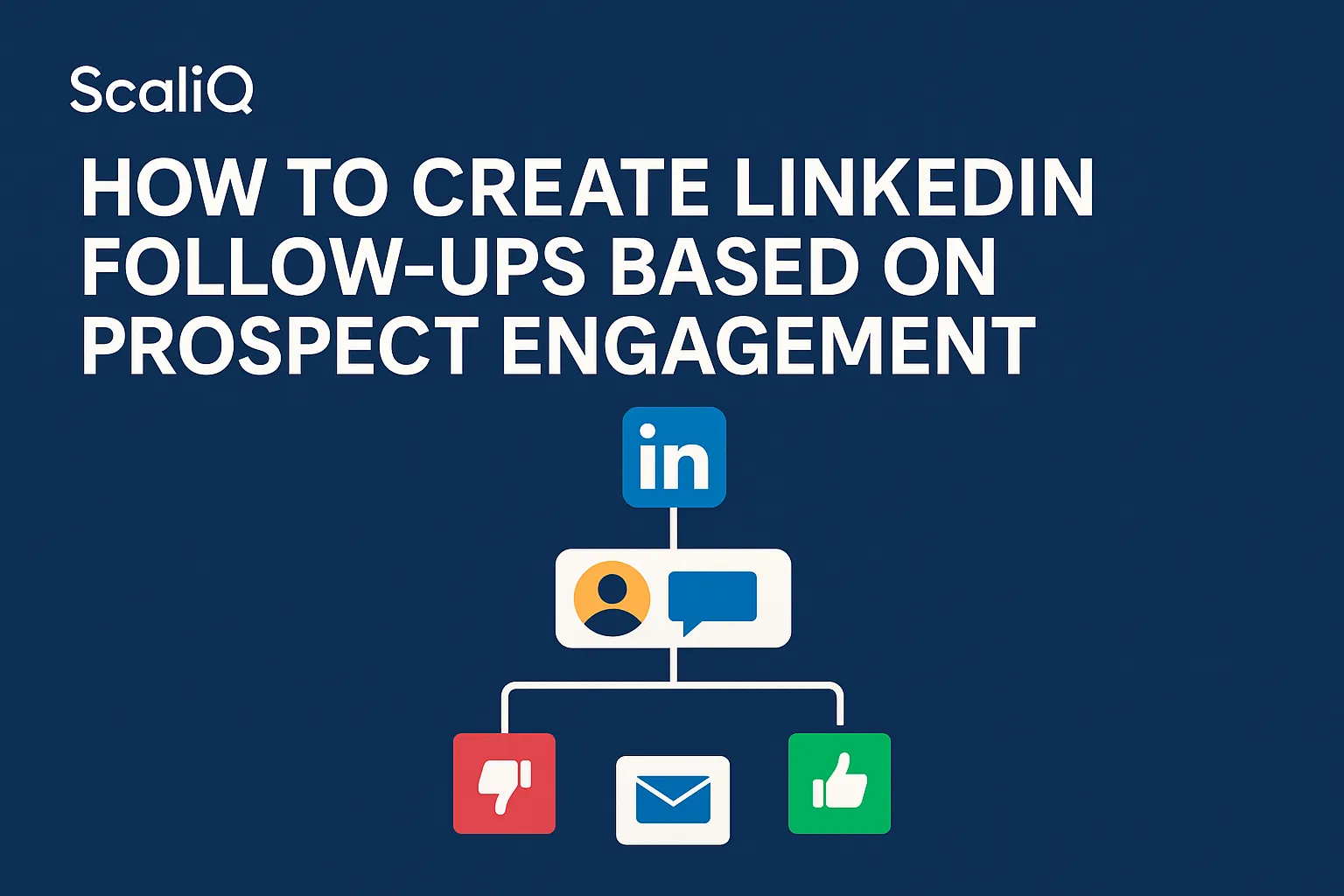
This is not a beginner’s guide to basic LinkedIn prospecting. If you are already running campaigns, you know that a static cadence underperforms. This article provides a practitioner-led, decision-tree approach to contextual outreach. By mapping each behavioral signal to the right next step, you can identify the signal, interpret the likely intent, choose the correct timing, send a highly relevant message, and know exactly when to stop.
At ScaliQ, our behavior-driven outreach approach proves that treating prospects as individuals rather than numbers drastically improves conversion rates. Whether you are dealing with a silent acceptance, profile engagement, or a soft reply, your follow-up strategy must adapt to the buyer's actions. You can explore more of our playbooks on signal-based prospecting by visiting Blog.
Which LinkedIn Signals Actually Matter
Not all prospect engagement signals carry equal weight. A like on a post might indicate passing curiosity, while a thoughtful comment or a direct reply signals active interest. To execute effective behavior-based follow-ups, you must separate meaningful buying behavior from weak or ambiguous platform activity.
A simple signal hierarchy helps structure your social selling engagement signals: Reply > Repeat Engagement > Profile View > Connection Acceptance > No Engagement. The goal is not to overinterpret a single click, but to use these actions as contextual clues to inform smarter, more relevant outreach. This hierarchy forms the foundation of the decision-tree logic we will use throughout this framework.
Strong vs. Weak LinkedIn Signals
To operationalize behavioral segmentation outreach, you need to quickly distinguish between strong and weak signals. Strong signals—such as direct replies, thoughtful comments, repeat post engagement, profile revisits, and message continuation—deserve faster, highly personalized follow-ups. Weaker signals—like a single profile view, a connection acceptance with no response, or a passive like—call for a much lighter-touch approach.
Why Context Beats a Fixed Outreach Cadence
Static cadences rely on a "spray and pray" mentality, pushing prospects through a rigid timeline regardless of their actions. This approach ignores intent shifts, making your personalized prospecting on LinkedIn feel robotic.
A contextual outreach strategy adapts. The timing and copy of your next message should inherently change based on whether the prospect accepted, engaged, replied, or ignored your initial outreach. Unlike automation-first sequences that prioritize sheer volume over relevance, a contextual LinkedIn outreach cadence prioritizes relationship building. Following LinkedIn’s official guidance on connecting with prospects, it is critical to review recent activity and establish relationship context before sending your next message.
A Simple Signal-Scoring Model for Prioritization
To manage follow-up timing efficiently, implement a simple prioritization model categorizing leads by high, medium, and low intent.
• High Intent (Message Now): Prospects who reply or consistently engage with your content move to the top of your queue.
• Medium Intent (Nurture Carefully): Acceptance without reply belongs here. These are not "interested leads" yet; they are simply open doors.
• Low Intent (Pause or Content Nurture): Total silence.
Using this score helps you decide on the fly whether to execute a reply vs silence follow-up, nurture the lead on LinkedIn through content, or pause outreach entirely.
How to Follow Up After Acceptance Without Reply
The most common and confusing signal on the platform is an accepted connection request that is met with silence. Acceptance is a positive signal, but it is not proof of buying intent.
The most frequent mistake sales reps make is sending a hard pitch immediately after the prospect clicks "accept." To build a successful LinkedIn follow-up strategy, you need a nuanced sequence for your first follow-up, your second touch, and your stopping rules.
What Connection Acceptance Usually Means
When a prospect accepts your request, it usually signifies an openness to network, mild curiosity, or simple name recognition. It rarely equals immediate buying intent.
Before drafting your LinkedIn follow-up message after connection accepted, review the prospect’s profile, recent activity, and current role. Use their acceptance as a cue for relevance, not a license for urgency. Treat them as a new professional acquaintance, not a qualified lead in your pipeline.
First Follow-Up After Acceptance
Your first touch should be a low-pressure follow-up focused entirely on relevance. The goal of contextual outreach is to start a dialogue, not close a deal.
Message Framework: Acknowledge the connection, add context or value, and provide a low-friction reason for a conversation.
"Hi [Name], thanks for connecting. I noticed you’re leading the [Department] team at [Company]—we’ve been doing a lot of work recently around [Specific Challenge]. Are you currently focused on [Challenge] this quarter, or is your priority elsewhere?"
This social selling follow-up feels conversational, specific to their role, and ends with a soft call-to-action (a simple question) rather than a heavy request for a 30-minute demo.
If They Accept but Stay Silent
If the prospect remains silent after your first follow-up, wait at least four to five days before reaching out again. Repeating the same ask will rapidly degrade your response rates.
Your second follow-up must change the angle. Instead of "just checking in," offer an insight, an observation, or a relevant resource tied to their priorities. If you still receive a LinkedIn no response follow-up scenario, it is time to switch from direct messaging to indirect warming through content engagement. At this point, the prospect moves into a lower-priority nurture bucket.
Mistakes to Avoid in the Accepted-But-Silent Scenario
When dealing with a reply vs silence follow-up, avoid immediate pitching, massive blocks of text, fake familiarity, and generic language. Persistence without new context is exactly what makes behavior-based follow-ups feel like spam.
If you are going to reach out again, you must change the timing, the message angle, or the channel. Many outreach tools stop at providing generic templates, missing the critical decision logic required for success. As noted in LinkedIn’s official guidance on connecting with prospects, restraint and relevance are key to maintaining your professional reputation.
To automate this decision logic seamlessly, explore how ScaliQ can help detect acceptance and trigger entirely different follow-up paths based on prospect response behavior.
What to Do After Profile Views or Content Engagement
Prospects often show passive or indirect interest outside of the inbox. Profile views and post engagement are highly valuable signals, but they must be interpreted carefully to fuel your contextual outreach. Turning lighter signals into warm, natural follow-ups requires differentiating between a one-off click and a repeated pattern of engagement.
How to Interpret a Profile View
A profile view generally signals curiosity, name recognition, or a prospect evaluating your credibility after seeing your initial message. However, a single profile view does not justify an aggressive pitch.
Check the context: did the view happen immediately after your outreach? After they read a post? Or out of the blue? Profile views become highly actionable when paired with connection acceptance or content engagement. To understand exactly what this data point means, you can review LinkedIn’s Who Viewed Your Profile feature, which clarifies how the platform tracks and displays this signal.
What to Send After a Profile View
When executing profile engagement outreach, your message should be built around relevance, not surveillance. Never say, "I saw you viewed my profile"—it feels intrusive and immediately puts the prospect on the defensive.
• Don't send: "I saw you checking out my profile! Let me know if you want to book a demo to learn about our software."
• Do send: "Hi [Name], noticed we run in similar circles around [Industry/Topic]. I recently put together a resource on [Specific Problem] that your team at [Company] might find useful. Mind if I send the link over?"
This behavior-based follow-up leans on shared context and a soft offer, rather than making the prospect feel watched.
Following Up After Content Likes, Comments, or Repeat Engagement
Content engagement is often a stronger buying-context signal than a silent message open. However, you must differentiate between a passive like and a thoughtful comment.
If a prospect comments on your post about outbound sales strategies, your personalized prospecting on LinkedIn should naturally follow that thread. Tailor your follow-up to the exact topic they engaged with, rather than restarting a generic pitch from scratch. Use their engagement as an invitation to continue a conversation they already started.
When to Message vs. When to Nurture Through Content
Knowing when to deploy direct outreach versus continued warming is the core of behavioral segmentation outreach.
• Direct Outreach: Trigger a message when multiple signals cluster together (e.g., Connection Acceptance + Profile Visit + Post Comment).
• Continued Nurture: Hold off on messaging when the signal is weak, isolated, or inconsistent (e.g., a single "Like" from a 2nd-degree connection).
Applying this filter prevents you from wasting effort on low-intent prospects while surfacing the warmest opportunities in your pipeline.
How to Handle Silence, Replies, and Stopping Rules
One of the biggest anxieties in LinkedIn prospecting is the tension between not wanting to leave money on the table and not wanting to become an annoyance. You need a practical framework for knowing when to persist, when to pivot, and when to stop entirely.
What to Do When There Is Total Silence
Total silence means no reply, no profile visits, and no content engagement after your initial outreach. In this scenario, limit your follow-up strategy for silent prospects to three or four touches before pausing.
Every subsequent message must introduce something new: a sharper angle, clearer relevance, or a lower-friction call-to-action. Repeatedly nudging a cold prospect with "Did you see my last message?" will not revive them; it will only get you blocked.
How to Follow Up After a Soft Reply
Soft replies include phrases like "not right now," "send me some details," or brief, polite brush-offs. These prospects are neither hot leads nor silent dead-ends.
Instead of pushing for a meeting, use social selling follow-ups that ask curiosity-driven questions to move the conversation forward naturally. According to research on the value of follow-up questions, asking thoughtful, relevant follow-up questions significantly improves conversation quality and likability. Use this to your advantage to uncover their actual timeline or deeper pain points.
How to Follow Up After a Real Reply
Once a prospect replies meaningfully, sequence execution ends, and conversation management begins. Your LinkedIn messaging sequence is officially paused.
Adapt to the prospect’s language, pace, and objections. Use their replies to qualify their interest, clarify their pain points, and offer the most logical next step. If they show high buyer readiness, this is the time to seamlessly transition the contextual outreach from LinkedIn to email or a discovery call.
Read States, Message Indicators, and False Assumptions
Do not over-rely on message indicators or assume a prospect's intent based on partial data. Just because a message is marked as "read" does not mean the prospect is actively ignoring you; they may have opened it on their phone while commuting and forgotten to reply.
To avoid overreacting to partial signals, familiarize yourself with LinkedIn message indicators and read states to understand platform functionality. Always rely on broader behavioral context rather than a single checkmark.
Clear Stopping Rules So Persistence Does Not Become Spam
Without clear stopping rules, follow-up timing devolves into spam. Implement these practical criteria to protect your brand reputation:
• Stop if there is no response after 3-4 context-aware touches.
• Stop if you see repeated weak signals with no escalation to conversation.
• Stop immediately upon explicit disinterest.
When you hit a stopping rule, pause direct messaging and shift to nurturing the prospect through content only.
How to Operationalize Signal-Based Follow-Ups
Moving from ad hoc interpretation to a repeatable workflow is how you scale behavior-based follow-ups across an entire sales team. You can use automation to support contextual outreach without making your messages sound automated.
Build a Simple Decision Tree for Your Team
Create a shared contextual follow-up strategy framework with specific branches for acceptance, profile engagement, content engagement, reply, and no engagement.
For each branch, define three fields:
1. Timing: How long to wait before the next touch.
2. Message Goal: What the message is trying to achieve.
3. Next Action: What to do based on the prospect's response.
Documenting examples ensures reps stay consistent without sounding scripted, making this an excellent tool for SDR onboarding and coaching.
Match Message Goals to Signal Type
Different signals require fundamentally different message goals. If a prospect views your profile, the goal is to re-engage interest. If they reply softly, the goal is to qualify the need. If they remain silent, the goal is to gracefully pause.
Using message intent as a filter before writing copy prevents reps from jumping to a meeting ask too early, ensuring your social selling follow-ups remain human and relevant.
Use Automation Carefully Without Losing Relevance
Automation is incredibly powerful for detecting signals, routing prospects, setting reminders, and drafting first-pass copy. However, human judgment is still required to interpret weak signals, adjust tone, and decide when not to hit send.
Avoid rigid automation platforms that ignore behavioral nuance. Instead, look for systems that excel in AI enrichment, verification, and orchestration. To see how modern teams operationalize signal-based workflows seamlessly, visit ScaliQ.
A Sample Weekly Workflow for Reps
To turn outreach behavior signals into a daily habit, suggest this practical review rhythm for your reps:
1. Sort engaged leads first: Reply to comments and direct messages immediately.
2. Review accepted-but-silent second: Send context-aware first follow-ups.
3. Nurture passive engagers third: Send soft resources to profile viewers.
4. Deprioritize total silence: Move unresponsive leads into content-nurture buckets.
Track which signals consistently lead to replies so you can refine your LinkedIn follow-up strategy over time.