

LinkedIn Outreach for Architecture and Engineering Firms
The core problem facing business development teams in the architecture, engineering, and construction (AEC) sector is simple but costly: generic outreach rarely works. Today’s buyers expect relevance, credibility, and timing tied directly to real projects. When an outreach message lacks these elements, it is immediately ignored.
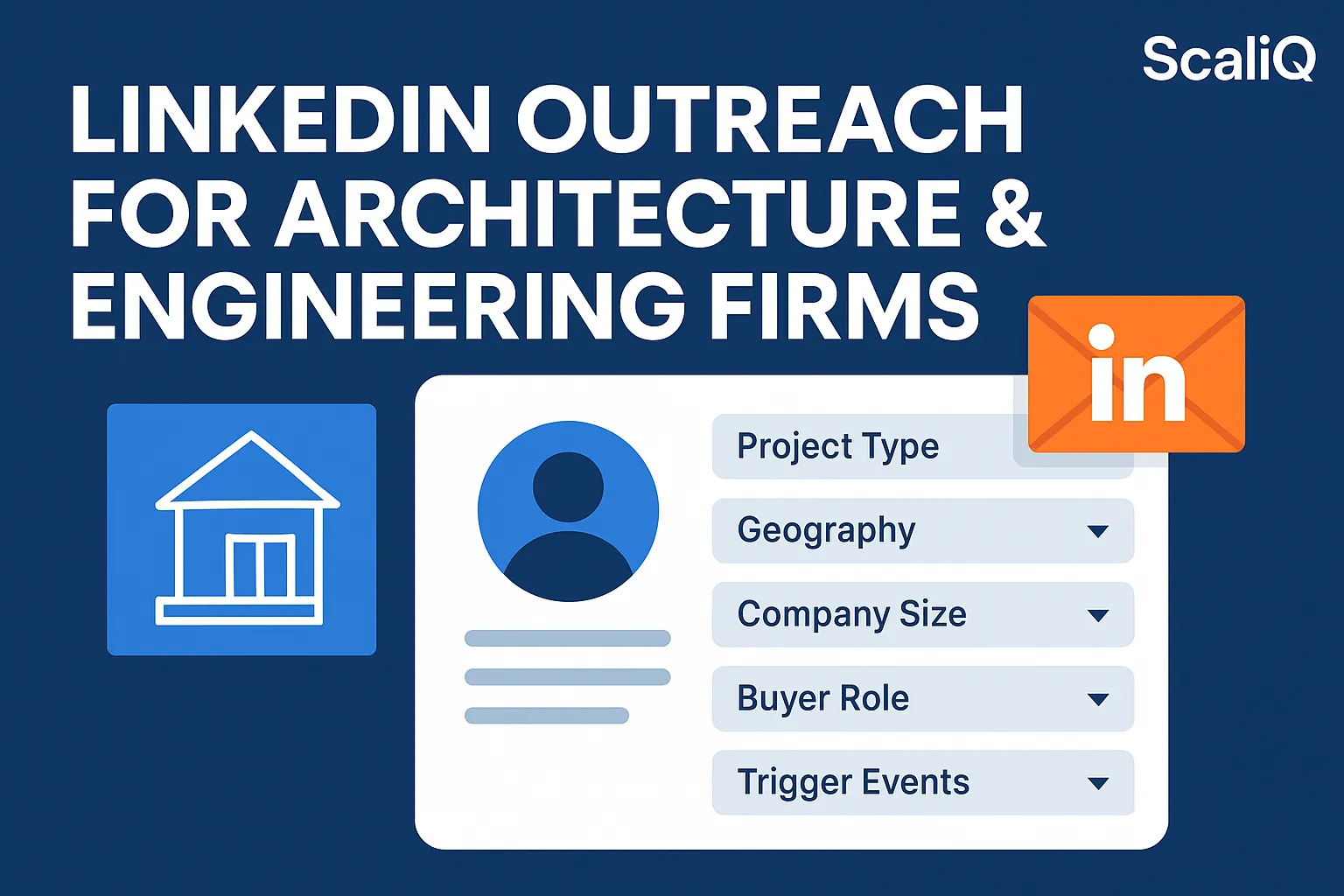
Architecture and engineering firms operate in environments defined by long sales cycles and relationship-driven trust. Because of this, LinkedIn functions best as a precision prospecting and credibility-building channel, rather than a high-volume numbers game. A successful LinkedIn outreach strategy for architecture and engineering firms requires meticulous segmentation by project type, geography, company size, decision-maker role, and trigger events.
This article serves as a practical playbook for building a qualified pipeline through professional services outreach. We will cover exactly how to execute targeted list building, craft persona-driven messaging, establish a multichannel cadence, and measure true pipeline outcomes. For business development leaders, marketers, and seller-doers, this is the blueprint for a repeatable, high-converting AEC lead generation process. By leveraging ScaliQ's approach to targeted outbound growth and project-led market segmentation, firms can stop guessing and start connecting with the right stakeholders at the right time.
Why LinkedIn Works for AEC Business Development
LinkedIn is far more than a networking platform; for AEC firms, it is a powerful engine for buyer discovery, credibility validation, and soft-entry prospecting. When paired with account-based targeting, LinkedIn becomes a highly effective environment for relationship-led business development.
In the context of the AEC pipeline, LinkedIn fits perfectly into early-stage account research, stakeholder mapping, securing warm introductions, and executing low-friction outreach. Broad lead generation tactics often fail in this industry because AEC buyers require multiple credibility signals before committing to a meeting. Trust-led outreach consistently outperforms aggressive direct pitching. According to SMPS Foundation AEC business development research, long sales cycles and seller-doer models demand a relationship-based approach to growth, proving that selective pursuit of qualified accounts yields higher ROI than mass prospecting.
Firms looking for a structured approach to segmented outbound for professional services can utilize ScaliQ to ensure their LinkedIn outreach aligns with these high-trust, relationship-driven buying cycles.
Where LinkedIn Fits in the AEC Growth Mix
LinkedIn is most useful when targeting named accounts, researching internal stakeholders, and creating initial brand familiarity before transitioning to email or phone conversations. This platform excels in B2B social selling for professional services, especially for complex consulting and engineering services where decision-makers need to vet a firm’s expertise and relevance before responding.
Crucially, an AEC marketing strategy should treat LinkedIn as a supporting pillar—not a replacement—for email, CRM management, and content marketing. It is the bridge between identifying a target account and earning the right to a deeper conversation.
Why Generic LinkedIn Prospecting Underperforms in AEC
Mass outreach fails in architecture and engineering because it suffers from low relevance, weak differentiation, and poor timing. Buyers instantly ignore outreach that lacks project context, sector experience, or role-based relevance.
Many generic outbound playbooks over-prioritize scale at the expense of context, leading to low response rates from LinkedIn outreach. Unlike broad, spammy LinkedIn outreach for professional services that relies on volume, successful AEC business development requires a highly differentiated approach. By prioritizing segmentation, relevance, and project timing, firms can bridge the critical gaps left by generic prospecting content and establish immediate authority.
How to Build and Segment Target Account Lists
To generate high-quality architecture firm leads and optimize engineering company prospecting, you must move away from broad, low-converting lists and build concrete frameworks for high-fit target accounts.
Defining an Ideal Client Profile (ICP) for AEC outreach requires looking at project type, geography, company size, sector, and stakeholder role. You must prioritize accounts based on a combination of fit and timing, rather than just relying on broad industry labels. Segmenting by decision-maker and understanding the influence structure within architecture, engineering, ownership, development, and operations teams is critical. Better lists directly improve personalization, response quality, and downstream pipeline efficiency.
As highlighted in the SBA guide to target market planning and the SBA framework for customer segments and channels, clear segment definition and accurate customer profiling are foundational to any successful account-based marketing strategy for architecture firms.
Start with an AEC-Specific Ideal Client Profile
An effective ICP for AEC lead generation goes beyond basic demographics. It must include dimensions specific to the built environment: project category, regional footprint, contract size, delivery model, and buyer sophistication.
For example, an architecture firm targeting healthcare renovations will build a vastly different list than an engineering consultancy focused on public infrastructure owners. By combining firmographic fit signals with your underlying business development strategy—rather than just relying on basic platform filters—you ensure your outreach is directed only at accounts capable of procuring your specific services.
Segment by Project Type, Geography, and Company Size
Segmentation should mirror how AEC firms actually win work: through market specialization and delivery fit. Account-based outreach for AEC firms must be categorized by niches such as education, healthcare, industrial, commercial, civic, or multifamily projects.
Geography is equally critical. Local relationships, permitting realities, regional funding mechanisms, and delivery partnerships dictate project viability. Furthermore, company size heavily influences buyer structure, budget ownership, and the tone of your outreach. Understanding how firms can personalize outreach by project type, geography, or company size is the key to escaping the generic inbox folder.
Identify the Right Buyer Roles and Influencers
AEC purchasing decisions are rarely made by one person. To succeed in LinkedIn prospecting for engineering firms, you must break down the common roles within an account: developers, owners, facilities leaders, operations leaders, procurement, project executives, and external consultants.
You must distinguish between the budget owner (who controls the capital), the technical evaluator (who assesses your engineering or design competence), and the internal champion (who advocates for your firm). Account mapping—identifying multiple stakeholders within a single organization—is far more effective than relying on a single point of contact.
Use Trigger Events to Prioritize Outreach
The most effective way to solve unclear prospect prioritization for architecture firms is to use trigger events. Publicly accessible signals such as hiring surges, facility expansions, funding rounds, corporate relocations, capital planning reports, permit activity, or project announcements allow you to rank accounts by immediate need.
Trigger-led outreach feels highly relevant because it aligns directly with active business moments. When executing an engineering firm sales strategy, mention only the most relevant trigger in your outreach to avoid overwhelming the message. This practical, trigger-based workflow is a major differentiator compared to broad competitor content that ignores timing altogether.
Practical List-Building Workflow
To streamline your LinkedIn lead generation strategy, follow this practical, repeatable workflow:
1. Define your niche: Identify the specific project type and region.
2. Build the account list: Source companies that fit the firmographic profile.
3. Map stakeholders: Identify the budget owners, technical evaluators, and champions.
4. Tag segments: Categorize by persona and company size.
5. Identify triggers: Look for recent funding, hiring, or expansion news.
6. Prepare proof points: Align your past project success with their current context.
For more insights on executing this workflow, explore educational content on outbound workflows and segmentation at the ScaliQ blog.
Messaging by Buyer Persona and Project Trigger
Writing LinkedIn outreach that feels relevant, credible, and low-pressure is an art. Strong messaging combines three elements: who the buyer is, what business context they are operating in, and why your firm is relevant to them right now.
You must lead with fit and insight, not a meeting request. Emphasize proof points such as similar project experience, sector expertise, regional knowledge, delivery outcomes, or specialized capabilities. According to the AIA report on technology culture and firm growth, modern growth efforts in architecture rely heavily on digital outreach and credibility-building to establish authority early in the relationship.
Core Principles of Non-Spammy AEC Outreach
To avoid spammy LinkedIn outreach for professional services, prioritize brevity, relevance, and specificity over cleverness or high-pressure sales tactics. Never use immediate “book a call” language in the first touch unless there is a clear, warm context. Your initial message must prove that you understand the buyer’s market, project environment, or operational priorities. Professional services outreach must always be consultative.
Messaging for Developers and Owners
Developers and owners care deeply about project outcomes, delivery confidence, schedule risk, partner fit, and market-specific experience. When considering how firms should tailor messaging for owners, facilities leaders, developers, and general contractors, focus on proof points tied to similar asset classes, expansion plans, redevelopment activity, or stakeholder coordination. Messages to this persona must demonstrate strategic business understanding, avoiding overly technical design jargon.
Messaging for Facilities, Operations, and Capital Planning Leaders
Facilities and operations leaders respond best to language centered around lifecycle value, phased execution, operational continuity, compliance, and modernization. Your B2B outreach for professional services should connect directly to practical, on-the-ground challenges like campus growth, deferred maintenance, workplace change management, or facility expansion. Keep the tone highly consultative, positioning your engineering company prospecting as a solution to their operational headaches.
Messaging for Procurement and Formal Buying Stakeholders
Procurement contacts prioritize process, qualifications, proven experience, and risk management. Messaging to this group should be restrained and credibility-led, showcasing clear evidence of fit and a deep familiarity with formal selection processes. It is vital to distinguish between nurturing procurement contacts to stay top-of-mind for future RFPs versus expecting them to originate immediate, sole-sourced opportunities.
How to Tie the Message to a Trigger Event
Trigger-based outreach improves timing, but it still requires restraint. Use one visible trigger alongside one relevant proof point. For example:
• Hiring surge: "Noticed the recent hiring push for the new regional office..." (Trigger) -> "...we recently helped [Similar Company] design their expanded headquarters to accommodate rapid headcount growth." (Proof Point)
• Funding news: "Saw the recent Series B announcement..." -> "...often this leads to facility expansion planning, which is exactly where we specialize."
• Relocation: "Congratulations on the upcoming move to Austin..." -> "...our local engineering team has navigated the specific permitting challenges in that district for three similar tech campuses."
Sample Low-Friction LinkedIn Sequence Structure
A trust-led, low-friction sequence structure is vastly superior to automation-heavy playbooks. A standard sequence for AEC business development should look like this:
1. Connection Request: Contextual and brief. (e.g., “Hi [Name], following your team's expansion into the industrial sector. We do a lot of structural engineering for similar facilities in the Midwest and I wanted to connect.”)
2. Short Follow-Up (Day 3): Thank them for connecting, provide a one-sentence value proposition.
3. Value Add (Day 10): Share a relevant insight or project case study. (e.g., “Thought you might find this brief on reducing supply chain delays in industrial builds useful based on your current pipeline.”)
4. Soft CTA (Day 21): A low-pressure invitation to chat. (e.g., “If you’re currently evaluating design partners for the upcoming phase, I’d be happy to share how we approached a similar challenge for [Client]. Open to a brief chat next week?”)
Outreach Cadence and Multichannel Follow-Up
AEC business development requires a realistic outreach rhythm that supports long sales cycles without feeling intrusive. Trust precedes meetings, meaning multiple touches across time and channels are necessary.
LinkedIn should be paired strategically with email, content marketing, and light account nurturing. Your cadence must reflect the buyer’s seniority, the project's timing, and the overall value of the target account.
A 3- to 5-Touch Cadence for AEC Firms
A light, 3- to 5-touch cadence structure typically includes a connection request, a follow-up note, a useful content share, and a soft meeting ask. Persistence matters, but over-messaging can severely damage credibility in professional services. Space your outreach based on the account's importance and the natural tempo of the market. Long sales cycles in architecture and engineering business development require patience; you are building a relationship, not forcing a transactional sale.
When to Add Email to the Workflow
Email becomes a necessary addition to the workflow when the account is a strong fit, the contact is highly senior, or a trigger event is time-sensitive. When comparing LinkedIn versus cold email for architecture firm lead generation, remember their unique strengths: LinkedIn is best for establishing familiarity and professional identity, while email allows for fuller context, attachments, and formal introductions.
Both channels should reinforce each other without duplicating the exact same message. For firms looking to orchestrate multichannel personalization and email follow-up seamlessly alongside LinkedIn, integrating tools like Repliq can provide excellent support.
Use Content to Build Credibility Between Touches
Instead of sending repeated "just checking in" messages, use content to build credibility between touches. Share case studies, thought leadership, market insights, or relevant project commentary. The most useful assets for AEC buyers include sector-specific work examples, regional expertise highlights, delivery lessons learned, and capital planning insights. Ensure strict alignment between your marketing content and your business development outreach to maintain a unified brand voice.
Coordinating LinkedIn with CRM and Account-Based Outreach
Outreach must be tracked at the account and stakeholder level, not just by individual messages. Document roles, trigger events, responses, and next steps meticulously inside your CRM. Disciplined workflow orchestration and regular review serve as strong trust signals for serious business development programs. This coordination ensures smooth follow-through between marketing teams, dedicated BD staff, and seller-doers who ultimately close the work.
How to Improve Response Quality and Measure Results
To truly optimize AEC lead generation, you must shift your focus away from vanity metrics and toward qualified conversations, account progression, and pipeline quality. In professional services, response quality matters far more than raw connection acceptance rates or sheer message volume.
Diagnose weak performance by critically analyzing your segmentation, messaging fit, trigger quality, and persona alignment. Continuous refinement based on replies, meetings, and influenced opportunities is essential. As recommended by NIST guidance on performance measurement and review, establishing a repeatable KPI and optimization framework ensures long-term outbound success.
Metrics That Actually Matter
Stop obsessing over simple "reply rates," which can be highly misleading if the replies are irrelevant or low-intent. Instead, track metrics that actually matter:
• Accepted connections within target ICPs
• Reply quality (positive sentiment vs. opt-outs)
• Stakeholder coverage (how many decision-makers per account are engaged)
• Meetings booked
• Qualified opportunities generated
• Influenced pipeline
Separate your top-of-funnel activity from actual pipeline contribution to get a clear picture of your LinkedIn lead generation strategy's effectiveness.
How to Diagnose Low Response Quality
If you are experiencing low response rates from LinkedIn outreach, you must identify the root cause. Problems usually stem from poor targeting, weak proof points, mistimed outreach, or generic wording.
Review your outreach performance by segment rather than treating all prospects as one massive audience. Use the replies you do receive to refine your persona assumptions and adjust your message angles. If owners are ignoring you but facilities managers are replying, your messaging may be too tactical and not strategic enough for the C-suite.
Optimization Levers for Better Pipeline Outcomes
When optimizing for better pipeline outcomes, change one variable at a time: the segment, the trigger, the message opener, the proof point, or the CTA. Tighter segmentation almost always outperforms simply sending more messages. Create a continuous feedback loop between your outbound team, content creators, and business development leaders.
ScaliQ’s unique advantage lies here: it is not just about outreach execution, but about applying structured segmentation and relevance tied to a real, overarching pursuit strategy.
Future-Proofing Your AEC LinkedIn Outreach Strategy
As buyers become increasingly sensitive to generic automation, precision and credibility will matter even more. The future of account-based outreach for AEC firms relies on highly personalized, research-backed workflows.
While AI can significantly support research, trigger identification, and personalization at scale, it cannot replace human judgment in trust-based AEC selling. Use technology to support segmentation and maintain workflow consistency, but keep your relationship-building authentic. The growing integration of LinkedIn signals, CRM processes, and multichannel orchestration will define the next era of successful professional services outreach.
Conclusion
LinkedIn is a high-value AEC business development channel, provided firms use it for targeted, relationship-led outreach rather than generic prospecting. The biggest pipeline gains come from meticulous segmentation by project type, geography, company size, buyer role, and trigger event.
By defining clear ICPs, building focused lists, mapping stakeholders, personalizing by persona, maintaining a light cadence, and measuring qualified outcomes, you build a sustainable growth engine. Business development leaders must think beyond message copy alone and treat outreach as an integrated part of a broader account-based growth system.
If you are ready to refine your AEC outbound strategy, improve your segmentation, and implement a highly structured workflow that drives real project revenue, explore ScaliQ to see how deep segmentation by project type, geography, and decision-maker role can transform your pipeline.