

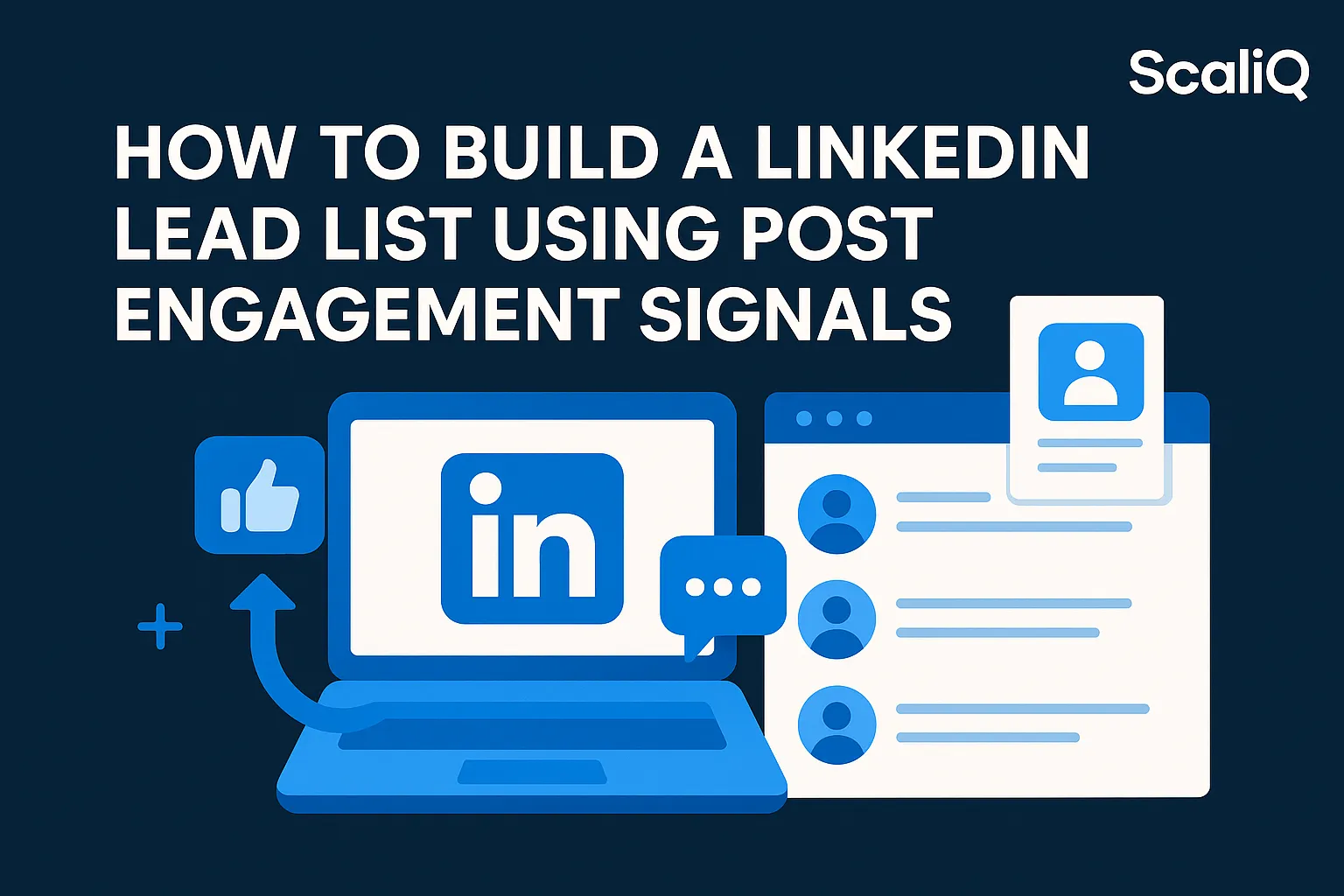
How to Build a LinkedIn Lead List Using Post Engagement Signals
The core frustration for SDR leaders and Go-To-Market (GTM) teams is universal: static lead lists decay rapidly, and untargeted cold outreach consistently lands without context or timing. When reps rely on massive data exports, they are gambling on relevance. By the time an email is sent, the prospect’s priorities have shifted, or the buying window has already closed.
However, there is a highly predictive alternative. LinkedIn reactions, comments, and repeat post interactions serve as live intent signals that empower teams to build warmer, highly relevant prospect lists. Creating a LinkedIn lead list using post engagement signals transforms outbound from a guessing game into a timed, context-driven conversation. This is not merely about extracting a list of users who liked a post. It is about engineering a definitive AI prospecting workflow—a complete system for signal capture, data enrichment, scoring, segmentation, continuous list refresh, and seamless CRM activation.
In this guide, B2B sales and growth operators will learn exactly how to build this repeatable system. You will discover which engagement signals matter most, how to transform raw post engagement leads on LinkedIn into qualified lead records, how to dynamically score and refresh your lists, and how to operationalize this data within your CRM.
To execute this effectively, teams need a structured methodology. ScaliQ [ScaliQ] is the system-focused brand behind engagement-based, dynamic lead list workflows, providing the orchestration needed to move away from stale exports and toward real-time, intent-driven prospecting.
Why Post Engagement Beats Static Lead Lists
Traditional list building relies heavily on static databases that become stale almost as soon as they are exported. In the B2B landscape, titles change, company priorities shift, and buying windows open and close with aggressive speed. Relying on a spreadsheet pulled three months ago guarantees a high bounce rate and low relevance.
The fundamental difference between broad Ideal Customer Profile (ICP) filtering and live engagement signals comes down to timing and context. A static list provides "fit only"—it tells you a prospect matches your target criteria, but not if they care about your solution right now. An engagement-based list provides fit, timing, and topical relevance. When a prospect interacts with specific content, they are revealing warmer interest than anyone on an untargeted cold list. A reaction signals baseline awareness. A comment signals stronger intent and a specific point of view. Repeat engagement indicates sustained relevance and active education on a topic.
Operationally, this allows teams to maintain dynamic lead lists that refresh continuously, rather than relying on one-off manual exports. Unlike standard list scraping or generic database pulls that lack buying context, intent-based lead generation focuses on building a dynamic prospecting engine. For a deeper dive into modern prospecting workflows, explore our strategy guide on dynamic list building [Blog]. Furthermore, maintaining accurate, dynamic lists aligns with best practices for CRM hygiene, similar to the structured list management native to LinkedIn Sales Navigator custom lead lists.
The core weaknesses of static outbound lists
"Fit-only" list building misses the most critical element of sales: active interest. When you target a prospect solely because they hold the title of "VP of Operations," you ignore whether they are actively trying to solve an operations problem.
Static lead databases go stale quickly. This stale data leads to wasted enrichment credits, poor targeting, and weak personalization that defaults to generic templates. Furthermore, manual list review is painstakingly slow. By the time a rep manually verifies a static list, the prospect's buying window may have already passed. Cold outreach lacks timing and context, resulting in the low reply rates that plague traditional sales prospecting automation.
Why engagement is a stronger buying-context signal
Engagement provides immediate contextual cues tied to a specific topic, creator, or business pain point. If a prospect comments on a post about reducing churn, you immediately know their current focus. This makes outreach infinitely more relevant; reps can directly reference the exact concept the prospect interacted with, bridging the gap between cold outreach and a warm introduction.
However, it is vital to treat these LinkedIn post engagement signals as a strong input for engaged prospecting, not as guaranteed proof of purchase intent. Social signal lead generation is a qualification layer that tells you why to reach out and what to say, ensuring your messaging lands with precision.
Which LinkedIn Signals Indicate Real Intent
To build a high-converting pipeline, you must separate meaningful engagement from social noise. Not all interactions are created equal. Understanding what engagement signals indicate buying intent on LinkedIn requires a clear hierarchy of signal strength.
The strongest signals are thoughtful comments, followed by repeat engagement across multiple posts, then high-relevance reactions, and finally, passive or low-context interactions. Intent depends heavily on the depth of the interaction, its recency, and the topic match. For example, a reaction to a viral meme is a weak signal. A detailed comment on a highly technical post about operational bottlenecks is a massive buying signal. When sourcing post engagement leads on LinkedIn, your goal is to interpret these signals accurately, pairing them with strict ICP fit to uncover true sales readiness.
Comments vs. reactions vs. repeat engagement
Comments consistently indicate stronger interest than simple likes. When a user takes the time to write a thoughtful comment, they are demonstrating active consideration and a willingness to engage in dialogue. A simple reaction, by contrast, may only indicate lightweight interest or passive scrolling.
Repeat engagement is where pattern-level relevance emerges. If a user consistently likes and comments on posts related to a specific pain point over three weeks, they are actively educating themselves on that problem. In a basic scoring model, a comment might be worth 10 points, a reaction 2 points, and repeat engagement an additional 15 points. This nuance is critical for effective LinkedIn engagement-based outreach and when looking to build a lead list from linkedin commenters or leverage linkedin post reactions prospecting.
Recency, frequency, and topical match
A recent engagement is vastly more actionable than an interaction from six months ago. Recency dictates the urgency of your outreach. Frequency—multiple interactions over time—can easily outweigh a single, strong signal because it proves sustained interest.
Crucially, topical match is the ultimate filter. Engagement on a narrowly relevant, niche topic is significantly more valuable than engagement on broad thought leadership. This combination of recency, frequency, and topic match is the engine behind effective intent-based lead generation and dynamic lead lists driven by social signal lead generation.
What counts as noise and should not trigger outreach
Raw engagement data is not sales-ready. Low-context reactions, interactions on irrelevant topics, or engagement from users outside your ICP should never be routed into immediate outbound campaigns.
Teams struggle to identify intent from noisy social interactions when they fail to filter out vanity engagement—such as likes on celebratory posts or interactions from students, competitors, and non-buying audiences. Engagement is just one layer of qualification. Effective LinkedIn prospect list building requires stripping away this noise to focus exclusively on accounts that have both the fit and the context to buy.
How to Turn Engagers Into Qualified Lead Records
Capturing a list of names who liked a post is only the first step. Raw engagers are not yet sales-ready. Before activating them, you must verify their role, company, ICP fit, and outreach context.
Transforming raw data into actionable pipeline requires a rigorous ai prospecting workflow. The system must capture the engager, identify their profile and company, enrich the record with B2B data, deduplicate against existing CRM records, validate their ICP fit, and finally store these fields in a structured lead record.
How do you turn LinkedIn post engagers into qualified leads? By ensuring every record contains specific, actionable fields: Name, company, title, functional area, ICP match, engagement type, engaged post/topic, recency, and source URL. This is where ScaliQ [ScaliQ] excels, orchestrating the workflow across capture, enrichment, and strict qualification rules so that reps only spend time on verified targets. Ensuring high data quality at this stage mirrors the rigorous standards of Sales Navigator CRM data validation.
Capture the right engagement data
When extracting publicly accessible data compliantly, the goal is to capture signal context, not just a list of names. You must collect the commenter or reactor's identity, the specific post URL, the core topic of the post, the exact timestamp of the interaction, and the engagement type (like, comment, repost). This metadata is what makes post engagement leads on LinkedIn actionable. It provides the foundation for interpreting LinkedIn post engagement signals and driving social signal lead generation.
Enrich for ICP fit and contact readiness
How do you enrich LinkedIn engagement data into usable lead records? By appending firmographic and demographic data to the raw profile. You must enrich engagers with their current company, accurate title, seniority level, and broader business context.
Enrichment must answer two binary questions: Is this person a fit for our product? And is this person actionable (do we have valid contact information)? Enrichment is mandatory because raw social data alone lacks the firmographic depth required for sales prospecting automation, dynamic lead lists, and intent-based lead generation.
Build a CRM-ready lead record
A qualified lead must be structured for downstream routing and outreach triggers. A CRM-ready record includes critical tagging: setting the lead source as "LinkedIn engagement," noting the signal type, logging the content topic, applying a lead score, and recording the last engaged date.
This structured approach to LinkedIn prospect list building supports advanced CRM lead generation workflows. By keeping the engagement metadata attached to the lead record, SDRs can easily segment lists, run accurate reporting, and deploy highly personalized messaging at scale.
How to Score, Segment, and Refresh Dynamic Lead Lists
Once leads are enriched and qualified, they must be prioritized. A static list treats every prospect equally, but a dynamic list ranks them based on intent.
A practical scoring framework evaluates signal strength, recency, frequency, topic relevance, and ICP fit. Based on these scores, leads are segmented into distinct cohorts: High-intent/high-fit (immediate outreach), High-intent/medium-fit (further qualification needed), Low-intent/high-fit (nurture campaigns), and Monitor only.
Because engagement happens continuously, dynamic lead lists must be continuously refreshed. The refresh cadence—whether daily or weekly—depends on your post volume and outbound capacity. Refresh rules prevent lists from decaying, ensuring that your outreach is always tied to the most current signals. For insights on automating these scoring and routing rules, review our guide on signal-based workflows [Blog].
A practical intent-scoring model
How do you prioritize LinkedIn leads based on engagement level? By applying a weighted scoring model. For example:
• Comment on relevant operational content = High weight (e.g., 50 points)
• Repeat reactions over several posts = Medium-high weight (e.g., 30 points)
• One-off low-context reaction = Low weight (e.g., 5 points)
Combine this engagement score with firmographic and role fit. A high-fit VP with a medium intent score might rank higher than a low-fit Manager with a high intent score. This practical model drives engaged prospecting and ensures your LinkedIn engagement-based outreach focuses on the accounts most likely to convert, answering exactly what engagement signals indicate buying intent on LinkedIn.
Segment leads for actionability
Segmentation dictates the next operational step. It routes the right lead to the right workflow. High-scoring leads are routed for immediate SDR follow-up. Medium-scoring leads enter an automated nurture list. High-fit but low-intent leads go to a monitor list to track future signals. Accounts showing multiple engaged stakeholders trigger account-based targeting plays. Proper segmentation is the backbone of LinkedIn prospect list building, ensuring dynamic lead lists translate into focused social signal lead generation.
Set refresh rules so the list stays alive
How often should lead lists refresh based on new post engagement? As often as your sales capacity allows you to action them. Practical refresh triggers include adding new engagers dynamically, updating scores when a prospect exhibits repeat engagement, downgrading stale leads after 30 days of inactivity, and instantly removing disqualified records. A dynamic list is a living system, not a static campaign asset, which is the defining characteristic of an advanced ai prospecting workflow.
How to Sync Engagement-Based Leads Into Outreach and CRM Workflows
The final phase of the workflow is operationalizing the data. The handoff from a scored list to execution must be frictionless.
Qualified leads are pushed into the CRM, assigned to the correct owner, and immediately enrolled in the appropriate outreach or nurture sequence. As new engagement occurs, field updates must be maintained dynamically. The ultimate advantage of this system is contextual personalization. The best use of engagement signals is not generic sequencing at scale, but crafting highly relevant, context-aware first touches.
Workflow orchestration requires syncing fields, triggering tasks, mapping lifecycle stages, and tracking outcomes. This eliminates the manual friction caused by fragmented tools, providing cleaner routing and significantly higher relevance in your outbound efforts. This level of orchestration pairs perfectly with robust CRM environments, leveraging capabilities similar to Sales Navigator CRM integration. For strategies on crafting the perfect message once leads are synced, check out this resource on personalized sequencing [Blog].
Route qualified leads into the right systems
Depending on your tech stack, leads may be routed directly to the CRM, into a sales engagement platform, or both. Routing logic should depend on the lead's score, territory owner, and campaign type. Automated task creation, strict ownership rules, and accurate lifecycle stage mapping ensure that no high-intent lead falls through the cracks. This CRM lead generation workflow is the operational heart of any ai prospecting workflow and modern sales prospecting automation.
Personalize outreach using engagement context
The goal of intent data is to make outreach feel natural, not automated. Reference the post topic or the business pain point the prospect engaged with. Avoid awkward, overly literal phrasing like, "I saw you liked John's post." Instead, frame it around the topic: "Noticed you were engaging with John's breakdown on reducing churn—curious if your team is currently tackling that bottleneck?" Contextual personalization works best when tied to the business pain points discussed in the content, elevating LinkedIn engagement-based outreach above cold outreach that lacks timing and context, and proving the value of intent-based lead generation.
Measure ROI from engagement-driven lead generation
To prove the value of this system, teams must track specific metrics: lead-to-meeting rate, reply rate, conversion by signal type, time-to-first-touch, and total pipeline influenced. By tracking these KPIs, revenue leaders can directly compare the performance of engagement-based lists against traditional static lists. Evaluate this linkedin engagement lead generation strategy not just on lead volume, but on the superior quality and efficiency it brings to dynamic lead lists and intent-based lead generation.
Compliance, Privacy, and Workflow Governance
Building an AI prospecting workflow requires strict adherence to responsible data usage, minimal necessary collection, and documented handling practices. Trustworthiness is a competitive advantage.
When enriching and activating business contact data, teams must prioritize privacy and direct-marketing compliance. Governance basics include defining exactly which data fields are allowed to be captured, documenting all third-party enrichment sources, setting clear data retention and refresh rules, and restricting outreach strictly to qualified, legitimate business contexts.
Unlike scraping-heavy approaches that ignore data hygiene, a professional workflow respects regulatory frameworks. For baseline privacy risk management, teams should align their enrichment workflows with standards like the NIST Privacy Framework. Additionally, B2B outreach practices must respect regional communications laws, guided by resources such as the ICO B2B marketing guidance.
Responsible use of engagement and enrichment data
Teams should only collect the data strictly necessary to qualify and route leads. Capturing excessive personal data creates unnecessary liability. By maintaining strict documentation and field discipline, organizations reduce privacy risks and improve prospect trust. Adhering to the NIST Privacy Framework ensures that your intent-based lead generation and sales prospecting automation remain compliant and secure. Remember, raw engagement data is not sales-ready—it must be processed responsibly.
Build governance into the workflow from day one
Governance should not be an afterthought. Establish approval rules for new campaigns, enforce strict field mapping standards, and automate refresh and deletion policies for stale data. Strong governance supports data accuracy, consistency, and superior CRM hygiene, ensuring that dynamic lead lists fuel a clean CRM lead generation workflow. Without it, disconnected tools create operational friction that degrades the entire system.
Real-World Workflow Example: From LinkedIn Engagement to Qualified Outreach
To understand how this operates in production, let's walk through a concrete, sequential example of the workflow.
Imagine a prospect comments on a detailed LinkedIn post about the pain of manual CRM data entry.
1. The system captures the engager's public profile URL, the post topic, and the timestamp.
2. The record is enriched, revealing the prospect is a VP of Sales Ops at a 500-person SaaS company (a perfect ICP match).
3. The system scores the lead: high intent (due to the thoughtful comment) and high fit.
4. The lead is segmented into the "Immediate Outreach" tier.
5. The record syncs to the CRM, assigns the account to the correct Enterprise SDR, and triggers a task.
6. The SDR executes context-aware messaging referencing the specific pain of manual CRM entry.
Where do teams commonly fail? They capture too much noise, skip the vital enrichment step, fail to score the intent properly, or let the list rot by never refreshing it. This step-by-step model proves why a systematic approach outperforms single-purpose extraction tools.
Example workflow steps
To replicate this, follow these steps: Capture post engagers on a relevant topic. Enrich for title, company, fit, and contact readiness. Score by comment depth, recency, repeat engagement, and ICP match. Segment into immediate outreach, nurture, or monitor buckets. Finally, sync into the CRM and launch contextual outreach. This is exactly how you build a LinkedIn lead list from post engagement, execute a flawless ai prospecting workflow, and maintain high-converting dynamic lead lists.
Conclusion
LinkedIn engagement is exponentially more valuable when treated as a live intent signal inside a structured prospecting workflow, rather than a one-off scraping tactic. By moving away from static databases, GTM teams can align their outreach with actual buyer timing and context.
The complete blueprint requires discipline: capture meaningful engagement compliantly, enrich the record with accurate B2B data, score the lead for both fit and intent, refresh the list dynamically to prevent data decay, and route the finalized record directly into your CRM and outreach platforms. The business outcome is undeniable: significantly better lead quality, stronger personalization, and a vastly more efficient outbound motion than static list exports can ever provide.
Audit your current outbound process today. Identify where your team is losing momentum by relying on stale lists, manual verification, or disconnected tools. To implement a true signal-based prospecting workflow and master dynamic list building, explore how ScaliQ [ScaliQ] orchestrates this exact methodology to build a compliant, high-converting pipeline.