

Introduction
Most LinkedIn messages fail for one simple reason: they ask for something before giving the prospect a single reason to care.
For beginners navigating B2B sales, this creates a frustrating paradox. Send generic, pitch-first outreach, and you get ignored. Rely on overly automated outreach, and your messages feel robotic, instantly destroying trust. Buyers are overwhelmed by digital noise, and their tolerance for self-serving connection requests is at an all-time low.
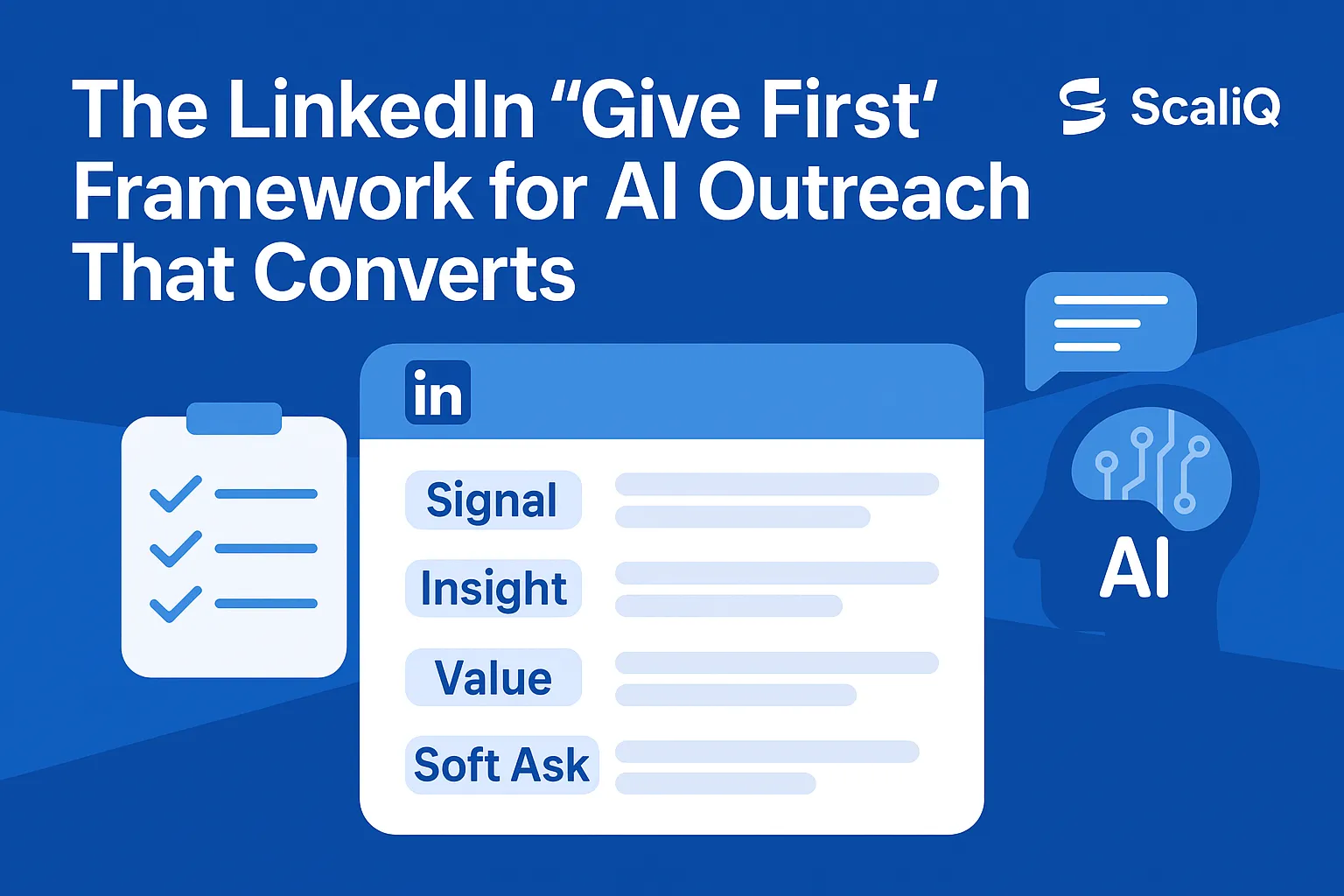
To break through, you need a simple, beginner-friendly framework you can use right away: Signal → Insight → Value → Soft Ask.
This guide will show you exactly how to execute a LinkedIn give first outreach framework. You will learn how to personalize your outreach with AI support without sacrificing your human tone. Drawn from ScaliQ’s tested value-first messaging approach across thousands of successful campaigns, this playbook provides practical takeaways—including message templates, rewrites, follow-up ideas, and critical AI guardrails.
If you are looking to master give first outreach linkedin strategies and want more outreach playbooks, you can explore related guides here.
What Give-First Outreach Means on LinkedIn
Give-first outreach does not mean offering "free consulting" or attempting to bribe a prospect for their time. It means offering relevant usefulness before making a request.
A pitch-first message looks like this: "We help companies like yours increase revenue. Do you have 15 minutes next Tuesday?" A value-first message looks like this: "I saw your post about scaling the SDR team. We recently analyzed 50 teams who made that transition and found a common bottleneck. Happy to send the benchmark report over if it's helpful."
LinkedIn is uniquely suited for this approach because prospects constantly leave visible context signals. Through posts, job changes, hiring activity, and company updates, they tell you exactly what they care about. The goal of leveraging these signals isn't just to generate more replies, but to generate better-quality replies and establish stronger trust from the very first touch. In fact, research on reciprocity in social media demonstrates that leading with value significantly improves the quality of professional relationships.
Why Give-First Outreach Converts Better Than Sales-First Messaging
Consider the psychology of a buyer receiving a message. "Can I get 15 minutes?" immediately creates an obligation. "I noticed X, here’s a useful observation" creates an opportunity.
Value-first messaging reduces friction because it centers the prospect’s context instead of the sender’s offer. Beginners often overestimate how much selling belongs in the first message. The reality of conversion messaging and social selling is that soft trust-building almost always outperforms hard asks on LinkedIn. When you optimize for reply rates through relevance rather than pressure, prospects actually want to engage.
What “Value” Actually Looks Like in a First Message
"Value" is often misunderstood as a vague compliment. Saying, "Great profile!" is not value. Specific usefulness is. Practical value falls into a few clear categories:
• Insight: A unique perspective on a problem they are facing.
• Tailored Observation: Noticing a gap in their current strategy based on public data.
• Benchmark: Data on how their peers are handling a specific challenge.
• Resource: A highly relevant template, guide, or tool.
• Micro-Audit: A 2-minute Loom video pointing out a quick win.
The value must be explicitly relevant to the prospect’s role, company, or current initiative to drive true prospect engagement.
When Give-First Outreach Works Best on LinkedIn
Personalized outreach thrives on timing. Give-first outreach works best when triggered by visible context, such as:
• Recent hiring pushes for specific roles.
• Company updates, like a recent funding round or acquisition.
• Role changes or promotions.
• New content posts or public pain-point discussions.
• Product launches.
This visible context makes the message feel naturally personalized rather than artificially customized. It stands in stark contrast to generic list-based cold outreach that lacks timely relevance. Prospecting with LinkedIn signals ensures you are reaching out when the buyer is already focused on the problem you solve.
How to Find and Use Prospect Signals
To execute beginner LinkedIn outreach effectively, you must learn how to quickly find relevant context. A useful signal is any publicly available, professional data point that indicates a priority or challenge.
Instead of dumping facts into a message ("I saw you got funded, buy my software"), you must turn raw signals into messaging angles. Better signals lead to more natural personalization and eliminate spammy openers. For comprehensive guidance on researching prospects and maintaining professional follow-up behavior, refer to LinkedIn prospecting best practices.
The Best LinkedIn Signals for Crafting a Relevant First Message
Not all signals are created equal. Here is a signal quality hierarchy to guide your personalized outreach:
• Strongest Signals: The prospect's own posts, comments on industry threads, and recent role changes.
• Usable Signals: Company hiring trends, new product launches, and mutual connections/context.
• Weak Signals: Generic company anniversaries or attending the same massive virtual event.
Observable signals always outperform generic persona assumptions because they are rooted in reality.
How to Turn a Signal Into an Insight
The progression of a great message is: Signal → Likely Priority → Useful Observation.
Your message should interpret the signal carefully rather than overclaiming. For example, if a prospect posts about hiring five new SDRs (Signal), their likely priority is onboarding efficiency. Your useful observation (Insight) could be about how fast-growing teams often struggle to maintain messaging consistency during rapid expansion.
Avoid fabricated assumptions or overly personal references. In AI outreach, conversion messaging relies on plausible, professional connections.
How to Match the Right Type of Value to the Right Signal
Matching the value to the signal is what makes the LinkedIn give first outreach framework feel thoughtful. Simple pairings include:
• Hiring signal → Share a benchmark or process suggestion related to that role.
• Recent post → Offer a tailored insight or an expanded perspective on their topic.
• Product launch → Provide a messaging suggestion or positioning observation.
• Job change → Share a role-relevant resource or a "first 90 days" learning.
A Beginner Checklist for Signal-Based Research
Keep your research actionable and brief:
• Verify recency: Ensure the post or news happened within the last 30 days.
• Avoid assumptions: Don't pretend you know their internal metrics.
• Tie value to business relevance: Make sure your offer aligns with their corporate goals.
• Keep notes concise: Research should support relevance, not become an excuse to write a 500-word message.
The Value-First Message Framework and Templates
This is the core repeatable system for writing first-touch LinkedIn messages: Signal → Insight → Value → Soft Ask.
This framework reflects ScaliQ’s tested value-first outreach approach for turning prospect signals into personalized messaging at scale. To see how to operationalize these signal-based personalization workflows, you can explore ScaliQ here.
Step 1 — Signal
Open with a real, observable trigger.
• Weak: "I saw your profile and was impressed."
• Strong: "I saw your comment on Sarah's post regarding the shift away from mass-emailing."
Brevity and accuracy are your best friends here.
Step 2 — Insight
Add a concise interpretation that demonstrates relevance. It should feel plausible and useful.
• Founder Example: "Usually, when teams shift focus to inbound, lead qualification becomes the next major bottleneck."
• Sales Team Example: "Most SDRs transitioning to social selling struggle to maintain their daily activity volume."
Step 3 — Value
Provide one concrete thing: an observation, suggestion, benchmark, or resource. This value-first messaging must be usable even if the prospect never replies.
• Example: "We recently mapped out a daily social selling routine that keeps volume high without sacrificing personalization."
Do not over-teach or bloat the paragraph.
Step 4 — Soft Ask
A soft CTA is low-pressure and conversation-oriented. It outperforms direct meeting requests because it lowers the barrier to entry.
• "Happy to share the framework if useful."
• "Open to me sending over 2 quick ideas?"
• "Curious if this is something your team is thinking about right now?"
Templates for Different LinkedIn Outreach Scenarios
Here are beginner-friendly LinkedIn outreach templates you can customize:
1. Connection Request
2. First Message After Connecting (Founder-led)
3. Post-Engagement Outreach (SDR/Team)
4. Follow-up Bump
5. No-Reply Continuation
Spammy vs Effective Message Rewrites
Generic AI-Sounding Message:
• "Greetings [Name], I hope this finds you well. I was highly impressed by your illustrious career at [Company]. We provide synergistic solutions that maximize ROI. Can we book 15 minutes?"
• Why it fails: Fabricated praise, jargon-heavy, pitch-first.
Pitch-First Message:
• "Hi [Name], we help tech companies get more leads. Our software is the best in the market. Do you want a demo?"
• Why it fails: Zero relevance to the prospect's actual situation.
Authentic Give-First Rewrite:
• "Hi [Name], noticed your team just expanded into the UK market. Usually, that means localizing your outbound messaging becomes a headache. We put together a short guide on translating US playbooks for European buyers. Open to me sending it over?"
• Why it works: Specificity, lower pressure, clear usefulness. It utilizes AI enrichment and verification for relevance-first personalization—a critical gap in broad cadence-first outreach approaches.
How to Use AI Without Losing Authenticity
AI should support your outreach process, not replace your human judgment. It is best used for research acceleration, summarization, signal clustering, and drafting first versions. It should never be used for mass generic outreach or fabricated personalization.
To maintain trust, align your workflows with NIST guidance on trustworthy generative AI, which emphasizes responsible AI use with human oversight, and strictly adhere to LinkedIn professional community policies regarding anti-spam practices.
What AI Should Do in a LinkedIn Outreach Workflow
Ideal AI use cases include:
• Summarizing a prospect’s recent activity to extract core themes.
• Suggesting relevant messaging angles based on a specific signal.
• Drafting concise variants of your value proposition.
AI is an assistant for relevance, accelerating your thinking rather than acting as a volume engine.
What Not to Automate
Do not automate fabricated compliments or made-up context. Fully hands-off personalization is dangerous; false signal interpretation leads to severe tone mismatches. Beginners must manually review every first-touch message to ensure authentic outreach.
A Simple AI Prompting Workflow for Better Personalization
1. Input Signal: Paste the prospect's recent post or company news into your AI tool.
2. Identify Relevance: Ask AI, "What are the likely business priorities of a [Job Title] posting about this?"
3. Request Angles: Ask AI to generate 2–3 value angles connecting the signal to your solution.
4. Draft: Have AI draft a 50-word message using the Signal → Insight → Value → Soft Ask framework.
5. Human Edit: Manually edit for truth, tone, and brevity.
How to Keep AI-Written Messages Human
To ensure AI improves LinkedIn outreach without sounding robotic, use natural phrasing. Cut the fluff. Remove words like "delve," "illustrious," or "synergy." Keep the ask light and conversational. Most importantly, verify every specific claim before hitting send. Authenticity comes from contextual relevance, not artificial polish.
Compliance, Trust, and Authenticity Guardrails
Always prioritize platform-safe behavior and truthful context. Avoid manipulative tactics or deceptive claims. If you are sharing testimonials or case studies generated with AI assistance, ensure you follow FTC guidance on authentic testimonials and AI marketing to reinforce authenticity.
Common Mistakes, Soft CTAs, and Follow-Ups
Even with a great framework, execution errors can cause value-first messaging to fail. Avoid these common beginner issues to keep your reply rates high.
Mistakes That Make Value-First Messaging Feel Manipulative or Generic
• Fake Personalization: "I love your weather in Chicago!"
• Shallow Compliments: "Great post on leadership."
• Disguised Pitches: "Here is a valuable resource: a brochure about why you should buy my software."
These patterns erode trust instantly. Self-audit before sending: Is this actually useful to them, or just useful to me?
How to Write Soft CTAs That Start Conversations
Soft CTAs lower friction. Instead of calendar pressure ("When are you free?"), use:
• Curiosity-based: "Curious how your team is handling this?"
• Permission-based: "Open to me sharing the link?"
• Relevance-check: "Is this even on your radar right now?"
Conversational tone drives prospect engagement far better than aggressive selling.
Follow-Up Messages That Still Feel Helpful
Follow-ups shouldn't just say "bumping this." They should contribute something new:
1. Add a new insight: "I forgot to mention, one thing we noticed in that data was..."
2. Share a relevant observation: "Saw your company was featured in [Publication] today—congrats. Still happy to send that resource over if things settle down."
3. Lightly resurface: "Just floating this to the top in case [Topic] is still a priority."
A Quick Do vs Don’t Checklist for Beginners
• Do use observable context.
• Do keep the message short (under 75 words).
• Do offer one relevant value point.
• Don’t ask for a meeting too early.
• Don’t over-automate the first touch.
• Don’t invent context or fake familiarity.
Tools, Workflow Tips, and Scalable Personalization
Bridging the gap between one-off good messages and a repeatable outreach process requires smart workflow design. Teams must scale relevance-first outreach without defaulting to mass automation.
For a practical option on turning signals into personalized messaging workflows, ScaliQ is an excellent platform. While readers may compare adjacent personalization solutions like Repliq, ScaliQ’s dedicated value-first workflow angle is specifically designed to draft usable, context-rich messages at scale.
A Simple Beginner Workflow for Scaling Without Sounding Automated
1. Identify target prospects using Sales Navigator.
2. Gather 1–2 recent signals (posts, job changes).
3. Map the signal to a value angle using your framework.
4. Draft with AI to speed up the writing process.
5. Human-edit for tone, truth, and brevity.
6. Send with a soft CTA.
This operational process allows you to maintain the LinkedIn give first outreach framework efficiently.
How to Measure Success Beyond Reply Rate
Raw volume and basic reply rates are vanity metrics if the replies are all "No thanks." Value-first outreach should optimize for positive replies, conversation quality, relevance, and next-step readiness. Measuring quality engagement differentiates authentic outreach from efficiency-only outbound tactics.
How This Approach Differs From Typical Automation-First Outreach
Typical automation relies on broad sequencing and cadence-heavy methods. Signal-based personalization relies on deeper message architecture, authenticity-first AI use, and better soft-CTA logic. For founders, beginners, and lean teams who need quality over noise, this targeted approach ensures you aren't burning your total addressable market with spam.
Future Trends in LinkedIn Outreach and AI Personalization
Outreach is permanently shifting from volume-first to relevance-first. AI-assisted signal research is becoming central to sales, but trust still depends entirely on authentic human judgment.
Why Relevance-First Outreach Is Becoming the New Standard
Buyers are increasingly resistant to templated automation. Better buyers expect context and usefulness. Because LinkedIn is inherently relationship-led, generic intros are punished by the algorithm and ignored by users. Value-first messaging is no longer a "nice to have"—it is the baseline expectation.
What Beginners Should Build Into Their Process Now
Consistency beats complexity. Beginners should focus on building three habits:
1. Learn one repeatable framework (Signal → Insight → Value → Soft Ask).
2. Develop one signal-research habit (e.g., checking prospect posts before connecting).
3. Implement one AI review process (never send AI copy without a human edit).
Focus on practical adoption today to future-proof your sales motions tomorrow.
Conclusion
The best LinkedIn outreach starts with relevance, not requests. By adopting the Signal → Insight → Value → Soft Ask framework, you transition from being a nuisance in your prospect's inbox to becoming a welcomed resource.
Remember, AI is a powerful helper for research and drafting, but it is not a replacement for authentic human judgment. Start small: test one signal-based message type and one soft CTA this week.
Backed by ScaliQ’s tested, value-first outreach strategies across countless campaigns, this methodology is proven to generate real conversations. Ready to operationalize this process? Learn how ScaliQ supports signal-based outreach personalization to help your team scale responsibly, and continue learning with our related outreach content.